 How to resolve AdBlock issue?
News
LAKE COUNTY, Calif. – Lake County Animal Care and Control has a group of mostly larger dogs waiting this week for their new homes.
Dogs available this week include basset hound, border collie, Chihuahua, dachshund, German Shepherd, Labrador Retriever, mastiff shepherd and wirehaired terrier mix.
Dogs that are adopted from Lake County Animal Care and Control are either neutered or spayed, microchipped and, if old enough, given a rabies shot and county license before being released to their new owner. License fees do not apply to residents of the cities of Lakeport or Clearlake.
If you're looking for a new companion, visit the shelter. There are many great pets hoping you'll choose them.
The following dogs at the Lake County Animal Care and Control shelter have been cleared for adoption (additional dogs on the animal control Web site not listed are still “on hold”).
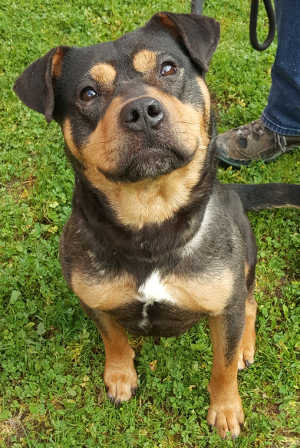
Female pit bull terrier
This female pit bull terrier mix has a short black and brown coat.
Shelter staff said she has no food aggression, allows for handling and gets along well with other male dogs her size. She would do best in a home with children ages 10 and up, and no small dogs or cats.
She is in kennel No. 9, ID No. 6884.
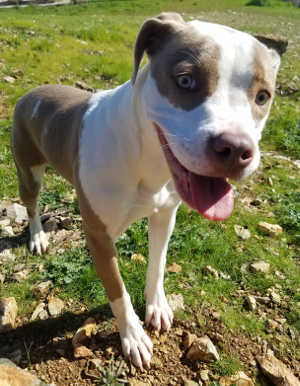
Female pit bull terrier
This female pit bull terrier has a short tan and white coat.
She’s in kennel No. 10, ID No. 6988.
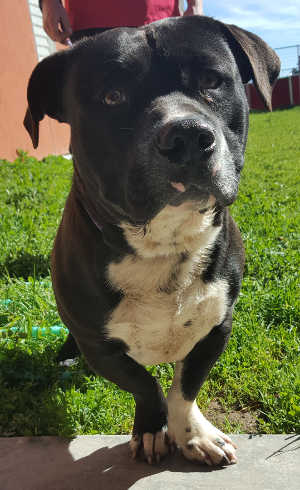
Pit bull terrier-basset hound mix
This male pit bull terrier-basset hound mix has a short black and white coat.
Shelter staff said he is extremely submissive and fearful of other dogs, and needs a home with an experienced dog owner willing to teach him confidence. He allows handling of mouth, ears, tail and paws, and gently takes treats.
He’s in kennel No. 11, ID No. 6967.
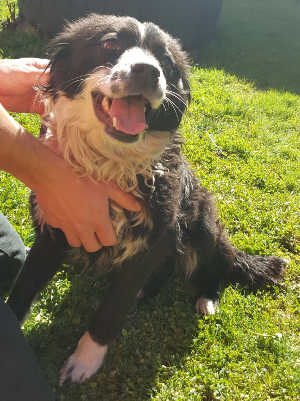
‘Betsy’
“Betsy” is a border collie mix with a long black and white coat.
Shelter staff said she’s good with other dogs.
She’s in kennel No. 12, ID No. 6952.
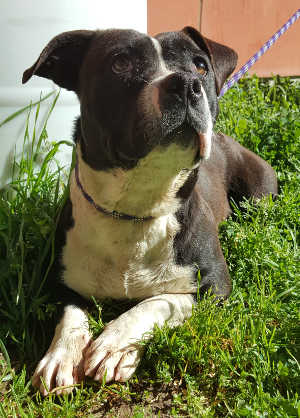
Pit bull terrier-basset hound mix
This female pit bull terrier-basset hound mix has a short black and white coat.
Shelter staff said she is very submissive with other dogs, and needs a loving owner to teach her confidence and how to walk on a leash, as now she just lays down and crawls. She would do best with an experienced dog owner and children over age 10.
She’s in kennel No. 13, ID No. 6966.
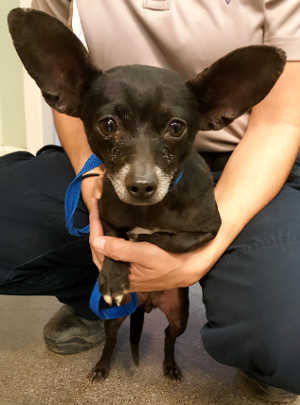
Chihuahua-dachshund mix
This female Chihuahua-dachshund mix has a short black coat.
She’s in kennel No. 15, ID No. 6977.
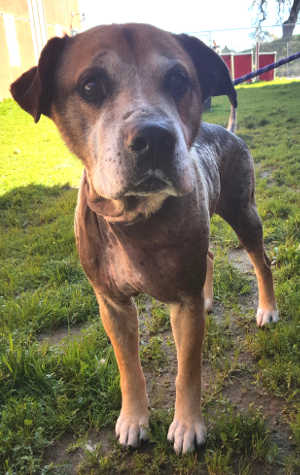
Male pit bull terrier
This male pit bull terrier has a short brown and tan coat.
He’s in kennel No. 16, ID No. 6978.
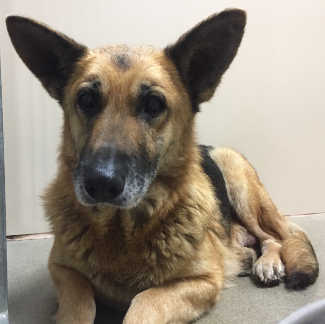
German Shepherd
This female German Shepherd has a long back and tan coat.
She’s in kennel No. 17, ID No. 6987.
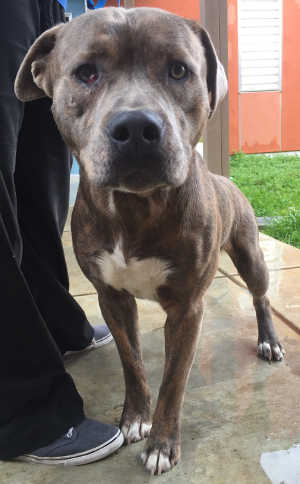
'Miles'
“Miles” is a young male pit bull terrier mix with a short brindle coat and gold eyes.
Shelter staff said he is great with other dogs and a little shy of people, but show him some kindness and he will learn to trust you. He would do great in a home with children ages 10 years old and up. They also believe he would be OK with cats. He’s looking for a calm, quiet home.
She's in kennel No. 19, ID No. 6875.
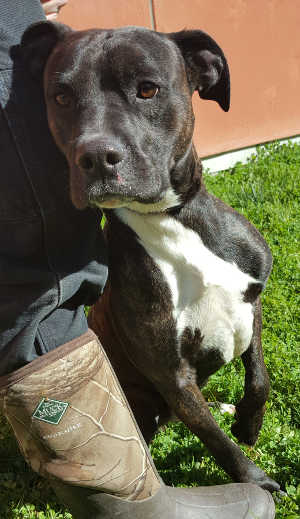
Male pit bull
This male pit bull terrier has a short brindle and white coat.
Shelter staff said he is very sweet with people. He would do best in a home with no cats and no other dogs, although shelter staff said they plan to reassess him on sociability.
He’s in kennel No. 21, ID No. 6968.
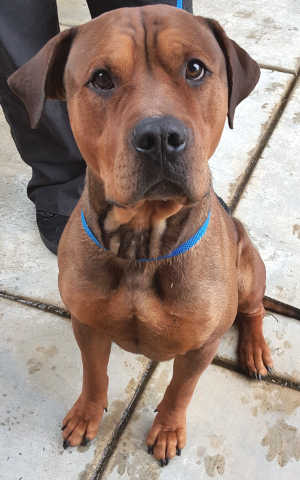
‘Teddy’
“Teddy” is a male mastiff-pit bull terrier with a short brown coat.
His adoption fees have been sponsored so he is free to an approved applicant.
Shelter staff said he is a mellow boy who has been waiting at the shelter for awhile for his new home.
He is great with other dogs, male or female, and is more interested in people than playing with other dog. Teddy is described as “big cuddle bug” who is very gentle when taking treats and eager to learn. He would do best with children ages 5 and older.
“The family that gets this boy is very lucky,” shelter staff said.
He's in kennel No. 22, ID No. 6835.
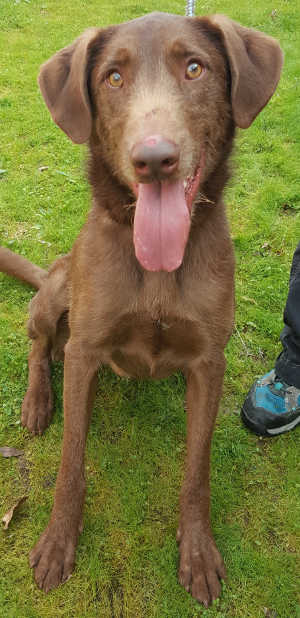
‘Ralph’
“Ralph” is a Labrador Retriever-wirehaired terrier mix with a medium-length brown coat.
He already has been neutered.
He’s in kennel No. 30, ID No. 6787.
To fill out an adoption application online visit http://www.co.lake.ca.us/Government/Directory/Animal_Care_And_Control/Adopt/Dog___Cat_Adoption_Application.htm .
Lake County Animal Care and Control is located at 4949 Helbush in Lakeport, next to the Hill Road Correctional Facility.
Office hours are Monday through Friday, 11 a.m. to 5 p.m., and 11 a.m. to 3 p.m., Saturday. The shelter is open from 11 a.m. to 4 p.m. Monday through Friday and on Saturday from 11 a.m. to 3 p.m.
Visit the shelter online at http://www.co.lake.ca.us/Government/Directory/Animal_Care_And_Control.htm .
For more information call Lake County Animal Care and Control at 707-263-0278.
Email Elizabeth Larson at

NORTHERN CALIFORNIA – A week after its condition led to a evacuation order for nearly 200,000 Sacramento Valley residents, repair work on the Oroville Dam’s emergency spillway continues.
The California Department of Water Resources said the dam’s outflows on Saturday were reduced from 70,000 cubic feet per second to 55,000 cubic feet per second to allow assessment teams to view debris buildup and dredge debris piles below the flood control spillway.
Even with the recent storms, officials said the reduced outflow continued to outpace the inflow into the reservoir.
Lake elevations continue trending downward and had fallen to 854 feet by 4 p.m. Saturday, officials said.
As runoff flows into the reservoir, officials said water levels will likely fluctuate but will remain within acceptable and typical depths during times of storm activity.
Despite current inclement weather, work continues on the area below the spillway, the monoliths, access roads and various eroded areas created by emergency spillway runoff, the Department of Water Resources reported.
Rock, aggregate, and cement slurry continue to be placed into areas affected by erosion. Officials said this work will continue 24 hours a day.
On Saturday crews also worked to construct a barge to carry excavation equipment that will dredge debris and sediment that has built up below the flood control spillway, the agency said.


NASA’s Juno mission to Jupiter, which has been in orbit around the gas giant since July 4, 2016, will remain in its current 53-day orbit for the remainder of the mission.
This will allow Juno to accomplish its science goals, while avoiding the risk of a previously-planned engine firing that would have reduced the spacecraft’s orbital period to 14 days.
“Juno is healthy, its science instruments are fully operational, and the data and images we’ve received are nothing short of amazing,” said Thomas Zurbuchen, associate administrator for NASA’s Science Mission Directorate in Washington. “The decision to forego the burn is the right thing to do – preserving a valuable asset so that Juno can continue its exciting journey of discovery.”
Juno has successfully orbited Jupiter four times since arriving at the giant planet, with the most recent orbit completed on Feb. 2. Its next close flyby of Jupiter will be March 27.
The orbital period does not affect the quality of the science collected by Juno on each flyby, since the altitude over Jupiter will be the same at the time of closest approach.
In fact, the longer orbit provides new opportunities that allow further exploration of the far reaches of space dominated by Jupiter’s magnetic field, increasing the value of Juno’s research.
During each orbit, Juno soars low over Jupiter’s cloud tops – as close as about 2,600 miles (4,100 kilometers). During these flybys, Juno probes beneath the obscuring cloud cover and studies Jupiter’s auroras to learn more about the planet's origins, structure, atmosphere and magnetosphere.
The original Juno flight plan envisioned the spacecraft looping around Jupiter twice in 53-day orbits, then reducing its orbital period to 14 days for the remainder of the mission.
However, two helium check valves that are part of the plumbing for the spacecraft’s main engine did not operate as expected when the propulsion system was pressurized in October.
Telemetry from the spacecraft indicated that it took several minutes for the valves to open, while it took only a few seconds during past main engine firings.
“During a thorough review, we looked at multiple scenarios that would place Juno in a shorter-period orbit, but there was concern that another main engine burn could result in a less-than-desirable orbit,” said Rick Nybakken, Juno project manager at NASA’s Jet Propulsion Laboratory (JPL) in Pasadena, California. “The bottom line is a burn represented a risk to completion of Juno’s science objectives.”
Juno’s larger 53-day orbit allows for “bonus science” that wasn’t part of the original mission design. Juno will further explore the far reaches of the Jovian magnetosphere – the region of space dominated by Jupiter’s magnetic field – including the far magnetotail, the southern magnetosphere, and the magnetospheric boundary region called the magnetopause.
Understanding magnetospheres and how they interact with the solar wind are key science goals of NASA’s Heliophysics Science Division.
"Another key advantage of the longer orbit is that Juno will spend less time within the strong radiation belts on each orbit,” said Scott Bolton, Juno principal investigator from Southwest Research Institute in San Antonio. “This is significant because radiation has been the main life-limiting factor for Juno.”
Juno will continue to operate within the current budget plan through July 2018, for a total of 12 science orbits. The team can then propose to extend the mission during the next science review cycle.
The review process evaluates proposed mission extensions on the merit and value of previous and anticipated science returns.
The Juno science team continues to analyze returns from previous flybys. Revelations include that Jupiter's magnetic fields and aurora are bigger and more powerful than originally thought and that the belts and zones that give the gas giant’s cloud top its distinctive look extend deep into the planet’s interior.
Peer-reviewed papers with more in-depth science results from Juno’s first three flybys are expected to be published within the next few months.
In addition, the mission's JunoCam – the first interplanetary outreach camera – is now being guided with assistance from the public. People can participate by voting on which features on Jupiter should be imaged during each flyby.
“Juno is providing spectacular results, and we are rewriting our ideas of how giant planets work,” said Bolton. “The science will be just as spectacular as with our original plan.”
More information on the Juno mission is available at http://www.nasa.gov/juno and http://missionjuno.org . Follow the mission on Facebook and Twitter at http://www.facebook.com/NASAJuno or http://www.twitter.com/NASAJuno .
LAKE COUNTY, Calif. – The senior centers in Lakeport and Kelseyville have released their menus for the week of Feb. 20 through 24.
The centers serve lunch from 11:45 a.m. to 12:30 p.m., Monday through Friday, with Lakeport also serving Sunday breakfast from 8 to 11 a.m.
This week's menu – which is subject to changes or substitutions – is as follows:
• Monday: Citrus herb chicken.
• Tuesday: Chili dog.
• Wednesday: Sweet and sour chicken.
• Thursday: Shredded beef pot roast over mashed potatoes.
• Friday: Chicken fajitas.
The weekday luncheons include soup of the day, salad bar, entrée, dessert and beverage. Non-seniors pay $6 and seniors 60 and older pay a suggested donation of $5.
Soup of the day and salad bar – which includes two to three types of salads plus toppings and fruit – is $4.
The Kelseyville Senior Center is located at 5245 Third St., telephone 707-279-2175.
The Lakeport Senior Activity Center is located at 527 Konocti Ave., 707-263-4218.
UPPER LAKE, Calif. – The Winter Wonderland Father-Daughter Dance will be held on Friday, Feb. 24.
The dance takes place from 6:30 to 8:30 p.m. at the Upper Lake High School cafeteria, 675 Clover Valley Road.
Ticket prices are $20 for a father and daughter, plus $5 for an additional child.
Girls can attend with fathers, grandpas, uncles, family friends or other father figures.
There will be music with a DJ, dancing, a photo booth and snacks.
Organizers said the event is open to the community.
Children don't have to be in school yet to attend.
Tickets are available at the front offices of Upper Lake Middle School and Upper Lake Elementary School, or contact Lisa Glenn at 707-533-7105.
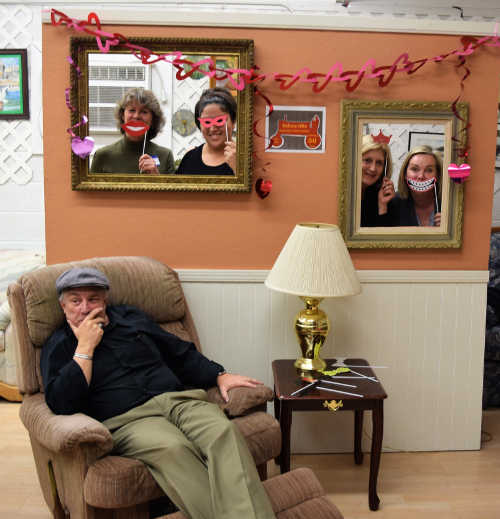
KELSEYVILLE, Calif. – Almost 40 people were in attendance for the Kelseyville Business Association’s annual pasta feed membership drive on Monday, Feb. 13.
Every year Studebaker’s Coffee and Sandwich Shop has donated an amazing meal and this year it was over the top.
Spinach and ricotta shells, lasagna, marinated vegetables, Caesar salad and garlic bread were on the menu and paired beautifully with Kelseyville wines. Many thanks to Chacewater, Fore Family, Smiling Dog Ranch, Rosa D’Oro and Wildhurst wineries.
Chocolates and port after dinner really finished things off nicely but not before the raffle prizes were handed out.
Members were especially generous this year and nearly everyone went home with something they could treasure. They also had fun hamming it up in Rick White’s photo booth.
If you are a local businessperson who is interested in helping to promote the activities in and around Kelseyville that benefit the community, consider membership in the Kelseyville Business Association.
The association is responsible for the development of a new festival, “Beer, Wine and Swine, which will take place on Father’s Day, June 18, as well as Kickin’ in the Country, Christmas in the Country, the American flags that line downtown on important holidays, street lights, tree trimming and many of the things that make Kelseyville a wonderful place to visit.
Kelseyville Business Association’s Web site offers a directory, events calendar, and a weekly events blast to help you promote your business and activities.
Businesses work better together. To receive your membership application email