 How to resolve AdBlock issue?
News
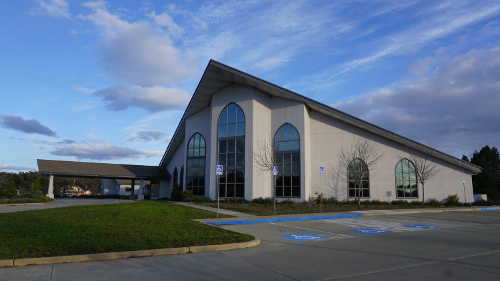
LAKEPORT, Calif. – As mandatory and advisory evacuations remain in effect for hundreds of Lake County residents, a second evacuation shelter has been opened in the north Lakeport area to accommodate those in need of a temporary place to stay.
Since mandatory evacuations were ordered for 225 residents of four neighborhoods in Lakeport – Lucky Four, Aqua Village and Willopoint Resort trailer parks and the Esplanade Street area – on Monday, the Lakeport Seventh-day Adventist Church at 1111 Park Way has opened its doors to evacuated community members.
Advisory evacuations also were issued Tuesday by the Lake County Sheriff’s Office for low-lying areas in Clearlake Oaks and the Clear Lake Keys on the Northshore, and Big Valley Rancheria, Corinthian Bay, Lands End and Soda Bay near Lakeport; and by the city of Clearlake on Thursday for the areas on Lakeshore Drive between Kern Street and San Joaquin Avenue.
The Seventh-day Adventist church, which also acted as an evacuation shelter during the Valley and Clayton fires, has for the second year also opened its doors as the Lake Ministerial Association's winter warming center for the homeless.
Rev. Shannon Kimbell-Auth of the Lake Ministerial Association said the Seventh-day Adventist Church is running the shelter with support from the Red Cross.
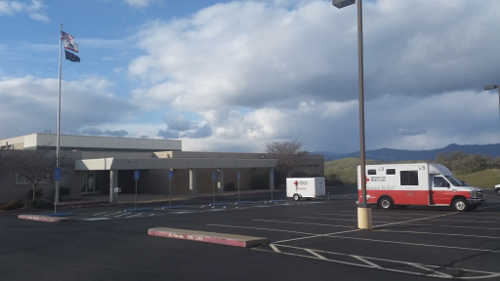
With the church hitting its county-approved emergency capacity of nearly 100 evacuees – an increase from the 24 allowed in its warming center operations – officials opened a second evacuation shelter at the Lakeport National Guard Armory, located at 1431 Hoyt Ave., next to the Lake County Jail.
Don Rowe, the Red Cross shelter manager at the armory, said the new shelter was opened on Thursday night.
He was one of four Red Cross volunteers from around the North Coast staffing the shelter – with assistance from two National Guard personnel – on Friday afternoon, when two evacuees were sheltering there. He said the facility can accommodate up to 40 people.
As for how long they might be open and when more evacuees may move in, “We really can't predict what might happen,” said Rowe.
Rowe added, “We're here. We're ready to help.”
He said the Red Cross encourages evacuees to register with www.safeandwell.org so family and friends can locate them.
A short distance away, at Lake County Animal Care and Control, Director Bill Davidson said his facility is housing six dogs from Lakeport whose families had to evacuate.
He said they've had limited requests for assistance, but continue to make themselves available for those needing help for their animals during the evacuation.
Davidson believes that people had more time to prepare for the flooding, unlike with the county's wildland fires, when people had to flee their homes immediately. That left Animal Care and Control and other rescue organizations, along with veterinarians from Lake County and beyond housing and caring for hundreds of animals.
He said his department has provided dog food, crates and other pet-related supplies – such as leashes – for the evacuation shelter at the church.
Those items provided by Animal Care and Control are staged at the entrance with other supplies and clothes that evacuees at the Seventh-day Adventist Church are welcome to take, according to Kimbell-Auth.
Pets were in evidence at the shelter on Friday, with kennels set up near cots and one man taking his friendly, bandanna-wearing dog out for a walk.
Kimbell-Auth said there were about 76 people registered at the shelter on Friday afternoon, with more expected – some people had gone to work that day and were expected to return – and a total of 99 cots set up.
The Salvation Army is providing breakfast and lunch daily, and food on the weekends. Dinners are being supplied by the groups that have been fixing meals for the warming center, Kimbell-Auth said. About 153 people came for dinner on Wednesday.
She said the church is sending to-go breakfast bags with the migrant workers who leave early for their jobs.
Friday was the first day the shelter had a Spanish interpreter there all day to help with the large number of Spanish-speaking evacuees. Ideally, Kimbell-Auth said they need an interpreter on the premises around the clock.
The shelter hosts a community meeting daily at 6 p.m. to update the evacuees on the situation, she said.
Families are taking up many of the small rooms and classrooms in the church, with other family groups sleeping in groups of cots lining the corridors, and still more individuals sleeping on cots in the large room at the rear of the church that has served as the warming center.
If the shelter's population grows, Kimbell-Auth said the plan is to keep families with children at the church and move others to the armory.
That's because she said the church has taken care to include in its setup facilities aimed at serving children.
She said those include a dedicated homework room, which featured three laptops and a server provided by Verizon's disaster services group, plus five Chromebooks that Schad Schweitzer, the youth and families advocate at the Lakeport Unified School District, arranged to have loaned to the center.
An AmeriCorps team was requested to help supervise the homework room, with volunteers helping out in the meantime, she said.
In addition, a Lakeport Unified school bus picks up the children from the evacuation shelter at 7:15 a.m. weekdays, she said.
Schweitzer also is getting gift cards for children for clothes, Kimbell-Auth said.
Earlier in the day, Lakeport Police officers had visited the children at the evacuation shelter to deliver toys and safety manuals. Kimbell-Auth said the officers had wanted the children to have a better memory of them after having to be the ones to tell them to leave their homes due to the flooding.
Children were playing together in the church's main entrance and in the hallways and main room late in the afternoon.
When Kimbell-Auth asked one little girl how she was doing, the child paused from her play and responded, “I think I'm good.”
With officials in the city of Lakeport estimating that it could be several weeks before Clear Lake's elevation falls below the 9-foot Rumsey flood stage – the lake's elevation was just below the 10.5-foot Rumsey mark early Saturday – Kimbell-Auth said the church's shelter is prepared to stay open until March 31, which also had been the final date for the warming center.
Kimbell-Auth said she is asking the Methodist Church to provide a case manager for helping long-term evacuees, as it had for the Valley fire.
Lakeport City Manager Margaret Silveira has visited the shelter daily to see what they need, Kimbell-Auth said.
“It's been a pretty amazing collaboration,” she said.
That includes the “brilliant” contributions from those who know a lot about needing a place to take shelter – the homeless community members who have been staying at the warming center.
“They have been fantastic help,” Kimbell-Auth said of the warming center's homeless residents, who helped set up cots at the church and also were sent over to help with set up at the armory.
Sheriff Brian Martin – who declared a local emergency due to the storms and flooding on Tuesday – stopped in at the church's evacuation center late Friday afternoon to see how things were going and to visit with some of the evacuees.
In particular, he said some of those staying at the center were concerned that their information was being collected to pass on to the federal government's immigration agencies.
But Martin said that wasn't happening. “We're here to help.”
Martin said a lot of people in the unincorporated county did leave under advisory evacuations, and many also stayed. He didn't have specific numbers about how many had decided to evacuate.
Besides the two shelters in north Lakeport, he said a family of six was staying at the Clearlake Oaks Moose Lodge. He said community members have questioned why there haven't been shelters set up in Clearlake, which he said is because there hasn't been the need for them there.
Noting that, “We're still reeling from the last two fire seasons,” he said, “We're staffing where there is a critical need.”
At the same time, Lake County is competing for emergency resources with other communities around the state – such as Oroville and San Jose. “Across the state, everyone is experiencing this,” Martin said.
Like other local officials, Martin was not anticipating the need for additional evacuations – as long as the predictions for a mild weekend storm with small rainfall totals but cold temperatures holds.
Important contact numbers, Web and physical addresses
– City of Lakeport Emergency Operations Center, currently available 24 hours a day: 707-263-5614.
– The county of Lake and the Office of Emergency Services has established an information telephone number available from 8 a.m. to 6 p.m. for residents affected by the recent storms: 707-263-3450.
– Evacuation center at the Seventh-day Adventist Church, 1111 Park Way, Lakeport: 707-263-6002.
– Evacuation center at the Lakeport National Guard Armory: 1431 Hoyt Ave.
– If your home or business is inundated, please contact the Lake County Community Development office at 707-263-2221 and Lake County Environmental Health at 707-263-1164 before reoccupying the structure.
– Lake County Animal Care and Control: For people who have pets and need assistance, call 707-263-0278.
– Red Cross “Safe and Well” Web site, where evacuees can register so family and friends can locate them: www.safeandwell.org .
Email Elizabeth Larson at

LAKEPORT, Calif. – the Lake County Library has added more than 90 children’s book titles to its collections at the libraries in Lakeport, Clearlake, Middletown and Upper Lake thanks to a grant from the Lake County Wine Alliance.
The new titles are available for checkout for free with a Lake, Sonoma, or Mendocino County library card and can be requested for pick up at your local branch from the library’s online catalog.
The Friends of the Lake County Library applied for the grant last spring and asked for help from the Lake County Wine Alliance to update and increase the number of materials at the library for children on the subjects of science, technology, engineering and math, known collectively in education as STEM.
A small portion of the funds from the grant was also spent on learning toys that will be used to expose young children to STEM topics at weekly storytimes and at other library events.
STEM topics are growing increasingly vital to the education of the young and old alike.
The California Department of Education notes that “through STEM education, students learn to become problem solvers, innovators, creators, and collaborators and go on to fill the critical pipeline of engineers, scientists, and innovators so essential to the future of California and the nation.”
The library strives to provide current and up to date materials on a variety of topics of importance to the community, but the library budget can’t always stretch far enough.
That’s why grants and community support from organizations like the Wine Alliance and the Friends of the Lake County Library are so important for helping to keep our library up to date as a valuable community resource, according to library officials.
You can find out more about the Lake County Library and sign up for weekly updates about what’s new at the library at http://library.lakecountyca.gov .
With extreme weather putting increasing stress on California’s roads, bridges and flood control system, Governor Edmund G. Brown Jr. on Friday announced a series of immediate and longer-term actions to bolster dam safety, improve flood protection and fix the state’s aging transportation and water infrastructure.
“Recent storms have pounded the state of California resulting in a dam spillway eroding, roads crumbling and levees failing,” said Gov. Brown. “Our aging infrastructure is maxed-out. We can take some immediate actions – and we will – but going forward we’ll need billions more in investment.”
Water
Earlier this week – with a break in the weather and the situation in Oroville stabilizing – the governor visited the incident command post and surveyed the regional flood control system, including areas recently impacted by flooding.
This followed the state of emergency the governor declared and the presidential emergency declaration the governor secured to bolster the state’s response.
On the heels of these actions, the governor on Friday announced a four-point plan to bolster dam safety and flood protection:
– Invest $437 million in near-term flood control and emergency response actions by redirecting $50 million from the General Fund and requesting a $387 million Proposition 1 appropriation from the Legislature as soon as possible.
– Require emergency action plans and flood inundation maps for all dams.
– Enhance California’s existing dam inspection program.
– Seek prompt regulatory action and increased funding from the federal government to improve dam safety.
Even with Friday’s action, California has nearly $50 billion in unmet flood management infrastructure needs.
To address these needs, the administration will continue to work with the Legislature through the budget process on solutions, including potential changes to Proposition 218, which continues to prevent local government from fixing core infrastructure.
Transportation
Recent storms have not just damaged the state’s flood control system; they have also hammered the state’s roads and bridges.
During the storm season alone, Gov. Brown’s emergency declarations have enabled the California Department of Transportation to begin more than $595 million in repairs to the state’s roads and bridges damaged by erosion, mud and rock slides, sinkholes and flooding.
Beyond the current storm season, California faces a broad array of transportation infrastructure challenges: $59 billion in deferred maintenance on highways and $78 billion on local streets and roads.
To fix these roads and bridges, Gov. Brown and legislative leaders are currently working to meet the goal they set to complete a transportation funding package by April 6.
Following up on his commitment to work with Washington, D.C. to invest in California’s infrastructure, Gov. Brown sent a letter to the president on Friday seeking expedited environmental review under Presidential Executive Order 13766.
This request covers 10 projects: nine high-priority transportation projects and reconstruction of the Oroville Dam spillways.
Friday’s request to the president includes projects on the initial list of 51 priority infrastructure projects, which California submitted to the federal government earlier this month. The Brown Administration is reviewing additional projects to submit for expedited review.
For additional information on the Governor’s four-point plan to bolster dam safety and flood protection, click here. For more on California’s ongoing flood management, click here.

NASA's Spitzer Space Telescope has revealed the first known system of seven Earth-size planets around a single star. Three of these planets are firmly located in the habitable zone, the area around the parent star where a rocky planet is most likely to have liquid water.
The discovery sets a new record for greatest number of habitable-zone planets found around a single star outside our solar system.
All of these seven planets could have liquid water – key to life as we know it – under the right atmospheric conditions, but the chances are highest with the three in the habitable zone.
“This discovery could be a significant piece in the puzzle of finding habitable environments, places that are conducive to life,” said Thomas Zurbuchen, associate administrator of the agency’s Science Mission Directorate in Washington. “Answering the question ‘are we alone’ is a top science priority and finding so many planets like these for the first time in the habitable zone is a remarkable step forward toward that goal.”
At about 40 light-years (235 trillion miles) from Earth, the system of planets is relatively close to us, in the constellation Aquarius. Because they are located outside of our solar system, these planets are scientifically known as exoplanets.
This exoplanet system is called TRAPPIST-1, named for The Transiting Planets and Planetesimals Small Telescope (TRAPPIST) in Chile.
In May 2016, researchers using TRAPPIST announced they had discovered three planets in the system. Assisted by several ground-based telescopes, including the European Southern Observatory's Very Large Telescope, Spitzer confirmed the existence of two of these planets and discovered five additional ones, increasing the number of known planets in the system to seven.
The new results were published Wednesday in the journal Nature, and announced at a news briefing at NASA Headquarters in Washington.
Using Spitzer data, the team precisely measured the sizes of the seven planets and developed first estimates of the masses of six of them, allowing their density to be estimated.
Based on their densities, all of the TRAPPIST-1 planets are likely to be rocky. Further observations will not only help determine whether they are rich in water, but also possibly reveal whether any could have liquid water on their surfaces.
The mass of the seventh and farthest exoplanet has not yet been estimated – scientists believe it could be an icy, "snowball-like" world, but further observations are needed.
"The seven wonders of TRAPPIST-1 are the first Earth-size planets that have been found orbiting this kind of star," said Michael Gillon, lead author of the paper and the principal investigator of the TRAPPIST exoplanet survey at the University of Liege, Belgium. "It is also the best target yet for studying the atmospheres of potentially habitable, Earth-size worlds."
In contrast to our sun, the TRAPPIST-1 star – classified as an ultra-cool dwarf – is so cool that liquid water could survive on planets orbiting very close to it, closer than is possible on planets in our solar system.
All seven of the TRAPPIST-1 planetary orbits are closer to their host star than Mercury is to our sun. The planets also are very close to each other.
If a person was standing on one of the planet’s surface, they could gaze up and potentially see geological features or clouds of neighboring worlds, which would sometimes appear larger than the moon in Earth's sky.
The planets may also be tidally locked to their star, which means the same side of the planet is always facing the star, therefore each side is either perpetual day or night. This could mean they have weather patterns totally unlike those on Earth, such as strong winds blowing from the day side to the night side, and extreme temperature changes.
Spitzer, an infrared telescope that trails Earth as it orbits the sun, was well-suited for studying TRAPPIST-1 because the star glows brightest in infrared light, whose wavelengths are longer than the eye can see.
In the fall of 2016, Spitzer observed TRAPPIST-1 nearly continuously for 500 hours. Spitzer is uniquely positioned in its orbit to observe enough crossing – transits – of the planets in front of the host star to reveal the complex architecture of the system.
Engineers optimized Spitzer’s ability to observe transiting planets during Spitzer’s “warm mission,” which began after the spacecraft’s coolant ran out as planned after the first five years of operations.
"This is the most exciting result I have seen in the 14 years of Spitzer operations," said Sean Carey, manager of NASA's Spitzer Science Center at Caltech/IPAC in Pasadena, California. "Spitzer will follow up in the fall to further refine our understanding of these planets so that the James Webb Space Telescope can follow up. More observations of the system are sure to reveal more secrets.”
Following up on the Spitzer discovery, NASA's Hubble Space Telescope has initiated the screening of four of the planets, including the three inside the habitable zone. These observations aim at assessing the presence of puffy, hydrogen-dominated atmospheres, typical for gaseous worlds like Neptune, around these planets.
In May 2016, the Hubble team observed the two innermost planets, and found no evidence for such puffy atmospheres. This strengthened the case that the planets closest to the star are rocky in nature.
"The TRAPPIST-1 system provides one of the best opportunities in the next decade to study the atmospheres around Earth-size planets," said Nikole Lewis, co-leader of the Hubble study and astronomer at the Space Telescope Science Institute in Baltimore, Maryland.
NASA's planet-hunting Kepler space telescope also is studying the TRAPPIST-1 system, making measurements of the star's minuscule changes in brightness due to transiting planets.
Operating as the K2 mission, the spacecraft's observations will allow astronomers to refine the properties of the known planets, as well as search for additional planets in the system. The K2 observations conclude in early March and will be made available on the public archive.
Spitzer, Hubble, and Kepler will help astronomers plan for follow-up studies using NASA's upcoming James Webb Space Telescope, launching in 2018.
With much greater sensitivity, Webb will be able to detect the chemical fingerprints of water, methane, oxygen, ozone, and other components of a planet's atmosphere. Webb also will analyze planets' temperatures and surface pressures – key factors in assessing their habitability.
NASA’s Jet Propulsion Laboratory (JPL) in Pasadena, California, manages the Spitzer Space Telescope mission for NASA's Science Mission Directorate. Science operations are conducted at the Spitzer Science Center, at Caltech, in Pasadena, California. Spacecraft operations are based at Lockheed Martin Space Systems Company, Littleton, Colorado. Data are archived at the Infrared Science Archive housed at Caltech/IPAC. Caltech manages JPL for NASA.
For more information about Spitzer, visit https://www.nasa.gov/spitzer .
For more information on the TRAPPIST-1 system, visit https://exoplanets.nasa.gov/trappist1 .


UPPER LAKE, Calif. – The Lake County Wine Studio is hosting a wine release party and artist show reception with Fore Family vineyards and artist, Teri Rose on Friday, March 3, from 5 to 8 pm. And Saturday, March 4, from 4 to 7 p.m.
The $15 ($12.50/per person for studio club members) wine sampler and appetizers by Rosey Cooks will showcase the 2015 Albarino paired with shrimp scampi skewers, 2014 GSM with a herbed Chèvre and olive tapenade on crostini with tomato, 2012 Cabernet Sauvignon with roasted beef bites with bleu cheese butter and caramelized onion on crostini, and the 2009 Late Harvest Sauvignon Blanc with fresh berries and honey mascarpone with lemon zest.
Artist Teri Rose (Dempsey née Takacs), was born in Bethlehem, Penn. In 1956, the first generation American of British and Hungarian immigrants.
With her family she moved Westward in 1960, stopping in Reno, and passed her adolescence in Southern California.
Her love of animals developed from her first moments when even as a young child she raised and tamed all manners of pets in her backyard – from chickens, to rabbits, to pigeons. She found her greatest joy in her animal companions and spent much of her time drawing them, imagining the horses she would ride and the places she would travel.
Her young experiences with animals and a fast developing California formed a strong yearning in her to live and be inspired by a country life.
After completing a Bachelor of Fine Arts from California Polytechnic Pomona, she moved to the California Central Coast in search of that life.
Since the mid-1980s, her ranch in Paso Robles has been an inspiration for her work in oil, pencils and sculpture.
Athletic as well as artistic, on her first attempt, she took “Top 20” in the Tevis Cup 100 Mile Race. Along with her beloved Arabian horse, Cadence, Rose was a member of the legendary Levi Ride and the 1994 World Champion Women’s Team, competing in this grueling contest through an unmatchable bond between horse and rider. An accomplished artist, endurance rider, and runner, Rose is also a devoted wife and mother.
Rose’s scenes trace their history back to the romance of early American landscape painters such as the Hudson River School especially George Inness and Thomas Cole, while her portraits recall the rich canvases of the old masters, most notably Raphael, Eugene Delacroix, Rembrandt, and Frans Hals the Elder.
Rose regularly shows throughout California, including the SLO Cattlemen’s Western Art Show and Draft Horse Classic, Grass Valley, where she has won numerous awards for her work. Her work has been featured in The Arabian Horse World, Horse Illustrated, The County News, Telegram Tribune, Draft Horse Journal, and been a cover image for SLO County Equestrian Guide and Inside International. Her art has an aspect of seasoned maturity, with close to forty years of productive expression.
In the late 1980s, Jim Fore won a first place award with his Pinot Noir in the Napa Town and Country Fair home winemaking division. The win gave him the drive to plant a small Cabernet vineyard in his back yard.
Since then, the passion has grown to more than 60 acres between Napa and on Cobb Mountain in Lake County, with a full suite of varietals from which they are making consistent award-winning, stand out wines.
They currently farm 17 acres on the Cobb property – varietals including Grenache Blanc, Syrah, Mourvedre, Grenache Noir, Cabernet Sauvignon and Zinfandel.
Fore, his wife Diane, and their son Eric, are very involved helping in all facets of their family business. They personally manage the Cobb Mountain vineyards and farm using sustainable techniques such as planting mixed blend cover crops that are tilled into alternating rows each year. Last year they opened their welcoming tasting room on Main Street, Kelseyville.
At this year’s prestigious SF Chronicle Wine Competition the Fore Family Albarino won a Silver medal and the GSM red blend won Gold, both which are among the featured wines at the receptions and during March at the Studio.
Lake County Wine Studio is a gallery for display of arts and a tasting room, wine bar and retail shop for the fine wines of Lake County. Artist's shows are held on a monthly basis with art and wine receptions held the first Friday and subsequent Saturday of each month.
The gallery is located at 9505 Main St. in Upper Lake. It is open Monday, Thursday, Saturday and Sunday from 1 to 7 p.m., and Friday from 1 to 8 p.m.
The Rose art show will be on display for the full month of March.
For more information call Lake County Wine Studio at 707-275-8030 or 707-293-8752.

SACRAMENTO – California Community Colleges Chancellor Eloy Ortiz Oakley, concerned by a dramatic drop in financial aid applications among undocumented students, reminded students that assistance is still available through the California Dream Act and urged them to apply.
“It’s apparent that the national conversation surrounding immigration and deportation has created an environment that is confusing and threatening to many of our students,” Oakley said. “Under the Dream Act, no student’s personal information is shared at the federal level. I encourage all eligible students to apply today for the Cal Grant, as well as other forms of state-funded financial aid, such as the Board of Governors Fee Waiver, that are available year-round.”
Last year at this time, the California Student Aid Commission had 34,000 applications. Now, just a few days before the March 2 Cal Grant deadline for new applications, there were only 20,000 applications on file.
The California Dream Act allows undocumented students to apply for many of the same financial aid opportunities available to others. Renewal of Cal Grants under the California Dream Act can be made after March 2.
More information can be found at www.icanaffordcollege.com .
“The California Community Colleges has always embraced the values of diversity and inclusion. It is what makes our system, and the state of California, strong and prosperous,” said Chancellor Oakley. “Our 113 community college campuses are a promise to the future and their doors are open to all eligible students. I urge everyone to apply.”
The California Community Colleges is the largest system of higher education in the nation composed of 72 districts and 113 colleges serving 2.1 million students per year.
Community colleges supply workforce training, basic skills education and prepare students for transfer to four-year institutions.
The Chancellor’s Office provides leadership, advocacy and support under the direction of the Board of Governors of the California Community Colleges.
For more information about the community colleges, please visit http://californiacommunitycolleges.cccco.edu/ .