 How to resolve AdBlock issue?
News
CLEARLAKE, Calif. – Soroptimist International of Clear Lake will feature a discussion on the health of Clear Lake at its luncheon meeting on Thursday, April 27.
The group will meet at 11:45 a.m. at Howard’s Grotto, 14732 Lakeshore Drive in Clearlake.
Lake County District 3 Supervisor Jim Steele, a longtime advocate for a robust lake management program that promotes ecotourism and a thriving economy, will speak on the topic, “Clear Lake, is it healthy?”
The topic was selected by group Vice President Brenda Crandall, the program meeting chair.
“Some say the lake is healthy, some say it’s not,” said Crandall. “We asked Supervisor Steele to speak because of his knowledge on the subject and background.”
Steele holds a bachelor’s degree in biology and a master’s degree in pollution biology, has taught college-level courses in freshwater ecology and environmental policy, worked for the state’s fish and wildlife agency for nearly 30 years and is a registered professional forester.
The cost for the luncheon is $14 per person.
To attend the meeting, please RSVP no later than Tuesday, April 25, by calling Ami Landrum at 707-350-7419.
Bessie Wilson
Feb. 23, 1923 - April 14, 2017
LAKE COUNTY, Calif. – Predeceased by parents, Charles H. Wilson and Anna Sophia Bausch, and son, Orville Donald Means, "Chip."
Survived by daughter, Debby (Jerry) Cockrum of Roseburg, Ore.; grandsons, Todd and Christopher Means, and Jason Jansen; numerous great-grandsons and great-granddaughters; and many friends.
Bessie loved to play bridge and was in many bridge clubs over the years.
Arrangements by Chapel of the Lakes Mortuary, 1625 N. High St., Lakeport, 707-263-0357 or 707-994-5611 or visit www.chapelofthelakes.com .
LAKEPORT, Calif. – William Edward Connor, AKA “Foster Bill,” 72, passed away unexpectedly on March 28, 2017, in Lakeport.
He is survived by his daughters, Lisa and Elisabeth Connor; sons, William Jr. (Terri), Reilly (Carrie), Aaron and Scotty Connor; 14 grandchildren; and two great-grandchildren.
“Foster Bill” will be truly missed in Upper Lake.
Arrangements entrusted to Jones Mortuary, www.jonesmortuary.com , FD311, Lakeport.
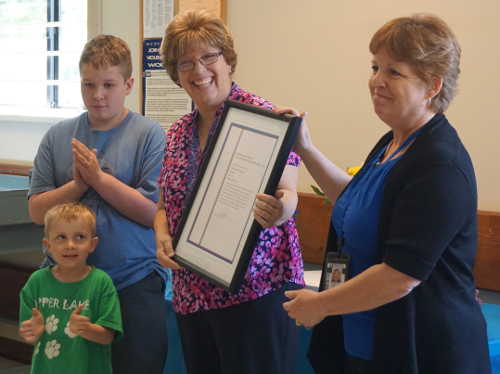
NICE, Calif. – As friends, family and fellow postal workers looked on, the postmaster of the community of Nice celebrated her swearing-in during a Friday afternoon ceremony.
Patricia Gross, 55, of Bachelor Valley, a 23-year veteran of the US Postal Service, took her oath from Manager of Post Office Operations Bobbie Riley at the Nice Post Office, located at 3964 East Highway 20.
About 30 people were on hand for the event, including several of Gross’ fellow postmasters from around the North Coast: Postmasters Mike Stafford of Lucerne, Sandy Dawson of Clearlake Oaks, Cathy Swarm of Ukiah, Rhonda Ahanotu of Geyserville, Maureen Butcher of Fulton and Anita Rackerby of Occidental and Camp Meeker, as well as Michelle Lewis, who is supervising the Lower Lake Post Office, and Maria Lane, Gross’ longtime friend who is the former Lakeport postmaster and now the acting manager of post office operations for the San Francisco District.
The event also was a family affair for Gross, with her son and daughter-in-law, grandchildren and father all on hand for the event. Her little grandson, Ethan, led the flag salute.
Lane said Gross is the eighth postmaster for Nice, where the US Postal Service established its first post office in 1930 in a small store on Lakeshore Boulevard. Max Maiereder was the first postmaster. Just down the road, the town of Upper Lake had established it first post office in 1853.
In 1944, the first Nice Post Office was built. That building is now a café. The current building on Highway 20 was built in 1990, Lane said.
Lane and Gross worked together beginning as rural carriers in the 1990s in Lakeport. Gross began with the US Postal Service in 1994, transferring to Upper Lake in 1996, also as a rural carrier, and then moving to Lucerne in 2000 as a clerk.
Later, she worked as an officer-in-charge at the Covelo and Laytonville Post Offices, earning her first postmaster position was in Glenhaven in 2008. She held that job until she was selected as the postmaster for Nice.
Gross actually became postmaster in Nice in October 2012, but the formalities of the swearing-in had been delayed for various reasons.
“We’re going to install her so she can stay here,” said Lane.
Riley, who has worked to open up the postmaster celebration ceremonies to the communities, explained that, in any town, there is only one postmaster, adding, “Not every town has them anymore.”
She said post offices mean a lot to communities, citing an annual survey of government agencies that consistently ranks the US Postal Service as the No. 1 most trusted government agency.
Riley said the Postal Service handles items – mail and packages – important to the US public, and recounting the history of the agency, she said the United States wouldn’t be what it is without the Postal Service.
She said the items the Postal Service handles has switched from mail to primarily packages. It’s also had to “right size,” which meant downsizing its staffing to some degree.
Riley recalled that, in 2001, after the terrorist attack in New York, President George W. Bush called then-US Postmaster General Jack Potter and asked him if the Postal Service could deliver mail as closely as possible to the attack site, as there was no better symbol that the country was still going and business was still moving.
“The Postal Service was important then and it’s important now,” she said.
Locally, the Postal Service has responded in similar fashion to natural disasters.
Gross told Lake County News that she and other local postal workers assisted in Kelseyville during the county’s wildland fires with processing mail for fire survivors.
She said the Postal Service set up mail delivery at the Napa County Fairgrounds in Calistoga, where hundreds of Valley fire survivors stayed for weeks during the mandatory evacuations.
Riley said the best part of her job is that she gets to pick the postmasters. While she didn’t pick Gross – who already was at Nice before Riley took her current post – she said she would have chosen her, as her selection criteria focuses on people who will serve communities well.
Then Riley administered the oath of office to Gross, who was surrounded by her three grandsons, Dominic, 12, Ethan, 5, and Wyatt, 18 months.
Afterward, she called up the rest of her family, including her son, Kevin and daughter-in-law, Angela, who works at the Upper Lake Post Office, and her father, John Fix of Lakeport, who were with her as Lane presented her with her certificate of office.
The moment choked up Gross’ father and many of her colleagues. Lane, who herself became teary-eyed, said the honor of serving the community hits home.
Gross explained later that her father had been very supportive of her career in the Postal Service, and had for some time been asking her when her ceremony would take place.
She said she is looking forward to staying in Nice. “The customers are great.”
At the Nice Post Office, Gross has two employees who process and deliver an average of 2,150 pieces of mail daily to 1,832 post office boxes and one highway contract route with 313 delivery stops.
“I just love my job,” she said, explaining that it includes a wide variety of duties pertaining to the office’s operations.
She added that, for a small town postmaster, there are more opportunities to work closely with the community than there would be in a larger city.
The US Postal Service also is hiring hundreds of positions throughout Northern California, said Lane, who said it’s estimated that 70 percent of the service’s workforce is preparing to retire.
She said they’re looking for people who want to get on a career track, have steady employment, good wages and a good retirement.
Those interested in applying can visit the US Postal Service’s job search site to see what is available in their area.
Email Elizabeth Larson at
Saturday, April 22 is Earth Day, a good time to remember what John Muir said so eloquently: "When we try to pick out anything by itself, we find it hitched to everything else in the universe."
The California Department of Fish and Wildlife, or CDFW, said that fact influences nearly everything it does to manage and protect the state's native plants, invertebrates, fish, wildlife and habitats.
Twenty million people in the U.S. participated in the first Earth Day in 1970, to increase public awareness of the damage humans were doing to the environment. People used the day to educate themselves and others about the relationship we have with the world's natural resources.
That year, California was one of the first states to enact statutes protecting rare and endangered animal species, and it remains a world leader in environmental protection. Now, Earth Day is celebrated every year by more than a billion people in 192 nations.
CDFW sees the effects of human behavior on wildlife and ecosystems every day. As the public steward for California's wildlife and habitat, CDFW practices conservation and restoration statewide with considerable success. California tule elk (Cervus elaphus nannodes) provide a good example.
By 1870 very few individual tule elk were known to exist; they were closely related and on the verge of extinction. When the state Legislature banned elk hunting in 1873, it was unclear if any even remained. One pair was discovered by a local game warden near Buttonwillow, and nurtured to save the species.
In 1977, seven elk were reintroduced to their former native habitat at Grizzly Island in Solano County. Since then, this herd has not only flourished, but provided seed stock for CDFW to establish new herds. Statewide, tule elk populations have expanded to 5,100 animals in 21 herds.
Two charismatic birds that were once endangered have recovered well enough to be de-listed under the U.S. Endangered Species Act: the Peregrine falcon (Falco peregrinus anatum) and California brown pelican (Pelecanus occidentalis californicus).
By 1969 both species' breeding populations had plummeted, primarily because of organochlorine pesticides like DDT. The chemicals made the birds' eggshells too thin and fragile to withstand the parents' weight in the nest, so multiple generations were crushed during incubation.
Recovery began when the state and federal governments and Canada banned the use of those pesticides. Reducing human disturbance of nesting and roosting sites aided the pelicans' recovery, and a captive breeding program supported recovery of the falcon population.
Along with landowners and other scientists, CDFW scientists' research and monitoring provided the facts needed to list both species, make their recovery possible, and determine when it was time to de-list them. CDFW continues to work with many partners to monitor de-listed species to ensure their populations remain healthy.
The endangered Light-footed Ridgway's Rail (Rallus longirostris levipes, formerly known as light-footed clapper rail) is slowly recovering, thanks to CDFW and other scientists and partners, and because of habitat acquisition by the Wildlife Conservation Board (WCB), which purchased land for the Upper Newport Bay Ecological Reserve. There, and in other coastal marshes of Southern California, these secretive birds are protected, and a captive breeding program is underway to supplement the wild population.
A population decrease in 2008 is believed to have been weather-related, and could be a harbinger of what's in store if climate change predictions come to pass. The consistent management and captive breeding program have brought the population back up to more than 600 pairs.
Eighty years ago people thought Southern sea otters (Enhydra lutris nereis) were extinct. A small colony was discovered at Big Sur in 1938 and given legal protection. The combined efforts of local, state and federal governments, nonprofit organizations and individuals have nurtured the population to around 3,000. That's only a fraction of historic numbers, but a step in the right direction.
In 1994 CDFW's Office of Spill Prevention and Response and UC Davis created the Oiled Wildlife Care Network (OWCN) to rescue, rehabilitate and release wildlife injured in oil spills. OWCN quickly became the world's premier oiled wildlife rescue organization and pioneered research in the subject to develop the best achievable care using the best available technology. Since 1995, the OWCN has responded to more than 75 oil spills throughout California and has cared for nearly 8,000 oiled birds and mammals.
"Working in the oil spill response field for over 25 years, I have seen how our community quickly responds to a detrimental environmental incident," CDFW Environmental Program Manager Randy Imai said. "So, I know we can all do this at a much smaller scale in our everyday lives. Every one of us can make a difference."
The WCB supports projects that benefit wildlife with bond money approved by California voters for environment-related projects. In 2016 alone, the WCB allocated approximately $93 million to more than 100 projects.
That money bought more than 8,000 acres of wildlife habitat, conservation easements on more than 33,000 acres of habitat, restoration and enhancement of more than 17,000 acres, public access rights, stream flow enhancement studies and infrastructure improvements, and it helped develop Natural Community Conservation Plans that protect multiple species.
You don't have to be a scientist, wildlife officer or legislator to protect California's wildlife and ecosystems.
There are many things most anyone can do, including:
– Pick up litter. Wildlife often mistake trash for food and die because of it, and wild birds can become entangled and die in abandoned fishing line.
– Don't use rat poison. Let rodents' natural predators-coyotes, foxes, bobcats, raptors (owls, hawks) and snakes-control their population. See our Rodenticides webpage for details.
– Replace your lawn with native plants to help conserve water and our native pollinators. Locally native plants can thrive in both dry and wet years.
– Conserve water. Conservation is the way of life in California. Use as little water as possible to prevent shortages and assure sufficient water for food crops and for ecosystem protection.
– Reduce, reuse, recycle. Most California cities and counties have recycling programs for both residents and businesses. Visit CalRecycle Earth Day.
– Buy in bulk and use recyclable materials. Compost veggie scraps and yard clippings in gardens. Landfills destroy valuable wildlife habitat, so think about that each time you make a trip to your garbage containers. The cumulative impacts are enormous.
– Use biodegradable soaps. They pollute less than other soaps.
– Drive less. Plan your errands to reduce the number of car trips. Walk, bike, carpool or take public transit. Spare the Air! If you can, make your next car electric or hybrid to help slow climate change.
– Never dump oil, chemicals, or any other waste into a storm drain or gutter.
– Take children out for nature walks and teach them about the local plants and animals. They can't be stewards of the future without understanding and caring for nature. We're all in it together on this one planet Earth.
– Volunteer at nature centers, ecological reserves, or for a government-led program like the Natural Resources Volunteer Program. Volunteer at schools or recreation centers, and create nature and ecology programs.
– Go birding! Share bird identification books and binoculars with others who may not have them. Visit California Audubon for information.
– Keep dogs on a leash in wild places, even on beaches. Don't let dogs flush birds. Birds need undisturbed time to nest successfully, to forage, and then to rest and preen and conserve energy.
– Keep cats indoors. Cats kill millions of birds each year, not out of malice, but because they're wired to kill and eat them. A clean litter box is not difficult to maintain. Just be sure to bag the waste in biodegradable material and dispose of it in your garbage can.
– Go solar. Utilities offer rebates, and if you can afford a solar energy system, you'll help reduce the rate of climate change. If you can't, let the sun warm your home through windows on sunny days.
– Conserve electricity, use natural light as much as possible, and turn off all lights when not in use. It takes natural resources to create energy and wildlife habitat is compromised or destroyed in the process. Energy production pollutes the air and produces greenhouse gases, contributing to the climate change problem and respiratory ailments. Use thermal drapes and energy-efficient windows to keep your home warm or cool as needed, and dress for the temperature, so you use the heat or air conditioner less. Use a clothes line outdoors or hang clothes to dry indoors. You'll save money as well as energy.
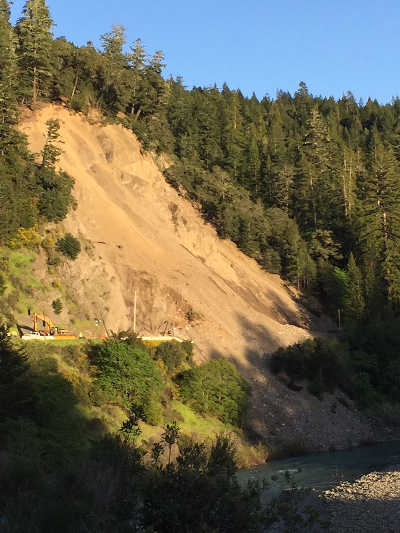
NORTH COAST, Calif. – Officials said Friday that new road closures are in effect after another slide affected a portion of Highway 101.
The California Highway Patrol reported that on the night of April 16, a large rock and mudslide occurred on Highway 101 approximately three miles north of the Standish Hickey State Recreation Area in Leggett.
The slide had spilled over temporary concrete railing and a catchment fence which was in place due to a previous rock slide in March, the agency said.
This latest slide is still active and has made travel across either side of Highway 101 impassible. The CHP said Highway 101 is closed north of the Standish Hickey State Recreation Area.
Since the slide closed Highway 101 earlier this week, travelers have taken Bell Springs Road to travel around the closure, the CHP said.
As a result of the heavy traffic and continued winter storms, road conditions on Bell Springs Road have deteriorated. The CHP said there have been several collisions and vehicles have become disabled with roadside services unable to reach them in a timely manner.
The CHP, Humboldt County Department of Transportation, Mendocino County Department of Transportation, Humboldt County Sheriff, Mendocino County Sheriff and Caltrans have determined that the safest action for the public would be to close Bell Springs Road to through traffic and restrict travel to local necessary and essential traffic.
Officers will be staffing the closures of Bell Springs Road and citizens should be prepared to provide proof/explanation of their need to be in the area to officers at the closures.
Proof can include but is not limited to: driver's license or registration card/ utility bill with address, work order for the area, etc.
Currently the alternate routes of travel for passenger vehicles and light trucks are Highway 36 and Highway 20. The current alternate routes of travel for larger commercial vehicles are Highway 20 and Highway 299, the CHP said.
Additionally, the CHP said the following roads are not alternate routes for the Highway 101 closure: Usal Road, Mina Road, Zenia Bluff Road, Hoagland Road and Briceland Thorn Road.
As for the situation at the Highway 101 slide, Caltrans reported late Friday that, weather permitting, it is looking “more possible” that the highway may be reopened in the middle of next week.
By 6 p.m. Friday, Caltrans’ contractor had removed more than 400 dump truck loads of slide material, despite the ongoing activity on the south side which caused numerous pauses in work. Caltrans said the night shift was working on the north end of the slide.
Check with Caltrans for additional updates or alternate routes at www.dot.ca.gov , https://www.facebook.com/CaltransD1/ or by calling 1-800-427-7623 (ROAD).