 How to resolve AdBlock issue?
News
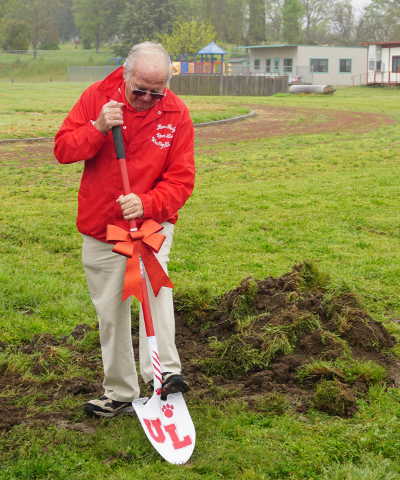
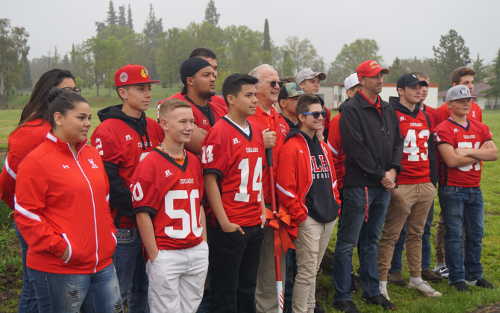
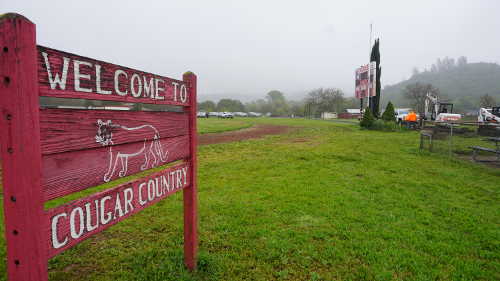
UPPER LAKE, Calif. – After nearly a decade of fundraising and planning, on Monday the booster club for Upper Lake High School, along with faculty, staff and students gathered to celebrate the beginning of construction on new lighting for the stadium in Cougar Country.
Led by the Upper Lake High School Booster Club, with support from the school district, the project to build lighting at the high school football stadium officially began on Monday following a brief ceremony.
Among those who came out for the rainy Monday morning groundbreaking were former board members Rich Swaney and John Tomkins, District 3 Supervisor Jim Steele, Upper Lake Unified Superintendent Patrick Iaccino, Upper Lake Unified School District Board President Keith Austin, Habematolel Pomo of Upper Lake Tribal Chair Sherry Treppa and members of her council, Upper Lake High School Principal Sandy Coatney, Upper Lake Middle School Principal Don Boyd and Upper Lake Elementary School Principal Stephanie Wayment, Athletic Director Mike Smith and a host of students, staff and faculty.
Also standing by at the ready with equipment to begin the work after the ceremony concluded were crew members from Modesto Executive Electric Inc., the project’s contractor.
Ron Raetz, a retired teacher and former district board member, has led the effort to bring lights to the stadium for the last nine and a half years along with his wife, Patty, also a retired Upper Lake High teacher.
He said the project started when, one October evening a decade ago, he and a group of parents were watching a soccer game at the stadium, with the children playing in the dark. Raetz said a woman watching the game said they needed lights, and that kicked off the effort.
Melanie Sneathen, president of the booster club, said they raised $165,000 but were still short of the total required to install the lights.
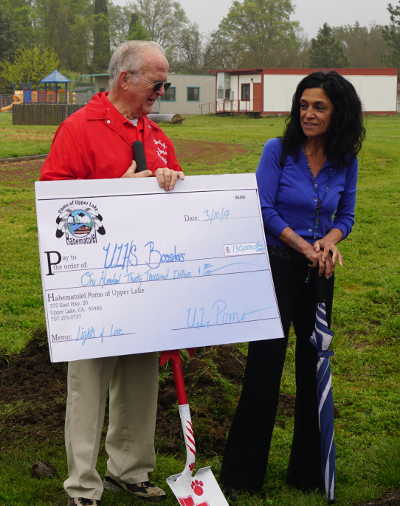
That’s when the Habematolel Pomo of Upper Lake, which owns Running Creek Casino, came forward, Sneathen said.
Sneathen said that, earlier this year, the tribe committed to a $130,000 donation for the lighting. The formal presentation of that final, critical piece of funding was part of the Monday celebration.
Treppa said when the tribe started the casino, it committed to helping with these kinds of community projects, especially those oriented toward youth.
“We’re very proud to be part of this,” said Treppa, who along with members of her tribal council presented Raetz and the boosters with a big check for $130,000.
Treppa also thanked community members for their support of the tribe.
Iaccino offered his thanks to the tribe, to Raetz and the community, and parent Sara Sanchez – who was herself a student at the high school, as was her father, both of them students of Patty Raetz – thanked the Raetzes for their tireless support of the project and the school.
“They have never, ever stopped helping our school,” Sanchez said.
She added of the project, “Upper Lake deserves it,” noting the improvements at the school over the last several years.
Raetz recalled the project’s beginnings and its inherent difficulties.
“You think there’s no way you’re going to raise that much money in this community,” he said.
The takeaway: “Don’t give up on your dreams,” he said, joking that, sooner or later, someone will bail you out.
“Now it’s time to start thinking about, what do we want to do next,” Raetz said.
Smith, as athletic director, committed to putting the best teams possible together to play on the field in the days ahead.
Iaccino told Lake County News that the project was carried out by the booster club, with the assistance of the school district and the requirement that, like all school projects, it ultimately must be approved by the Division of the State Architect.
Last year there had been concerns that there could be more costs incurred due to environmental requirements for the project. However, after state officials reviewed the project, that concern was allayed, and the work was cleared to begin, Iaccino said.
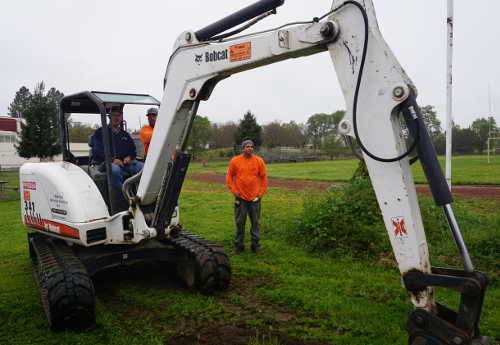
On Monday, the contractor was set to begin digging the footings for the four light standards, said Iaccino. There will be two standards on each side of the field, with the footings to be dug down 20 feet.
Iaccino said the light installation is expected to be completed by the time graduation arrives at the end of May.
This is expected to be the last major project Iaccino will see concluded during his tenure as superintendent. He will retire June 30 after more than 10 years in the district.
During that time, he has overseen major campus building and modernization projects, and was a prime mover behind the successful effort to unify the elementary and high school districts.
Beyond the lighting project, the stadium, which has been in use since 1976, also needs new seating, Iaccino said.
Currently, there are seats for about 500 spectators on one side of the field. Iaccino said they have begun getting bids to put in 1,000 new seats, with estimates ranging between $250,000 and $300,000 for that new stadium seating.
There are other big tasks ahead, including a high school weight room rebuild and millions of dollars of modernization required at the elementary school, with the latter expected to be part of a bond measure to be proposed to district voters in 2018, Iaccino said.
Email Elizabeth Larson at
Expectations are everything. When we expect a certain outcome, we make it more likely to happen.
The best we can do as parents, as teachers, as role models and government leaders is to have high expectations for those we influence.
At the Economic Forecast presentation held at the Twin Pine Event Center on Dec. 9, 2015, one of the speakers made the point that Lake County is poised to rise from being one of the bottom counties in the state’s socioeconomic ladder.
Christian Ahlmann said that we have a beautiful lake, outdoor adventure, and great wines and produce. If we continually push to get that message across, businesses will come that will add value to our county and we all will rise.
He was right. It’s happening, but it will take time for the county to feel the effects. We all must be patient and keep delivering the message, over and over.
We have a great opportunity right now because of our recent fires and headlines.
People know us. People know our name. Let’s teach them that Lake County is a land of treasures: beautiful lake, outdoor adventure, great wines and produce.
The visitors will come. The businesses will come. The money will come. Just as it did in Napa a short few decades ago.
We compare ourselves to Napa because we have the same roots, the same beginnings. We can achieve their median income level if we have that expectation. And we can do it better since we can learn from their mistakes!
When we don’t hold out for our best version of Lake County, when we cave in to the demands of the present, we lose our opportunity to prosper.
The Dollar General brand is a rapacious corporate entity that brings with it the mark of economic distress. That’s because Dollar General specifically seeks out communities marked as low income.
The presence of a Dollar General store in a community creates an expectation of poverty for residents, visitors and, notably, future residents and business leaders.
We urge you to hold out for Lake County’s best. Have high expectations and we will rise to them. Quick fixes are just a finger in the dike.
Beth Rudiger is president and Monica Rosenthal the secretary of the Middletown Area Merchants Association Board of Directors in Middletown, Calif.
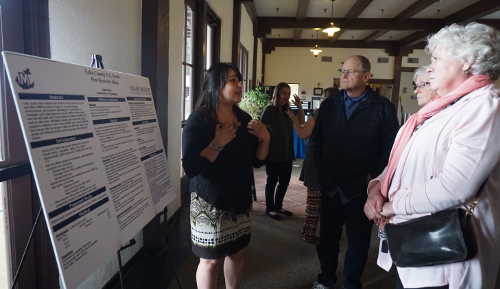
LUCERNE, Calif. – This year’s graduating class at Marymount California University in Lucerne presented their final capstone projects in a special Monday open house.
Eight graduating seniors – who, along with a ninth student will receive their degrees at Marymount California University’s May commencement ceremony – presented their capstone projects in the Lakeside Campus’ main lobby and reception area on Monday evening.
The work presented was the culmination for each of them of a year of study in addressing a need in the Lake County community while gaining organizational and research skills.
Of those eight individuals, five are business students with adjunct professor Dr. Richard Smith and three are psychology students with assistant professor Dr. Emma Ogley-Oliver.
Smith said the yearlong capstone project is required of all Marymount graduating seniors.
The goal of the projects is threefold, Smith said: it’s meant to benefit the community, to help seniors prepare for entering the job market and to help the academic program itself.
“This is actually their final exam,” said Smith, who was grading the students on their work.
The projects included studies on a birthing center, why people don’t go to college and how a sampling of local employers found that better pay isn’t offered in exchange for college degrees, internal training for services, increasing political efficacy, connecting businesses and jobseekers, the working homeless, fire recovery ideas from youth and behavioral health day programs.
Yadira Ortiz, who will receive her bachelor’s degree in business management in May, studied how businesses seek employees and how job hunters find positions.
She used an anonymous online survey to help gather information, and found that the two sides don’t seem to be finding each other very easily, with most businesses getting employees either through word of mouth or when people come in to apply for a job.
“I feel like there’s a disconnect,” Ortiz said, and that the local employment agency, while effective to a degree, could do better if it did more outreach about the availability of its services.
After graduation, Ortiz – who was born and raised in Lake County – said she hopes to stay in the county and find a job with the help of her new degree.
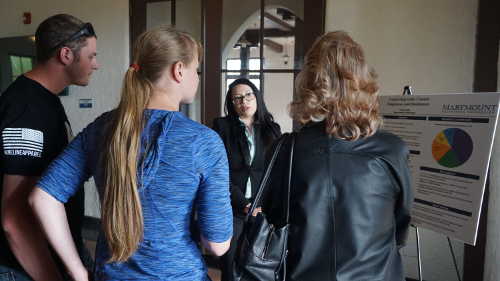
Psychology student Zabdy Neria studied youth perspectives on the recovery from the county’s wildland fires.
Neria, who also has worked for the last two years as a Lake County Behavioral Health case manager, said the project idea came to her when she was talking to a youngster she knows who was very upset about last August’s Clayton fire.
When she asked the boy about ideas he had for helping in response to the fire, she said he lit up and became excited.
That was the jumping off point to working with a small sample of eight students in grades fourth through seventh at Konocti Education Center’s afterschool program, Neria said.
The goal was to identify what the community’s youth thinks is needed in fire recovery. She said they came up with a number of suggestions, from “safe zones” where people can respond to get supplies and information, to more affordable housing and community caring projects, such as donation collection bins or blanket-making projects.
“They’re thinking critically and they’re coming up with these great ideas to help the community,” Neria said.
She said it’s opened up the possibility for further research, not just with that age group – with Neria noting that she has a long waiting list of children who wanted to participate – but also high school- and college-age students.
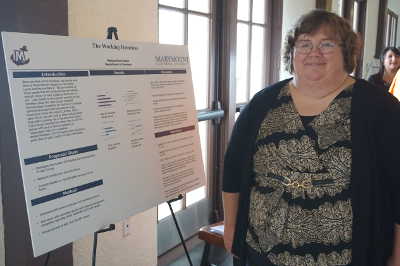
Business student Melissa Mae Hodder studied the working homeless.
Hodder said she wanted to understand why it is so hard for the small sample group of people she studied to find housing, even when they’re employed.
She said there is a gap between what they earn and the median rental prices in the county, which have gone up. There also are challenges with credit checks and the amount of money needed to get into a rental.
Hodder’s findings include a limited amount of affordable housing in the county that’s been further reduced due to the county’s wildland fires, and programs to help low-income residents – like Section 8 – being seriously waitlisted.
The topic, she added, needs more research and study.
Marymount California University is now open for enrollment in upper division courses in liberal arts, psychology and business management for fall 2017.
For information call or email Kathy Windrem at
Email Elizabeth Larson at
NORTHERN CALIFORNIA – Assemblymember Cecilia Aguiar-Curry on Monday honored Judge David Rosenberg at the California State Assembly annual Holocaust Remembrance Ceremony.
Judge Rosenberg is the son of Holocaust survivors Fay and Harry Rosenberg.
“It was a privilege to have Judge Rosenberg at the Capitol to honor him and his parents,” said Aguiar-Curry (D-Winters), whose district includes Lake County.
“Despite the pain and suffering of the Holocaust, it is imperative that we remember this tragic time and all of those who were victims, both survivors and those we lost,” she said. “We must always remember what happens when we turn a blind eye to bigotry, hatred, and discrimination.”
For the past 13 years, the California State Assembly has honored survivors of the Holocaust during Holocaust Remembrance Week.
This year, April 23 to 30 has been designated as the Holocaust Remembrance Week.
As time passes and fewer witnesses remain, Aguiar-Curry said it is imperative to honor today’s survivors, their families, and those who perished during the Holocaust.
Rosenberg, born in 1946, immigrated to the United States in 1949. He graduated from the California Polytechnic State University with a Bachelor of Science degree in 1968.
After graduating from college he served for two years in the U.S. Army before attending the University of California, Davis School of Law. He graduated with his Juris Doctorate in Law in 1974.
David Rosenberg has served as mayor of the City of Davis, Yolo County supervisor, deputy executive secretary and chief of staff to Gov. Jerry Brown, and a senior advisor to Gov. Gray Davis.
Since 2003 he has served as a judge assigned to the Yolo County Superior Court. He has dedicated endless hours of services to his community on various boards and charities, and continues to serve the people of California.
Aguiar-Curry represents the Fourth Assembly District, which includes all of Lake and Napa counties, parts of Colusa County, all of Yolo County except West Sacramento, Dixon in Solano County and Rohnert Park in Sonoma County.
Visit her Web site at www.asm.ca.gov/aguiar-curry .
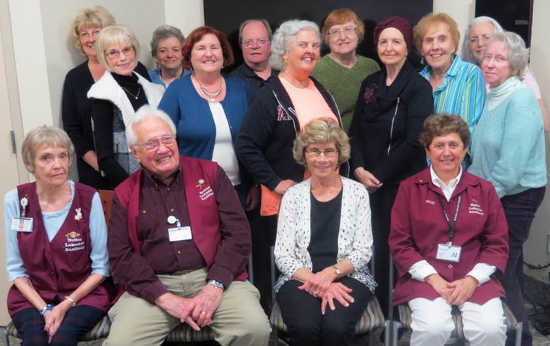
LAKEPORT, Calif. – In the nearly four years that Revae Leppanen has served as a member of Sutter Lakeside Hospital’s Auxiliary, she has discovered the sense of giving back to be deeply fulfilling.
Leppanen, who retired to Lake County after a 25-year career as a teacher in Napa, wanted to give back as well as meet new people.
“After I settled in, I felt the need to do something with myself other than work on my genealogy, which I’ve done for 45 years,” said Leppanen. “The auxiliary was a good opportunity to meet new people. I’ve definitely made good friends.”
The Sutter Lakeside Hospital Auxiliary consists of over 22 members who regularly volunteer their time to work in the hospital gift shop, assemble Family Birth Center gift baskets, hold bake sales, and greet surgery patients in the surgery center.
In 2016, auxiliary members worked over 6,300 hours; in the years since it began, the auxiliary has donated over $150,000 to the hospital for equipment and improvements.
“I’m very proud of that,” said Leppanen. “The auxiliary has made an immense difference through the money we give back to the hospital.”
Leppanen, who also volunteers for the hospital’s Patient Experience Council, uses her time working in the gift shop to interact with patients and lend a listening ear.
“The most rewarding thing is the interaction with the patients that come in,” said Leppanen. “We get people who are killing time, and people just want to talk. They enjoy that, and open up about how they’re feeling. I really enjoy that I’m contributing to helping them.”
Leppanen was appointed the Volunteer of the Year for 2016 for her involvement in both the auxiliary and the Patient Experience Council.
“I was totally floored,” said Leppanen. “I was thrilled and felt honored that I would be pointed out this way. I texted all my kids.”
“I am amazed by everything the volunteers do,” said Dan Peterson, chief administrative officer, Sutter Lakeside Hospital. “They participate in such a wide range of activities and do so much good for our patients. They help make our patient experience here great, from the services they provide to the funding they generate for special projects and meaningful new services. Our auxiliary volunteers are a special group who give not only of their time, but of their energy and love by providing help to those in need.”
According to Leppanen, auxiliary is a worthy investment. “I would say that if you would like to meet a marvelous group of people, interact with patients, and feel as if you’re really contributing to your community, this is the place for you.”
To learn more about Sutter Lakeside Hospital, or to find out how to get involved, please contact Morgen Wells at 707-262-5121, or by email at
Morgen Wells is community relations and fund development coordinator.
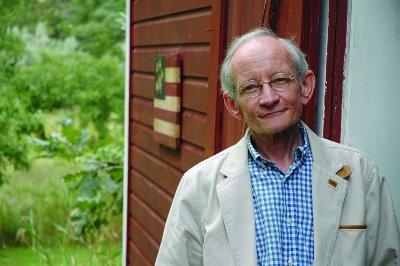
I'm celebrating my 78th birthday by publishing one of my own poems. When an old guy like me is still writing poetry, he tends to write a lot of old-guy poems.
Look for Me
Look for me under the hood
of that old Chevrolet settled in weeds
at the end of the pasture.
I'm the radiator that spent its years
bolted in front of an engine
shoving me forward into the wind.
Whatever was in me in those days
has mostly leaked away,
but my cap's still screwed on tight
and I know the names of all these
tattered moths and broken grasshoppers
the rest of you've forgotten.
American Life in Poetry does not accept unsolicited submissions. It is made possible by The Poetry Foundation ( www.poetryfoundation.org ), publisher of Poetry magazine. It is also supported by the Department of English at the University of Nebraska-Lincoln. Poem copyright ©2017 by Ted Kooser, “Look for Me." Poem reprinted by permission of Ted Kooser. Introduction copyright © 2017 by The Poetry Foundation. The introduction's author, Ted Kooser, served as United States Poet Laureate Consultant in Poetry to the Library of Congress from 2004-2006.