 How to resolve AdBlock issue?
News
BERKELEY, Calif. – As we grow old, our nights are frequently plagued by bouts of wakefulness, bathroom trips and other nuisances as we lose our ability to generate the deep, restorative slumber we enjoyed in youth.
But does that mean older people just need less sleep?
Not according to researchers at the University of California, Berkeley, who argue in an article published April 5 in the journal Neuron that the unmet sleep needs of the elderly elevate their risk of memory loss and a wide range of mental and physical disorders.
“Nearly every disease killing us in later life has a causal link to lack of sleep,” said the article’s senior author, Matthew Walker, a UC Berkeley professor of psychology and neuroscience. “We’ve done a good job of extending life span, but a poor job of extending our health span. We now see sleep, and improving sleep, as a new pathway for helping remedy that.”
Unlike more cosmetic markers of aging, such as wrinkles and gray hair, sleep deterioration has been linked to such conditions as Alzheimer’s disease, heart disease, obesity, diabetes and stroke, he said.
Though older people are less likely than younger cohorts to notice and/or report mental fogginess and other symptoms of sleep deprivation, numerous brain studies reveal how poor sleep leaves them cognitively worse off.
No magic pill
Moreover, the shift from deep, consolidated sleep in youth to fitful, dissatisfying sleep can start as early as one’s 30s, paving the way for sleep-related cognitive and physical ailments in middle age.
And, while the pharmaceutical industry is raking in billions by catering to insomniacs, Walker warns that the pills designed to help us doze off are a poor substitute for the natural sleep cycles that the brain needs in order to function well.
“Don’t be fooled into thinking sedation is real sleep. It’s not,” he said.
For their review of sleep research, Walker and fellow researchers Bryce Mander and Joseph Winer cite studies, including some of their own, that show the aging brain has trouble generating the kind of slow brain waves that promote deep curative sleep, as well as the neurochemicals that help us switch stably from sleep to wakefulness.
“The parts of the brain deteriorating earliest are the same regions that give us deep sleep,” said article lead author Mander, a postdoctoral researcher in Walker’s Sleep and Neuroimaging Laboratory at UC Berkeley.
Aging typically brings on a decline in deep non-rapid eye movement (NREM) or "slow wave sleep," and the characteristic brain waves associated with it, including both slow waves and faster bursts of brain waves known as “sleep spindles.”
Youthful, healthy slow waves and spindles help transfer memories and information from the hippocampus, which provides the brain’s short-term storage, to the prefrontal cortex, which consolidates the information, acting as the brain’s long-term storage.
“Sadly, both these types of sleep brain waves diminish markedly as we grow old, and we are now discovering that this sleep decline is related to memory decline in later life,” said Winer, a doctoral student in Walker’s lab.
Another deficiency in later life is the inability to regulate neurochemicals that stabilize our sleep and help us transition from sleep to waking states. These neurochemicals include galanin, which promotes sleep, and orexin, which promotes wakefulness. A disruption to the sleep-wake rhythm commonly leaves older adults fatigued during the day but frustratingly restless at night, Mander said.
Of course, not everyone is vulnerable to sleep changes in later life: “Just as some people age more successfully than others, some people sleep better than others as they get older, and that’s another line of research we’ll be exploring,” Mander said.
The hunt for new treatments
Meanwhile, non-pharmaceutical interventions are being explored to boost the quality of sleep, such as electrical stimulation to amplify brain waves during sleep and acoustic tones that act like a metronome to slow brain rhythms.
However, promoting alternatives to prescription and over-the-counter sleep aids is sure to be challenging.
“The American College of Physicians has acknowledged that sleeping pills should not be the first-line kneejerk response to sleep problems,” Walker said. “Sleeping pills sedate the brain, rather than help it sleep naturally. We must find better treatments for restoring healthy sleep in older adults, and that is now one of our dedicated research missions.”
Also important to consider in changing the culture of sleep is the question of quantity versus quality.
“Previously, the conversation has focused on how many hours you need to sleep,” Mander said. “However, you can sleep for a sufficient number of hours, but not obtain the right quality of sleep. We also need to appreciate the importance of sleep quality.
“Indeed, we need both quantity and quality,” Walker said.
Yasmin Anwar writes for the UC Berkeley News Center.
KELSEYVILLE, Calif. – A teenage girl who went missing on Tuesday morning has been located.
The Lake County Sheriff’s Office said 15-year-old Leah Waters was found and is safe.
The girl was last seen at about 9:20 a.m. on Tuesday, running into a nearby creek bed.
The original sheriff’s office report on the girl’s disappearance said she was a Kelseyville High School student who had left the school on Tuesday morning after a disagreement.
However, Kelseyville Unified Superintendent Dave McQueen told Lake County News that she is a middle school student who at the time of her initial disappearance hadn’t come to school for the day.
The Lake County Sheriff's Office thanked the community for its assistance in locating her.
LAKEPORT, Calif. – The search for a new Lakeport Unified School District superintendent is moving ahead on schedule, according to an update from the board president.
At its March 16 meeting, the Lakeport Unified School District Board voted unanimously to launch a condensed, confidential hiring process for a new head for the district, which has enrollment of about 1,500 students.
That decision resulted from the anticipation of Calistoga Joint Unified School District making an offer to Lakeport Unified Superintendent Erin Smith-Hagberg, as Lake County News has reported.
The day after the meeting, Calistoga Joint Unified released a statement formally acknowledging that Smith-Hagberg had been selected to lead the district.
The board chose to move rapidly due to Smith-Hagberg being to leave the district June 30, at the end of her contract.
In a letter to the community the district released on Monday, Board President Dennis Darling said the hiring process has moved according to the short schedule the board had laid out, and he anticipated a contract with the new candidate to be on the May 11 board agenda.
“We are very pleased with the process, the quality of the candidates who applied, and especially with
who we have selected to fill the position,” he said, adding that he believes the community also will be pleased.
The application deadline was April 21. Darling said the district received applications from 15 individuals coming from areas ranging from Seattle to San Diego.
Darling said those applications were screened by professionals using criteria that had been submitted by community members during public meetings that began in March. The screeners gave input to the board that it considered at a special meeting on April 24.
From the 15 applications, the board identified seven “very strong candidates” and invited six of them to interviews on April 27, with three of the candidates invited back for more intensive, final interviews the following day, Darling said.
“The three finalists were very strong and any one of the three could serve as our superintendent,” Darling said. “After significant deliberation and discussion, our board identified one final candidate to move forward in the process.”
However, Darling said the candidate won’t be named publicly until several more steps are completed, including the checking of 15 references, contract negotiation and a professional background check.
The district is being assisted in the recruitment process by Dr. Scott Mahoney, a Windsor-based educational hiring consultant with a background working in Lake County. Mahoney also led the recruitment that resulted in Smith-Hagberg being hired in Calistoga.
If all goes well, Darling said the board hopes to be able to announce the name of the new district superintendent by the end of the week, with contract approval at the May 11 board meeting.
Once the hiring is official, Darling said the new superintendent will spend three days in the district prior to the end of the school year to meet staff, and will spend time working and transitioning with Smith-Hagberg.
Darling said the new superintendent will officially start on July 1.
Email Elizabeth Larson at
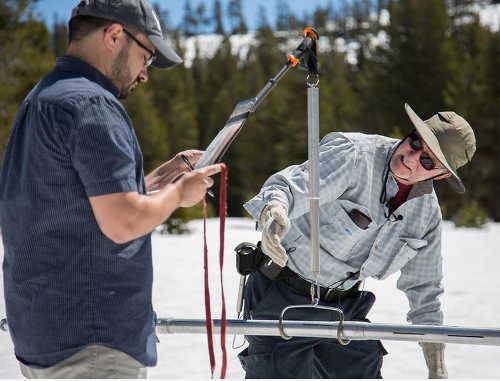
NORTHERN CALIFORNIA – The Department of Water Resources held the state’s final snow survey of the water year on Monday, with readings once again showing a strong water supply thanks to this year’s storms.
The Monday manual snow survey by the Department of Water Resources at Phillips Station in the Sierra Nevada found a snow water equivalent of 27.8 inches, 190 percent of the May 1 long-term average there, or 14.6 inches.
Electronic measurements indicate the water content of the statewide snowpack today is 42.5 inches, 196 percent of the May 1 average.
The snow water equivalent of the northern Sierra snowpack is 39.9 inches (199 percent of average); the central and southern Sierra readings are 47.1 inches (202 percent of average) and 37.6 inches (180 percent of average), respectively.
Monday’s readings will help hydrologists forecast spring and summer snowmelt runoff into rivers and reservoirs. The melting snow supplies approximately one-third of the water used by Californians.
"California’s cities and farms can expect good water supplies this summer,” said DWR Acting Director Bill Croyle. “But this ample snowpack should not wash away memories of the intense drought of 2012-2016. California’s precipitation is the most variable in the nation, and we cannot afford to stop conserving water.”
Snowpack water content is measured manually on or near the first of the month from January to May.
The Phillips snow course, near the intersection of Highway 50 and Sierra-at-Tahoe Road, is one of hundreds surveyed manually throughout the winter.
Manual measurements augment the electronic readings from about 100 sensors in the state’s mountains that provide a current snapshot of the snowpack’s water content.
The first of April is normally when snowpack water content is at its peak.
Frank Gehrke, chief of the California Cooperative Snow Surveys Program, conducted the survey at Phillips and said of his findings, 2017 has been “an extremely good year in terms of the snowpack.”
Gehrke said the snowpack is encouraging in terms of surface water supplies. “The thing we’re looking out for is primarily the southern Sierra, where we have full reservoirs and in some cases a huge snowpack,” he said. “We want to make sure that we prudently manage that so we don’t cause any downstream issues.”
California's reservoirs are fed both by rain and snowpack runoff. A majority of the state's major reservoirs are above normal storage levels for today’s date.
Lake Oroville in Butte County, the State Water Project's principal reservoir, is 91 percent of average for the date (74 percent of its 3.5-million acre-foot capacity).
Shasta Lake north of Redding, the federal Central Valley Project's largest reservoir with a capacity of 4.5 million acre-feet, is at 109 percent of average (94 percent of capacity).
Earlier this month, the Department of Water Resources increased its estimate of this year’s State water Project supply to 100 percent of requests for contractors north of the Sacramento-San Joaquin Delta and 85 percent of requests for other contractors, the highest since the 100-percent allocation in 2006.
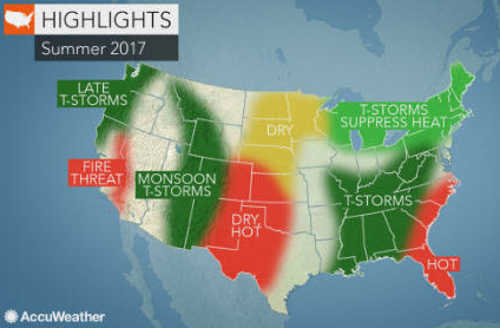
AccuWeather reports wet weather and severe storms will keep extreme temperatures at bay in the Northeast and mid-Atlantic this summer, while heat and humidity plague the South.
Meanwhile, California will be at risk from wildfires due to abundant vegetation as the Northwest grapples with outbreaks of severe weather.
Early storms to hold back extreme heat in Northeast; Thunderstorms aim for mid-Atlantic
Unlike the summer of 2016, when drought conditions gripped the Northeast and mid-Atlantic, this summer will bring on-and-off wet weather to both regions.
“Especially in June and July, we should see some showers and storms from time to time,” AccuWeather Lead Long-Range Forecaster Paul Pastelok said.
The moisture will help to hold back extreme and prolonged heat.
“I think we'll have some hot weather, but it won't be as prolonged as we saw last year a couple of times,” he said.
However, northeastern I-95 cities, including New York City and Boston, may end up with slightly more 90-degree days than normal – although still fewer than last year.
"[Areas] farther south may be at or slightly below normal due to a little bit more moisture over the summer," Pastelok said.
Fire threat to continue in Southeast despite storms, possible tropical hit
More than 100 fires have ripped across Florida this spring, and the threat shows no sign of relenting into the summer season.
“The only thing that can really save them early on will be a tropical hit that could take place,” Pastelok said.
“The chances are a little bit low on that, so we'll probably have to deal with more smoke in the air down in central and southern Florida going into the early summer,” he said.
Areas more likely to be impacted by the tropics early on include the western Gulf Coast, including New Orleans and Houston. The Carolina coast may also be at risk.
“I'd be concerned about Charleston up to Cape Hatteras,” Pastelok said, adding that water temperatures are already running above normal in that area.
Severe weather will also threaten the Carolinas in June.
Across the Southeast, showers and storms will be widespread. With humidity levels running high, flooding downpours may result.
Heat and dryness grip the northern, southern Plains
Early in the season, periods of warmth across the northern Plains will trigger severe weather.
However, the storms are not expected to last long. Drier conditions will set in from mid- to late season, allowing temperatures to climb.
How persistent the heat is will determine whether a mild or moderate drought is likely to develop. Prolonged dryness could put stress on crops later in the season.
“This is a tricky area that we're watching very closely,” Pastelok said.
California wildfires to rage despite rain, snow; severe weather to strike Northwest
Despite significant rain and mountain snow across California early this year, wildfires will still pose a threat this summer.
Significant precipitation has led to abundant vegetation which can serve as fuel for fires, Pastelok said.
Early in the season, heat may be inconsistent across California, but temperatures are predicted to rise significantly in July, increasing the chances for fires.
Meanwhile, the Northwest will face periods of severe weather.
Shower and thunderstorms will strike in June at times, but the latter part of the season will bring the greatest risk for severe weather across the interior Northwest, including Spokane, Washington and Boise, Idaho.
Dear members of the Lakeport Educational Community,
I'm writing once again to update you on our superintendent search. Our board has been very busy since my April 14 update to you.
The deadline for applications from candidates desiring to be our superintendent was Friday, April 21.
Fifteen people submitted applications and they came in from as far away as Seattle, Wash., all the way down to San Diego.
The professional screeners spent Saturday, April 22, and Sunday, April 23, screening the applications against the criteria that came from all the input our community provided to Dr. Mahoney.
We considered the input from the screeners at our Special Board Meeting on Monday evening, April 24. We identified seven very strong candidates and invited six of them to interview with us on Thursday, April 27.
We interviewed using questions developed from the input we received starting at 7 a.m. By 8:30 p.m. that night we decided to invite three candidates back for a more intensive, final interview the next day.
The three finalists were very strong and any one of the three could serve as our superintendent. After significant deliberation and discussion, our board identified one final candidate to move forward
in the process.
The next steps are for Dr. Mahoney to contact fifteen references for the candidate, negotiate a contract, and to have a professional background check conducted. If we can get these tasks accomplished this week, we hope to be able to announce the name of our new superintendent by the end of the week.
Contract approval will be on the agenda at our May 11 board meeting.
The new superintendent will spend three days in our district prior to the end of the school year to meet staff and spend time transitioning with outgoing Superintendent Erin Smith-Hagberg. The official start date is July 1.
We are very pleased with the process, the quality of the candidates who applied, and especially with who we have selected to fill the position. We believe you will be, too!
Dennis Darling is president of the Lakeport Unified School District Board of Trustees in Lakeport, Calif.