 How to resolve AdBlock issue?
News
LAKE COUNTY, Calif. – The shelter at Lake County Animal Care and Control is once again filled up with dogs in need of new homes, including a new group of puppies.
This week’s dogs include mixes of Chihuahua, German Shepherd, golden retriever, pit bull, shepherd and wirehaired terrier.
Dogs that are adopted from Lake County Animal Care and Control are either neutered or spayed, microchipped and, if old enough, given a rabies shot and county license before being released to their new owner. License fees do not apply to residents of the cities of Lakeport or Clearlake.
If you're looking for a new companion, visit the shelter. There are many great pets hoping you'll choose them.
In addition to the animals featured here, all adoptable animals in Lake County can be seen here: http://bit.ly/Z6xHMb .
The following dogs at the Lake County Animal Care and Control shelter have been cleared for adoption (additional dogs on the animal control Web site not listed are still “on hold”).
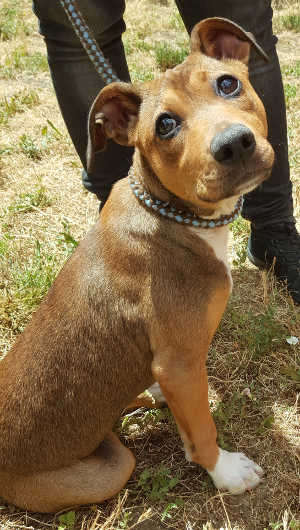
Shepherd mix
This female shepherd mix has a short red and black coat with white markings.
She’s in kennel No. 6, ID No. 7678.
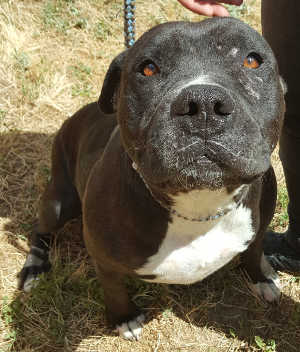
‘Luna’
“Luna” is a pit bull terrier mix with a short black coat and white markings.
She has already been spayed.
She’s in kennel No. 20, ID No. 7627.
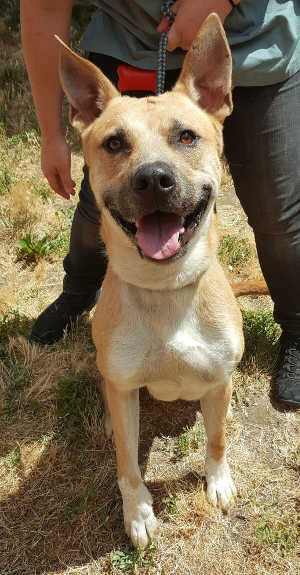
‘Scooby Doo’
“Scooby Doo” is a male German Shepherd mix with a short tan coat.
Shelter staff said he is good with other dogs but has high energy so will need guidance. He knows basic commands.
He’s in kennel No. 21, ID No. 7666.
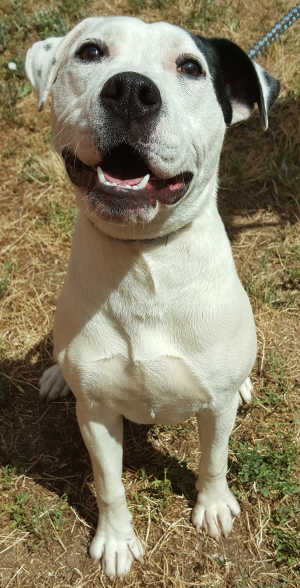
‘Ayla’
“Ayla” is a female pit bull terrier.
She has a short white coat with black markings.
She is in kennel No. 22, ID No. 7701.
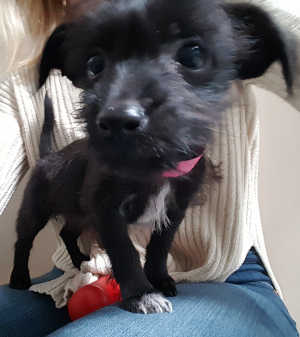
Wirehaired terrier-Chihuahua puppy
This female wirehaired terrier-Chihuahua puppy has a short black and white coat.
She’s in kennel No. 23a, ID No. 7690.
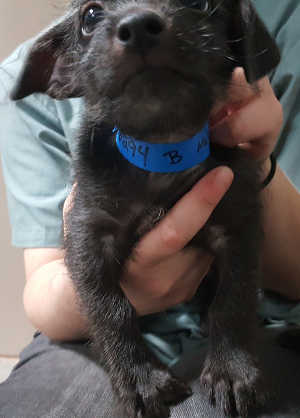
Wirehaired terrier-Chihuahua puppy
This male wirehaired terrier-Chihuahua puppy has a short black and white coat.
He’s in kennel No. 23b, ID No. 7691.
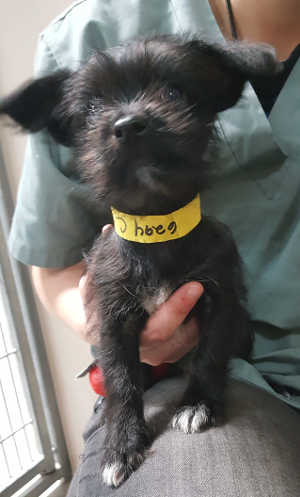
Wirehaired terrier-Chihuahua puppy
This female wirehaired terrier-Chihuahua puppy has a short black and white coat.
She’s in kennel No. 23c, ID No. 7692.
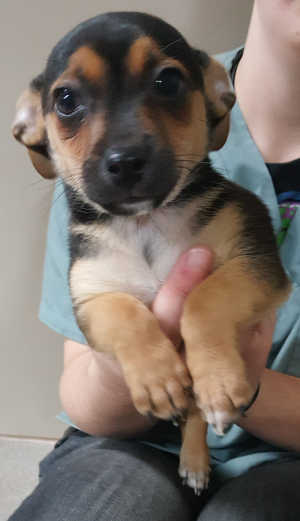
Wirehaired terrier-Chihuahua puppy
This male wirehaired terrier-Chihuahua puppy has a short black and tan coat.
He’s in kennel No. 23d, ID No. 7693.
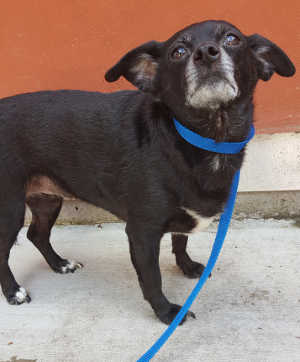
‘Nana’
“Nana” is an older female Chihuahua with a black coat.
She already has been spayed.
She’s in kennel No. 25a, ID No. 7710.
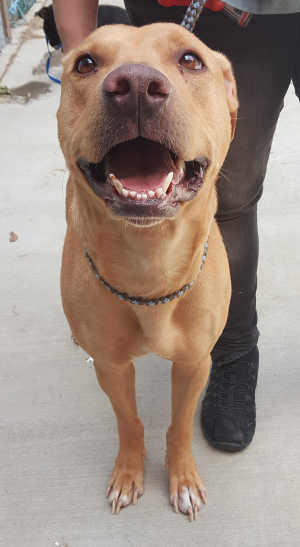
‘Wrinkle’
“Wrinkle” is a male golden retriever mix.
He has a short brown coat and has been neutered.
He’s in kennel No. 25b, ID No. 7711.
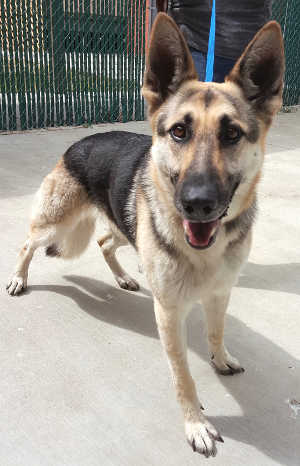
‘Charley’
“Charley” is a female German Shepherd.
She has a classic medium-length black and tan coat.
Charley already has been spayed. Shelter staff said she is good with other dogs her size, but not good with small dogs and cats due to her high prey drive.
She’s in kennel No. 26, ID No. 7605.
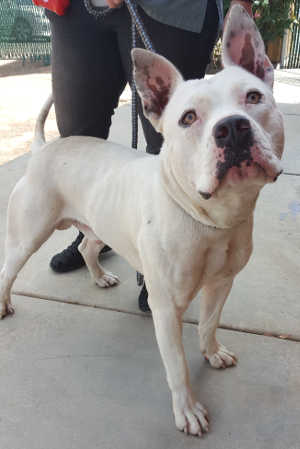
Pit bull terrier
This male pit bull terrier has a short white coat.
He’s in kennel No. 29, ID No. 7722.
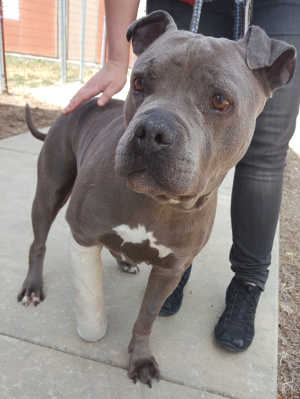
‘Kane’
“Kane” is a male pit bull terrier with a short gray coat and white markings.
He already has been neutered.
He’s in kennel No. 30, ID No. 6713.
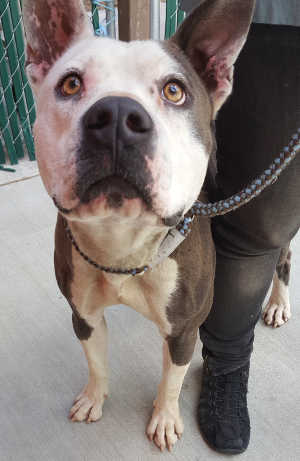
Pit bull terrier
This male pit bull terrier has a short brown and white coat.
He’s in kennel No. 31, ID No. 7723.
To fill out an adoption application online visit http://www.co.lake.ca.us/Government/Directory/Animal_Care_And_Control/Adopt/Dog___Cat_Adoption_Application.htm .
Lake County Animal Care and Control is located at 4949 Helbush in Lakeport, next to the Hill Road Correctional Facility.
Office hours are Monday through Friday, 11 a.m. to 5 p.m., and 11 a.m. to 3 p.m., Saturday. The shelter is open from 11 a.m. to 4 p.m. Monday through Friday and on Saturday from 11 a.m. to 3 p.m.
Visit the shelter online at http://www.co.lake.ca.us/Government/Directory/Animal_Care_And_Control.htm .
For more information call Lake County Animal Care and Control at 707-263-0278.
Email Elizabeth Larson at
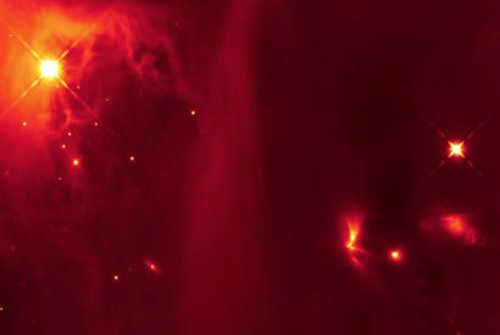
Did our sun have a twin when it was born 4.5 billion years ago?
Almost certainly yes – though not an identical twin. And so did every other sunlike star in the universe, according to a new analysis by a theoretical physicist from the University of California, Berkeley, and a radio astronomer from the Smithsonian Astrophysical Observatory at Harvard University.
Many stars have companions, including our nearest neighbor, Alpha Centauri, a triplet system. Astronomers have long sought an explanation. Are binary and triplet star systems born that way? Did one star capture another? Do binary stars sometimes split up and become single stars?
Astonomers have even searched for a companion to our sun, a star dubbed Nemesis because it was supposed to have kicked an asteroid into Earth's orbit that collided with our planet and exterminated the dinosaurs. It has never been found.
The new assertion is based on a radio survey of a giant molecular cloud filled with recently formed stars in the constellation Perseus, and a mathematical model that can explain the Perseus observations only if all sunlike stars are born with a companion.
"We are saying, yes, there probably was a Nemesis, a long time ago," said co-author Steven Stahler, a UC Berkeley research astronomer.
"We ran a series of statistical models to see if we could account for the relative populations of young single stars and binaries of all separations in the Perseus molecular cloud, and the only model that could reproduce the data was one in which all stars form initially as wide binaries. These systems then either shrink or break apart within a million years."
In this study, "wide" means that the two stars are separated by more than 500 astronomical units, or AU, where one astronomical unit is the average distance between the sun and Earth. A wide binary companion to our sun would have been 17 times farther from the sun than its most distant planet today, Neptune.
Based on this model, the sun's sibling most likely escaped and mixed with all the other stars in our region of the Milky Way galaxy, never to be seen again.
"The idea that many stars form with a companion has been suggested before, but the question is: how many?" said first author Sarah Sadavoy, a NASA Hubble fellow at the Smithsonian Astrophysical Observatory. "Based on our simple model, we say that nearly all stars form with a companion. The Perseus cloud is generally considered a typical low-mass star-forming region, but our model needs to be checked in other clouds."
The idea that all stars are born in a litter has implications beyond star formation, including the very origins of galaxies, Stahler said.
Stahler and Sadavoy posted their findings in April on the arXiv server. Their paper has been accepted for publication in the Monthly Notices of the Royal Astronomical Society.
Stars birthed in 'dense cores'
Astronomers have speculated about the origins of binary and multiple star systems for hundreds of years, and in recent years have created computer simulations of collapsing masses of gas to understand how they condense under gravity into stars. They have also simulated the interaction of many young stars recently freed from their gas clouds.
Several years ago, one such computer simulation by Pavel Kroupa of the University of Bonn led him to conclude that all stars are born as binaries.
Yet direct evidence from observations has been scarce. As astronomers look at younger and younger stars, they find a greater proportion of binaries, but why is still a mystery.
“The key here is that no one looked before in a systematic way at the relation of real young stars to the clouds that spawn them," Stahler said. "Our work is a step forward in understanding both how binaries form and also the role that binaries play in early stellar evolution. We now believe that most stars, which are quite similar to our own sun, form as binaries. I think we have the strongest evidence to date for such an assertion.”
According to Stahler, astronomers have known for several decades that stars are born inside egg-shaped cocoons called dense cores, which are sprinkled throughout immense clouds of cold, molecular hydrogen that are the nurseries for young stars.
Through an optical telescope, these clouds look like holes in the starry sky, because the dust accompanying the gas blocks light from both the stars forming inside and the stars behind.
The clouds can, however, be probed by radio telescopes, since the cold dust grains in them emit at these radio wavelengths, and radio waves are not blocked by the dust.
The Perseus molecular cloud is one such stellar nursery, about 600 light-years from Earth and about 50 light-years long. Last year, a team of astronomers completed a survey that used the Very Large Array, a collection of radio dishes in New Mexico, to look at star formation inside the cloud.
Called VANDAM, it was the first complete survey of all young stars in a molecular cloud, that is, stars less than about 4 million years old, including both single and mulitple stars down to separations of about 15 astronomical units.
This captured all multiple stars with a separation of more than about the radius of Uranus' orbit – 19 AU – in our solar system.
Stahler heard about the survey after approaching Sadavoy, a member of the VANDAM team, and asking for her help in observing young stars inside dense cores.
The VANDAM survey produced a census of all Class 0 stars – those less than about 500,000 years old – and Class I stars – those between about 500,000 and 1 million years old.
Both types of stars are so young that they are not yet burning hydrogen to produce energy.
Sadavoy took the results from VANDAM and combined them with additional observations that reveal the egg-shaped cocoons around the young stars.
These additional observations come from the Gould Belt Survey with SCUBA-2 on the James Clerk Maxwell Telescope in Hawaii.
By combining these two data sets, Sadavoy was able to produce a robust census of the binary and single-star populations in Perseus, turning up 55 young stars in 24 multiple-star systems, all but five of them binary, and 45 single-star systems.
Using these data, Sadavoy and Stahler discovered that all of the widely separated binary systems – those with stars separated by more than 500 AU - were very young systems, containing two Class 0 stars. These systems also tended to be aligned with the long axis of the egg-shaped dense core.
The slightly older Class I binary stars were closer together, many separated by about 200 AU, and showed no tendency to align along the egg's axis.
"This has not been seen before or tested, and is super interesting," Sadavoy said. "We don't yet know quite what it means, but it isn't random and must say something about the way wide binaries form."
Egg-shaped cores collapse into two centers
Stahler and Sadavoy mathematically modeled various scenarios to explain this distribution of stars, assuming typical formation, breakup and orbital shrinking times.
They concluded that the only way to explain the observations is to assume that all stars of masses around that of the sun start off as wide Class 0 binaries in egg-shaped dense cores, after which some 60 percent split up over time. The rest shrink to form tight binaries.
"As the egg contracts, the densest part of the egg will be toward the middle, and that forms two concentrations of density along the middle axis," he said. "These centers of higher density at some point collapse in on themselves because of their self-gravity to form Class 0 stars."
"Within our picture, single low-mass, sunlike stars are not primordial," Stahler added. "They are the result of the breakup of binaries. "
Their theory implies that each dense core, which typically comprises a few solar masses, converts twice as much material into stars as was previously thought.
Stahler said that he has been asking radio astronomers to compare dense cores with their embedded young stars for more than 20 years, in order to test theories of binary star formation.
The new data and model are a start, he says, but more work needs to be done to understand the physics behind the rule.
Such studies may come along soon, because the capabilities of a now-upgraded VLA and the ALMA telescope in Chile, plus the SCUBA-2 survey in Hawaii, "are finally giving us the data and statistics we need. This is going to change our understanding of dense cores and the embedded stars within them," Sadavoy said.
Robert Sanders writes for the UC Berkeley News Center.
LAKEPORT, Calif. – After numerous delays, the trial is under way for a Clearlake man charged with first-degree murder for a September 2013 shooting that left one man dead and wounded two others.
Joshua Robert Beavers, 28, is on trial for shooting 29-year-old David Ferrell to death at his home in Clearlake on Sept. 8, 2013, and for wounding Ferrell’s friends, Rachel Patterson and Paul Cressy.
Chief Deputy District Attorney Richard Hinchcliff, who is prosecuting the case, charged Beavers with murder; assault with a firearm on Ferrell, Patterson and Cressy; the attempted murder of Patterson and Cressy; discharge of a firearm in a grossly negligent manner; unlawfully carrying a loaded firearm on one’s person or in a vehicle; unlawfully possessing a short-barreled shotgun; and numerous special allegations for firearm use and inflicting great bodily injury.
Beavers pleaded not guilty to all of the charges in 2013.
On the day of the shooting, Beavers confronted a former friend, Cameron Fallis, at Ray’s Food Place over issues that arose between Fallis and his mother, Angel Esquivel, and her husband Orlando Esquivel Sr. Beavers had become a friend of the Esquivels, thought of them as parents and also dated their daughter.
The Esquivels said that confrontation occurred when they were on their way to Walmart. When they returned to their home Beavers retrieved two weapons that belonged to the couple, a .22-caliber semiautomatic Ruger handgun and a sawed-off .410-caliber shotgun. Beavers then got the Esquivels to drive him in their van – along with Brenden Alicea and Daniel Cunningham – to Ferrell’s home at 19th and Gardner, where Fallis was staying.
Parking on a nearby street, Beavers, Orlando Esquivel Sr., Alicea and Cunningham walked down to Ferrell’s home, finding him outside with Fallis nearby. Witnesses testified that Ferrell – a friendly man who wasn’t being confrontational – was unarmed, shirtless and wearing a pair of shorts.
After a brief exchange, Beavers is said to have pulled the handgun from his waistband, shooting Ferrell at point-blank range in the face. A single bullet struck him in the corner of his eye, killing him instantly.
Beavers and the men with him then fled, with Beavers reportedly firing two to three more shots, striking Cressy in the elbow and Patterson in the side.
When they got to the van where Angel Esquivel was waiting, the men piled in and directed her to drive off. She drove a short distance before several of the men got out of the vehicle and Orlando Esquivel buried the handgun. He later led police to the gun’s location.
Clearlake Police officers would track the group to the Esquivels’ home on 21st Avenue a short time later, taking them into custody.
Alicea and the Esquivels eventually were sentenced for acting as accessories. The Esquivels each received a year and Alicea 280 days, which they served in the Lake County Jail.
Cunningham – who also goes by the last name of Miller – evaded arrest until December 2013. In March 2014 he pleaded guilty to being a felon in possession of a firearm and was sentenced to six years in state prison.
Testimony in the case finally began on June 7, after a series of delays that ranged from Judge Andrew Blum being unavailable due to illness to issues with contaminated water at the courthouse as the result of a water main leak.
Then there was the matter of witnesses – in particular, Cressy and Alicea – reluctant to continuing to cooperate due to the time that has passed since the case began.
In a brief discussion held out of the jury’s presence at the end of the first day of testimony on June 7, Cressy objected to having to return, saying he “had a life.” Blum told Cressy he could expect to spend part of that life in custody if he continued to defy court orders and refuse to cooperate.
Hinchcliff acknowledged that it’s an old case and that Cressy had been cooperative for the first two and a half years.
Then on Thursday, District Attorney’s Office investigators tracked down Alicea, who they said had defied a subpoena and not reported to court to testify, and brought him from Clearlake to court in Lakeport in wrist and ankle cuffs.
Due to concerns he would leave the county and return to the Stockton area where he now lives without testifying, Blum ordered Alicea be kept in jail until he is due to return to court next week.
Beavers is represented by lead counsel Edward Savin and co-counsel, Andrea Sullivan, who is a partner in Lake Indigent Defense, the new organization heading up the county’s public defender contract.
Sullivan told Lake County News on Friday that it’s been decided that Beavers will take the stand and testify in his defense. While she said that could change later in the proceedings, at this point it’s anticipated to go forward.
Initial time estimates have the trial – which runs Wednesdays through Fridays – continuing through the end of July.
The testimony so far
In brief opening arguments, Hinchcliff laid out the sequence of the crime and the complex web of those who were involved.
In her opening, Sullivan said that the shooting didn’t come out of the blue, that it was the product of family issues that went back nearly 20 years combined with the involvement of the principal figures in growing and selling marijuana.
“There will be evidence that the marijuana business in Lake County can be violent,” she said.
First to take the stand in the trial on June 7 was Fallis, who the prosecution argues was the intended target of the shooting.
Fallis said he met Beavers when they were both boys and being cared for in a group home. Beavers later would meet Fallis’ mother at another group home in Ukiah where she worked and he was staying.
Both young men would gravitate to the Clearlake area when they reached their majority and left their group homes. According to testimony both would end up working in various capacities – Fallis as a seller and grower, and Beavers as a grower, overseer and “jack of all trades” – in the area’s illicit marijuana trade.
Fallis – who spent most of his childhood out of his mother’s custody – said he remembered his mother and stepfather growing marijuana from the time he was a small child.
The relationship between Fallis and his mother was troubled, and he was at various times homeless. He became friends with Ferrell, who allowed him to stay in a trailer on his property. Fallis said he sold marijuana, tended a nearby marijuana garden and also panhandled at Walmart in order to help bring money to the Ferrell family.
“David Ferrell was my best friend but I called him my brother,” Fallis said.
He recalled being assaulted by Beavers at Ray’s Food Place on the morning of the shooting. Fallis said Beavers told him he wasn’t working for the right people – in reference to selling marijuana for someone other than his parents – and Fallis had to give them an ounce of marijuana he had in his backpack. Evidence presented at court included surveillance video of the assault.
Fallis went back to Ferrell’s property, where a birthday party was supposed to take place later that day for Patterson and one of Ferrell’s daughters. He said Beavers and the others arrived, and Ferrell had told him he needed to fight Beavers – without weapons.
Fallis – who insisted that neither he nor Ferrell had any weapons during the confrontation – said Beavers reached up under his shirt and then extended his arm toward Ferrell, holding the handgun. At that point, Fallis said he was shoved from behind and then he heard the crack of the .22-caliber pistol.
“I remember David dropping in front of me,” Fallis said, crying and clutching his head with both hands. “I heard the sound of gurgling when David hit the ground.”
This week Cunningham, the Esquivels, Patterson and a doctor all took the stand.
Cunningham was returned from state prison, where he continues to serve his sentence, in order to testify. When he appeared on Wednesday in a green and white jumpsuit, he also had a blackened right eye, the result of an assault the previous week by assailants at the jail who called him a snitch.
Hinchcliff would attempt to introduce that assault into testimony before the jury in an effort to rehabilitate the credibility of Cunningham, a longtime friend of Beavers who originally had told police that Ferrell had a weapon but has since stated that Ferrell was unarmed.
Hinchcliff said the assault underscored the danger faced by Cunningham – who works as an inmate firefighter with Cal Fire – in testifying. However, Blum agreed with the defense objections that the testimony could be highly prejudicial to Beavers’ case and lead jurors to believe that Beavers – also in custody at the jail – had something to do with the assault.
Cunningham testified to witnessing Beavers assault Fallis on the morning of the shooting, and then going back to the Esquivels’ home where Beavers handed him the .410 shotgun.
Having previous felony burglary and stolen vehicle convictions, Cunningham said it was his mistake to agree to take the weapon, believing that he would have violated a “brother’s code” had he refused.
Cunningham now maintains that he saw no weapons during the confrontation other than the one handled by Beavers, who he didn’t want to get off on self-defense based on his past statements.
He said the shooting happened suddenly. “I literally heard my own heartbeat at that point,” Cunningham said, noting he “zoned out” afterward. “That shot kind of canceled everything out.”
After the shooting, Beavers shaved off his long hair to help change his appearance, Cunningham said. He said Beavers appeared to be anything but remorseful or regretful afterward, calling Ferrell a “fool.”
During cross-examination Cunningham also would testify that he had been involved in helping Beavers in the marijuana trade, and that Fallis and the Esquivels also were in the marijuana business.
During the course of the Esquivels’ testimony, it was revealed that Angel Esquivel owned the gun Beavers used to kill Ferrell. She had bought both the handgun and shotgun a week apart, from different individuals, about a month before the shooting, trading Norco, a prescription painkiller, for the handgun.
While Angel Esquivel said she couldn’t identify the handgun presented to her in court as hers, her husband confirmed that it was her gun.
They both also discussed their personal issues with Fallis, who Orlando Esquivel said had often stolen items from them so he could quickly sell them. He said that, days before the shooting, Fallis had stolen three of his eight surveillance cameras.
Orlando Esquivel said Beavers – who had started calling him “Pops” a few days before Ferrell’s shooting” – wanted to confront Fallis and “slap him up” over the family issues that had developed.
Asked why he didn’t stop the confrontation that turned fatal, Orlando Esquivel said of his stepson, “I wanted to watch Cameron get beat up, to be honest.”
Also testifying on Friday was Dr. David Racker, a diagnostic and intervention radiologist who reviewed the x-rays of Cressy’s damaged elbow.
His brief testimony was followed by that of Cressy, who said he had known Ferrell for about a year before the shooting occurred. Cressy was at the Ferrell home that afternoon, ahead of the birthday party, when he heard loud voices and a gunshot.
“I went around the corner and he was down,” Cressy said of Ferrell, who he tried to help by applying pressure to his wound. He said Ferrell stopped breathing within 30 seconds of him arriving at his side.
While he was sitting on the ground trying to help Ferrell, Cressy said he heard at least two more gunshots, and was struck in the elbow by a bullet. He subsequently was flown to Santa Rosa Memorial Hospital for treatment.
During her turn on the stand, Patterson said she had never known Ferrell to have a gun, and that Ferrell listened to Fallis about his assault by Beavers and tried to calm him down.
She said she was inside Ferrell’s home with his wife and children when she saw him, through the window, talking with individuals who came to the property. Then she heard a gunshot and yelling.
Another man blocked the front door to try to keep her from going out, but she said she jumped through a window to go out to help Ferrell, who she found on the ground, not breathing.
While she was outside she was struck by a bullet in the side. She said she looked up the driveway and saw the face of the man with the gun in his hand, pointed in her direction. At that time she had never seen him before.
A juror submitted a written question about whether Patterson saw the shooter in the courtroom. She said yes, referring to Beavers.
She also was asked by a juror if she had identified Beavers during an in-field lineup. At that time, he had shaved off his hair, and Patterson said she had told police that he looked familiar.
Testimony in the case will resume on Wednesday, June 21.
Email Elizabeth Larson at
LUCERNE, Calif. – A Lucerne woman was arrested Wednesday night after authorities said she used a Taser on two people at a local park.
Patricia Kathleen Dail, 51, was arrested for assault with a Taser and threatening crime with the intent to terrorize, according to Sgt. Corey Paulich of the Lake County Sheriff’s Office.
At 8 p.m. Wednesday, deputies from the Lake County Sheriff’s Office were dispatched to the area of Alpine Park in Lucerne for a report of a female attempting to use a Taser on another female, Paulich said.
Deputies arriving in the area were flagged down, Paulich said. The suspect, identified as Dail, was being detained by several people who had witnessed the incident.
Two female victims reported that Dail had used a Taser on them. Paulich said one of the victims had faint markings on her neck that were consistent with a Taser.
Several witnesses reported seeing Dail use the Taser on both victims. Paulich said the witnesses then went to the aid of the victims and took the Taser from Dail.
Dail then made threats that she would have someone kill the witnesses, he said.
When Dail was questioned regarding the incident, she told deputies that the victims had willingly walked into the Taser while she was activating it, according to Paulich’s report.
Paulich said Dail explained that she was called down to the park by a group of unknown people. The group was threatening her and she told the group if they continued she would defend herself.
She activated her Taser and while it was activated the victims walked into the Taser, Paulich said.
Based on the statements, deputies placed Dail under arrest and transported her to the Lake County Jail where she was booked into custody, Paulich said.
Dail remained in jail on Friday night, with bail set at $40,000, according to jail records. She’s tentatively scheduled to appear in court for arraignment on Tuesday, June 20.
The California Department of Public Health and the California Governor’s Office of Emergency Services are reminding everyone to stay cool and hydrated as temperatures across the state continue to climb.
For the next several days, temperatures are expected to be 10 to 15 degrees above normal with many places topping 100 degrees.
“It’s going to be a hot week, and we would like everyone to protect themselves from the dangers of excessive heat,” said CDPH Director and State Health Officer Dr. Karen Smith. “It is important that everyone stay cool, stay hydrated, stay inside and take other precautions to prevent heat-related illness.”
Extreme heat poses a substantial health risk, especially for vulnerable populations including young children, the elderly, those with chronic diseases or disabilities, pregnant women and people who are socially isolated.
“Simple actions can avoid tragic situations when we know weather changes like these are in the forecast,” said Cal OES Director Mark Ghilarducci. “Err on the side of caution if you’re going to be outside these coming days.”
Heat-related illness includes: cramps, heat exhaustion, heat stroke and death. Warning signs of heat-related illnesses may include heavy sweating, muscle cramps, weakness, headache and nausea. Vomiting, paleness, tiredness and dizziness can also be indicators of heat-related illness.
In areas where air quality is poor, people with heart disease, asthma or other respiratory diseases should reduce or eliminate their outdoor activities.
Summer schools and programs with children who have sensitive conditions, including heart disease, asthma and other respiratory diseases, should conduct activities indoors as much as possible.
CDPH offers the following tips to stay safe during this period of excessive heat:
• Never leave infants, children, elderly or pets in a parked car. It can take as little as 10 minutes for the temperature inside a car to rise to levels that can kill.
• Drink plenty of water or juice, even if you are not thirsty. Avoid alcohol.
• If you don’t have air conditioning, visit a cooling center or a public place with air conditioning (such as a shopping mall or library) to cool off for a few hours each day.
• Avoid outdoor physical exertion during the hottest parts of the day. Reduce exposure to the sun from 10 a.m. to 4 p.m. when UV rays are strongest, and keep physical activities to a minimum during that time.
• Wear a wide-brimmed hat to cover the face and neck, wear loose-fitting clothing to keep cool and to protect your skin from the sun.
• Regularly check on any elderly relatives or friends who live alone. Many may be on medications which increase likelihood of dehydration.
• To prevent overheating, use cool compresses, misting, showers and baths. Get medical attention if you experience a rapid, strong pulse, you feel delirious or have a body temperature above 102 degrees.
• Liberally apply sunscreen (at least SPF 15) 15 minutes before venturing outdoors and re-apply at least every two hours – sunscreen may reduce the risk of skin cancer, the number one cancer affecting Californians.
Visit CDPH’s Web site for more tips for preventing heat-related illness and tips for treating heat-related illness. You can also find more information about summer heat on Cal OES’ Web site.
Some people, quite naturally, do not want their family to know the contents of their revocable living trust until after they die.
So just who gets to see a copy of a person's living trust, and when do they get to see it?
Initially the settlor and his or her attorney are the only ones who see the revocable living trust; presuming that the settlors is also the initial trustee.
While the trust is revocable the trustee has no duty to provide a copy of the trust to any beneficiaries because the beneficiaries' rights can still be taken away by the settlor.
Is a trust recorded? No, transferring real property into the trust only requires that a trust transfer deed is recorded; the trust is not recorded. A trust transfer deed only discloses the existence of the trust and the identity of the trustee.
If the real property being transferred is subject to a deed of trust (security interest) then the secured lender may sometimes ask to see a copy of certain portions of the trust or a trustee's certification of trust.
Because transferring real property into one's living trust is now so commonplace this is often ignored. Nonetheless, the gifts under the trust do not have to be disclosed.
When transferring title to a financial account (e.g., a brokerage or bank account) into a trust the financial institution will want to see who are the authorized current and possible future trustees; whether the trust is revocable (or irrevocable); and are the trustee's powers.
If and when the settlor becomes incapacitated the trust typically becomes irrevocable because the settlor, who can amend or revoke the trust while competent, is then unable to revoke or amend their trust. The beneficiaries then have vested interests in the trust.
Accordingly, the beneficiaries are entitled to a complete copy of the trust and may request information regarding the assets, liabilities and administration of the trust.
Sometimes, however, the incapacity of a settlor does not make the trust irrevocable. The trust may allow someone else – such as a power holder or trust protector – the power to amend or revoke the trust when a living settlor becomes incapacitated.
When the settlor dies not only the beneficiaries but the deceased settlor's heirs, even those who are disinherited, are each entitled to a complete copy of the trust. The trustee is required to provide them with a notice of such right.
Because all beneficiaries are entitled to a complete copy of the trust, settlors may choose to make small gifts to friends and family (who are not also heirs) outside of the trust so they do not later become entitled to request a copy of the trust.
A will may be used to make gifts to such beneficiaries. So long as less than a total of $150,000 in gross values passes under the will no probate is required.
A trust becomes open to the public when the trustee petitions the court for an order regarding the trust. A copy of the trust must be attached to the petition and served on all persons who receive notice of the proceedings. Moreover, the Trust becomes part of a court file and open to inspection by the public.
While a trust is a confidential document it is not a private document. Beneficiaries and heirs (even disinherited heirs) are entitled to a complete copy of the trust when the settlor dies.
Others, such as banks and creditors may have an interest in seeing a copy of the trust. They typically only require seeing limited portions of the trust as relevant to their interests. A trustee's certification of trust, which does not disclose any gifts, should suffice.
Dennis A. Fordham, Attorney, is a State Bar-Certified Specialist in estate planning, probate and trust law. His office is at 870 S. Main St., Lakeport, Calif. He can be reached at