 How to resolve AdBlock issue?
News
The board will meet beginning at 9 a.m. Tuesday, July 11, in the board chambers on the first floor of the Lake County Courthouse, 255 N. Forbes St., Lakeport.
The meeting can be watched live on Channel 8 and online at https://countyoflake.legistar.com/Calendar.aspx. Accompanying board documents, the agenda and archived board meeting videos also are available at that link.
In an untimed item, the board will consider an updated resolution for the purpose of selling Holiday Harbor, located at 3605 and 3655 Lakeshore Boulevard in Nice, which it previously had listed for sale, as Lake County News has reported. The minimum asking price is $650,000.
The board also will, for the first time, consider a resolution declaring its intent to sell the former visitor center, located at 6110 State Highway 20 in Lucerne, for a minimum bid of $260,000. The county closed the visitor center in the fall of 2014.
In another untimed item, the board will consider giving direction to staff with regard to the Lake County General Plan review.
The full agenda follows.
CONSENT AGENDA
7.1: (a) Waive the formal bidding process pursuant to Lake County Code Section 38.2, as it is not in the public interest due to the unique nature of goods or services; and (b) approve the agreement between the county of Lake and Catholic Charities for specialty mental health services provided at St. Vincent School for Boys for Fiscal Year 2017-18 in the amount of $50,000; and authorize the chair to sign.
7.2: (a) Waive the formal bidding process pursuant to Lake County Code Section 38.2, as it is not in the public interest due to the unique nature of goods or services; and (b) approve the agreement between the county of Lake and Victor Treatment Centers Inc. for specialty mental health services for Fiscal Year 2017-18 in the amount of $75,000; and authorize the chair to sign.
7.3: (a) Waive the formal bidding process, pursuant to Lake County Code Section 38.2, as it is not in the public interest due to the unique nature of goods or services; and (b) approve the agreement between the county of Lake and Lake County Office of Education – Safe Schools Healthy Students Program for school-based specialty mental health services for Fiscal Year 2017-18 for a contract maximum of $250,000; and authorize the chair to sign.
7.4: (a) Waive the formal bidding process, pursuant to Lake County Code Section 38.2, as it is not in the public interest due to the unique nature of goods or services; and (b) approve the agreement between the county of Lake and Native American Mental Health Services dba North American Mental Health Services for telepsychiatry services for Fiscal Year 2017-18 for a contract maximum of $300,000; and authorize the chair to sign.
7.5: Approve the renewal of annual Veterans Subvention Program Certificate of Compliance and annual Medi-Cal Cost Avoidance Program Certificate of Compliance and authorize the chair to sign.
7.6: Adopt resolution approving a request for county of Lake Health Services to submit a renewal application and certification statement for the Maternal, Child and Adolescent Health (MCAH) Grant with the state of California, Department of Public Health for Fiscal Year 2017 through 2018, in the amount of $285,272 and authorizing the board chair to sign said certification.
7.7: Approve agreement between the county of Lake, Probation Department and Hilltop Recovery Services for intensive residential alcohol and drug treatment for the period of July 1, 2017 through June 30, 2018, for an amount not to exceed $50,000 annually; and authorize the chair to sign.
7.8: Sitting as the Lake County Sanitation District, Board of Directors, approve Amendment No. 1 between Lake County Sanitation District and Brelje & Race Consulting Engineers in the amount of $64,000 and a total contract amount of $544,000 for the Anderson Springs Septic to Sewer Project; and authorize the chair to sign.
7.9: Sitting as the Lake County Sanitation District, Board of Directors, adopt resolution authorizing Special District’s administrator to sign funding agreement in the amount of $1,123,000 with United States Department of Agriculture-Rural Utilities Service for the Anderson Springs Sewer Project.
7.10: a) Approve lease agreement between the county of Lake and the Assembly Committee on Rules, California State Assembly for a District Satellite Office at the County-owned building at 885 Lakeport Blvd.; and authorize the chair to sign and b) approve amendment one to the lease agreement between the county of Lake and the Senate Rules Committee, California Legislature for a district satellite office at the county-owned building at 885 Lakeport Blvd.; and authorize the chair to sign.
7.11: Adopt a resolution declaring intent to adopt a resolution to vacate a portion of Summer Drive in the Anderson Springs Subdivision, in the county of Lake.
7.12: Approve contract by and between the county of Lake and Dr. Jacqueline Benjamin, MD for pathology services as needed by the sheriff/coroner; and authorize the chair to sign.
7.13: Approve contract between the county of Lake and Lake Family Resource Center for differential response services in the amount of $70,000, from July 1, 2017 to June 30, 2020; and authorize the chair to sign.
7.14: Approve the Standard Agreement (Number 16-5022) between the California Department of Social Services and the county of Lake, for the Resource Family Approval (RFA) program from January 1, 2017 through June 30, 2019; and authorize the Social Services director to sign.
TIMED ITEMS
8.2, 9:30 a.m.: General Plan Amendment GPAP 12-02 and Rezone RZ 12-02 of all or a portion of four properties from Agriculture to Rural Residential and a rezone from “A-FF-FW-SC-WW” Agriculture-Floodway Fringe-Floodway-Scenic-Waterway to “RR-FF-FW-SC-WW” Rural Residential-Floodway Fringe-Floodway-Scenic-Waterway. The project is located at 20444, 20646 and 20684 State Highway 175 and 20612 Dry Creek Cutoff, Middletown, APNs 014-002-39, 40, 48 and 014-440-05.
UNTIMED ITEMS
9.1: Consideration of appointment of one supervisor to serve as alternate governing board member to the Lake and Mendocino Area Agency on Aging.
9.2: Consideration of the following appointments: Mental Health Board Public Defender Oversight Committee.
9.3: Consideration of an ordinance amending Section 2-192.1, Article XXVI, Chapter 2 of the Lake County Code, Providing Authority to Execute Leases and Licenses.
9.4: (a) Consideration of resolution amending Resolution 2016-07 declaring the Board of Supervisors intent to sell property, not required for public use, known as Holiday Harbor, located at 3605 and 3655 Lakeshore Boulevard, Nice, California (APN’s 032-133-35 and 032-137-01), pursuant to Government Code Section 25520 Et Seq.; and (b) consideration of resolution declaring the Board of Supervisors intent to sell property, not required for public use, known as the Visitor Information Center, located at 6110 State Highway 20, Lucerne, California (APN 034-112-360), pursuant to Government Code Section 25520 Et Seq.
9.5: Report and direction to staff with regard to the Lake County General Plan review.
9.6: Consideration of an agreement for medical services in Lake County detention facilities with California Forensic Medical Group for Fiscal Year 2017-18.
9.7: Consideration of an ordinance repealing load and speed limits on Wolf Creek Bridge on Wolf Creek Road, Bridge No. 14C-0049.
9.8: Continued from June 27, consideration of the award of bid for the Harbin Springs Road at Harbin Creek Bridge Replacement Project; Bid No. 17-04, Federal Aid Project No: BRLO-5914 (106) in the amount of $1,092,803.60; and authorize the chair to sign the agreement and execute the notice of award.
CLOSED SESSION
10.1: Public employee evaluations title: Health Services director.
10.2: Continued from June 27 and June 20, closed session pursuant to Revenue and Taxation Code section 1605.4 for Local Board of Equalization deliberations as to assessment appeal of Princess Margaret LLC c/o Leland Kraemer, 950 Waugh Lane, Ukiah, CA. Application No. 15-010 (Mendocino County), Assessor’s Parcel No. 003-150-00-03.
Email Elizabeth Larson at
The council will meet at 5:30 p.m. Thursday, July 13, for a closed session evaluation of City Manager Greg Folsom before the open session of the meeting begins at 6 p.m. in the council chambers at Clearlake City Hall, 14050 Olympic Drive.
The two main business items on the agenda include the proposed updates to the classification and benefit plan for management employees.
Folsom’s report to the council explained that the classification and benefit plan hasn’t been updated since 2009.
Proposed modifications include a change from “city administrator” to “city manager”; an increase in the life insurance policy from $10,000 to $20,000 for included non-safety employees; a requirement that all employees pay 100 percent of their share of the Public Employees Retirement System, rather than the city paying the employee’s share, which is required by recent legislation; and allowing up to 40 hours of unused executive leave to be paid per calendar year.
The updated plan also allows for a salary adjustment based on the city’s financial condition, with staff recommending a 3.5-percent adjustment effect on July 1, as was provided to the Municipal Employees Association members.
Financial implications for all of the adjustments have been included in the new fiscal year budget, which the council approved in June, Folsom reported.
The council also will discuss accepting the new fiscal year salary schedule, the fiscal impacts of which also are included in the new budget, according to the report from Finance Director Chris Becnel.
Becnel said the changes are the result of completed negotiations with several bargaining units, including the Clearlake Police Officer Association, Municipal Employees Association, Middle Management Association and the Management/Confidential Employees.
On Thursday there also will be presentations of certificates of appreciation to Joyce Overton, Samantha Sandhoft and Lorilei Gamble for their service to Lake County Youth Services and the Clearlake Youth Center, and to the Lakeshore Lions Club for its 60th annual Redbud Parade and July 4 festivities.
On the meeting's consent agenda – items considered noncontroversial and usually accepted as a slate on one vote – are warrant registers; consideration of a letter of support for Woodland College’s distance learning grant application; consideration of the used oil payment program application by the county of Lake; and consideration of a resolution authorizing the submittal of an application to CalRecycle for Illegal Disposal Site Abatement Grant.
Email Elizabeth Larson at
The committee, or LEDAC, will meet from 7:30 to 9 a.m. Wednesday, July 12, at Lakeport City Hall, 225 Park St.
The meeting is open to the public.
The group will review the final draft of the Lakeport Economic Development Plan for 2017 to 2022. The plan is set to be presented to the Lakeport City Council at its regular July 18 meeting.
Also on the agenda is a presentation by Middletown Art Center Executive Lisa Kaplan on The Resilience Project, a countywide arts initiative supported in part by a grant from the California Arts Council.
There also will be updates on the Lakefront Revitalization Plan, the Carnegie Library, impacts of this winter’s floods, the city’s hotel feasibility study and other city projects.
After this week’s meeting, LEDAC is next set to gather on Sept. 13.
LEDAC advocates for a strong and positive Lakeport business community and acts as a conduit between the city and the community for communicating the goals, activities and progress of Lakeport’s economic and business programs.
The membership includes Chair Wilda Shock, Vice Chair Christine Hutt, Secretary Terre Logsdon and members Denise Combs, Bill Eaton, George Feola, Melissa Fulton, Pam Harpster, George Linn, Taira St. John and Panette Talia. Lakeport Community Development Director Kevin Ingram and City Manager Margaret Silveira serve as ex-officio committee members.
Email Elizabeth Larson at
This week in history features George Washington and his feats before the American Revolution.
A continent up for grabs
By the middle of the 18th century the entire continent of North America was still up for grabs – the board lay open, waiting for each party to make its move.
The French had strongholds in Louisiana and to the north along the Mississippi River. They had a firm hold over Montreal and the region of Quebec and now looked to complete the chain of forts and settlements into the Ohio River Valley, joining their northern holdings with their southern ones in the Gulf.
The English, fearful of the stranglehold this would place on their colonies – essentially preventing them from expanding west of the Appalachians – looked to stop their centuries-long enemies from accomplishing this maneuver.
 This geopolitical tango dance guaranteed the conflict that was to come: the French and Indian War, just one theater of the larger Seven Years War that waged across Europe (read more about the lead-up to the war in this previous “This Week in History” article).
Although war would not officially be declared until 1756, beginning in 1754 the two empires clashed in a series of bloody conflicts that swept into its stream many of the same people who would feature prominently in America’s future War of Independence: Horatio Gates, Benjamin Franklin and George Washington among thousands of others.
Washington’s first taste of war
In December of 1752 George Washington, a young Virginian gentleman-farmer who had just come into possession of his half-brother’s estate on Mount Vernon, was made a commander of Virginia’s militia.
Although he had no previous military experience, that wasn’t unheard of in the colonies. The position was, after all, as much political as military.
Fate, however, saw fit to place Washington in the position precisely when things started heating up. The French-backed Indians continued to raid the colony’s eastern borders, and the colonial assembly was inundated with the cries from refugees fleeing the conflict. Something had to be done.
First, diplomacy. In 1753, Lieutenant Governor of Virginia Robert Dinwiddie sent 21-year old Washington to the French to demand they halt their harassment of traders in the Ohio-River valley.
Although he returned with bad news – the French had no such intentions – Washington published his account of his journey through what was largely-unexplored territory; an account that made the dashing young officer an instant celebrity.
A year later, Dinwiddie ordered now promoted Lieutenant-Colonel Washington take 160 Virginia militiamen and return to the Ohio country to “act on the defensive” but, if faced with resistance “make Prisoners of or kill and destroy” all those who got in his way.
On his way to the region at the head of a reconnaissance party, Washington ran into the French diplomatic-military delegation on a similar mission to Washington.
Shots rang out and after a brief firefight the officer in charge of the French company, Ensign Joseph Coulon de Villiers de Jumonville and over a dozen other Frenchmen lay dead. Washington’s brief foray and firefight ignited the brewing conflict into open war.
The coming of Braddock
With war inevitable, the British sent Major General Edward Braddock and a small number of regular troops to her colonies in the New World.
Upon arrival to his new command, he immediately set about concocting a plan to deal with the French. The half-hearted attempt at diplomacy hadn’t been working and Washington’s brief foray against them confirmed what the British had already assumed: the French would continue chipping away at the fragile borders of the English colonies.
Military might would be Braddock’s plan; a four-pronged assault that would finally check French aggression.
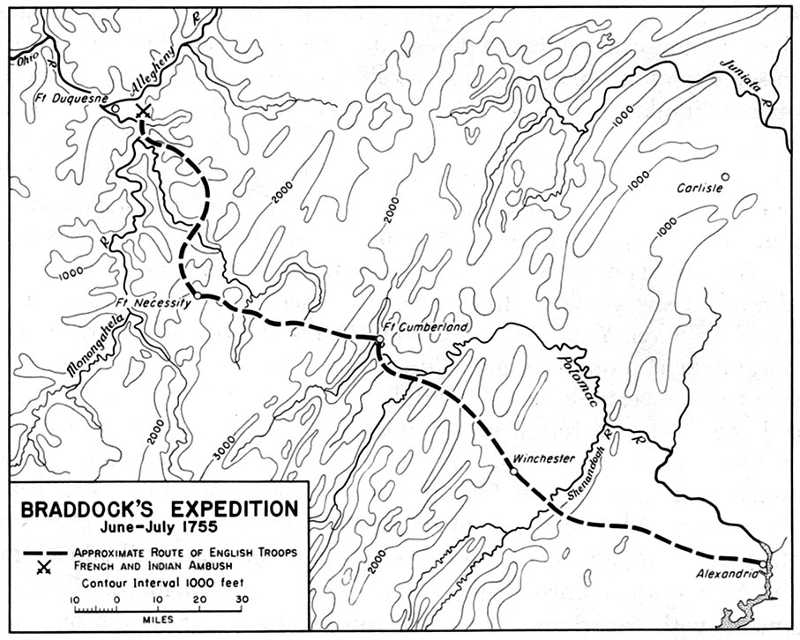
Braddock himself would lead the prong against Fort Duquesne, a stronghold the French had used to lead raids against Pennsylvania and Virginia.
The fort itself sat in what is today downtown Pittsburgh, Pennsylvania. Braddock would lead more than 2,000 regular troops and an assortment of colonial militia and Indian allies on this assault through dense, nearly impenetrable wilderness.
Before he could set off however, Braddock faced a logistical nightmare unequaled in European theaters of war: miles upon miles of virgin forest with no more than animal trails piercing its veil.
Braddock had to muster colonial support for such an enterprise. Unfortunately, the British general was not all around well-liked by the Americans he frequently insulted.
Benjamin Franklin, who had the dubious honor of hosting the general on his way to his ill-fated battle against the French commented on Braddock: “The General was, I think, a brave man, and might probably have made a good figure in some European war. But he had too much self-confidence; too high an opinion of the validity of regular troops; too mean a one of both Americans and Indians.”
There was one American the general took rather well to: George Washington. Rather than maintain his low militia rank, Washington had tried but failed to obtain a commission in the British army. Instead, he served as a volunteer aide-de-camp to Braddock, who took the young officer on willingly.
After gathering as many wagons and other supplies as he could harangue from the colonials, Braddock set off with his men on an extremely ill-conceived campaign in Spring of 1755. Rather than start the march to Fort Duquesne in Philadelphia, Braddock set off from Virginia – a route that added many miles over the rugged hillsides of the Allegheny Mountains.
Leading the column of soldiers, which often stretched like a massive snake four miles behind, were a troop of brawny men wielding axes. These woodsmen cut a broad path through the forest, opening the way for the army (complete with cannon) to follow behind.
Salvage from defeat
Reaching the River Monongahela on this day in 1755, the advance force of Braddock’s army, some 1,300 strong, were surprised by a much smaller force of French and Indians who had set out from Fort Duquesne to reconnoiter the British.
Taking advantage of the cover, the French sniped at the British troops. The very road they had cut through the forest now served only to expose the British to the ruthless musketry of their unseen enemies.
Although many officers attempted to organize the soldiers into some semblance of order, too many of their number fell to well-placed shots from the tree line (out of the 86 officers under Braddock well over 50 of them were either killed or wounded during the fight).
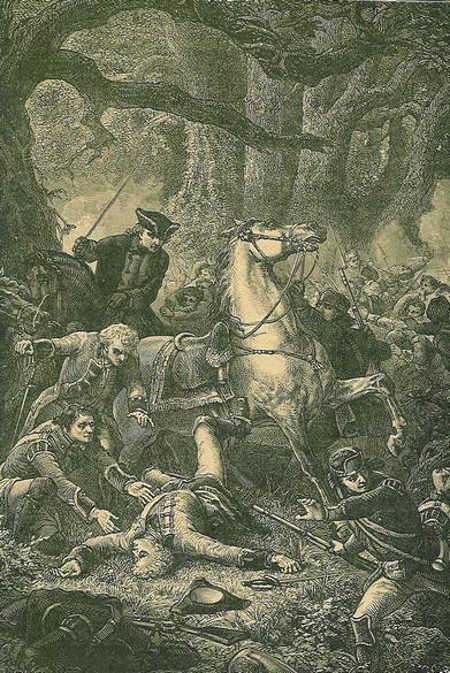
Among the number of British officers fatally struck down was Braddock himself. With panic in the air, George Washington rode out.
Temporarily suffering from one of the many illnesses that cloud about armies of the day, Washington had been lagging behind when the fighting started. Now the tall Virginian rode pell-mell to the line of battle and attempted to organize some semblance of order in the retreating troops.
Over the course of the next several hours, the 23-year old Washington had two horses shot from under him and his jacket riddled with bullet holes.
All in all, the British had some 977 killed or wounded in what turned out to be a smashing defeat in a war that was not even officially recognized yet.
From the ashes of defeat, however, arose the name of the young George Washington, proclaimed by some “the Hero of Monongahela.”
Antone Pierucci is a Sacramento-based public historian and a freelance writer whose work has been featured in such magazines as Archaeology and Wild West as well as regional California newspapers.
LAKE COUNTY, Calif. – Before pioneers began to inhabit and change the landscape of what is now Lake County, the various Indian nations such as the Pomo, Miwok, Wappo, Yuki and Patwin Indians would have looked upon great deciduous oak woodlands and ever-green pine forests.