"If music be the food of love, play on."– William Shakespeare
LAKE COUNTY, Calif. – When you really think about music, you begin to recall that music has always been with us – from the beat of our mother's heart to ancestral flutes, and on into the present.
Music can be found on elevators and in symphony halls; it's in the movies we watch and on our devices.
Then there's the whole world of music in nature, with its melodious bird song, singing breezes, as well as the refrain of harmonious creek song as it bubbles over boulders in its path.
Each culture has always had its own form of music. This music has spanned millennia, reaching back more than 55,000 years.
There have always been a number of influences on a particular culture's music, such as technological advances, socio-economics and even a culture's climate figures into the music equation.
In prehistoric times the tribal peoples of North America were able to make use of their surroundings to utilize bones and branches or twigs for clappers and flutes – and, of course, their own voices.
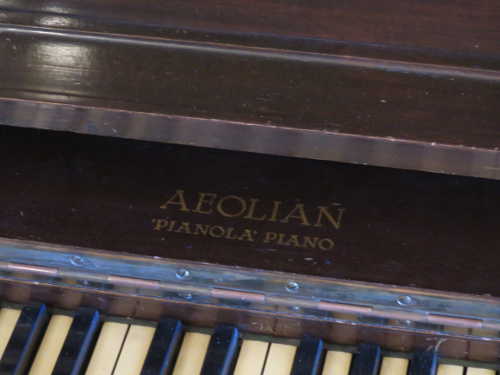
An Aeolian piano at the Ely Stage Stop and Country Museum in Kelseyville, Calif. Photo by Kathleen Scavone.
In ancient Greece music factored into their theater and into choruses.
The diversity of music and modes of playing it are vast. There is classical traditional music which followed the ending of the Roman Empire, cathedral music performed in enormous churches, the Gregorian chants of the Medieval era, and on and on.
What some of our Lake County pioneers may have enjoyed is piano music.
Later on, the player piano or pianola was enjoyed, several of which may be found in our local museums around the county.
The pianola was patented in 1897 by American E. S. Votey. These amazing pianos each held a pneumatic operating mechanism that played piano tunes on premade music rolls.
When the pianola arrived on the scene there was a flurry of large advertising campaigns to signify the arrival of the $250 music machines.
This self-playing piano machine was more than a novelty, however. It perforated paper rolls really rolled out the tunes!
There was a time in America when around half of the pianos in the population's homes were of the player piano type.
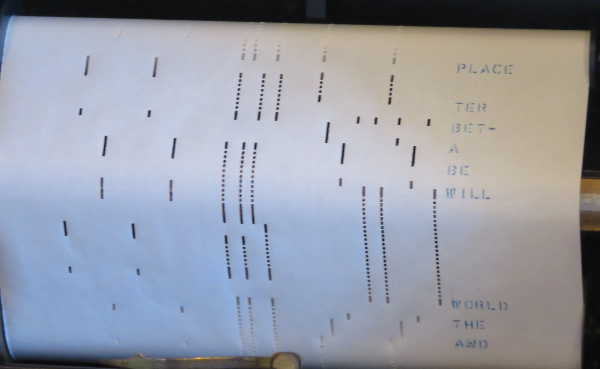
The music roll for the Aeolian piano at the Ely Stage Stop and Country Museum in Kelseyville, Calif. Photo by Kathleen Scavone.
There were several companies that manufactured player pianos.
In Germany Edwin Welle devised a piano that had play-back capabilities so that performances could be listened to again and again.
The Aeolian Co. was a popular manufacturer as well as Ampico Co. Ampico was an abbreviation for American Piano Co.
After a time, song words were added to the paper rolls, allowing for singalongs to occur beside the piano.
Sales of the player pianos peaked at about 1924, when upgrades to the recordings played on phonographs occurred.
Then, after the radio became popular, and next, the 1929 stock market crash caused sales of the beautiful pianos declined further.
Kathleen Scavone, M.A., is a retired educator, potter, writer and author of “Anderson Marsh State Historic Park: A Walking History, Prehistory, Flora, and Fauna Tour of a California State Park” and “Native Americans of Lake County.” She also formerly wrote for NASA and JPL as one of their “Solar System Ambassadors.” She was selected “Lake County Teacher of the Year, 1998-99” by the Lake County Office of Education, and chosen as one of 10 state finalists the same year by the California Department of Education.
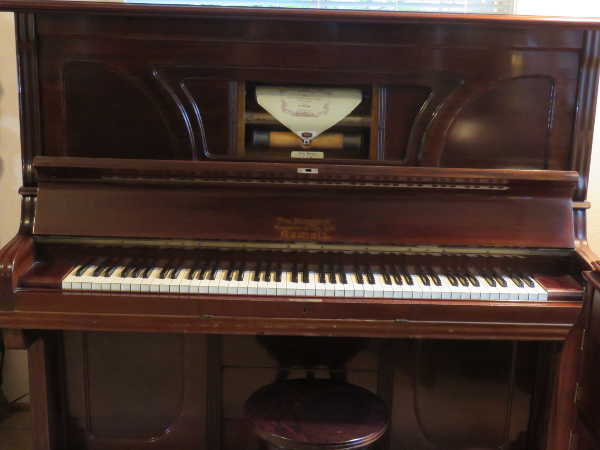
The 1903 Autopiano by Kastner & Co. Photo by Kathleen Scavone.
LAKE COUNTY, Calif. – There’s a big group of dogs at Lake County Animal Care and Control this week waiting to meet their new families.
The dogs available this week include mixes of border collie, Chihuahua, dachshund, German Shepherd, husky, Labrador Retriever, shepherd, Shih Tzu, pit bull terrier and terrier.
Dogs that are adopted from Lake County Animal Care and Control are either neutered or spayed, microchipped and, if old enough, given a rabies shot and county license before being released to their new owner. License fees do not apply to residents of the cities of Lakeport or Clearlake.
If you're looking for a new companion, visit the shelter. There are many great pets hoping you'll choose them.
The following dogs at the Lake County Animal Care and Control shelter have been cleared for adoption (additional dogs on the animal control Web site not listed are still “on hold”).
This female Chihuahua is in kennel No. 2a, ID No. 8232. Photo courtesy of Lake County Animal Care and Control. Female Chihuahua
This female Chihuahua has a short brindle and white coat.
She already has been spayed.
She’s in kennel No. 2a, ID No. 8232.
This male Shih Tzu is in kennel No. 3, ID No. 8264. Photo courtesy of Lake County Animal Care and Control. Male Shih Tzu
This male Shih Tzu has a medium-length black coat with white markings.
He’s in kennel No. 3, ID No. 8264.
“Minnie” is a Chihuahua mix in kennel No. 4, ID No. 8168. Photo courtesy of Lake County Animal Care and Control. ‘Minnie’
“Minnie” is a Chihuahua mix with a short tan coat.
She already has been spayed.
She’s in kennel No. 4, ID No. 8168.
“Bacardi” is a female German Shepherd puppy in kennel No. 6, ID No. 8308. Photo courtesy of Lake County Animal Care and Control. ‘Bacardi’
“Bacardi” is a female German Shepherd puppy.
She has a short black and tan coat.
Bacardi is in kennel No. 6, ID No. 8308.
“Moose” is a male pit bull terrier mix in kennel No. 9, ID No. 8211. Photo courtesy of Lake County Animal Care and Control. ‘Moose’
“Moose” is a male pit bull terrier mix with a short red and white coat.
He’s in kennel No. 9, ID No. 8211.
“Satchel” is a male border collie and Labrador Retriever mix in kennel No. 12, ID No. 8275. Photo courtesy of Lake County Animal Care and Control. ‘Satchel’
“Satchel” is a male border collie and Labrador Retriever mix with a short black and white coat.
He already has been neutered.
He’s in kennel No. 12, ID No. 8275.
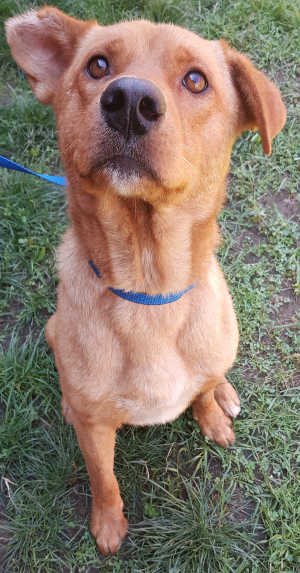
This male shepherd mix is in kennel No. 13, ID No. 8186. Photo courtesy of Lake County Animal Care and Control. Male shepherd mix
This male shepherd mix has a short red coat.
He’s in kennel No. 13, ID No. 8186.
This male dachshund-terrier mix is in kennel No. 15, ID No. 8114. Photo courtesy of Lake County Animal Care and Control. Dachshund-terrier mix
This male dachshund-terrier mix has a short black and white coat.
He already has been altered.
He also knows a trick – staff says he will stand for treats, as he does in the photo above.
Visit him in kennel No. 15, ID No. 8114.
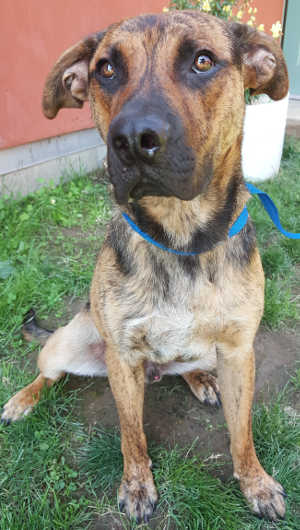
This male shepherd mix is in kennel No. 18, ID No. 8253. Photo courtesy of Lake County Animal Care and Control. Male shepherd mix
This male shepherd mix has a short black and brown coat.
Shelter staff said he already is housebroken.
He’s in kennel No. 18, ID No. 8253.
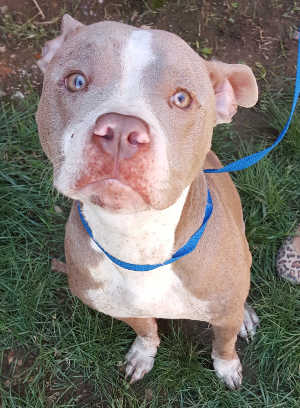
This young male pit bull terrier is in kennel No. 19, ID No. 8212. Photo courtesy of Lake County Animal Care and Control. Pit bull terrier
This young male pit bull terrier has a short blue and white coat.
He’s in kennel No. 19, ID No. 8212.
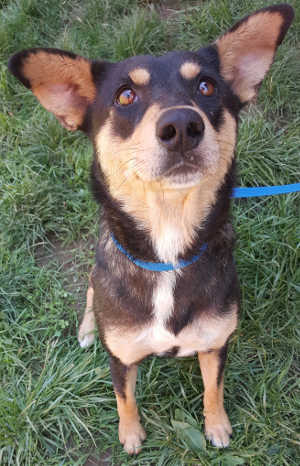
This female shepherd mix is in kennel No. 20, ID No. 8170. Photo courtesy of Lake County Animal Care and Control. Female shepherd mix
This female shepherd mix has a short black and tan coat.
She’s in kennel No. 20, ID No. 8170.
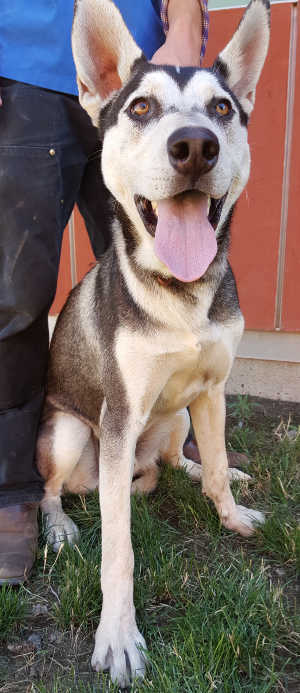
This male husky is in kennel No. 22, ID No. 8090. Photo courtesy of Lake County Animal Care and Control. Male husky
This male husky has a medium-length gray and white coat.
He’s in kennel No. 22, ID No. 8090.
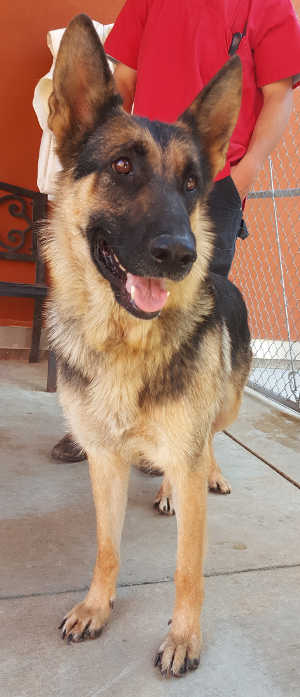
“Chase” is a young male German Shepherd in kennel No. 23, ID No. 8288. Photo courtesy of Lake County Animal Care and Control. ‘Chase’
“Chase” is a young male German Shepherd.
He has a short brown coat.
Chase is in kennel No. 23, ID No. 8288.
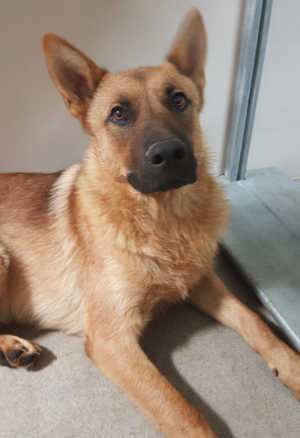
“Canela” is a female German Shepherd in kennel No. 24, ID No. 8286. Photo courtesy of Lake County Animal Care and Control. ‘Canela’
“Canela” is a female German Shepherd with a medium-length black and brown coat.
She’s in kennel No. 24, ID No. 8286.
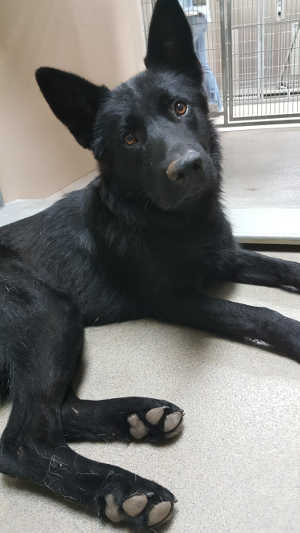
This young male German Shepherd is in kennel No. 25, ID No. 8287. Photo courtesy of Lake County Animal Care and Control. Male German Shepherd
This young male German Shepherd has a short black coat.
He’s in kennel No. 25, ID No. 8287.
“Sachi” is a female Chihuahua is in kennel No. 34a, ID No. 8243. Photo courtesy of Lake County Animal Care and Control. ‘Sachi’
“Sachi” is a female Chihuahua with a short tan coat.
She has already been spayed and is housebroken.
Sachi is in kennel No. 34a, ID No. 8243.
“Trouble” is as male pit bull terrier mix in kennel No. 34b, ID No. 8244. Photo courtesy of Lake County Animal Care and Control. ‘Trouble’
“Trouble” is as male pit bull terrier mix.
He has a short blue and white coat and already is housebroken.
He’s in kennel No. 34b, ID No. 8244.
Lake County Animal Care and Control is located at 4949 Helbush in Lakeport, next to the Hill Road Correctional Facility.
Office hours are Monday through Friday, 11 a.m. to 5 p.m., and 11 a.m. to 3 p.m., Saturday. The shelter is open from 11 a.m. to 4 p.m. Monday through Friday and on Saturday from 11 a.m. to 3 p.m.
For more information call Lake County Animal Care and Control at 707-263-0278.
Email Elizabeth Larson at This email address is being protected from spambots. You need JavaScript enabled to view it.. Follow her on Twitter, @ERLarson, or Lake County News, @LakeCoNews.
As teachable moments go, it’s an extraordinary one: Aug. 21 marks the first time in nearly a century that a total solar eclipse will span the entire United States.
“For most of us, this is a once-in-a-lifetime opportunity,” said Jonathan Osborne, the Kamalachari Professor of Science Education at Stanford Graduate School of Education, or GSE. “For young children, it’s also a great stimulus to their curiosity.”
The event, Osborne said, prompts many kids to question why the universe works the way it does: Are the moon and the sun really the same size? Why isn’t everyone on Earth seeing this at the same time? How can we predict so accurately when it’s going to happen?
“Questions like this drive science,” said Osborne, whose research includes investigating how to help students use evidence to argue scientific concepts. “Answering these questions often requires us to imagine the world not as it appears to be and then develop an idea that explains it.”
Making science accessible
Students of any age can participate in lessons around the event. Many schools will be in session, though some have postponed their opening day so that students can witness the occurrence with their families.
The path of totality – where observers see the moon completely cover the sun – will pass through parts of only 14 states. But weather permitting, people in every state will see at least a partial eclipse. (Of course, no one should look directly at it without a certified solar filter or viewer sold by a reputable vendor.)
The perceptible impact of the eclipse makes it a relatively approachable scientific subject for both children and adults, said Bryan Brown, an associate professor of science education and associate dean for student affairs at GSE.
“Some science phenomena are abstract and you have to think hard to imagine their implications,” Brown said. “But when you’re experiencing an eclipse, you’re experiencing movement in the universe. It’s not an abstract thing.”
For lesson ideas and other guidance, Brown and Osborne suggest that adults take advantage of resources available online through NASA and popular television personalities like Bill Nye and Steve Spangler.
“People have this idea that only scientists can teach kids science,” said Brown, who also directs a one-week summer science camp for inner-city students in the San Francisco Bay Area. “But there are ways to become science teachers at home.”
Projects for young learners
Eclipse-related educational activities naturally tend to focus on science and math: solar viewer construction, mathematical challenges, solar system modeling and so on.
But projects that involve geography, history and social studies – like working with eclipse maps and reading accounts of eclipses from ancient civilizations – are also relevant. Students can even be encouraged to explore literature, music and other art inspired by celestial bodies and events.
Those fortunate enough to be in the path of totality can also participate in real-time scientific experimentation. With total coverage, for example, observers will experience a sudden, marked change in the temperature due to the loss of light.
“If you have a thermometer that responds rapidly,” Osborne said, “it’s worth measuring the drop in temperature.” If not, he said, students can still track how long the change lasts.
“The main thing is to listen,” Osborne said. “If there are a lot of insects and animal life, they all go very quiet.”
Ultimately, Brown said, the experience can inspire in youngsters a more palpable sense of the space they occupy in the world.
“We get a chance to see how we fit relative to the rest of the universe,” Brown said. “It’s a great cosmic experience – the only one we can experience without going anywhere.”
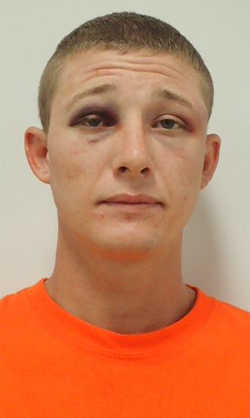
Travis Frank Yudnich, 25, of Clearlake Oaks, Calif., was arrested on Saturday, August 12, 2017, for a stabbing. Lake County Jail photo. CLEARLAKE OAKS, Calif. – A Clearlake Oaks man has been arrested for stabbing another man during a fight last weekend.
Travis Frank Yudnich, 25, was arrested early on the morning of Saturday, Aug. 12, a few hours after the incident occurred, according to Sgt. Corey Paulich of the Lake County Sheriff’s Office.
Paulich said the stabbing occurred at about 2 a.m. Aug. 12 at a residence in the 17000 block of Holly Way in Spring Valley.
Yudnich and a 26-year-old Clearlake Oaks man – whose name has not been released – were visiting the residence when a physical altercation broke out between them, Paulich said.
Paulich said no one knew why the fight started, although both men appeared to have been intoxicated.
During the fight authorities said Yudnich stabbed the victim. He is also alleged to have tried to hit the victim with his vehicle based on a witness statement, according to Chief Deputy District Attorney Richard Hinchcliff.
The victim, who suffered damage to a lung from the stabbing, was transported via air ambulance to an out-of-county trauma center. Neither Paulich nor Hinchcliff had any information on Friday on the victim’s condition.
Paulich said deputies found Yudnich at his home and arrested him at about 4:30 a.m. Aug. 12.
On Friday, Yudnich remained in custody at the Lake County Jail, with bail set at $50,000, according to jail records.
Hinchcliff said Yudnich has four counts of assault with a deadly weapon against him for the use of the knife and the vehicle.
Yudnich has previously had cases in the local criminal system involving misdemeanors which were “nothing serious,” Hinchcliff said.
In this new case, Yudnich is facing up to seven years in prison if convicted, according to Hinchcliff.
Email Elizabeth Larson at This email address is being protected from spambots. You need JavaScript enabled to view it.. Follow her on Twitter, @ERLarson, or Lake County News, @LakeCoNews.
LAKE COUNTY, Calif. – A man convicted nearly 40 years ago of the brutal murder of an elderly Lucerne man has been denied parole for the 13th time.
On Wednesday, the Board of Parole Hearings denied parole for convicted murderer Jeffrey Scott Sargent, 67.
Senior Lake County Deputy District Attorney John DeChaine attended the lifer hearing at the Department of Corrections California Health Care Facility in Stockton, successfully arguing against Sargent’s release.
This was Sargent’s 13th subsequent parole hearing since his conviction in 1978, the District Attorney’s Office reported.
Sargent was convicted of first-degree murder for the killing of 83-year-old Gedney Robinson and sentenced to seven years to life on May 15, 1978.
He was sentenced by Superior Court Judge John Golden and originally was prosecuted by previous District Attorney Robert L. Crone Jr.
Sargent’s minimum eligible parole date was Oct. 28, 1984.
According to investigation reports by the Lake County Sheriff’s Office, on Sept. 22, 1977, a report was received from Fresno Police that a 1974 Ford belonging to the victim was going to be used in a robbery.
When deputies responded to the victim’s small cabin on Second Avenue in Lucerne, they found the front door broken and Robinson dead inside.
Robinson had been stabbed seven times – five times in the heart and two times in the back, with defensive wounds on his arms.
Sargent took a ring off the victim’s finger, $40 from his wallet, and his vehicle. Robinson had just returned home the same day from a rock collecting trip to Nevada.
When arrested, Sargent denied any involvement in the murder. The investigation revealed that Sargent was a career criminal who had just been paroled from prison.
He had gone to Lake County two days before the murder to see his wife, who was living near Robinson. Sargent had been using heroin and PCP at the time of the murder.
Some of the property stolen from Robinson was located in Sargent’s possession and the investigation revealed that Sargent had lied to investigators about his involvement.
Following a mistrial, Sargent pleaded guilty to first-degree murder in exchange for a special circumstance allegation being dropped.
At the four-hour parole hearing this week, Sargent stated that he had gone to the residence of Robinson, whom he had never met before, and asked to use his telephone.
Sargent stated that an argument turned physical outside of Robinson’s residence, and he stabbed Robinson to defend himself. At the time Sargent was 28 years old and Robinson was 83 years old, had poor eyesight and was hard of hearing.
The evidence collected at the scene contradicted Sargent’s version of the event, instead suggesting that Sargent broke into the elderly victim’s home – most likely to steal items to support his drug habit – and stabbed him to death in his bed, where he was later found by law enforcement.
DeChaine asked the Board of Prison Hearings to deny Sargent’s parole on the ground that he still presents an unreasonable risk of danger to the public if released.
DeChaine also pointed out that Sargent failed to accept responsibility for his conduct, which showed his lack of insight into the crime and the triggers that led to his homicidal act.
Robinson’s niece, his only living relative, also attended the hearing with her husband to ask the parole commissioners to deny parole.
The Board of Prison Hearings determined that Sargent still presents too great of a risk of danger to the public if released and denied parole.
The presiding commissioner noted, among other things, that Sargent was evasive in his answers at the hearing, continues to show no empathy for the victim’s family, and that his parole plan was simplistic and could be a recipe for disaster.
Other significant factors included the determination that Sargent has yet to learn the skills necessary to overcome his anger and substance abuse issues.
Sargent’s next parole hearing will be in three years.
LAKE COUNTY, Calif. – Over the summer a team comprised of staff from school districts throughout Lake County, the Lake County Office of Education and Lake County District Attorney’s Office have been working to resolve the ongoing issue of truancy in our county schools.
The mission of the team was to create an attendance and truancy framework of current best practices in prevention, intervention and – if needed – legal protocols to improve school attendance and reduce truancy.
These best practices are arranged in a tiered structure that meets the student and parent/caregiver at their level of need.
Tier 1 includes teaching clear expectations, schools acknowledging good and improved attendance for all students/families; Tier 2 includes individualized interventions for students/families needing extra support; Tier 3 includes support services, case management, possible SARB Hearing, and in the worst case scenario, a referral to the District Attorney’s Office.
“Our goal is to work with school districts and the county office of education to get these kids back into school,” said Lake County District Attorney Don Anderson. “The law requires students attend school regularly. We have a duty to do what we can to ensure a successful future for our students and an education is critical to their success.”
School districts don’t take making a referral to the DA’s office lightly.
The school districts and Lake County Student Attendance Review Board, or SARB – composed of representatives from various youth/family-serving and law enforcement agencies – meet with each family to examine the factors contributing to the student’s truancy.
The panel, with input from the student and family, develops a legally-binding contract that clearly outlines the attendance expectations and identifies available school and community resources to assist the family in overcoming the barriers that led to truancy.
“The Student Attendance Review Board is really the last option the school districts, the county office and families have to improve their student’s attendance before a referral for prosecution is made to the District Attorney’s Office,” said Rob Young, current Lake County Office of Education SARB chair.
In the few cases where families disregard the terms of the contract and attendance does not improve, the county or district level SARBs have the authority to refer the case to the District Attorney’s Office for prosecution.
If the family is found guilty, the consequences can be community service, parent education classes, suspension/delay in students getting their driver’s license, and or fines up to $2,000.
“We aren’t in the business of getting families involved in the legal system, actually quite the opposite,” said Lake County Superintendent of Schools Brock Falkenberg. “What we want as educators, community members and even future employers is for students to gain the academic and social skills they will need to succeed, now and in their future.”
Falkenberg added, “Reducing absenteeism is a simple, cost-effective strategy for improving academic performance. Starting as early as preschool and kindergarten, chronic absence – missing 10 percent or more school days – during the school year can leave a third grader unable to read proficiently, a sixth grader struggling with coursework, a high schooler off track for graduation, and adults without the skills needed to compete in a 21st century workforce.”
The group thanked numerous individuals for their contribution to the content of the County Attendance and SARB framework.
They included District Attorney Don Anderson and Deputy District Attorney Chanel Crawford; Konocti Unified staffers, Superintendent Donna Becnel, Manager of Student and Family Services Debi Malley and Lower Lake Elementary Principal Tarin Benson; Middletown Unified Superintendent Catherine Stone; Upper Lake Elementary Principal Stephanie Wayment; and Lake County Office of Education staff, Lake County Superintendent of Schools Brock Falkenberg and Truancy Officer Jon Dudding.
 How to resolve AdBlock issue?