How to resolve AdBlock issue?
Refresh this page
How to resolve AdBlock issue?
Refresh this page
Lake County News,California
  • Home
    • Registration Form
  • News
    • Education
    • Veterans
    • Community
      • Obituaries
      • Letters
      • Commentary
    • Police Logs
    • Business
    • Recreation
    • Health
    • Religion
    • Legals
    • Arts & Life
    • Regional
  • Calendar
  • Contact us
    • FAQs
    • Phones, E-Mail
    • Subscribe
  • Advertise Here
  • Login

News

Middletown Area Town Hall to meet March 13

MIDDLETOWN, Calif. — The Middletown Area Town Hall, or MATH, has plans this week to discuss community asset mapping and project updates around the south county area.

MATH will meet at 7 p.m. Thursday, March 13, in the Middletown Community Meeting Room/Library at 21256 Washington St., Middletown. The meeting is open to the public.

Zoom will not be available. Viewers can participate via PEG TV at www.youtube.com/LakeCountyPegTV.

On the agenda are guest speakers Magdalena and Eliot Hurwitz of the Springs Community Redevelopment Association who will present highlights from the Cobb Mountain Area Community Resilience and Development Strategy as it relates to identifying community assets for the purpose of fire resiliency and updating the General Plan and Area Plans.

MATH will discuss a presentation to the Board of Supervisors, a grievance committee report on a February complaint, work on the bylaws and take action on correspondence, as well as get updates on the Cannabis Ordinance Task Force and planning projects in the Middletown and Hidden Valley Lake areas.

MATH — established by resolution of the Lake County Board of Supervisors on Dec. 12, 2006 — is a municipal advisory council serving the residents of Anderson Springs, Cobb, Coyote Valley (including Hidden Valley Lake), Long Valley and Middletown.

For more information email This email address is being protected from spambots. You need JavaScript enabled to view it.. 

Email Elizabeth Larson at This email address is being protected from spambots. You need JavaScript enabled to view it.. Follow her on Twitter, @ERLarson, and on Bluesky, @erlarson.bsky.social. Find Lake County News on the following platforms: Facebook, @LakeCoNews; X, @LakeCoNews; Threads, @lakeconews, and on Bluesky, @lakeconews.bsky.social.

5 reasons veterans are especially hard-hit by federal cuts


A protester holds a sign during a demonstration against President Donald Trump, Elon Musk and the Trump administration outside the Indiana Statehouse in Indianapolis. Jeremy Hogan/SOPA Images/LightRocket via Getty Images
Jamie Rowen, UMass Amherst

The Department of Veterans Affairs is planning to cut 83,000 jobs, slashing employment by over 17% at the federal agency that provides health care for millions of veterans, according to an internal memo obtained by The Associated Press on March 5, 2025.

The department known as the VA manages and directly provides comprehensive services for veterans. Those services include health care, short- and long-term housing options, life insurance, pensions, education stipends, and assistance in jails and courts. The VA also engages in pathbreaking public health research. One-quarter of the VA’s 482,000 employees are veterans.

For the past month, the Trump administration has been cutting federal spending, causing numerous hardships for government employees, the agencies they work for and the people they serve.

But veterans are among those hardest hit, and the impact goes well beyond job loss.

My research on veterans in the criminal legal system illustrates the stark challenges that service members already face as they integrate back into civilian life.

Trump’s budget cuts will make this process only harder. Here are five reasons why.

A man standing with a sign that says 'I'm a USAIR Force veteran Republican leaders are all cowards!'
A protest of layoffs at the VA in Jamaica Plain on Feb. 21, 2025. Stuart Cahill/Boston Herald via Getty Images

1. Eroding the federal workforce

Federal law requires employers to give veterans an advantage in hiring over people who have not served in the military.

Under the 1944 Veterans Preference Act, employers should hire veterans over other candidates and retain veterans over other employees during layoffs. The idea is to compensate for the economic loss of serving in the military and acknowledge the government’s obligation, especially, to support disabled veterans.

Due to this veterans preference, nearly 30% of federal workers are veterans, half of whom are disabled. This means that veterans, who make up 6.1% of the U.S. population, are disproportionately affected by federal worker cuts.

One estimate is that of the 38,000 federal employees fired in the first five weeks of the Trump administration, 6,000 are veterans.

2. Gutting VA health care

Cuts to the federal workforce are also affecting medical care for veterans. The Veterans Health Administration workforce constitutes 90% of the VA’s 482,000 workers, so cuts to VA workers mean cuts to health care.

These cuts come at a time when veterans’ health care needs are increasing. The VA enrolled 400,000 veterans in its benefits system from March 2023 through March 2024, 30% more than the prior year. It also expanded eligibility for former service members to receive VA health care. Trump’s cuts will make it more difficult for the VA to provide health care for these newly eligible veterans.

These cuts roll back President Joe Biden’s investment in the VA to address long-standing staffing problems. The Office of Inspector General’s 2024 report on VA staffing shortages reveals that 137 of 139 VA health centers nationwide report a severe staffing shortage in at least one area, particularly nursing and psychology.

Staff shortages have led to long wait times for care. These wait times vary from days to months, with some VA clinics still so understaffed that they are unable to take new patients for primary care or mental health needs. Staff increases over the past few years shortened wait times while providing care to more veterans.

In 2024, the VA said it was working hard to fill its 66,000 vacancies, aiming to improve health care for the more than 9 million veterans it serves.

Now, just one year later, the VA faces the loss of 83,000 jobs. These cuts may contribute to fundamental changes in VA health care. Rather than help veterans directly, the VA may pay for veterans to seek medical care outside the VA system, leading to higher costs and lower quality.

Other Trump directives will prevent gender-affirming care to veterans. Veterans with diagnoses related to gender identity increased from 2,513 to 10,457 between 2011 to 2021.

3. Destaffing the suicide hotline

In Trump’s cuts to social services, the country’s Veterans Crisis Line, which both the VA and the Department of Health and Human Services oversee, is losing employees to layoffs, despite existing staffing shortages. An estimated 800 to 900 of the 1,130 crisis-line workers have always worked remotely, so ending remote work options will further undermine staffing.

Signs on the side of a granite building.
A quote from Abraham Lincoln about the Veterans Affairs mission is affixed to the side of one of the department’s buildings. Government Accounting Office

Current data shows an average of 17.6 veteran suicides per day. Suicide remains the second-leading cause of death among veterans under 45 years old. Current VCL caller data is not publicly available, but staff report that the service fields 60,000 calls a month.

In the past, the VA reported nearly 3 million calls between 2009 and 2017, which led to 82,000 emergency dispatches to prevent veterans from harming themselves. The VA steadily increased crisis-line staffing to address concerns that, given the volume of calls, veterans were not receiving help in a timely manner.

Fewer staff, already suffering from burnout, undermines this work, as callers already at high risk for suicide will face longer wait times and improper care.

The first Trump administration made veteran suicide prevention a policy priority; its latest moves impede this goal.

4. Losing research

The VA’s investment in research, about $916 million a year, has contributed to a comprehensive understanding of veterans’ well-being, meaning the government can target aid toward those in need.

VA research has also helped spark major medical breakthroughs on the link between smoking and cancer, prompting the surgeon general to put warnings on cigarettes, and the most widely used method to measure and treat prostate cancer.

VA research and data are instrumental in the social sciences. There are millions of veterans who come from diverse sociodemographic groups, and social science researchers are able to track them over time.

With overall budget cuts at the VA and the federal workforce reduction, at least 350 VA researchers will likely lose their jobs. That, along with a Trump directive to stop research on how poverty and race shape veteran health outcomes, will undermine not only the general well-being of veterans but also the entire medical establishment’s knowledge about substance use, mental health and deeper insights that VA research can provide on prevention and treatment of cancer and cardiovascular disease.

5. Looming cuts to other benefits

Numerous reports indicate that Republicans in Congress want to reduce so-called entitlements, including food stamps and Medicaid, the health insurance for the country’s poorest citizens.

Cutting Medicaid would hurt veterans’ health, too, because not all veterans have access to federally funded health care through the VA, for a variety of reasons. Estimates show that over the past decade nearly 10% of veterans use Medicaid for at least some of their health care benefits, and 40% of those veterans rely exclusively on Medicaid for all their health care.

Further, approximately 400,000 veterans are uninsured. Given their income, half of these uninsured veterans should be eligible for Medicaid, as long as looming cuts don’t change eligibility requirements.

In addition, 1.2 million veterans received aid through the federally funded supplemental nutritional access program, or SNAP. Working-age veterans face an elevated risk of experiencing food insecurity compared to their nonveteran peers.

Veterans are still overrepresented among the homeless population. Many do not have financial flexibility to make up for these cuts.

Making good on a promise

All Americans are affected by Trump’s federal funding cuts. But as my research shows, the budget-slashing looks to be especially hard on those who served in the military.

The media and political blowback against Trump’s cuts has already begun. Negatively impacted veterans are gaining increasing visibility. Both Democratic and Republican lawmakers have begun calling on the Department of Defense to prioritize retaining and rehiring veterans.

The first Trump administration committed to expanding services for veterans. Now, it’s executing a stark policy reversal with acute consequences for the very same veterans the U.S. government promised to protect and serve since the country’s founding.The Conversation

Jamie Rowen, Associate Professor of Legal Studies and Political Science, UMass Amherst

This article is republished from The Conversation under a Creative Commons license. Read the original article.

Salato named North Coast Woman of the Year

Dr. Becky Salato. Courtesy photo.

LAKE COUNTY, Calif. — On Monday, Senate Leader Mike McGuire led a celebration during a Senate floor ceremony at the State Capitol honoring Becky Salato, superintendent of Konocti Unified School District, as the 2025 North Coast Woman of the Year.

As superintendent, Becky Salato prides herself on building bridges and strong relationships in Lake County and the communities she works for, constantly delivering results for the students and families she proudly serves.

McGuire said Salato has fearlessly guided Konocti Unified through some of the toughest challenges facing the community including the COVID pandemic, low graduation rates, and multiple wildfires that have upended lives and destroyed countless homes in Lake County.

“Becky Salato has dedicated her life to improving the lives of kids. Her belief is simple, but bold: all kids, no matter their background, deserve the best,” McGuire said. “Her leadership during some of the most challenging times Lake County has faced has been stellar. The entire Lake County community has benefited from her dedication and leadership and we are so fortunate to have her here in Northern California. This recognition is very well deserved.”

Sen. McGuire honored Salato on the Senate floor with a resolution as part of the Senate’s annual Woman of the Year ceremony.

“I am so honored to be acknowledged by Sen. McGuire,” said Salato. “He’s a tireless advocate for our students and we’re all grateful for his partnership. I feel incredibly fortunate to be able to do the work I do with our amazing Konocti students, teachers, and staff. Their futures are always worth the fight. I look forward to many more years of serving our community together.”

Becky Salato has been serving as Konocti Unified School District’s superintendent for five years.

She said she is proud of the district’s accomplishments in recent years but says the work is far from over.

Last month, the Association of California School Administrators named Salato the 2024 Region 4 Superintendent of the Year, as Lake County News has reported.

McGuire is President pro Tempore of the California Senate. He represents the North Coast of California, which stretches from the Golden Gate Bridge to the Oregon border, including Del Norte, Trinity, Humboldt, Lake, Mendocino, Sonoma, and Marin counties.

Clearlake City Council picks new Planning Commission members

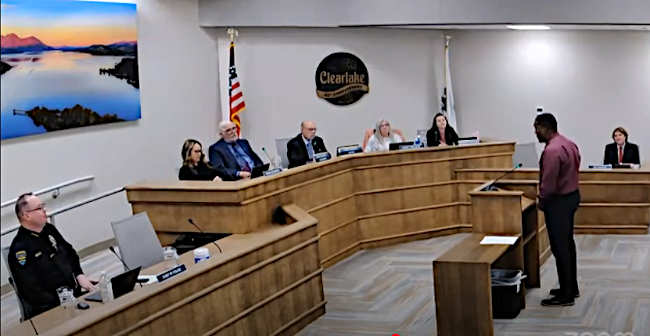
Derek Counts introduces himself to the Clearlake City Council during its meeting on Thursday, March 6, 2025. Counts would be the top vote getter in the council’s vote to select new members for its Planning Commission. YouTube screen capture.

CLEARLAKE, Calif. — The Clearlake City Council on Thursday selected two new members and reappointed the current chair to the city’s Planning Commission.

Following interviews with several candidates during the Thursday night meeting, the council voted to appoint Derek Counts and Ray Silva to the commission for the first time, and reappoint Fawn Williams, who is completing her first four-year term.

City Clerk/Administrative Services Director Melissa Swanson said Commissioner Terry Stewart did not plan to seek another term.

Williams and another incumbent, Robert Coker, both asked to be reappointed, Swanson said.

Swanson said that, based on the City Council Norms and Procedures, if a planning commissioner has served only one term and wishes to serve a second term,
that commissioner may submit a letter of interest no later than 30 days before the end of their term for consideration of reappointment. The meeting packet included a Jan. 11 email from Williams seeking reappointment.

Along with Coker, Counts, Silva and Williams, business owner Carlos Ramos also was seeking an appointment to the commission.

With the exception of Williams — who was attending a Cal Cities conference with Commissioner Christopher Inglis — all of the candidates were in attendance at the meeting in order to answer questions from the council.

Following the interviews, the council members submitted their rankings of the four candidates — not including Williams.

Counts was the top vote getter, followed by Silva, Ramos and Coker.

Counts is a 2009 Lower Lake High School graduate who lived in Las Vegas for a time before returning to Clearlake.

“I was quick to move away from here,” he said, but noted he wanted to go to school and found out the city had offered support programs to attend college, an apparent reference to the Clearlake College Promise program the council approved in December 2021.

He attended Woodland Community College and earned an associate’s degree in social and behavioral science. Counts also earned a degree in radiology in 2021 and works as an x-ray technician at Sutter Lakeside Hospital.

“I did all of my schooling here based off of opportunities that the community provided me. And so, in turn, I want to be a part of the change here,” he said.

Counts added, “I grew up in a lot of different places and this is the one place that actually saw the potential in me and gave me opportunity to achieve that potential.”

Silva, a resident of the Highlands Harbor area, has been a general contractor for over 40 years, working on hundreds of projects in the county and city. He’s been a member of the Measure V Oversight Committee for eight years and served four years on the Lake County Building Board of Appeals, among other committee service.

He said he wants to see the city thrive and succeed and maintain the small town atmosphere. Silva supports commercial growth and wants to see anyone who wants to work have a job available.

Council member Tara Downey moved to approve Counts and Silva, along with the reappointment of Williams, with Jessica Hooten seconding and the council approving the motion 5-0.

Mayor Russell Cremer told them they will be seated at the next commission meeting. City Manager Alan Flora said there were no items of business for the meeting originally scheduled to have taken place this week, so he was uncertain of when the next meeting would be scheduled.

In other business, the council also made appointments to the city’s Measure V Citizens Oversight Committee, which monitors the city’s one-cent road sales tax.

Councilmember Mary Wilson appointed Ramos, who was the only applicant present, while Hooten appointed Dave Hughes and Downey appointed Brett Freeman.

The council voted 5-0 to approve that slate, and also voted unanimously to appoint Supervisor Bruno Sabatier as the oversight committee chair.

Email Elizabeth Larson at This email address is being protected from spambots. You need JavaScript enabled to view it.. Follow her on Twitter, @ERLarson, and on Bluesky, @erlarson.bsky.social. Find Lake County News on the following platforms: Facebook, @LakeCoNews; X, @LakeCoNews; Threads, @lakeconews, and on Bluesky, @lakeconews.bsky.social.

State and local agencies to present on Clear Lake hitch March 13

LAKE COUNTY, Calif. — State and local agencies are going to present the latest developments regarding the Clear Lake hitch and answer questions in a meeting this week.

The informational session, organized by Lake County Farm Bureau, will take place from 5:30 to 7:30 p.m. Thursday, March 13, in the Board of Supervisors chambers on the first floor of the Lake County Courthouse, 255 N. Forbes St. in Lakeport.

The presenting agencies include the California Water Resource Control Board, California Department of Fish and Wildlife, Habematolel Pomo of Upper Lake and Lake County Department of Water Resources.

“It’s mostly to allow the community, specifically the agricultural community, the opportunity to directly interact with those agents and ask questions,” said Rebecca Harper, executive director of Lake County Farm Bureau.

The hitch, a large minnow found only in the Clear Lake watershed, holds ecological and cultural significance. It has drawn increased attention in recent years due to its apparent decline in numbers.

In mid-January, the U.S. Fish and Wildlife Services proposed to list the Clear Lake hitch as a threatened species under the federal Endangered Species Act, 11 years after it was listed by the state.

The proposal is currently in a 60-day public comment period, ending Monday, March 17.

Since the start of 2025, there have been multiple local outreach efforts to inform the public of the current situation of the endangered local fish.

The Farm Bureau held a similar workshop in January. In February, hitch experts from state and local agencies presented to the Board of Supervisors on the hitch situation following the announcement of the federal proposal.

Last week, the Lake County Water Resources’ hitch staff held a training session for 20 community members participating in the new Hitch Community Science Observation program at Lakeport’s Silveira Community Center.

For more information on the hitch, contact Lake County Farm Bureau at 707-263-0911 or Lake County Water Resources at 707-263-2344.

Email staff reporter Lingzi Chen at This email address is being protected from spambots. You need JavaScript enabled to view it.. 

Senate Democrats warn scheme to fire Social Security staff will disrupt benefits

U.S. Senator Alex Padilla (D-Calif.) joined the entire Senate Democratic caucus in warning the Social Security Administration, or SSA, that Donald Trump and Elon Musk’s scheme to purge the Social Security workforce will jeopardize the ability of millions of Americans to get their earned benefits.

These actions threaten the roughly 6.3 million Californians who receive critical Social Security benefits, more than any other state in the nation.

“Your characterization of its recent reorganizations and staffing reductions as ‘duplicative,’ ‘redundant’ or ‘non-mission critical’ is an utter farce and insulting to the thousands of Americans who dedicated their career in service of the agency’s mission,” wrote the senators. “These public servants worked on critical projects focusing on improving customer service for all its customers, reducing waste, fraud, and abuse, and ensuring that all Americans, particularly those with disabilities, can access SSA offices and their earned benefits.”

Social Security is one of the nation’s most popular and effective programs, providing a foundational income that workers pay into the system to accumulate for their retirement and providing insurance protection against unexpected hardship.

Social Security workers help Americans navigate some of their most important moments, such as birth, marriage, and retirement, to ensure they can access their earned benefits.

In-person services are critical for people who lack reliable internet access and cannot navigate Social Security’s website.

On average, 120,000 Americans visit and 233,000 call the agency’s field offices every day. Slashing staff and eliminating field offices will put Americans at risk of missing their earned benefits when they need them most, and prevent them from getting answers when they have questions about those benefits.

To ensure customer service for millions of Americans is not disrupted, the Senators requested answers from Acting SSA Commissioner Leland Dudek on how driving out staff with 20 years of experience would support Americans accessing benefits.

In addition, the letter requests information on the number of SSA employees that have left or been fired.

The letter also seeks information about how SSA will determine which field and regional offices are shut down — as the Department of Government Efficiency’s, or DOGE, “Wall of Receipts” touts a list of field offices they have or will terminate leases for.

The full text of the letter is published below.


Acting Commissioner Dudek:

We write to express our strong concern over the Social Security Administration’s (SSA) reckless actions to shutter offices, slash SSA’s workforce, and close field offices across the country. These draconian cuts to SSA will have a devastating toll on Americans’ ability to access their earned benefits. Additionally, they seem to have been made with no consideration for their impact on the agency’s ability to achieve its mission.

Nearly every American interacts with SSA at certain points in our lives, particularly during significant moments like a birth and adoption; marriage and divorce; onset of a life-altering disability; retirement from work; or the death of a spouse. SSA employees help seniors enroll into Medicare, help Americans determine when to retire and file for Social Security benefits, and help Americans file for disability benefits. Access to in-person services is especially important for people who have difficulty speaking by phone, who do not have reliable internet access, and people who have difficulty understanding program rules. Every day, over 120,000 people visit and 233,000 call SSA’s field offices, on average. In Fiscal Year 2024 alone, SSA processed over 8 million Social Security benefit claims, 1.4 million Supplemental Security Income (SSI) claims, and received over 57 million calls to their field offices and nearly 80 million calls through SSA’s 1-800 Number.

As one of the nation’s most popular and effective programs, Social Security provides a foundation of income on which workers can build for their retirement, as well as valuable insurance protection against unexpected hardship. By slashing staff and eliminating field offices, fewer Americans will be able to seek assistance during pivotal life events and risk causing further hardship to those in dire circumstances.

The agency’s brash decision defies the President’s pledge to not touch Social Security and the Administration’s policies. In the Office on Management and Budget and Office of Personnel Management joint memo about slashing the federal workforce, there are references to ensuring that any workforce reductions at Social Security will have a positive effect on the delivery of services. Based on the rash actions to date, we have serious concerns that the administration takes this assurance and commitment seriously. Empirical evidence and basic common sense shows that further reducing staff and field offices will have a substantial adverse impact on Americans’ ability to access Social Security benefits. A 2017 academic study found field office closures lead to “large and persistent reductions” in the number of applications and receipt of disability benefits, which are more acutely felt among those with severe physical and mental disabilities, low income, and those without a college degree. Similarly, a 2020 Social Security Advisory Board report found that a two-year long hiring freeze and reduction in field office operating hours resulted in higher congestion in the field offices, with the number of visitors waiting over an hour increased by 78 percent and the average wait time increased 37 percent to 24.9 minutes. Simply put, making it more cumbersome to access Social Security does not make the program more efficient nor does it improve customer service. The administration hasn’t even provided estimates of what the changes it has already taken credit for will mean for customer services and key workloads.

Your characterization of its recent reorganizations and staffing reductions as “duplicative,” “redundant” or “non-mission critical” is an utter farce and insulting to the thousands of Americans who dedicated their career in service of the agency’s mission. These public servants worked on critical projects focusing on improving customer service for all its customers, reducing waste, fraud, and abuse, and ensuring that all Americans, particularly those with disabilities, can access SSA offices and their earned benefits. Moreover, eliminating those staff does not eliminate their work. Driving staff out of the agency and forcing the remaining staff to complete more work is a recipe for burnout, low morale, and worse productivity.

Despite your stated commitment to transparency, the agency’s decision to strip down SSA while keeping Members of Congress, community leaders, advocates, and the public in the dark undermine the agency’s own stated policy and best practices. As you know, even subtle changes to SSA’s service delivery can cause significant disruptions to its customers. SSA must take care to ensure that community leaders and stakeholders are consulted so service to the public continues in the most effective, efficient, and caring way possible. The only explanation that can justify SSA’s actions is to appease the President and Elon Musk in their crusade to dismantle the federal government. Musk made his views towards Social Security clear when he called the program “the biggest Ponzi scheme of all time.”

We urge you to cease any activities that threaten Americans’ Social Security benefits. To understand the agency’s recent actions, please detail the steps SSA took to ensure customer service remains uninterrupted for the millions of Americans no later than March 12, 2025. This should include:

1. Any and all qualitative and quantitative analyses conducted to evaluate the impact of these changes on SSA’s ability to administer the programs and on SSA’s customers since January 20, 2025;

2. A report detailing how:

a. Reduced staff in the regional offices would improve customer service;
b. Reduced staff in field offices would improve customer service;
c. Reduced staff in state disability determination services would improve customer service;
d. Reduced staff in hearings offices would improve customer service;
e. Reduced staff in appeals councils would improve customer service;
f. Reduced staff in Social Security Card Centers would improve customer service;
g. Reduced staff in teleservice centers would improve customer service;
h. Reduced staff in program centers would improve customer service;

3. A report explaining how driving out experienced SSA employees with at least 20 years of experience would improve customer service;

For the decision to consolidate ten regional offices into four, please also provide:

1. The number of SSA employees working when the regional office closed and their responsibilities;

2. The percentage of SSA employees in the regional office who were terminated, resigned, or retired;

3. The number of claims or post-entitlement actions that were pending in the regional office at the time of closure, and how SSA will ensure those pending cases are timely addressed;

4. The list of evaluating factors or criteria SSA considered in determining to close the regional office.

5. A list of all community outreach meetings SSA conducted with key community leaders (e.g., mayor, city council, etc.), unique institutions (e.g., schools for the blind, hospitals, prisons, etc.), advocacy groups, community-based organizations that represent SSA clients, employees and labor groups about the proposed closure, consolidation, or relocation of the affected office since January 20, 2025;

6. Whether you or other senior SSA officials conducted any outreach with Members of Congress and U.S. Senators and/or their staff who represent the affected regional office about the proposed closure prior to your February 28 announcement.

Thank you for your prompt attention to this matter.
  • 236
  • 237
  • 238
  • 239
  • 240
  • 241
  • 242
  • 243
  • 244
  • 245

Community

  • Lake County Wine Alliance offers sponsor update; beneficiary applications open 

  • Mendocino National Forest announces seasonal hiring for upcoming field season

Public Safety

  • Lakeport Police logs: Thursday, Jan. 15

  • Lakeport Police logs: Wednesday, Jan. 14

Education

  • Woodland Community College receives maximum eight-year reaffirmation of accreditation from ACCJC

  • SNHU announces Fall 2025 President's List

Health

  • California ranks 24th in America’s Health Rankings Annual Report from United Health Foundation

  • Healthy blood donors especially vital during active flu season

Business

  • Two Lake County Mediacom employees earn company’s top service awards

  • Redwood Credit Union launches holiday gift and porch-to-pantry food drives

Obituaries

  • Rufino ‘Ray’ Pato

  • Patty Lee Smith

Opinion & Letters

  • The benefits of music for students

  • How to ease the burden of high electric bills

Veterans

  • CalVet and CSU Long Beach team up to improve data collection related to veteran suicides

  • A ‘Big Step Forward’ for Gulf War Veterans

Recreation

  • Wet weather trail closure in effect on Upper Lake Ranger District

  • Mendocino National Forest seeking public input on OHV grant applications

  • State Parks announces 2026 Anderson Marsh nature walk schedule 

  • BLM lifts seasonal fire restrictions in central California

Religion

  • Kelseyville Presbyterian to host Ash Wednesday service and Lenten dinner Feb. 18

  • Kelseyville Presbyterian Church to hold ‘Longest Night’ service Dec. 21

Arts & Life

  • Auditions announced for original musical ‘Even In Shadow’ set for March 21 and 28

  • ‘The Rip’ action heist; ‘Steal’ grounded in a crime thriller

Government & Politics

  • Lake County Democrats issue endorsements in local races for the June California Primary

  • County negotiates money-saving power purchase agreement

Legals

  • March 3 hearing on ordinance amending code for commercial cannabis uses

  • Feb. 12 public hearing on resolution to establish standards for agricultural roads

How to resolve AdBlock issue?
Refresh this page
