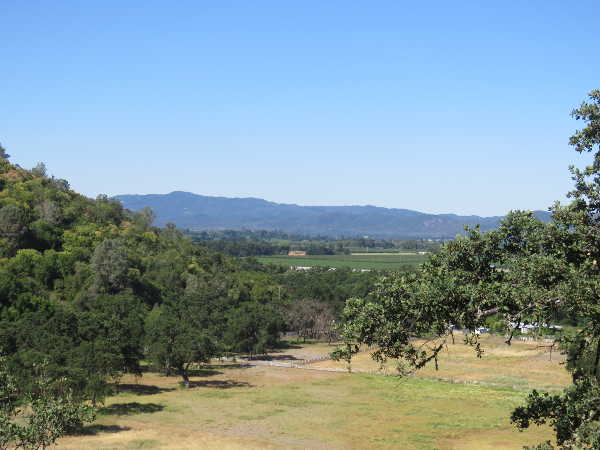
The Big Valley in Lake County, Calif. Photo by Kathleen Scavone. "Treat the earth well. It was not given to you by your parents- it was loaned to you by your children."– Indian proverb
LAKE COUNTY, Calif. – According to the “History of Lake County – 1881,” a description of the Big Valley's location is, "Beginning at the foot of Uncle Sam this valley extends in a circular course to the south-west, embracing Kelseyville and Highland Springs; thence northerly to Lakeport."
Uncle Sam is the name the settlers gave to Mount Konocti.
The Big Valley was once home to ancient oaks. Settlers cleared the valley for orchards. Acres of prolifically producing pears and grapevines adorn the rich soils now.
The valley was the homeland for peoples of ancient times called the Xa-Ben-Na-Po Pomo Indians.
Here, and elsewhere in what is now Lake County evidence points to the rich lifeways of the people of the past.
The Pomo Indians thrived in Lake County because of the abundance of foods such as acorns – a staple, seeds, game, fowl and, of course a plentitude of fish from Clear Lake and the surrounding streams.
Here is where they garnered a wealth of resources for home-building and constructing boats from the lush tule reeds that once ringed the Clear Lake in profusion.
Obsidian for tool-making was also in abundance due to the volcanic nature of the lands, especially around Mount Konocti and Borax Lake.
When Mexican and Spanish occupation of these lands occurred in the 1800s, the land and lifeways of the Pomo peoples of the past were altered forever.
The Indians were stripped of their sacred hunting and fishing grounds. Soon, settlers appeared and life changed evermore for the Indians when they were forced to work on ranchos and missions.
The Xa-Ben-Na-Po of today belong to the Big Valley Rancheria Band of Pomo Indians. They are working on maintaining their tribe's history and do so via ceremonial and educational events. One of the events is their Tule Boat Festival which is held each year on the lake.
Regarding the Big Valley's geology, according to geologist Dean Enderlin, "Much of the valley is underlain by sedimentary rocks that formed in ancient Clear Lake during the period that Mount Konocti was an active volcano (around 200,000 years ago). These early lake beds were buried and lithified over the millennia, but as the Clear Lake Basin continues to change its shape, some of these deposits have been uplifted, and are now elevated well above lake level. In the Lakeport and Kelseyville area, these ancient lake beds are called the Kelseyville Formation. Further south, by Lower Lake, similar deposits are known as the Lower Lake Formation."
The book entitled "History of Lake County – 1881” discussed Big Valley's geologic features as volcanic in nature with basalt and obsidian, along with limestone.
The obsidian features extend from Mount Konocti, southwest to Cobb Mountain. Much of the obsidian is sharp as a knife and shiny black, and is known as bottle rock, while other obsidian features are spotted, pocked and have the appearance of anthracite. The limestone outcroppings were never considered to be of a quantity to mine back then.
The Big Valley contributes to the value of Lake County's flourishing agricultural crops today, with its pears, walnuts and grapes.
Lake County, overall, has a pear crop that grossed $26,098,171. 00 according to Lake County Department of Agriculture's 2015 Crop Report. In that same year walnuts grossed $5,383,560.00 and winegrapes grossed $63,390,181.00.
The pioneers of The Big Valley paved the way for Lake County's now-abundant agricultural endeavors, when they settled in the Big Valley to grow grapes, sugar beets, vegetables, rye, oats, barley and fruits such as apples.
The abundance of rich soil was and remains conducive to growing lush grasses to allow for cattle to graze upon.
Kathleen Scavone, M.A., is a retired educator, potter, writer and author of “Anderson Marsh State Historic Park: A Walking History, Prehistory, Flora, and Fauna Tour of a California State Park” and “Native Americans of Lake County.” She also formerly wrote for NASA and JPL as one of their “Solar System Ambassadors.” She was selected “Lake County Teacher of the Year, 1998-99” by the Lake County Office of Education, and chosen as one of 10 state finalists the same year by the California Department of Education.
LAKE COUNTY, Calif. – Lake County Animal Care and Control has a new group of big dogs ready for new homes this week.
The dogs offered adoption this week include mixes of border collie, German Shepherd, heeler, husky, Labrador Retriever, pit bull and shepherd.
Dogs that are adopted from Lake County Animal Care and Control are either neutered or spayed, microchipped and, if old enough, given a rabies shot and county license before being released to their new owner. License fees do not apply to residents of the cities of Lakeport or Clearlake.
If you're looking for a new companion, visit the shelter. There are many great pets hoping you'll choose them.
The following dogs at the Lake County Animal Care and Control shelter have been cleared for adoption (additional dogs on the animal control Web site not listed are still “on hold”).
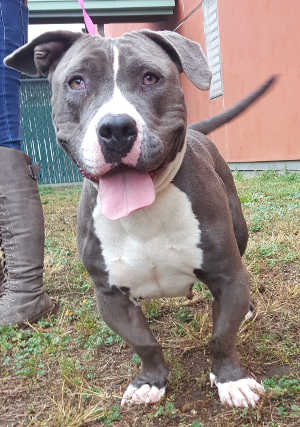
This male pit bull terrier is in kennel No. 3, ID No. 8817. Photo courtesy of Lake County Animal Care and Control. Pit bull terrier
This male pit bull terrier has a short blue and white coat.
Shelter staff said he was tested with a female dog and got along great with her.
He is in kennel No. 3, ID No. 8817.
This female Labrador Retriever is in kennel No. 4, ID No. 8966. Photo courtesy of Lake County Animal Care and Control. Labrador Retriever
This female Labrador Retriever has a short black coat with white markings.
She is in kennel No. 4, ID No. 8966.
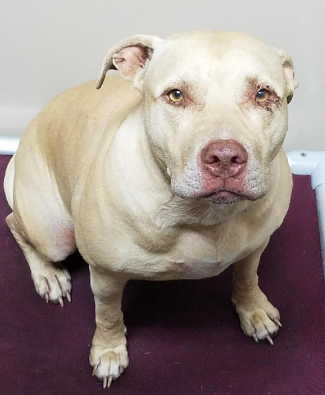
This female pit bull terrier is in kennel No. 7. ID No. 8893. Photo courtesy of Lake County Animal Care and Control. Pit bull terrier
This female pit bull terrier has a short blue coat.
She is in kennel No. 7. ID No. 8893.
This female pit bull terrier is in kennel No. 8, ID No. 8974. Photo courtesy of Lake County Animal Care and Control. Pit bull terrier
This female pit bull terrier has a short blue and white coat.
She’s in kennel No. 8, ID No. 8974.
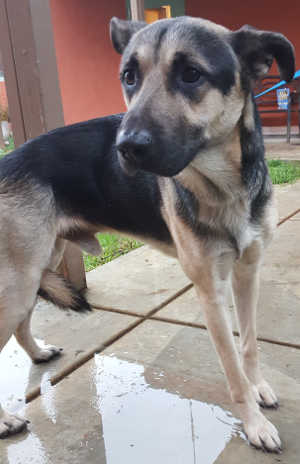
This male German Shepherd is in kennel No. 9, ID No. 8993. Photo courtesy of Lake County Animal Care and Control. German Shepherd
This male German Shepherd has a medium-length black and tan coat.
He’s in kennel No. 9, ID No. 8993.
“Mischief” is a female border collie-heeler mix in kennel No. 10, ID No. 8970. Photo courtesy of Lake County Animal Care and Control. ‘Mischief’
“Mischief” is a female border collie-heeler mix.
She has a short black and white coat.
Mischief is in kennel No. 10, ID No. 8970.
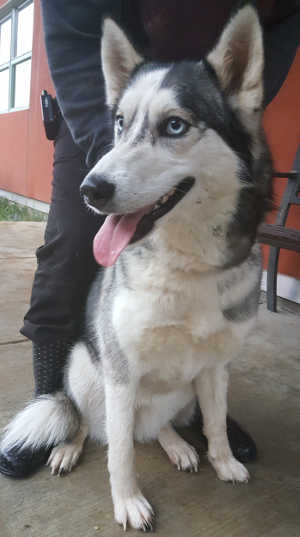
“Bella” is a female husky in kennel No. 12, ID No. 8985. Photo courtesy of Lake County Animal Care and Control. ‘Bella’
“Bella” is a female husky.
She has a medium-length black and white coat and blue eyes, and is potty trained.
Shelter staff said she should not be around livestock.
She’s in kennel No. 12, ID No. 8985.
“Blaze” is a male husky mix in kennel No. 13, ID No. 6807. Photo courtesy of Lake County Animal Care and Control. ‘Blaze’
“Blaze” is a male husky mix.
He has a fluffy red and white coat and blue eyes.
Shelter staff said he is potty trained but should not be around livestock.
He’s in kennel No. 13, ID No. 6807.
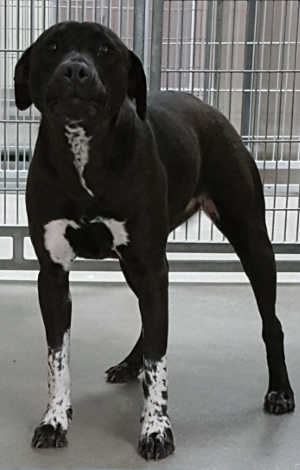
This male pit bull terrier is in kennel No. 14, ID No. 8996. Photo courtesy of Lake County Animal Care and Control. Pit bull terrier
This male pit bull terrier has a short black and white coat.
He’s in kennel No. 14, ID No. 8996.
“Marley” is a female pit bull terrier mix in kennel No. 15, ID No. 8857. Photo courtesy of Lake County Animal Care and Control. ‘Marley’
“Marley” is a female pit bull terrier mix with a short tan coat.
She already has been spayed.
She’s in kennel No. 15, ID No. 8857.
“GracieMae” is a female border collie-heeler mix in kennel No. 17, ID No. 8972. Photo courtesy of Lake County Animal Care and Control. ‘GracieMae’
“GracieMae” is a female border collie-heeler mix.
She has a short black and white coat and already is spayed.
She’s in kennel No. 17, ID No. 8972.
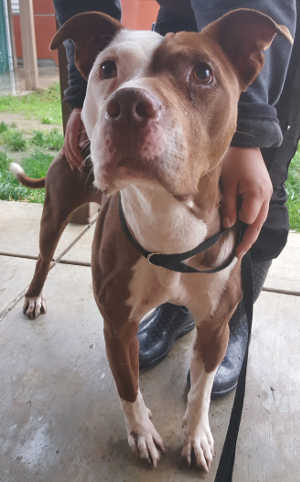
This female pit bull terrier is in kennel No. 19, ID No. 8965. Photo courtesy of Lake County Animal Care and Control. Pit bull terrier
This female pit bull terrier has a short red and white coat.
She already has been spayed.
She’s in kennel No. 19, ID No. 8965.
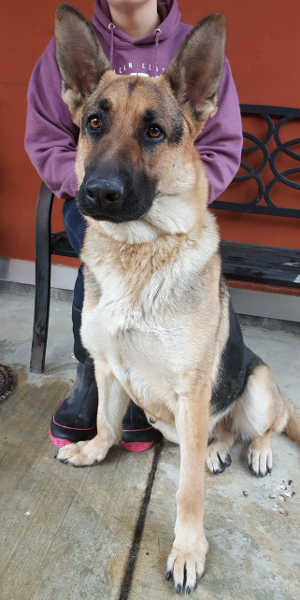
This female German Shepherd is in kennel No. 22, ID No. 8943. Photo courtesy of Lake County Animal Care and Control. German Shepherd
This female German Shepherd has a medium-length brown and black coat.
She’s in kennel No. 22, ID No. 8943.
“Jack” is a male shepherd mix in kennel No. 25, ID No. 8721. Photo courtesy of Lake County Animal Care and Control. ‘Jack’
“Jack” is a male shepherd mix.
He has a long black and white coat and has already been neutered.
He’s in kennel No. 25, ID No. 8721.
This female pit bull terrier is in kennel No. 26, ID No. 8916. Photo courtesy of Lake County Animal Care and Control. Pit bull terrier
This female pit bull terrier has a short fawn and white coat.
She is in kennel No. 26, ID No. 8916.
This male shepherd is in kennel No. 30, ID No.8929. Photo courtesy of Lake County Animal Care and Control. Shepherd mix
This male shepherd has a medium-length black and brown coat.
He already has been neutered.
He’s in kennel No. 30, ID No. 8929.
Lake County Animal Care and Control is located at 4949 Helbush in Lakeport, next to the Hill Road Correctional Facility.
Office hours are Monday through Friday, 11 a.m. to 5 p.m., and 11 a.m. to 3 p.m., Saturday. The shelter is open from 11 a.m. to 4 p.m. Monday through Friday and on Saturday from 11 a.m. to 3 p.m.
For more information call Lake County Animal Care and Control at 707-263-0278.
Email Elizabeth Larson at This email address is being protected from spambots. You need JavaScript enabled to view it.. Follow her on Twitter, @ERLarson, or Lake County News, @LakeCoNews.
Artist’s impression of the planet Ross 128 b. Courtesy of European Southern Observatory.
A temperate Earth-sized planet has been discovered only 11 light-years from the Solar System by a team using ESO’s unique planet-hunting HARPS instrument.
The new world has the designation Ross 128 b and is now the second-closest temperate planet to be detected after Proxima b.
It is also the closest planet to be discovered orbiting an inactive red dwarf star, which may increase the likelihood that this planet could potentially sustain life.
Ross 128 b will be a prime target for ESO’s Extremely Large Telescope, which will be able to search for biomarkers in the planet's atmosphere.
A team working with ESO’s High Accuracy Radial velocity Planet Searcher, or HARPS, at the La Silla Observatory in Chile has found that the red dwarf star Ross 128 is orbited by a low-mass exoplanet every 9.9 days.
This Earth-sized world is expected to be temperate, with a surface temperature that may also be close to that of the Earth. Ross 128 is the “quietest” nearby star to host such a temperate exoplanet.
“This discovery is based on more than a decade of HARPS intensive monitoring together with state-of-the-art data reduction and analysis techniques. Only HARPS has demonstrated such a precision and it remains the best planet hunter of its kind, 15 years after it began operations,” explains Nicola Astudillo-Defru (Geneva Observatory – University of Geneva, Switzerland), who co-authored the discovery paper.
Red dwarfs are some of the coolest, faintest — and most common — stars in the Universe.
This makes them very good targets in the search for exoplanets and so they are increasingly being studied. In fact, lead author Xavier Bonfils (Institut de Planétologie et d'Astrophysique de Grenoble – Université Grenoble-Alpes/CNRS, Grenoble, France), named their HARPS programme The shortcut to happiness, as it is easier to detect small cool siblings of Earth around these stars, than around stars more similar to the Sun.
Many red dwarf stars, including Proxima Centauri, are subject to flares that occasionally bathe their orbiting planets in deadly ultraviolet and X-ray radiation.
However, it seems that Ross 128 is a much quieter star, and so its planets may be the closest known comfortable abode for possible life.
Although it is currently 11 light-years from Earth, Ross 128 is moving towards us and is expected to become our nearest stellar neighbor in just 79 000 years – a blink of the eye in cosmic terms. Ross 128 b will by then take the crown from Proxima b and become the closest exoplanet to Earth.
With the data from HARPS, the team found that Ross 128 b orbits 20 times closer than the Earth orbits the Sun. Despite this proximity, Ross 128 b receives only 1.38 times more irradiation than the Earth.
As a result, Ross 128 b’s equilibrium temperature is estimated to lie between -60 and 20°C, thanks to the cool and faint nature of its small red dwarf host star, which has just over half the surface temperature of the Sun.
While the scientists involved in this discovery consider Ross 128b to be a temperate planet, uncertainty remains as to whether the planet lies inside, outside, or on the cusp of the habitable zone, where liquid water may exist on a planet’s surface.
Astronomers are now detecting more and more temperate exoplanets, and the next stage will be to study their atmospheres, composition and chemistry in more detail.
Vitally, the detection of biomarkers such as oxygen in the very closest exoplanet atmospheres will be a huge next step, which ESO’s Extremely Large Telescope, or ELT, is in prime position to take.
“New facilities at ESO will first play a critical role in building the census of Earth-mass planets amenable to characterization. In particular, NIRPS, the infrared arm of HARPS, will boost our efficiency in observing red dwarfs, which emit most of their radiation in the infrared. And then, the ELT will provide the opportunity to observe and characterize a large fraction of these planets,” concludes Xavier Bonfils.
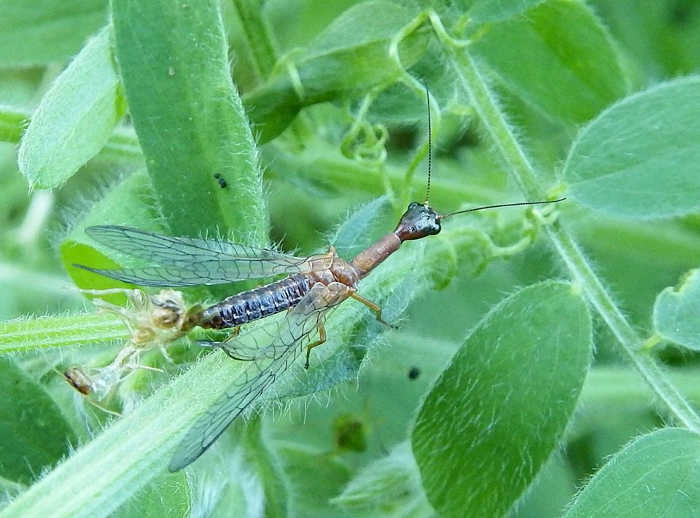
This male snake fly had just shed its skin. The skin, called “exuvia,” is usually eaten by the insect. Photo by Mary K. Hanson.
NORTHERN CALIFORNIA – We all know what a housefly (Musca domestica) looks like, but lots of creatures we call “flies” don’t actually look like the typical housefly at all.
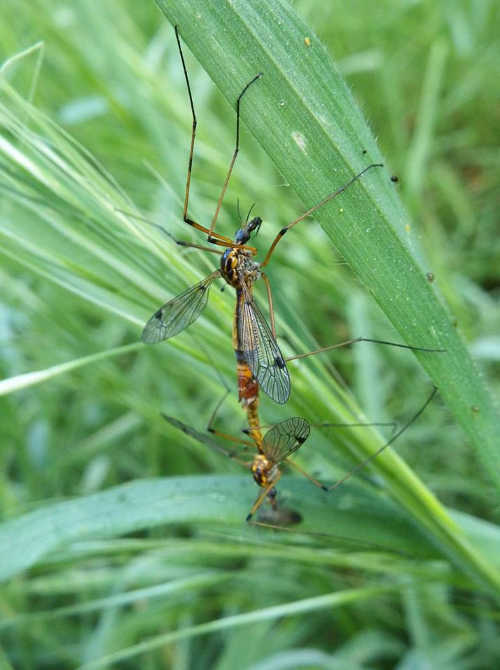
Two of most interesting and bizarre ones readily found in our region are the crane fly (of insect family Tipulidae) and the snake fly (of the order Raphidioptera) most visible in the spring and summer months.
Crane flies are those long-legged insects that many folks call “mosquito hawks”, even though the flies don’t hunt or eat mosquitos.
In fact, most adult crane flies don’t eat or drink much of anything, and some of the 15,000 species don’t even have mouth parts.
They also don’t have stingers like female mosquitoes do, so they can’t sting or bite you – but they still may be able to creep you out with their gangly long-legged flights.
If you’re able to get close to one, you’ll see that it has large eyes and an elongated face (rostrum).
On its back is one set of wings that are clearly visible, but look closer. Behind the wings you’ll also see little protrusions with a ball at the end of them.
These are the “halteres” and like oddly modified wings, they help keep the fly steady and maneuverable in flight.
Although there are some aquatic species, the majority of crane flies spend most of their lives underground as larvae called “leatherjackets”, named for their thick-skinned hides.
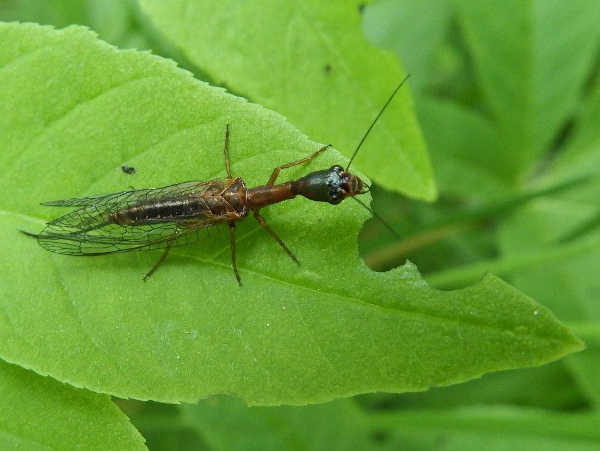
This female snake fly is typical of her species. Note the long stinger-looking protrusion at the end of her body. That’s her ovipositor, and it’s specially made to bore into and under tree bark where she’ll lay her eggs. Don’t worry, though; snake flies don’t sting. Photo by Mary K. Hanson. These terrestrial larvae eat roots, decomposing plants and microorganisms – which can make them pests if they start foraging on the roots of your lawn.
But they are actually a valuable part of the ecosystem because they help to aerate the soil and process organic material.
When their larval stage is over, the leatherjackets pupate, and then emerge from the earth as fully formed crane flies. In our region we see mostly gray and yellow variations.
Female crane flies emerge with their eggs already intact and waiting for fertilization. That’s a time saving adaptation no doubt born of the fact that the mature winged crane flies usually only live for about a week.
The lifespan of the snake fly is significantly longer (about three years), but it spends the majority of that time as a voracious aphid-eating larva.
Vaguely related to lacewings, snake flies are considered “living fossils” that haven’t changed much since the early Jurassic period (140 million years ago).
There are about 250 different species, all of them confined to western North America, and about 20 of those species live in California.
The snake fly’s most identifying features are its long prothorax (that part of an insect between the head and the abdomen that usually hold the first pair of legs) and its two wings which are heavily veined like a dragonfly’s wings.
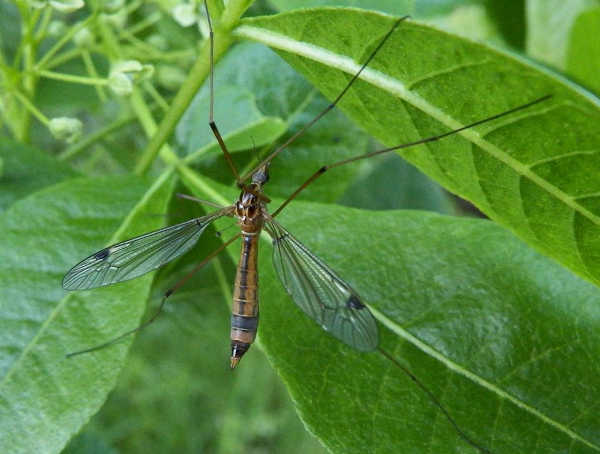
Look in between this crane fly’s left wing and leg and you’ll see a tiny protrusion called a “haltere”; it helps to stabilize the fly in flight. Photo by Mary K. Hanson. On the females, the other distinguishing feature is their elongated ovipositor which pokes out of the back end of the abdomen and looks like a thick stinger. Snake flies don’t sting, but they do have tough mouth parts and can give you a nip if you mishandle them.
That long ovipositor allows the female snake fly to bore into and under the bark of trees to lay her eggs. The eggs hatch into larvae that look sort of, well, Frankenstein-ish. The front half looks like an adult snake fly, but the back end is long and wormlike, like a giant stomach.
Both the larvae and adults are predatory, eating a variety of aphids, mites, psyllids and other soft-bodied insects. In fact, they are thought to be exceedingly beneficial to fruit orchards where some species dine specifically on those pests that can damage apples or peaches.
Like the Crane flies, snake flies go through “complete metamorphosis” and have a pupal stage.
But unlike the crane fly pupa which encases itself in a hard “shell,” the snake fly pupa has no casing or cocoon, and actually moves around and even feeds for about 10 months while it continues to grow and develop. In this stage, the pupa looks almost like an adult snake fly, but it is pale (often white) and has only rudimentary wing buds.
Although you’ll see the crane flies just about anywhere, snake flies are most commonly found in woody or forested areas.
So, next time you’re out on a nature walk, keep an eye out for these critters. They valuable parts of the ecosystem that are also engaging to watch and learn more about.
Mary K. Hanson is a Certified California Naturalist, author and nature photographer. Tuleyome is a501(c)(3) nonprofit conservation organization based in Woodland, CA. For more information, see their website at: www.tuleyome.org.
This is a mating pair of crane flies. The yellow-orange ones are sometimes referred to as “tigers”, but they’re not in the least bit ferocious. Most adult crane flies don’t eat or drink much of anything, and some of the 15,000 species don’t even have mouth parts. Photo by Mary K. Hanson.
LAKE COUNTY, Calif. – The Lake County Holiday Fund will once again make holiday food boxes available to those in need, with the sponsoring organizations also asking for the community’s help to fund the effort.
Registration for holiday food boxes for the northern portion of Lake County will be taken from 9 a.m. to 4 p.m. Monday, Nov. 27, at Lake Family Resource Center, 5350 Main St. in Kelseyville.
Residents of residents of Finley, Glenhaven, Kelseyville, Lakeport, Lucerne, Nice and Upper Lake should register on that day.
For the southern portion of Lake County – including residents of Clearlake, Clearlake Oaks, Clearlake Park, Lower Lake and Spring Valley – holiday box registration takes place at NCO Community Action, located at 14832 Lakeshore Drive in Clearlake, from 2 to 5 p.m. Tuesday, Nov. 28; 9 a.m. to 2 p.m. Wednesday, Nov. 29; and 11 a.m. to 5 p.m. Thursday, Nov. 30.
No sign ups will be accepted after those days.
All applicants must appear in person, bringing a photo identification and proof of physical residence.
Only one box per address will be allowed.
The boxes will be distributed in December before the holidays. Distribution information will be given at the time of registration.
Donations for the Lake County Holiday Fund are now being accepted at any branch of WestAmerica Bank or Umpqua Bank. Checks should be written to the Lake County Holiday Fund.
Because the Lake County Hunger Task Force is now the fiduciary agency, donations are tax-deductible, since the task force is a registered nonprofit.
The annual holiday food box effort is a cooperative undertaking that includes the Lakeport Rotary, NCO Community Action, Lake County Hunger Task Force, Lake Family Resource Center, WestAmerica Bank, Umpqua Bank and Lake County Publishing.
California's 2017 wine harvest wrapped up early this fall following summer heat spurts and a growing season that saw significant rain throughout the state ending a five-year drought.
While October wildfires in North Coast wine communities made international headlines, the state's vineyards and wineries were not significantly affected.
Napa, Sonoma and Mendocino counties, the regions most impacted, grow 12 percent of California's winegrapes, and 90 percent percent of the harvest in Napa and Sonoma and 85 percent in Mendocino were already picked and in production at wineries before the fires.
"The vast majority of California's 2017 winegrape harvest was unaffected by the wildfires and the vintage promises to be of excellent quality," said Robert P. (Bobby) Koch, president and CEO of Wine Institute. "The outpouring of support locally and from around the world for people in the impacted communities has been phenomenal. We are saddened by the loss of lives and homes and this will truly be remembered as a harvest of the heart. Wineries are at work making their 2017 wines and welcoming visitors during this beautiful late fall/early winter season."
Lake County Agricultural Commissioner Steve Hajik told Lake County News that no vineyards were damaged or impacted by October’s Sulphur fire.
The report said that in Lake County generous yields and excellent quality have the region’s vintners excited about 2017.
Harvest in Lake County began slightly later than normal and was still in full swing in early October, with a few final picks happening into late October.
The county’s winter rains replenished groundwater and fed abundant cover crops, particularly valuable in helping the land heal in areas recovering from 2015 and 2016 wildfires.
A late summer heat wave had minimal impact on Lake County vineyards as growers prepared with advance irrigation to avert vine stress, so fruit was not subject to shrinkage or raisining.
Vintners we able to give the fruit longer hang time into the cooler days of October, and winemakers are very optimistic about quality, according to the report.
With all but late harvest grapes in, statewide vintners are looking back at the 2017 growing season. The drought is over with the season beginning with rainfall that refilled reservoirs and replenished soils.
Harvest began early at a normal pace in many regions, and then progressed rapidly during a heat wave in late August and early September.
Temperatures cooled mid-September, slowing the harvest pace and allowing red grapes to ripen gradually. Many regions are reporting reduced yields due to the heat spell, but vintners are reporting strong quality for the 2017 vintage.
The California Department of Food and Agriculture estimated in early August that the state's overall crop size would reach four million tons, down slightly from 4.03 million in 2016 and above the historical average of 3.9 million tons. The heat wave will likely lower this prediction.
"We had above average rainfall this winter on the Central Coast, but not as much as areas that saw flooding," said Steve Lohr, CEO, J. Lohr Vineyards & Wines. "It was wonderful because it helped fill up the reservoirs and bring new life to cover crops that had been parched after several years of drought. It has been a good year for us, all in all, on the Central Coast," Lohr said. "From the 30,000-foot perspective, I would say that these wines are going to show particularly nicely in their youth but will have the capacity to age."
According to Neil Bernardi, vice president of winemaking at Duckhorn Wine Co., the increased rainfall also brought vine-vigor challenges.
"It required special focus on cover crops and tillage and closely managing canopies. Cabernet Sauvignon grapes in Napa Valley and Alexander Valley look especially healthy," he said. "Our Pinot Noir, Zinfandel and Merlot have excellent color, extraction and flavor, and Sauvignon Blanc and Chardonnay are showing excellent aromatics and great acidity."
The rainfall helped vines in the Santa Cruz Mountains rebound from the drought, but also caused some problems during flowering.
"Zinfandel got caught by spring rain during bloom and most of our Zinfandel sites are down in tonnage anywhere from 15 percent to 40 percent," said Eric Baugher, chief operating officer and winemaker, Ridge Vineyards Monte Bello Winery. "It does appear that the Zinfandel vintage will be an extraordinary one, similar to 1999. I expect similar excellent quality out of Chardonnay since the fruit had such great intensity of flavor from the petite-size clusters and berries."
A heat spell impacted many California regions in late summer, speeding up harvest schedules and requiring extra vigilance.
"Some vineyards that had exposed fruit showed desiccation," said David Hayman, vice president of winegrowing for Delicato Family Vineyards, which farms grapes across the state. "Ripeness was accelerated and a lot of fruit became ready all at once. Flavors across the board look good."
 How to resolve AdBlock issue?