LAKEPORT, Calif. – The Board of Supervisors this week will offer its thanks to the county’s retiring health officer, discuss the status of the Lucerne Hotel and consider forming a tourism improvement district.
The board will meet beginning at 9 a.m. Tuesday, Nov. 28, in the board chambers on the first floor of the Lake County Courthouse, 255 N. Forbes St., Lakeport.
The meeting can be watched live on Channel 8 and online at https://countyoflake.legistar.com/Calendar.aspx. Accompanying board documents, the agenda and archived board meeting videos also are available at that link.
In an item timed for 9:08 a.m., the board will present a proclamation recognizing the retirement of Dr. Karen M. Tait, health officer, and honoring her for her many years of outstanding service to the county of Lake.
At 9:10 a.m., the board will consider continuing a proclamation of a local health emergency made by Tait in response to the October Sulphur fire, and get an update from staff on the fire recovery.
At 9:45 a.m., the board will hold a discussion and consideration of the status of the historic Lucerne Hotel, which the county purchased in 2010.
In June, Marymount California University, which held a lease for the building, abruptly left, and the county has kept the building closed ever since as it negotiates with Marymount to resolve the outstanding lease agreement.
County Administrative Officer Carol Huchingson report to the board explained that the county has had interest in the building from numerous individuals and entities, resulting in four concept papers.
“Those interests include a hotel, research center, conference and event center, a cannabis cultivation and education center, recovery and rehabilitation facility, educational facility, soup kitchen, and office space,” Huchingson said.
Huchingson is asking the board to consider whether to issue a request for proposals for the building or instead to seek to sell it. An updated appraisal has valued it at $3 million.
Also on Tuesday, at 10:15 a.m. the board will consider an agreement between the county of Lake and Civitas for formation of a Lake County Tourism Improvement District.
The full agenda follows.
CONSENT AGENDA
7.1: Authorize our board’s vote for the incumbent and sole candidate for Group 1’s CMSP Governing Board position, Richard Forster.
7.2: Approve leave of absence request for June Richmond, eligibility worker, from Oct. 26, 2017, to Dec. 29, 2017.
7.3: Approve leave of absence request for Mary Ramus, environmental health specialist, from Oct. 8, 2017, to Dec. 10, 2017, or until such time as the Environmental Health Department has completed a recruitment and is ready to make a conditional offer of employment to fill the position, whichever date is sooner.
7.4: Approve leave of absence request for Robert Montgomery, behavioral health case manager, from Aug. 2, 2017, to Aug. 21, 2017.
7.5: Approve the agreement between the county of Lake and Adventist Health St. Helena Hospital for the Fiscal Year 2017-18 for a contract maximum of $100,000 and authorize the board chair to sign the agreement.
7.6: Adopt resolution approving the standard agreement for the multi-year contract between the county of Lake and the Department of Health Care Services for substance use disorder services for Fiscal Year 2017-18 through Fiscal Year 2019-20, and authorizing the Behavioral Health administrator to sign the standard agreement.
7.7: Approve Amendment 2 to the agreement between the county of Lake and Ford Street Project for an increase of $40,000 for a new contract maximum of $50,000 and authorize the board chair to sign the amendment.
7.8: Approve Amendment 2 to the agreement between the county of Lake and Center Point DAAC for a decrease of $60,000 for a new contract maximum of $30,000 and authorize the board chair to sign the amendment.
7.9: Approve Amendment 1 to the agreement between the county of Lake and Crestwood Behavioral Health for Adult Residential Support and Specialty Mental Health Services for Fiscal Year 2017-18 for an increase of $450,000 for a new contract maximum of $950,000 and authorize the board chair to sign the amendment. not available not available.
7.10: Approve Amendment 2 to the agreement between the county of Lake and Resource Development Associates for technical assistance with the MHSA Three Year Plan for Fiscal Year 2017-18 for a contract maximum of $50,000 and authorize the board chair to sign the amendment.
7.11: Adopt proclamation recognizing the retirement of Dr. Karen M. Tait, health officer, and honoring her for her many years of outstanding service to the county of Lake.
7.12: Authorize approval of interim appointment of Carolyn Holladay, Public Health Nurse III, to Public Health nursing director until such time as the open position has been permanently filled.
7.13: Authorize approval of interim appointment of Dr. Gary Pace, M.D., MPH, MCP, to county health officer effective Dec. 2, 2017, until such time as the open position has been permanently filled.
7.14: Sitting as Lake County Sanitation District Board of Directors, adopt Resolution Cancelling Fund 254 Lake County Sanitation District Southeast Operations & Maintenance Reserve Designation in the Amount of $20,000.
7.15: Approve right of way contract and grant deed for Caltrans’ acquisition of a portion of Trailside Park along State Highway 175 and authorize the chair to sign the right of way contract and the grant deed, along with instructions to the clerk to notarize the grant deed.
7.16: Adopt Resolution Amending Resolution No. 2017-125 establishing position allocations for Fiscal Year 2017/2018 for Budget Unit 4121.
7.17: (a) Waive the formal bidding process, pursuant to Lake County Code Section 2-38.2, as it is not in the public interest due to the unique nature of the goods or services, and authorize the Public Services director/assistant purchasing agent to issue a purchase order not to exceed $119,288.88 to GeoLogic Computer Systems; and (b) waive the formal bidding process, pursuant to Lake County Code Section 2-38.4, as it is not in the public interest due to the existence of a state of emergency and the unique nature of the goods or services, and authorize the Public Services director/assistant purchasing agent to issue a purchase order not to exceed $63,426.41 to LSC Environmental Products.
7.18: Adopt resolution approving right of way certification for Mockingbird Lane over Robinson Creek Bridge Replacement Project, in Lake County. Federal Project Number: BRLO-5914(105) and authorize the Public Works director to execute the right of way certification.
7.19: Approve facility agreement between the county of Lake and the Chapel of the Lakes for autopsy services and authorize the chair to sign.
TIMED ITEMS
8.2, 9:08 a.m.: Presentation of proclamation recognizing the retirement of Dr. Karen M. Tait, health officer, and honoring her for her many years of outstanding service to the county of Lake.
8.3, 9:10 a.m.: (a) Consideration of continuation of a proclamation of a local health emergency by the Lake County health officer; and (b) update and discussion on Sulphur fire recovery.
8.4, 9:30 a.m.: (a) Public hearing to solicit citizen input regarding the 2017 notice of funding availability; and (b) consideration of resolution approving an application for funding and the execution of a grant agreement and any amendments thereto from the notice of funding availability for 2017 Community Development Block Grant Program.
8.5, 9:45 a.m.: Discussion and consideration of Lucerne Hotel status.
8.6, 10:15 a.m.: Consideration of agreement between the county of Lake and Civitas for formation of a Lake County Tourism Improvement District.
UNTIMED ITEMS
9.2: Consideration of the following appointments: Emergency Medical Care Committee Spring Valley CSA #2, Lake County Public Authority Advisory Committee.
9.3: Consideration of (a) board appointment to CSAC Board of Directors for 2018; and (b) board appointment of delegate and alternate to the Rural County Representatives (RCRC) Board of Directors for 2018; and (c) board appointment of delegate and alternate to Golden State Finance Authority (GSFA) Board of Directors for 2018.
CLOSED SESSION
10.1: Conference with real property negotiators pursuant to Gov. Code sec. 54956.8: Properties: 1150 and 1160 Mockingbird Lane, Lakeport, CA. 95453 APNs: 004-081-04 and 004-081-03. Agency negotiators: Scott DeLeon and Jeff Rein. Negotiating parties: County of Lake and Nancy Jane Williams, property owner. Under negotiation: Price and terms of payment.
Email Elizabeth Larson at This email address is being protected from spambots. You need JavaScript enabled to view it.. Follow her on Twitter, @ERLarson, or Lake County News, @LakeCoNews.
LAKE COUNTY, Calif. – A report from the California Department of Public Health this month shows that the adolescent birth rate has dropped to a record low across California, with Lake County seeing the lowest rate in several years.
The CDPH report said that for 2015, the latest year in the study, 17.6 births per 1,000 females aged 15 to 19, a 10 percent decline from the 2014 rate of 19.6 and a 62 percent decline from the 2002 rate of 46.7.
“By empowering young people with the knowledge, tools and resources to make healthy choices, California is succeeding in reducing births among adolescents,” said CDPH Director and State Public Health Officer Dr. Karen Smith.
In Lake County, the adolescent birth rate in 2015 was 31.1 live births per 1,000 females aged 15 to 19.
That’s down from a rate of 34.7 in 2014 and 36.1 in 2013, and a significant drop from the 2000 rate of 52.
CDPH reported that the adolescent birth rate decreased across all racial and ethnic groups between 2000 and 2015.
During this time, the adolescent birth rate dropped among Hispanics from 77.3 to 27.0, among African-Americans from 59.1 to 19.7, among Whites from 22.3 to 6.9, and among Asians from 15.0 to 2.9.
Despite declining birth rates, racial disparities persist in adolescent childbearing in California.
African-American and Hispanic adolescents were three to four times as likely to give birth as White females.
Additionally, the adolescent birth rate varies considerably across counties, from a low of 6.7 in Marin County to a high of 43.1 in Del Norte County.
California has a number of programs aimed at preventing adolescent pregnancy and improving pregnancy outcomes among young women.
CDPH funds the Information and Education Program, the Personal Responsibility Education Program authorized through the Affordable Care Act of 2010, and the Adolescent Family Life Program for expectant and parenting adolescents.
Also, the state provides no-cost family planning services to eligible men and women, including adolescents, through the Family PACT Program.
LAKEPORT, Calif. – Lake County Animal Care and Control is offering several cats and kittens to new homes.
This week’s cats include some strays rescued from the Sulphur fire area.
If you're looking for a new companion, visit the shelter. There are many great pets there, hoping you'll choose them.
For those looking for a barn cat to keep the rodents at bay, be sure to ask about the barn cat adoption program. Feral barn cats are adopted out for $1 each, which includes altering, ear notching and vaccines.
Lake County Animal Care and Control is located at 4949 Helbush in Lakeport, next to the Hill Road Correctional Facility.
Office hours are Monday through Friday, 11 a.m. to 5 p.m., and 11 a.m. to 3 p.m., Saturday. The shelter is open from 11 a.m. to 4 p.m. Monday through Friday and on Saturday from 11 a.m. to 3 p.m.
For more information call Lake County Animal Care and Control at 707-263-0278.
This male domestic medium hair is in cat room kennel No. 9, ID No. 8901. Photo courtesy of Lake County Animal Care and Control. Male domestic medium hair
This male domestic medium hair has an all-black coat.
He already has been neutered.
He’s in cat room kennel No. 9, ID No. 8901.
This male domestic medium hair is in cat room kennel No. 53, ID No. 8973. Photo courtesy of Lake County Animal Care and Control. Male domestic medium hair
This male domestic medium hair has a white coat and blue eyes.
He’s in cat room kennel No. 53, ID No. 8973.
This adult female domestic short hair is in kennel No. 88, ID No. 8742. Photo courtesy of Lake County Animal Care and Control. Female domestic short hair
This adult female domestic short hair was found in Clearlake Oaks on Oct. 13 in the Sulphur fire area.
She has a brown tabby coat and gold eyes.
She is in cat room kennel No. 88, ID No. 8742.
This young female domestic short hair cat is in kennel No. 99, ID No. 8739. Photo courtesy of Lake County Animal Care and Control. Female domestic short hair
This young female domestic short hair cat was found in Clearlake on Oct. 13 in the Sulphur fire area.
She has a torbie coat and gold eyes. She has not been altered.
She’s in cat room kennel No. 99, ID No. 8739.
This male gray tabby kitten is in kennel No. 133a, ID No. 8770. Photo courtesy of Lake County Animal Care and Control. Gray tabby kitten
This male gray tabby kitten has a short coat and green eyes.
He’s in cat room kennel No. 133a, ID No. 8770.
This female gray tabby kitten is in kennel No. 133b, ID No. 8771. Photo courtesy of Lake County Animal Care and Control. Gray tabby kitten
This female gray tabby kitten has a short coat and blue eyes.
She’s in cat room kennel No. 133b, ID No. 8771.
“Sweet Tart” is a male domestic short hair in cat room kennel No. 136a, ID No. 8951. Photo courtesy of Lake County Animal Care and Control. ‘Sweet Tart’
“Sweet Tart” is a male domestic short hair with an orange tabby coat.
He already has been neutered.
He’s in cat room kennel No. 136a, ID No. 8951.
This young female domestic short hair cat is in kennel No. 147, ID No. 8732. Photo courtesy of Lake County Animal Care and Control. Female domestic short hair
This young female domestic short hair cat was found in Clearlake on Oct. 12 in the Sulphur fire area.
She has a gray coat and green eyes. She has not been spayed.
She’s in cat room kennel No. 147, ID No. 8732.
Email Elizabeth Larson at This email address is being protected from spambots. You need JavaScript enabled to view it.. Follow her on Twitter, @ERLarson, or Lake County News, @LakeCoNews.
A new map released this month by a collaborative that includes the US Geological Survey and NASA details croplands worldwide in the highest resolution yet, helping to ensure global food and water security in a sustainable way.
The map establishes that there are 1.87 billion hectares of croplands in the world, which is 15 to 20 percent – or 250 to 350 million hectares, also referred to as Mha – higher than former assessments.
The change is due to more detailed understanding of large areas that were never mapped before or were inaccurately mapped as non-croplands.
Earlier studies showed either China or the United States as having the highest net cropland area, but this study shows that India ranks first, with 179.8 Mha (9.6 percent of the global net cropland area).
Second is the United States with 167.8 Mha (8.9 percent), followed by China with 165.2 Mha (8.8 percent) and Russia with 155.8 Mha (8.3 percent). Statistics of every country in the world can be viewed in an interactive map.
South Asia and Europe can be considered agricultural capitals of the world due to the percentage of croplands of the total geographic area.
Croplands make up more than 80 percent of Moldova, San Marino and Hungary; between 70 and 80 percent of Denmark, Ukraine, Ireland and Bangladesh; and 60 to 70 percent of the Netherlands, United Kingdom, Spain, Lithuania, Poland, Gaza Strip, Czech Republic, Italy and India. For comparison, the United States and China each have 18 percent croplands.
The study was led by the USGS and is part of the Global Food Security-Support Analysis Data @ 30-m (GFSAD30) Project.
The map is built primarily from Landsat satellite imagery with 30-meter resolution, which is the highest spatial resolution of any global agricultural dataset.
“The map clearly shows individual farm fields, big or small, at any location in the world,” said Prasad Thenkabail, USGS research geographer and principal investigator for the GFSAD30 Project Team. “Given the high resolution of 30 meters and 0.09 hectares per pixel, a big advantage is the ability to see croplands in any country and sub-national regions, including states, provinces, districts, counties and villages.”
With the global population nearing the 7.6 billion mark and expected to reach 10 billion by 2050, it is of increasing importance to understand and monitor the state of agriculture across the world in great detail.
This new research is useful to international development organizations, farmers, decision makers, scientists and national security professionals.
“This map is a baseline and starting point for higher level assessments, such as identifying which crops are present and where, when they grow, their productivity, if lands are left fallow and whether the water source is irrigated or rainfed,” said Thenkabail. “Comparisons can be made between the present and past years as well as between one farm and another. It is invaluable to know the precise location of croplands and their dynamics to lead to informed and productive farm management.”
Not only does this map and accompanying data have significant food security implications, but it is also critical as a baseline for assessing water security.
Nearly 80 percent of all human water use across the world goes towards producing food, and this research provides insight on “crop per drop,” which is an assessment of the amount of crops produced per unit of water.
“The project is a major undertaking for many reasons,” said Thenkabail. “One major challenge was obtaining cloud-free images in regions such as the tropics and during rainy seasons. That took multiple years in some areas. This project required the use of satellite-acquired big-data analytics using machine learning algorithms on a cloud computing platform such as the Google Earth Engine.”
Another important aspect of this project was the rigorous validation of the map, leading to an overall accuracy of 92 percent. Validation was performed by an independent team for 72 zones across the world.
The USGS led this project and played an especially valuable role in providing Landsat imagery.
The USGS acquires, processes, archives and distributes – freely to anyone in the world – Landsat data from 1972 to the present day. This project uses a one-of-a-kind dataset primarily of Landsat satellite imagery from the year 2015. Remote sensing is critical to achieving a global perspective as well as objective and unbiased information.
The GFSAD30 Project Team’s goal is to map global croplands and their attributes routinely, rapidly, consistently and accurately year after year.
The project is a collaborative effort among the USGS, National Aeronautics and Space Administration, Bay Area Environmental Research Institute, University of New Hampshire, California State University Monterey Bay, University of Wisconsin, Northern Arizona University, International Crops Research Institute for the Semi-Arid Tropics, U.S. Department of Agriculture, U.S. Environmental Protection Agency, Environmental Systems Research Institute of Indonesia and Google.
The project is funded by NASA’s Making Earth System Data Records for Use in Research Environments Program, with supplemental funding from the USGS.
On Saturday, November 25, 2017, Big Valley 4-H members planted daffodil bulbs in Kelseyville, Calif. Pictured from, left to right, back row, Mark Marek, Darrin Knight, Bonna Preston, Tim Brown, Crystal Johnson, Michelle Brown, Carson Holden Reid and Evan Holdenried; middle row, Jayden Preston, Katey Brown, Payten Preston and Sarah Nave; front row, Jessica Mulka, Ceci Knight and Andrew Nave. Not pictured (taking photo): Marilyn Holdenried. KELSEYVILLE, Calif. – Spring is months away, but local 4-H members are making sure there will be plenty of beautiful flowers to enjoy when it arrives.
On Saturday, Big Valley 4-H members – with the help of family and friends – planted 970 daffodil bulbs on Gas Hill in Kelseyville as a community service project.
The daffodils were purchased with donations from friends, family and community members.
The club reported that the conditions were perfect – the soil had been softened by earlier rains and the weather was dry and just right for planting.
Now, they are impatiently awaiting the beautiful blooms that will appear in the spring.
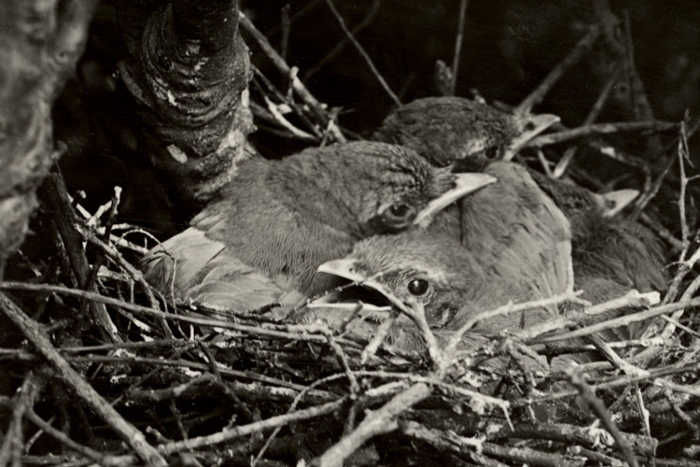
California scrub jay nestlings in Berkeley, May 20, 1921. A new study compared nesting data from the early 1900s to similar data today and found that California birds are nesting earlier to avoid warmer weather. Photo courtesy of UC Berkeley's Museum of Vertebrate Zoology.
A new study suggests that many of California’s birds are adapting to rising temperatures by breeding earlier than they did a century ago.
A comparison of nesting data recorded in the early 1900s with similar data today for more than 200 species of California birds shows that overall they are breeding five to 12 days earlier than they did 75 to 100 years ago.
Earlier studies found that many but not all birds in California's mountains are moving north or to higher elevations to find cooler temperatures in the face of global warming.
“The shift to earlier breeding that we detected allows birds to nest at similar temperatures as they did a century ago, and helps explain why half the bird species in the mountainous areas of California did not need to shift upward in elevation in response to climate warming over the past century,” said co-author Steven Beissinger, a UC Berkeley professor of environmental sciences, policy and management.
The study was led by former UC Berkeley graduate student Morgan Tingley, now an assistant professor at the University of Connecticut in Storrs, UConn postdoc Jacob Socolar, former UC Berkeley postdoc Peter Epanchin, now of the United States Agency for International Development, and Beissinger.
Early spring arrivals have long been noted by the public and reported by scientists, but the assumption has been that the birds are tracking resources, primarily food: with warming temperatures, plants produce leaves and seeds earlier, and insects emerge earlier.
The new study spotlights another major reason: By nesting a week earlier, birds produce eggs and young at a temperature about 1 degree Celsius (1.8 degrees Fahrenheit) lower than if they nested at the normal time in the same place. This exactly counterbalances the approximately 1 degree Celsius increase in global temperatures over the past century.
"By nesting a week or 10 days earlier, birds are avoiding some of the negative effects of climate warming," Beissinger said.
"The good news is that there may be more flexibility for species to respond to climate change than we thought, and not all species may need to move farther north or to higher elevations," he added. "But we don’t know yet whether staying in place and shifting schedules earlier is a permanent solution, or only provides temporary relief from the 2 degree Celsius (3.5 degrees Fahrenheit) rise in temperatures forecast to occur."
Birds may find, for example, that the window of good temperatures for breeding becomes shorter, which may limit the opportunity to re-nest if they fail the first time.
Larger species that have a longer nesting period might not have enough time to complete their nests before it starts to become too warm, he said.
Early 1900s data from historic Grinnell survey
The researchers used historical data on animal species and numbers collected between 1911 and 1929 by UC Berkeley biologist Joseph Grinnell and his colleagues and students.
These data have proved invaluable for assessing how the state's birds and mammals have altered their geographic and elevational ranges over the past century.
In 2009, Tingley, then a UC Berkeley graduate student, and Beissinger used this data to show that about half the state's birds had physically moved northward or to higher elevations to escape the heat as temperatures increased over the past 100 years.
With the Grinnell survey data as a baseline, UC Berkeley researchers have conducted resurveys of the entire state as part of the Grinnell Resurvey Project.
Beissinger and his colleagues focused on the bird data, looking at the shift in nest timing for 202 species across most of northern California, from the northwest coast to Monterey, and in the western mountains from Kings Canyon and Sequoia national parks to Lassen National Park.
To help understand the relationship between temperature and nesting, the researchers also accessed data from 47,023 monitored bird nests across North America from over 100 species that had been collected by citizen scientists contributing to Project Nestwatch, run by the Cornell Laboratory of Ornithology in New York.
Analyzing these data, the researchers discovered that nesting success varied significantly on the fringes of birds' breeding ranges: At warmer temperatures, birds on the northern, cooler fringes saw higher success, while those on the southern, hotter fringes saw less breeding success.
“In the colder parts of the breeding ranges, abnormally warm summers increase the survival of nestlings, but in warm southern parts of ranges, abnormally warm summers decrease their survival,” said Tingley. “Breeding earlier means breeding colder, and temperature matters for survival of nestlings.”
“Previously adaptations of range changes and timing changes have always been thought of separately. What we show is this might not be so simple and they could be intertwined,” said Socolar.
Robert Sanders writes for the UC Berkeley News Center.
 How to resolve AdBlock issue?