LAKE COUNTY, Calif. – Lake County Animal Care and Control is offering six dogs this holiday week for adoption, some decked out in festive style.
The dogs offered adoption this week include mixes of Alaskan Malamute, husky, pit bull and shepherd.
Dogs that are adopted from Lake County Animal Care and Control are either neutered or spayed, microchipped and, if old enough, given a rabies shot and county license before being released to their new owner. License fees do not apply to residents of the cities of Lakeport or Clearlake.
If you're looking for a new companion, visit the shelter. There are many great pets hoping you'll choose them.
The following dogs at the Lake County Animal Care and Control shelter have been cleared for adoption (additional dogs on the animal control Web site not listed are still “on hold”).
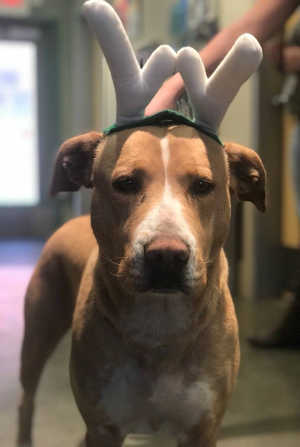
This female pit bull terrier is in kennel No. 5, ID No. 9126. Photo courtesy of Lake County Animal Care and Control. Female pit bull terrier
This female pit bull terrier has a short tan and white coat.
She’s in kennel No. 5, ID No. 9126.
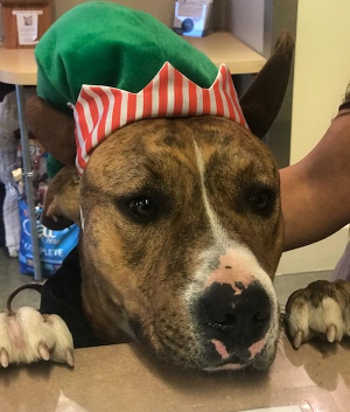
This male pit bull terrier is in kennel No. 6, ID No. 9127. Photo courtesy of Lake County Animal Care and Control. Male pit bull terrier
This male pit bull terrier has a short brindle and white coat.
He’s in kennel No. 6, ID No. 9127.
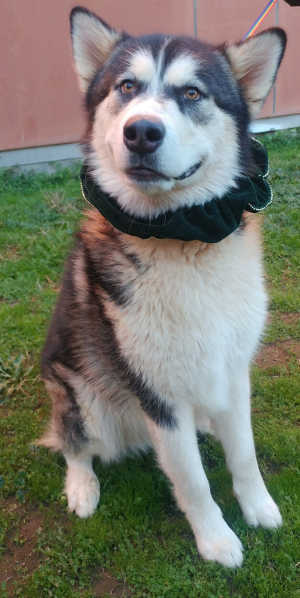
This male Husky-Alaskan Malamute mix is in kennel No. 10, ID No. 9125. Photo courtesy of Lake County Animal Care and Control. Husky-Alaskan Malamute
This male Husky-Alaskan Malamute mix has a long black and white coat.
He’s in kennel No. 10, ID No. 9125.
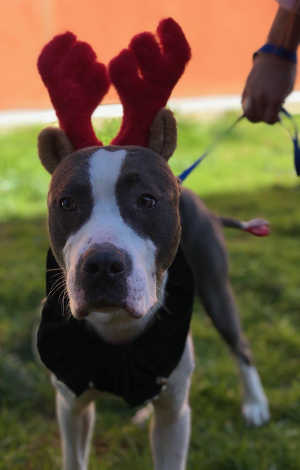
“Romeo” is a male pit bull terrier in kennel No. 19, ID No. 9075. Photo courtesy of Lake County Animal Care and Control. ‘Romeo’
“Romeo” is a male pit bull terrier.
He has a short gray and white coat.
He’s in kennel No. 19, ID No. 9075.
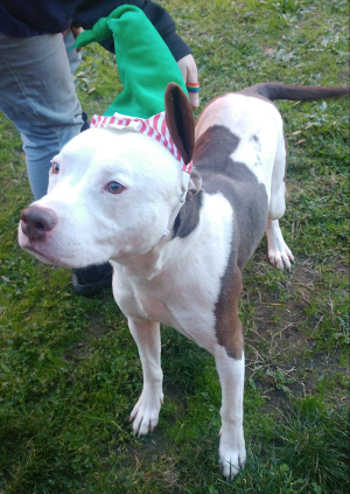
This male pit bull terrier is in kennel No. 29, ID No. 9003. Photo courtesy of Lake County Animal Care and Control. Male pit bull terrier
This male pit bull terrier has a short brown and white coat.
He already has been neutered.
He’s in kennel No. 29, ID No. 9003.
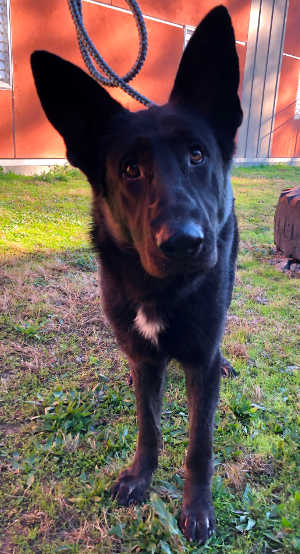
This male shepherd mix is in kennel No. 32, ID No. 9042. Photo courtesy of Lake County Animal Care and Control. Shepherd mix
This male shepherd mix has a long black coat with white markings.
He’s in kennel No. 32, ID No. 9042.
Lake County Animal Care and Control is located at 4949 Helbush in Lakeport, next to the Hill Road Correctional Facility.
Office hours are Monday through Friday, 11 a.m. to 5 p.m., and 11 a.m. to 3 p.m., Saturday. The shelter is open from 11 a.m. to 4 p.m. Monday through Friday and on Saturday from 11 a.m. to 3 p.m.
For more information call Lake County Animal Care and Control at 707-263-0278.
Email Elizabeth Larson at This email address is being protected from spambots. You need JavaScript enabled to view it.. Follow her on Twitter, @ERLarson, or Lake County News, @LakeCoNews.
Gov. Edmund G. Brown Jr. on Saturday announced that he has granted 132 pardons and 19 commutations.
Individuals who have been convicted of a crime in California may apply to the Governor for a pardon. Those granted pardons all completed their sentences and the majority were convicted of drug-related or other nonviolent crimes. Pardons are not granted unless they are earned.
A gubernatorial pardon may be granted to individuals who have demonstrated exemplary behavior and have lived productive and law-abiding lives following their conviction.
The process includes eligible individuals obtaining a Certificate of Rehabilitation, which is an order from a superior court declaring that a person convicted of a crime is now rehabilitated. This requirement was waived for a refugee who is currently detained as part of a federal immigration proceeding. When a pardon is granted, the California Department of Justice and the Federal Bureau of Investigation are notified so that they may update their records on the applicant. The pardon is filed with the Secretary of State and the Legislature, and it is a public record. The governor also granted 19 commutations to current inmates.
Inmates currently serving a sentence for a conviction by the California Courts can petition to have their sentence reduced by applying for a commutation. In the majority of these commutations, these individuals have been granted the opportunity to make their case before the Board of Parole Hearings, which will determine whether they are ready to be released from prison.
Copies of the gubernatorial pardons and commutations can be seen below.
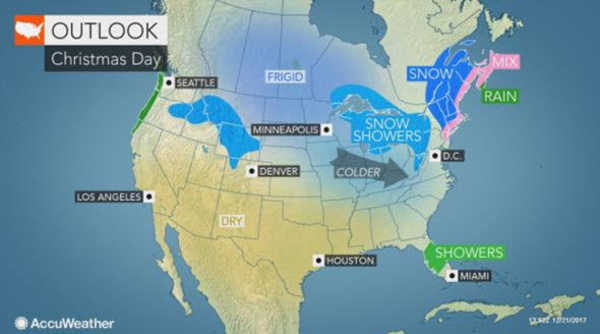
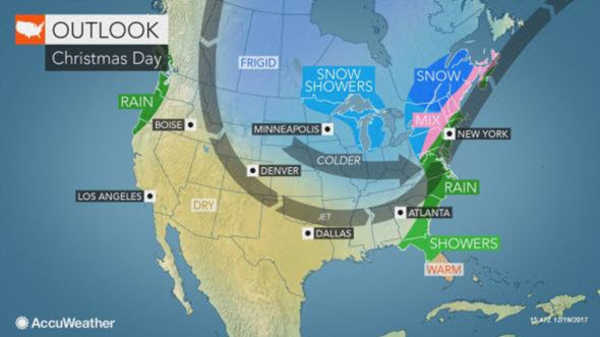
AccuWeather reports several storm systems will impact parts of the United States in the lead up to Christmas and will determine who will and will not experience a white Christmas.
In addition to bringing the chance of a white Christmas to some areas, travel may be hindered by the storms.
A white Christmas in the U.S. is defined as having an inch or more of snow on the ground on the morning of Dec. 25.
"The greatest chance of a white Christmas will be across the Midwest, Great Lakes, northern New England and the Rockies," AccuWeather Lead Long-Range Forecaster Paul Pastelok said.
While cold air pours across the central U.S., it will be a different story for the Southeast, mid-Atlantic and Northeast.
An area of high pressure across the Southeast will bring above-average warmth to most of the East during the days leading up to Christmas, according to Pastelok. The storm system across the Midwest will collide with this warmth, making for rain across a great deal of the Northeast.
This will likely squash white Christmas chances for the major I-95 cities in the Northeast, including Washington D.C., Philadelphia, New York and Boston, and melt existing snow for many places of the interior Northeast.
A few areas where the snow will likely last through Christmas will be western and upstate New York to northern New England where the snowcover is deep. While mild air will melt some of the snow, most of it will remain.
The wild card leading up to Christmas will be a last-minute storm likely to develop in the southern part of the country on Christmas Eve.
While multiple scenarios are still in play, this storm will ride along the jet stream and across the Northeast coast for Christmas morning.
Should this be the case, there could be a fresh dose of snow from the Ohio Valley to interior parts of the Northeast on Christmas Eve night and Christmas Day, with enough cold to allow the snow to accumulate.
Dry weather and a wildfire risk will continue in California, while a couple of storms may bring rounds of mixed precipitation to the coastal Northwest into Christmas Day.
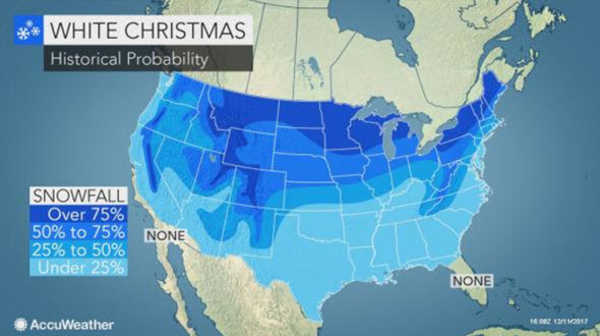
Historically, there are several areas in the U.S. that often experience a white Christmas. The northern tier of the country where it is often colder usually has an inch of snow on the ground on Dec. 25.
Areas in and around the Rockies in the western U.S. often have plenty of snow built up by Christmas. Favorable lake-effect snow areas around the Great Lakes also have a moderate to high chance each year of waking up to snow on Christmas.
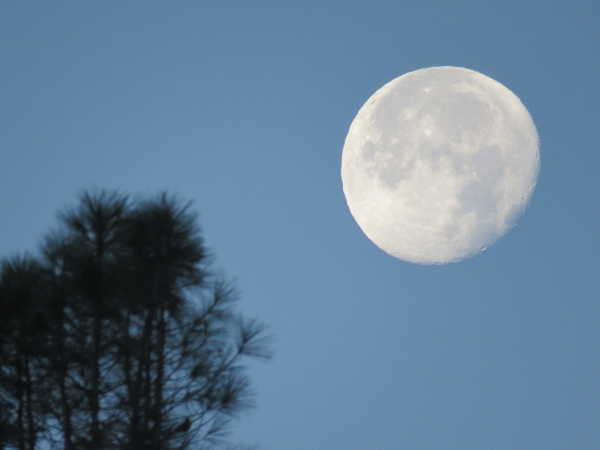
The December 2017 supermoon. Photo by Kathleen Scavone. “We all shine on...like the moon and the stars and the sun...we all shine on...come on and on and on...”– John Lennon
LAKE COUNTY, Calif. – The recent supermoon over Lake County's skies was a stunning and amazing sight to behold.
The skies here in Lake County are crystalline and perfect for gazing upon heavenly bodies.
Just what is a supermoon? According to Wikipedia:
"A supermoon is a full moon or a new moon that approximately coincides with the closest distance that the Moon reaches to Earth in its elliptic orbit, resulting in a larger-than-usual apparent size of the lunar disk as seen from Earth."
The next supermoon which will coincide with perigee, or the closest the moon comes to earth during its orbit, will occur during the new year, on Jan. 2 and 31, with the Jan. 2 supermoon slated as the most super, closest and largest, according to EarhtSky's Web site.
The colossal-appearing moon received the moniker, “supermoon” around 30 years ago when an astrologer named Richard Noelle – yes, an astrologer, rather than an astronomer coined the term!
The appearance of a supermoon, or full moon, over time has been falsely attributed to disasters such as tsunamis and volcanic eruptions, but contrary to popular belief, experts delineate that no hard evidence can prove the correlations.
Folklore holds that a full moon causes all manner of weird goings-on, such as a higher crime rate and “lunacy” such as howling. Experts who study lunar rhythm and its relationship to human behavior do find evidence to support a full moon's effect on some people.
But the findings are not consistent. Some studies show that a full moon affects sleep patterns in adults, but not in children. According to Time Magazine, "Even if the moon has as significant an effect on sleep as studies suggest, what's less clear is the mechanism behind it."
The full moon has most certainly been romanticized and applied to the titles of movies, such as the 1902 silent film, "A Trip to the Moon", the 1929 science fiction silent film, "Woman in the Moon," "Paper Moon", and more. Poetry abounds with moon as its subject, such as Emily Dickinson's "I watched the Moon Around the House," Ted Hughes's poem "Full Moon and Little Frieda” and Henry David Thoreau's "The Moon," to name but a few. Who doesn't know a song or two that features our own satellite, the moon? Songs such as "Moon River," "Bad Moon Rising," "Dancing in the Moonlight" and "Moondance" may come to mind.
Kathleen Scavone, M.A., is a retired educator, potter, writer and author of “Anderson Marsh State Historic Park: A Walking History, Prehistory, Flora, and Fauna Tour of a California State Park” and “Native Americans of Lake County.” She also formerly wrote for NASA and JPL as one of their “Solar System Ambassadors.” She was selected “Lake County Teacher of the Year, 1998-99” by the Lake County Office of Education, and chosen as one of 10 state finalists the same year by the California Department of Education.
LAKE COUNTY, Calif. – The holiday season is upon us and Cal Fire wants you and your loved ones to enjoy this time of year.
As we come together to celebrate, there are a few ways to ensure your festivities are safe and injury free.
If you are using candles to celebrate the holidays, make sure to place them in an open area and at least 3 feet from combustible decorations.
Extinguish candles before leaving a room (don’t leave them unattended) and make sure to keep them out of the reach of small children and away from pets.
If you are cooking and baking, stay in the kitchen, as it is easy to get distracted with friends and family around.
Did you know that unattended cooking is the leading cause of home fires? Keep objects that can catch fire away from cooking surfaces such as pot holders, paper towels, loose clothing and other flammable items.
Try to keep the stovetop, burners, and oven clean. Spilled oil, splattered grease, or food debris can catch fire while the stove or oven is being used or during the oven’s self-cleaning cycle.
Always check the oven to make sure it’s empty before turning it on. Use the oven for cooking only, not for storage.
Always have the lid or a fire extinguisher nearby when cooking. If a fire occurs, cover the pan with the lid to smother the fire or use the fire extinguisher.
Never attempt to move the pan, and never pour water on an oil/grease fire; it will explode and grow. When in doubt, just get out.
Did you know that a Christmas tree can be one of the most hazardous items in your home? An ignited tree can be totally consumed by a fire in 3 to 5 seconds, and generate more than 2,000 degrees of radiant heat.
Make sure to fill with water daily, and check lights carefully for broken sockets or frayed wires – replace any damaged strings. Place your tree away from exits, fireplaces, and other heat sources and make sure to remove your tree promptly after the holidays.
Electrical fires run high during the holiday season, try to repair or replace worn, damaged outlets, cords and appliances immediately.
Use a surge protector for lights to avoid an overload. Use no more than three sets of lights per single extension cord. Plug the surge protector directly into an outlet, not into an extension cord or another surge protector.
Stapling cords to the wall can damage the wire and cause a fire. Avoid running cords across doorways, under carpets, or under furniture. Unplug lights before going to bed or leaving the house. Use outdoor lighting for outdoors and indoor lighting for indoor use.
“This festive season should be a joyous time for family and friends,” said Lynne Tolmachoff, Cal Fire’s Chief of Public Education. “We want you to have a wonderful celebration and following a few simple safety tips can help minimize your chance of an accident.”
For more safety tips on how to protect you and your family, visit www.fire.ca.gov.
In 1968, Apollo 8 placed humans into lunar orbit for the first time. As the astronauts in their spacecraft emerged from behind the Moon, they were surprised and enchanted by an amazing view of Earth rising over the lunar horizon. Bill Anders quickly snapped a picture of the spectacular Earthrise.
Humankind viewed their planet and saw not a jigsaw puzzle of states and countries on an uninspiring flat map – but rather a whole planet uninterrupted by boundaries, a sphere of dazzling beauty floating alone in the void.
Cameras on NASA spacecraft have treated us to intriguing perspectives of our home planet from various locales.
The Deep Space Climate Observatory, or DSCOVR mission, was launched to monitor the solar wind in real time, but it has also delivered these wondrous images of every continent peeking out from misty shrouds blanketing our ultramarine oceans.
Since mid-2015, DSCOVR has been snapping images like these of the fully-lit Earth, most days every 1 to 2 hours, from a stable point between the Earth and the Sun that is about a million miles (1.6 million km) away.
On Valentine's Day 1990, the Voyager spacecraft captured this photo of our planet from the amazing distance of 3.7 billion miles (6 billion km). This ‘Pale Blue Dot’ image, requested by Carl Sagan of the Voyager imaging team, showed the Earth as a single pixel and inspired Sagan’s book of the same name.
As Sagan wrote "The Earth is a very small stage in a vast cosmic arena… this distant image of our tiny world … underscores our responsibility to … preserve and cherish the pale blue dot, the only home we've ever known."
A number of spacecraft have taken the opportunity to capture images and videos of Earth and the Moon when flying by Earth for a “gravity assist” to far-off bodies in our solar system.
Galileo did so in 1992 on its way to Jupiter, as did Juno nearly two decades later. In 2005, MESSENGER took these beautiful images of our home, then looked back again just before entering Mercury’s orbit five years later.
MESSENGER isn’t the only spacecraft to look back at home from its destination across the solar system.
On July 19, 2013, NASA's Cassini spacecraft slipped into Saturn's shadow and turned to image the planet, seven of its moons, its inner rings – and, in the background, our home planet. NASA’s Lunar Reconnaissance Orbiter, or LRO, has collected a treasure trove of data and discoveries about the Moon.
LRO’s camera also treated us to spectacular views of our planet from lunar orbit. Here’s one such image taken in October 2015.
Images of home have come back to us from Mars’ orbit and from the surface of Mars itself.
The High Resolution Imaging Science Experiment, or HiRISE, on NASA’s Mars Reconnaissance Orbiter took this picture of our planet and its moon on Nov. 20, 2016, when Mars was 127 million miles (200 million km) away from Earth.
This image, captured by NASA's Curiosity Mars rover from the surface of Mars on Jan. 31, 2014, showed ‘evening star’ Earth shining more brightly than any star in the Martian night sky. From the vantage point of Mars, Earth is visible either in the early evening or early morning, just as Venus is from the vantage point of Earth.
What might the caption be when a human stands on the surface of Mars and focuses the camera back on home?
 How to resolve AdBlock issue?