LAKE COUNTY, Calif. – Lake County Animal Care and Control has five dogs ready to go to new homes this week.
The dogs offered adoption this week include mixes of Australian Shepherd, greyhound, Labrador Retriever, pit bull and shepherd.
Dogs that are adopted from Lake County Animal Care and Control are either neutered or spayed, microchipped and, if old enough, given a rabies shot and county license before being released to their new owner. License fees do not apply to residents of the cities of Lakeport or Clearlake.
If you're looking for a new companion, visit the shelter. There are many great pets hoping you'll choose them.
The following dogs at the Lake County Animal Care and Control shelter have been cleared for adoption (additional dogs on the animal control Web site not listed are still “on hold”).
“Rowdy” is a female greyhound-Labrador Retriever mix in kennel No. 8, ID No. 9523. Photo courtesy of Lake County Animal Care and Control. ‘Rowdy’
“Rowdy” is a female greyhound-Labrador Retriever mix.
She has a short black coat with white markings, and already has been spayed.
She’s in kennel No. 8, ID No. 9523.
This female Australian Shepherd mix is in kennel No. 10, ID No. 9539. Photo courtesy of Lake County Animal Care and Control. Australian Shepherd mix
This female Australian Shepherd mix has a long tan and black coat.
She is in kennel No. 10, ID No. 9539.
This male pit bull-Labrador Retriever mix is in kennel No. 11, ID No. 9591. Photo courtesy of Lake County Animal Care and Control. Pit bull-Labrador Retriever mix
This male pit bull-Labrador Retriever mix has a short black coat.
He already has been neutered.
He’s in kennel No. 11, ID No. 9591.
This female Labrador Retriever-shepherd mix is in kennel No. 19, ID No. 9586. Photo courtesy of Lake County Animal Care and Control. Labrador Retriever-shepherd mix
This female Labrador Retriever-shepherd mix has a short black coat with white markings.
She’s in kennel No. 19, ID No. 9586.
“Onyx” is a female shepherd mix in kennel No. 22, ID No. 4174. Photo courtesy of Lake County Animal Care and Control. ‘Onyx’
“Onyx” is a female shepherd mix.
She has a medium-length black coat with white markings, and already has been spayed.
She’s in kennel No. 22, ID No. 4174.
Lake County Animal Care and Control is located at 4949 Helbush in Lakeport, next to the Hill Road Correctional Facility.
Office hours are Monday through Friday, 11 a.m. to 5 p.m., and 11 a.m. to 3 p.m., Saturday. The shelter is open from 11 a.m. to 4 p.m. Monday through Friday and on Saturday from 11 a.m. to 3 p.m.
For more information call Lake County Animal Care and Control at 707-263-0278.
Email Elizabeth Larson at This email address is being protected from spambots. You need JavaScript enabled to view it.. Follow her on Twitter, @ERLarson, or Lake County News, @LakeCoNews.
Notanee Bourassa knew that what he was seeing in the night sky was not normal.
Bourassa, an IT technician in Regina, Canada, trekked outside of his home on July 25, 2016, around midnight with his two younger children to show them a beautiful moving light display in the sky – an aurora borealis.
He often sky gazes until the early hours of the morning to photograph the aurora with his Nikon camera, but this was his first expedition with his children.
When a thin purple ribbon of light appeared and starting glowing, Bourassa immediately snapped pictures until the light particles disappeared 20 minutes later.
Having watched the northern lights for almost 30 years since he was a teenager, he knew this wasn’t an aurora. It was something else.
From 2015 to 2016, citizen scientists – people like Bourassa who are excited about a science field but don't necessarily have a formal educational background – shared 30 reports of these mysterious lights in online forums and with a team of scientists that run a project called Aurorasaurus.
The citizen science project, funded by NASA and the National Science Foundation, tracks the aurora borealis through user-submitted reports and tweets.
The Aurorasaurus team, led by Liz MacDonald, a space scientist at NASA’s Goddard Space Flight Center in Greenbelt, Maryland, conferred to determine the identity of this mysterious phenomenon. MacDonald and her colleague Eric Donovan at the University of Calgary in Canada talked with the main contributors of these images, amateur photographers in a Facebook group called Alberta Aurora Chasers, which included Bourassa and lead administrator Chris Ratzlaff. Ratzlaff gave the phenomenon a fun, new name, Steve, and it stuck.
But people still didn't know what it was.
Scientists' understanding of Steve changed that night Bourassa snapped his pictures. Bourassa wasn't the only one observing Steve. Ground-based cameras called all-sky cameras, run by the University of Calgary and University of California, Berkeley, took pictures of large areas of the sky and captured Steve and the auroral display far to the north.
From space, the European Space Agency Swarm satellite just happened to be passing over the exact area at the same time and documented Steve.
For the first time, scientists had ground and satellite views of Steve. Scientists have now learned, despite its ordinary name, that Steve may be an extraordinary puzzle piece in painting a better picture of how Earth's magnetic fields function and interact with charged particles in space. The findings are published in a study released today in Science Advances.
"This is a light display that we can observe over thousands of kilometers from the ground,” said MacDonald. “It corresponds to something happening way out in space. Gathering more data points on STEVE will help us understand more about its behavior and its influence on space weather.”
The study highlights one key quality of Steve: Steve is not a normal aurora. Auroras occur globally in an oval shape, last hours and appear primarily in greens, blues and reds. Citizen science reports showed Steve is purple with a green picket fence structure that waves. It is a line with a beginning and end. People have observed Steve for 20 minutes to 1 hour before it disappears.
If anything, auroras and Steve are different flavors of an ice cream, said MacDonald. They are both created in generally the same way: Charged particles from the Sun interact with Earth's magnetic field lines.
The uniqueness of Steve is in the details. While Steve goes through the same large-scale creation process as an aurora, it travels along different magnetic field lines than the aurora. All-sky cameras showed that Steve appears at much lower latitudes. That means the charged particles that create Steve connect to magnetic field lines that are closer to Earth's equator, hence why Steve is often seen in southern Canada.
Perhaps the biggest surprise about Steve appeared in the satellite data. The data showed that Steve comprises a fast moving stream of extremely hot particles called a sub auroral ion drift, or SAID. Scientists have studied SAIDs since the 1970s but never knew there was an accompanying visual effect. The Swarm satellite recorded information on the charged particles' speeds and temperatures, but does not have an imager aboard.
"People have studied a lot of SAIDs, but we never knew it had a visible light. Now our cameras are sensitive enough to pick it up and people's eyes and intellect were critical in noticing its importance," said Donovan, a co-author of the study. Donovan led the all-sky camera network and his Calgary colleagues lead the electric field instruments on the Swarm satellite.
Steve is an important discovery because of its location in the sub auroral zone, an area of lower latitude than where most auroras appear that is not well researched. For one, with this discovery, scientists now know there are unknown chemical processes taking place in the sub auroral zone that can lead to this light emission.
Second, Steve consistently appears in the presence of auroras, which usually occur at a higher latitude area called the auroral zone. That means there is something happening in near-Earth space that leads to both an aurora and Steve. Steve might be the only visual clue that exists to show a chemical or physical connection between the higher latitude auroral zone and lower latitude sub auroral zone, said MacDonald.
"Steve can help us understand how the chemical and physical processes in Earth's upper atmosphere can sometimes have local noticeable effects in lower parts of Earth's atmosphere,” said MacDonald. “This provides good insight on how Earth's system works as a whole."
The team can learn a lot about Steve with additional ground and satellite reports, but recording Steve from the ground and space simultaneously is a rare occurrence. Each Swarm satellite orbits Earth every 90 minutes and Steve only lasts up to an hour in a specific area. If the satellite misses Steve as it circles Earth, Steve will probably be gone by the time that same satellite crosses the spot again.
In the end, capturing Steve becomes a game of perseverance and probability.
"It is my hope that with our timely reporting of sightings, researchers can study the data so we can together unravel the mystery of Steve's origin, creation, physics and sporadic nature," said Bourassa. "This is exciting because the more I learn about it, the more questions I have."
As for the name "Steve" given by the citizen scientists? The team is keeping it as an homage to its initial name and discoverers. But now it is STEVE, short for Strong Thermal Emission Velocity Enhancement.
Other collaborators on this work are: the University of Calgary, New Mexico Consortium, Boston University, Lancaster University, Athabasca University, Los Alamos National Laboratory and the Alberta Aurora Chasers Facebook group.
If you live in an area where you may see STEVE or an aurora, submit your pictures and reports to Aurorasaurus through www.aurorasaurus.org or the free iOS and Android mobile apps. To learn how to spot STEVE, click here.
Kasha Patel works for NASA's Goddard Space Flight Center, Greenbelt, Md.
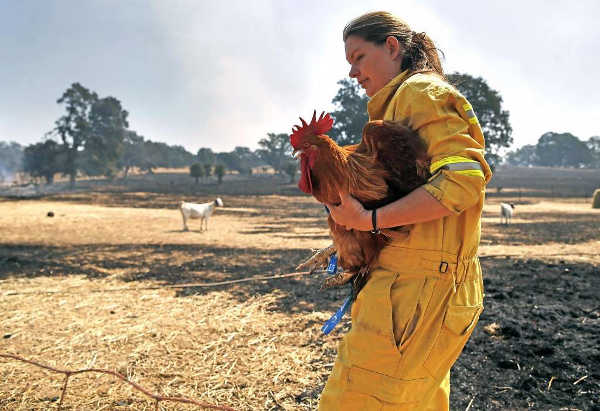
Lake County Animal Care and Control Officer Holly Bray rescues a chicken during the Clayton fire in Lower Lake, Calif., in August 2016. Photo courtesy of Animal Care and Control. LAKEPORT, Calif. – Lake Evacuation and Animal Protection will hold its annual training later this month, and community members interested in joining the effort are invited to take part.
The meeting and volunteer recruitment event will take place from 9 a.m. to 1 p.m. Saturday, March 31, in the Little Theater at the Lake County Fairgrounds, 401 Martin St., Lakeport. Participants are asked to enter at the Martin Street main gate, turn right into large field in front of the Little Theater.
Lake Evacuation and Animal Protection, or LEAP as it’s known, was created in 2011 under the aegis of Lake County Animal Care and Control.
It has filled a critical role in the years since, with Animal Care and Control staff and the LEAP volunteers saving and helping animals in the county’s wildland fires over several summers.
The group’s efforts won it the 2015 Governor’s Volunteering and Service Award for Governmental Agency of the Year, as Lake County News has reported.
Animal Care and Control Director Bill Davidson said they are planning to change the training up a bit this year.
“Instead of just lecture, we are hoping to break everyone into four groups and rotate them through the four main areas of operation that LEAP provides: Field services, staging area, disaster response trailer and office work,” he said.
Davidson added that they hope to let everyone get a little hands-on experience during the training sessions.
Snacks will be provided.
For more information about LEAP call Lake County Animal Care and Control at 707-263-0278.
Email Elizabeth Larson at This email address is being protected from spambots. You need JavaScript enabled to view it.. Follow her on Twitter, @ERLarson, or Lake County News, @LakeCoNews.
LAKE COUNTY, Calif. – On Saturday many Lake County residents will join people across the nation in celebrating Irish heritage and culture as part of St. Patrick’s Day.
St. Patrick’s Day, March 17, now coincides with Irish-American Heritage Month, thanks to a 1991 proclamation by the US Congress and an annual proclamation by the president.
The day began as a holiday to honor St. Patrick, who introduced Christianity to Ireland in the fifth century.
However, the first St. Patrick’s Day parade didn’t take place in Ireland but in New York City on March 17, 1762, and featured Irish soldiers serving in the English military, according to a US Census Bureau fact sheet. This parade became an annual event, with President Truman attending in 1948.
The Census Bureau reported that 32.3 million Americans – or 10 percent of the United States’ population – claimed Irish ancestry in 2016, making it the No. 2 ancestry group in size, behind German with 44.7 million, according to the American Community Survey.
There are estimated to be 20,590 Irish speakers in the United States, the agency said.
In Lake County, the Census Bureau’s American Community Survey for 2012 to 2016 found that there were 6,882 residents who reported Irish ancestry. In keeping with the nationwide pattern, that group ranked No. 2 in size compared to those reporting German ancestry, who totaled 7,744.
Those interested in finding out more about their ancestry can find information at the following sites:
– Irish Department of Culture, Heritage and the Gaeltacht: Dedicated to assisting visitors with searching for family history records, www.irishgenealogy.ie.
– Information on travel and events in Ireland: www.ireland.com.
Email Elizabeth Larson at This email address is being protected from spambots. You need JavaScript enabled to view it.. Follow her on Twitter, @ERLarson, or Lake County News, @LakeCoNews.
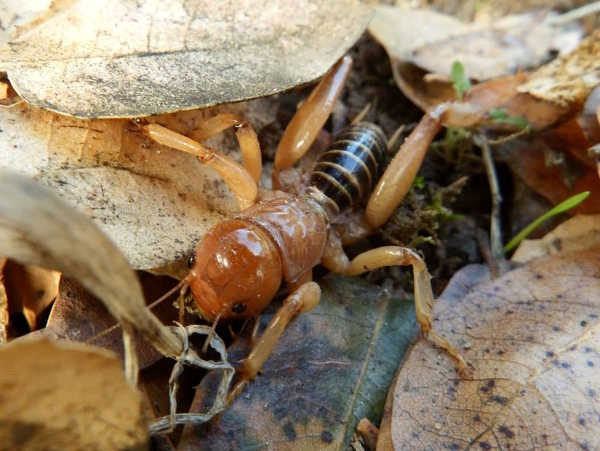
The Jerusalem Cricket’s eyes are multi-faceted, and its hard-pinching jaws are made for crunching up dead and decaying organic matter. Photo by Robin Loznak, used with permission.
NORTHERN CALIFORNIA – Imagine a humpbacked insect with opposable “thumbs” on its front legs, “meat hooks” on its hind legs, limbs that can regrow after being removed, and crushing mouth parts that can inflict a bite so painful you’d think you’d been poisoned by it.
No, it’s not an alien or something from a nightmare, it’s a very real insect: the Jerusalem Cricket (Stenopelmatus sp.).
Native to Mexico and the western United States, the Jerusalem Cricket looks something like a giant mutant ant, with a vaguely human head and dark multifaceted eyes.
Although they appear like something out of a horror movie, these insects – which are not crickets and don’t hail from Jerusalem – are actually fairly benign.
It’s thought that their name stems from the early 1900’s when the exclamation “Oh, Jerusalem!” was commonly used to express feelings of astonishment or disgust. They’re also referred to as “red-skulls,” “children of the earth” and more commonly as “potato bugs.”
Although the name “potato bug” was derived from the notion that these insect eat tubers, like potatoes, that’s only partially true.
Jerusalem crickets do eat roots and tubers, but usually only those of plants that are either already dead or dying. They’re one of nature’s recyclers. They’ll even eat their own shed skin between each molt. Other insects – living or dead -- are also added to their diet to provide them with more nourishment.
The Jerusalem crickets have no wings, so they are earthbound, and on the surface of the earth they are actually rather slow and clumsy in their movements.
It’s underground where the Jerusalem cricket is most comfortable and most adept. Its specialized feet are used mostly for burrowing through the soft earth and under rocks and the roots of trees.
It actually spends the majority of its time underground, but is often found on the surface after a hard rain when its burrows get flooded. Once above ground, these insects are easy-pickings for predators.
As we mentioned, the Jerusalem cricket packs a hard bite, but it’s not venomous. When a bite won’t stave off an attack, the Jerusalem cricket will “skunk” an aggressor with a foul-smelling odor.
See those finger-like protrusions coming out of the last segment of the Jerusalem Cricket’s abdomen? Those are the “cerci,” a kind of tactile sensory organ. Photo by Mary K. Hanson. They don’t vocalize much, although they can hiss by expelling air through the spiracles on their bodies. Without wings, the “crickets” cannot produce sound as some other insects can, nor can they hear, so they communicate with one another by drumming their abdomen against the ground.
It’s believed that different species of Jerusalem cricket create different drumming songs to attract their mates. The drumming that one Jerusalem cricket produces is picked up by other Jerusalem crickets through special sensors on their legs called “subgenual” (Latin for “below the knee”) organs. Other insects, like cockroaches, have similar organs, but the organs’ shape and sensitivity varies by insect.
Males Jerusalem crickets can be distinguished from the females by the black “hooks” that appear between the cerci at the end of the abdomen. The cerci are those short fingerling-looking things that protrude from the last segment of the abdomen. In lieu of the black hooks, female Jerusalem Crickets will have a long ovipositor below the cerci.
During the mating season, the Jerusalem Crickets are vulnerable to predation since their drumming requires that they be above ground. Another danger to the males during this time is the fact that the females will often attack and eat their suitors immediately after mating.
Once they have been fertilized, the female will lay her eggs in the ground, usually a few inches from the surface, and abandon them there.
After the eggs hatch, it takes about two years for the young “crickets” to reach their full size and sexual maturity.
During those two years, they go through about 12 molts, growing larger after each one until they’re about 2 inches long.
A growing Jerusalem Cricket can regrow a lost limb during the next successive molt after it’s injured, in much the same way some crabs can regrow a lost claw.
Although these weird-looking insects may seem like the stuff of science fiction, they’re actually an integral part of the environment.
Their burrowing helps to aerate the soil, they’re eating helps to process organic matter, and their bodies add nutrition to the diet of birds, bats, coyotes, foxes and other animals.
So, they may be creepy-looking, but they do their jobs well.
Mary K. Hanson is a Certified California Naturalist, author and nature photographer. Tuleyome is a 501(c)(3) nonprofit conservation organization based in Woodland. For more information, visit www.tuleyome.org.
On Friday, Congressman Mike Thompson (CA-05) announced that he and a record 182 members of Congress from both parties are requesting $75 million in federal funding for the National Instant Criminal Background Check Systems, or NICS.
“A strong background checks system helps keep guns out of the hands of dangerous individuals. That’s why I am proud to announce a record number of supporters for my appropriations request for the NICS background checks system,” said Thompson, who chairs the Gun Violence Prevention Task Force. “This is strong progress, but our work to prevent gun violence continues. Congress should also immediately take up my bipartisan background checks bill, H.R.4240, which will expand the system and close loopholes to help keep our schools, our communities, and our nation safe.”
A copy of the letter is below.
March 18, 2018
The Honorable John Culberson The Honorable José E. Serrano Chairman Ranking Member House Subcommittee on Commerce, Justice, House Subcommittee on Commerce, Justice, Science and Related Agencies Science and Related Agencies H-310, The Capitol 1016 Longworth House Office Building Washington, DC 20515 Washington, DC 20515
“Dear Chairman Culberson and Ranking Member Serrano:
“As the Committee begins writing the Fiscal Year (FY) 2019 Commerce, Justice, Science, and Related Agencies Appropriations bill, we respectfully request funding for implementation of the National Instant Background Check Systems (NICS) Improvement Amendments Act of 2007 (Pub. L. No. 110-180) at a $75 million level. The Act provides for grants to states to upgrade their electronic databases, incentives for states to transmit electronic records to NICS, penalties for states that do not comply, and requirements for keeping NICS up-to-date, including the removal of obsolete or erroneous records. The Act also provides financial incentives for states to develop “relief from disabilities” procedures for persons who have lost the right to possess a firearm due to a mental health adjudication or commitment but are later determined not to pose a danger to public safety.
“As you are aware, the Gun Control Act of 1968 (Pub. L. No. 90-618) precludes certain persons, including felons, those adjudicated mentally ill, illegal aliens, drug abusers, and those under a restraining order, from purchasing or possessing firearms. The only way to enforce these requirements effectively is to ensure that NICS has up-to-date records from state and federal sources. At present, millions of records are currently missing from the various databases that make up NICS. Many states do not have the resources necessary to implement the technology to automate criminal history and mental health records, which has allowed persons otherwise prohibited from purchasing or owning firearms to do so in violation of federal law. This remains a serious problem because many states still do not submit adequate numbers of mental health and criminal records to make NICS work as intended.
“The intent of NICS Improvement Amendments Act is to ensure there are sufficient resources to provide accurate and timely data about persons prohibited from possessing firearms. This cannot be achieved absent adequate funding for NICS. In fact, demand for this funding is increasing every year and we must provide adequate funding to meet this growing need. While the Act authorized a combined total of $1.125 billion from FY 2009 through FY 2013, a total of only $63.567 million was appropriated during that time.
“We fully understand the current constraints on the federal budget and appropriations process. Keeping citizens safe, however, must be Congress’s top priority. The NICS Improvement Amendments Act has been severely underfunded in years past, and the-all-too-frequent tragedies across our Nation unfortunately show that gun violence is still a very serious issue that plagues our country. Ensuring NICS has complete and timely information to keep firearms out of the hands of persons who cannot safely and legally possess them while at the same time protecting Americans’ Second Amendment rights will save lives. Consequently, we respectfully urge the Committee to fund the NICS Improvement Amendments Act at a level that at minimum of $75 million.”
Thompson represents California’s Fifth Congressional District, which includes all or part of Contra Costa, Lake, Napa, Solano and Sonoma counties.
 How to resolve AdBlock issue?





 [Source: U.S. Census Bureau]