How to resolve AdBlock issue?
Refresh this page
How to resolve AdBlock issue?
Refresh this page
Lake County News,California
  • Home
    • Registration Form
  • News
    • Education
    • Veterans
    • Community
      • Obituaries
      • Letters
      • Commentary
    • Police Logs
    • Business
    • Recreation
    • Health
    • Religion
    • Legals
    • Arts & Life
    • Regional
  • Calendar
  • Contact us
    • FAQs
    • Phones, E-Mail
    • Subscribe
  • Advertise Here
  • Login

News

What causes the powerful winds that fuel dust storms, wildfires and blizzards? A weather scientist explains


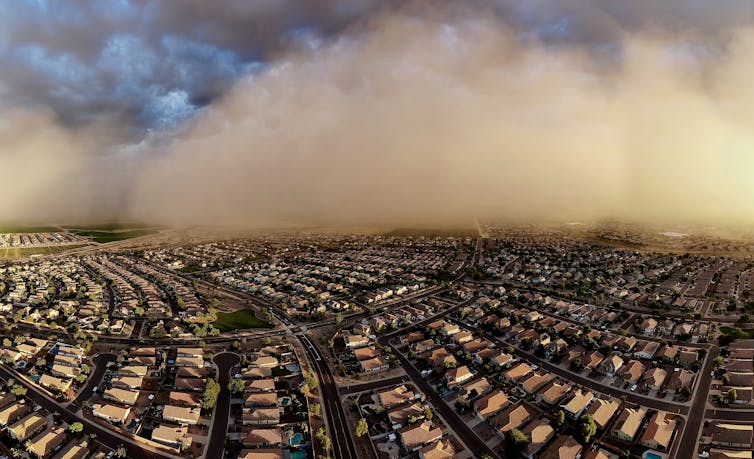
When huge dust storms like this one in the Phoenix suburbs in 2022 hit, it’s easy to see the power of the wind. Christopher Harris/iStock Images via Getty Plus

Windstorms can seem like they come out of nowhere, hitting with a sudden blast. They might be hundreds of miles long, stretching over several states, or just in your neighborhood.

But they all have one thing in common: a change in air pressure.

Just like air rushing out of your car tire when the valve is open, air in the atmosphere is forced from areas of high pressure to areas of low pressure.

The stronger the difference in pressure, the stronger the winds that will ultimately result.
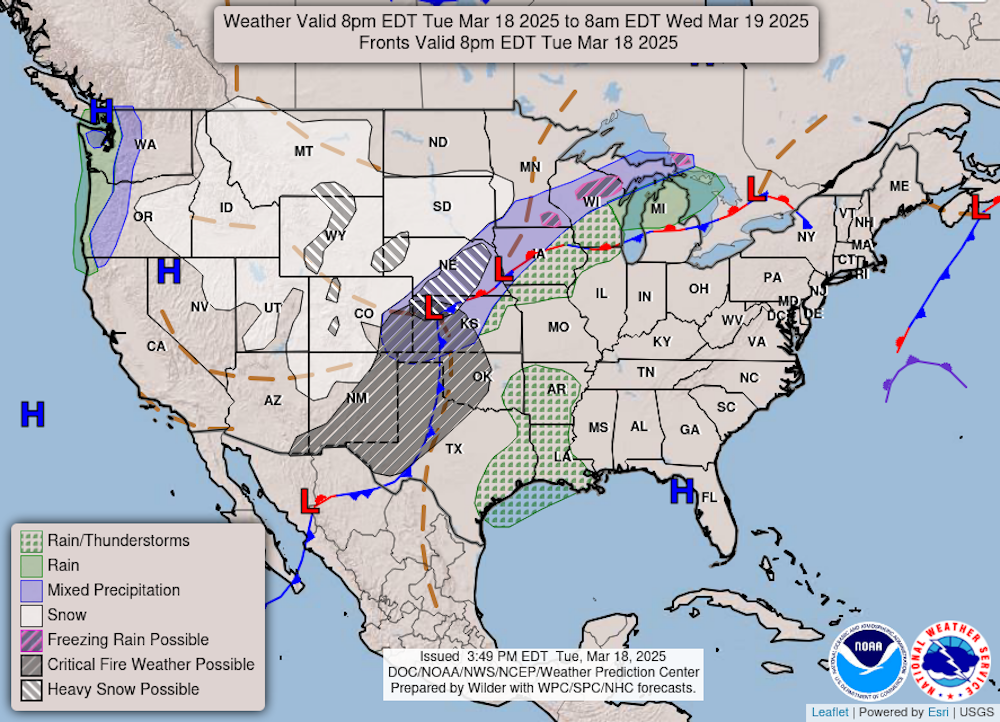
A weather map with a line between high and low pressure stretching across the U.S.
On this forecast for March 18, 2025, from the National Oceanic and Atmospheric Administration, ‘L’ represents low-pressure systems. The shaded area over New Mexico and west Texas represents strong winds and low humidity that combine to raise the risk of wildfires. NOAA Weather Prediction Center

Other forces related to the Earth’s rotation, friction and gravity can also alter the speed and direction of winds. But it all starts with this change in pressure over a distance – what meteorologists like me call a pressure gradient.

So how do we get pressure gradients?

Strong pressure gradients ultimately owe their existence to the simple fact that the Earth is round and rotates.

Because the Earth is round, the sun is more directly overhead during the day at the equator than at the poles. This means more energy reaches the surface of the Earth near the equator. And that causes the lower part of the atmosphere, where weather occurs, to be both warmer and have higher pressure on average than the poles.

Nature doesn’t like imbalances. As a result of this temperature difference, strong winds develop at high altitudes over midlatitude locations, like the continental U.S. This is the jet stream, and even though it’s several miles up in the atmosphere, it has a big impact on the winds we feel at the surface.
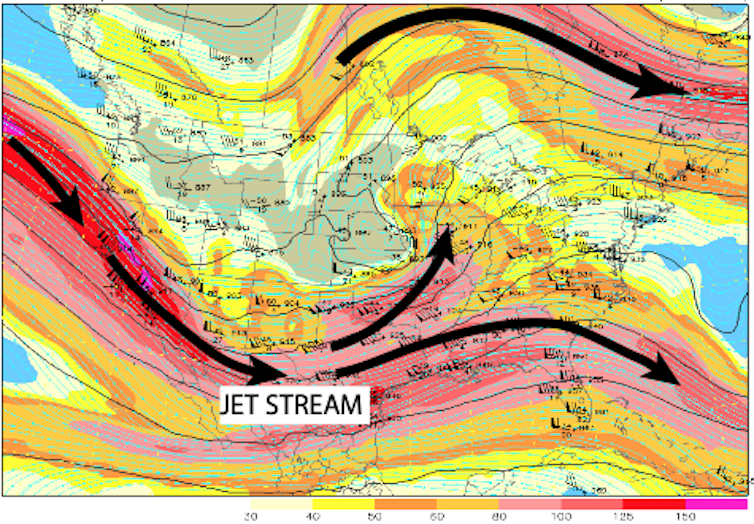
Wind speed and direction in the upper atmosphere on March 14, 2025, show waves in the jet stream. Downstream of a trough in this wave, winds diverge and low pressure can form near the surface. NCAR

Because Earth rotates, these upper-altitude winds blow from west to east. Waves in the jet stream – a consequence of Earth’s rotation and variations in the surface land, terrain and oceans – can cause air to diverge, or spread out, at certain points. As the air spreads out, the number of air molecules in a column decreases, ultimately reducing the air pressure at Earth’s surface.

The pressure can drop quite dramatically over a few days or even just a few hours, leading to the birth of a low-pressure system – what meteorologists call an extratropical cyclone.

The opposite chain of events, with air converging at other locations, can form high pressure at the surface.

In between these low-pressure and high-pressure systems is a strong change in pressure over a distance – a pressure gradient. And that pressure gradient leads to strong winds. Earth’s rotation causes these winds to spiral around areas of high and low pressure. These highs and lows are like large circular mixers, with air blowing clockwise around high pressure and counterclockwise around low pressure. This flow pattern blows warm air northward toward the poles east of lows and cool air southward toward the equator west of lows.

A maps shows pressure changes don't follow a straight line.
A map illustrates lines of surface pressure, called isobars, with areas of high and low pressure marked for March 14, 2025. Winds are strongest when isobars are packed most closely together. Plymouth State University, CC BY-NC-SA

As the waves in the jet stream migrate from west to east, so do the surface lows and highs, and with them, the corridors of strong winds.

That’s what the U.S. experienced when a strong extratropical cyclone caused winds stretching thousands of miles that whipped up dust storms and spread wildfires, and even caused tornadoes and blizzards in the central and southern U.S. in March 2025.

Whipping up dust storms and spreading fires

The jet stream over the U.S. is strongest and often the most “wavy” in the springtime, when the south-to-north difference in temperature is often the strongest.

Winds associated with large-scale pressure systems can become quite strong in areas where there is limited friction at the ground, like the flat, less forested terrain of the Great Plains. One of the biggest risks is dust storms in arid regions of west Texas or eastern New Mexico, exacerbated by drought in these areas.

Downtown is barely visible through a haze of dust.
A dust storm hit Albuquerque, N.M., on March 18, 2025. Another dust storm a few dats earlier in Kansas caused a deadly pileup involving dozens of vehices on I-70. AP Photo/Roberto E. Rosales

When the ground and vegetation are dry and the air has low relative humidity, high winds can also spread wildfires out of control.

Even more intense winds can occur when the pressure gradient interacts with terrain. Winds can sometimes rush faster downslope, as happens in the Rockies or with the Santa Ana winds that fueled devastating wildfires in the Los Angeles area in January.

Violent tornadoes and storms

Of course, winds can become even stronger and more violent on local scales associated with thunderstorms.

When thunderstorms form, hail and precipitation in them can cause the air to rapidly fall in a downdraft, causing very high pressure under these storms. That pressure forces the air to spread out horizontally when it reaches the ground. Meteorologists call these straight line winds, and the process that forms them is a downburst. Large thunderstorms or chains of them moving across a region can cause large swaths of strong wind over 60 mph, called a derecho.

Finally, some of nature’s strongest winds occur inside tornadoes. They form when the winds surrounding a thunderstorm change speed and direction with height. This can cause part of the storm to rotate, setting off a chain of events that may lead to a tornado and winds as strong as 300 mph in the most violent tornadoes.

How a tornado forms. Source: NOAA.

Tornado winds are also associated with an intense pressure gradient. The pressure inside the center of a tornado is often very low and varies considerably over a very small distance.

It’s no coincidence that localized violent winds from thunderstorm downbursts and tornadoes often occur amid large-scale windstorms. Extratropical cyclones often draw warm, moist air northward on strong winds from the south, which is a key ingredient for thunderstorms. Storms also become more severe and may produce tornadoes when the jet stream is in close proximity to these low-pressure centers. In the winter and early spring, cold air funneling south on the northwest side of strong extratropical cyclones can even lead to blizzards.

So, the same wave in the jet stream can lead to strong winds, blowing dust and fire danger in one region, while simultaneously triggering a tornado outbreak and a blizzard in other regions.The Conversation

Chris Nowotarski, Associate Professor of Atmospheric Science, Texas A&M University

This article is republished from The Conversation under a Creative Commons license. Read the original article.

Lake County Library Literacy Program provides important training

LAKE COUNTY, Calif. — As California Library Week is marked this week, the Lake County Library is preparing to train a new group of volunteers in its Literacy Program.

The Lake County Library Literacy Program will host a springtime new tutor training on Wednesday, April 16, at the Redbud Library, located at 14785 Burns Valley Road in Clearlake.

The training is free and will take place from 10 a.m. to 4 p.m.

Light snacks and refreshments will be provided, along with training materials at no cost.

Tutors are in high demand at the Library Literacy Program, with more volunteer tutors needed in the Clearlake area, bilingual tutors for the English as a Second Language Program, and tutors available and willing to tutor at the Lake County Jail.

A recent survey of adult skills indicated 26% of Lake County adults have literacy skills at level one or below.

Many adults want to improve their reading and writing skills so they can access better jobs, further their own education, advocate for their children, and overall improve their way of life.

Through hard work and perseverance, adult learners can change their own, and their family’s lives, for the better. Becoming a tutor can help someone to a better future.

No experience is needed, and ongoing support and workshops are provided for tutors. Upon completion of the training, tutors will be matched with adult learners in a variety of settings around the county.

Those who would like to help adults improve their literacy skills are encouraged to attend.

Hosted by Literacy Program Coordinator Georgina Marie Guardado and facilitated by Lake County Literacy Coalition Board Member Pam Klier, participants will learn useful techniques for teaching adults to read and write.

Learn more about the Literacy Program online at https://www.lakecountyca.gov/836/Literacy-Program. 

For more information or to register for tutor training, please call 707-263-7633 or email This email address is being protected from spambots. You need JavaScript enabled to view it..

Middletown Area Town Hall to discuss Valley Fire anniversary, hold election for alternates

MIDDLETOWN, Calif. — The Middletown Area Town Hall, or MATH, will meet this week to discuss plans for the Valley Fire anniversary, hear project updates and hold an election.

MATH will meet at 7 p.m. Thursday, April 10, in the Middletown Community Meeting Room/Library at 21256 Washington St., Middletown. The meeting is open to the public.

Zoom will not be available. Viewers can participate via PEG TV at www.youtube.com/LakeCountyPegTV. 

On the agenda is a discussion about plans for the 10th anniversary of the Valley Fire in September.

There also will be updates on Middletown area projects such as the NinaStar cannabis project, proposed campgrounds, the Guenoc Maha project and the Middletown Area Plan Update.

Action items include an election for alternates for the MATH Board, a bylaws revision and correspondence.

MATH also will discuss downtown a Caltrans safety improvement project, a possible time change for the meetings and a firewise community designation.

MATH — established by resolution of the Lake County Board of Supervisors on Dec. 12, 2006 — is a municipal advisory council serving the residents of Anderson Springs, Cobb, Coyote Valley (including Hidden Valley Lake), Long Valley and Middletown.

For more information email This email address is being protected from spambots. You need JavaScript enabled to view it.. 

Email Elizabeth Larson at This email address is being protected from spambots. You need JavaScript enabled to view it.. Follow her on Twitter, @ERLarson, and on Bluesky, @erlarson.bsky.social. Find Lake County News on the following platforms: Facebook, @LakeCoNews; X, @LakeCoNews; Threads, @lakeconews, and on Bluesky, @lakeconews.bsky.social.

With peak fire season on horizon, California launches statewide wildfire preparedness campaign


“Prepare your home and property! Start at the house and work your way out.” Millions of Californians will soon see that message as the state launches a new wildfire preparedness campaign to support preparation efforts for fire season.

As California heads into peak wildfire season, Cal Fire is urging residents across the state to take proactive steps now to protect their homes and communities.

This week’s campaign launch follows Gov. Gavin Newsom’s action last month proclaiming a state of emergency to fast-track critical projects protecting communities from wildfire, ahead of peak fire season.

This year has already seen an unprecedented start to the year with January’s Eaton and Palisades fires in Los Angeles. These fires rank as the second and third most destructive in California’s history, underpinning the importance of acting now to prepare one’s family, property, and community for wildfire.

“The Los Angeles fires are a stark reminder of the year-round threat wildfire poses for our communities. As we head into peak fire season, we’re ramping up efforts to communicate with those in areas where preparedness measures like home hardening and defensible space can save lives. Now is the time to prepare your home and property,” said Gov. Newsom.

This year’s campaign emphasizes two essential strategies in wildfire preparedness: home hardening and defensible space.

Now through late May residents across the state will see digital and social media advertising, posters and materials at hardware and convenience stores, and messaging at gas pumps and other popular locations in Wildland Urban Interface communities.

Outreach will be delivered in both English and Spanish to reach as many Californians as possible.

Creating a five foot buffer zone of defensible space, known as Zone 0, and taking steps to harden your home has been scientifically proven to be the most effective way to increase the likelihood of your home surviving a wildfire.

Gov. Newsom has invested unprecedented resources into wildfire response and prevention, including nearly doubling Cal Fire’s budget to $4 billion and investing 10x the amount than when the governor took office for forest and land management.

The state has also created the world’s largest aerial firefighting fleet, increased the use of prescribed burns, and implemented new technologies including AI and satellite technology to fight fires.

Key tips to prepare for wildfire

Home hardening:

Install or upgrade to fire-resistant materials on roofs, vents, siding, windows, and decks.

Clear debris from roofs, gutters, vents, and under decks.

Seal all cracks and openings larger than 1/8 inch to prevent embers from entering the home.

Defensible space:

Maintain a 5-foot ember-resistant zone immediately around the home—no flammable vegetation or materials.

Maintain 100 feet of defensible space, including trimming trees, cutting grasses, and removing dead vegetation.

Store combustible items (firewood, propane tanks, vehicles) at least 30 feet away from structures.

To make preparation easier, CAL FIRE offers the firePLANNER tool at ReadyForWildfire.org, where residents can:

Create a custom wildfire readiness plan.

Access checklists, safety tips, and alerts.

Stay informed with real-time wildfire and evacuation updates.

Now is the time to act. Start at the house and work your way out. Learn more at ReadyForWildfire.org.

The trade deficit isn’t an emergency – it’s a sign of America’s strength


When U.S. President Donald Trump imposed sweeping new tariffs on imported goods on April 2, 2025 – upending global trade and sending markets into a tailspin – he presented the move as a response to a crisis. In an executive order released the same day, the White House said the move was necessary to address “the national emergency posed by the large and persistent trade deficit.”

A trade deficit – when a country imports more than it exports – is often viewed as a problem. And yes, the U.S. trade deficit is both large and persistent. Yet, as an economist who has taught international finance at Boston University, the University of Chicago and Harvard, I maintain that far from a national emergency, this persistent deficit is actually a sign of America’s financial and technological dominance.

The trade deficit is the flip side of an investment magnet

A trade deficit sounds bad, but it is neither good nor bad.

It doesn’t mean the U.S. is losing money. It simply means foreigners are sending the U.S. more goods than the U.S. is sending them. America is getting more cheap goods, and in return it is giving foreigners financial assets: dollars issued by the Federal Reserve, bonds from the U.S. government and American corporations, and stocks in newly created firms.

That is, a trade deficit can only arise if foreigners invest more in the U.S. than Americans invest abroad. In other words, a country can only have a trade deficit if it also has an equally sized investment surplus. The U.S. is able to sustain a large trade deficit because so many foreigners are eager to invest here.

Why? One major reason is the safety of the U.S. dollar. Around the world, from large corporations to ordinary households, the dollar is used for saving, trading and settling debts. As the world economy grows, so does foreigners’ demand for dollars and dollar-denominated assets, from cash to Treasury bills and corporate bonds.

Because the dollar is so attractive, the Federal Reserve gets to mint extra cash for use abroad, and the U.S. government and American employers and families can borrow money at lower interest rates. Foreigners eagerly buy these U.S. financial assets, which enables Americans to consume and invest more than they ordinarily could. In return for our financial assets, we buy more German machines, Scotch whiskey, Chinese smartphones, Mexican steel and so on.

Blaming foreigners for the trade deficit, therefore, is like blaming the bank for charging a low interest rate. We have a trade deficit because foreigners willingly charge us low interest rates – and we choose to spend that credit.

US entrepreneurship attracts global capital – and fuels the deficit

Another reason for foreigners’ steady demand for U.S. assets is American technological dominance: When aspiring entrepreneurs from around the world start new companies, they often decide to do so in Silicon Valley. Foreigners want to buy stocks and bonds in these new companies, again adding to the U.S. investment surplus.

This strong demand for U.S. assets also explains why Trump’s last trade war in 2018 did little to close the trade deficit: Tariffs, by themselves, do nothing to reduce foreigners’ demand for U.S. dollars, stocks and bonds. If the investment surplus doesn’t change, the trade deficit cannot change. Instead, the U.S. dollar just appreciates, so that imports get cheaper, undoing the effect of the tariff on the size of the trade deficit. This is basic economics: You can’t have an investment surplus and a trade surplus at the same time, which is why it’s silly to call for both.

It’s worth noting that no other country in the world enjoys a similarly sized investment surplus. If a normal country with a normal currency tries to print more money or issues more debt, its currency depreciates until its investment account – and its trade balance – goes back to something close to zero. America’s financial and technological dominance allows it to escape this dynamic.

That doesn’t mean all tariffs are bad or all trade is automatically good. But it does mean that the U.S. trade deficit, poorly named though it is, does not signify failure. It is, instead, the consequence – and the privilege – of outsized American global influence.

The president’s frenzied attacks on the nation’s trade deficit show he’s misreading a sign of American economic strength as a weakness. If the president really wants to eliminate the trade deficit, his best option is to rein in the federal budget deficit, which would naturally reduce capital inflows by raising domestic savings.

Rather than reviving U.S. manufacturing, Trump’s extreme tariffs and erratic foreign policy are likely to instead scare off foreign investors altogether and undercut the dollar’s global role. That would indeed shrink the trade deficit – but only by eroding the very pillars of the country’s economic dominance, at a steep cost to American firms and families.The Conversation

Tarek Alexander Hassan, Professor of Economics, Boston University

This article is republished from The Conversation under a Creative Commons license. Read the original article.
Lake County supervisors approve letter supporting school and road funding after federal budget exclusion

LAKE COUNTY, Calif. — Last week, the Lake County Board of Supervisors unanimously approved sending a letter to Congressman Mike Thompson supporting a bipartisan bill to reauthorize essential federal funding for rural schools and infrastructure — funding omitted from the budget passed by Congress in March.

The Secure Rural Schools program helps fund public services like schools and roads in counties with large tracts of federal land. Last year, it brought more than $33 million to rural communities across California.

However, it expired in June and was not reauthorized, as CalMatters has reported. Although it was passed unanimously in the Senate in the fall, it was not included in the temporary budget passed in December and the congressional budget passed in March.

“We will stop receiving funding as of April of this year,” said Lake County Officer of Education Director Brock Falkenberg during the Board of Supervisors meeting last Tuesday.

Without renewal, schools may face layoffs and program cuts, while infrastructure projects risk stalling.

“The Secure Rural Schools Program has been instrumental in providing stable funding for our schools and infrastructure,” the supervisors’ letter to Thompson said.

“Rural roads that ensure access to schools, ingress and egress in the event of wildfire emergencies, and promote rural economic opportunity are maintained using this crucial funding source. Any reduction in either education or roads funding would be detrimental to Lake County; public safety, long-term economic vibrancy, and access to critical services will all be affected,” the letter said.

Now, over 50 congressmembers across states and partylines, including Thompson, have cosponsored the Secure Rural Schools Reauthorization Act 2025, seeking renewal of this critical funding.

“I know we're speaking to the choir with our congressman, but appreciate what he's doing and anything we can do to back him up and let him know that we can help his voice become louder,” District 2 Supervisor Bruno Sabatier said before the board voted unanimously in favor of sending the letter.

Rural California — including Lake County — is taking the hit

The Secure Rural Schools funding is distributed based on the acreage of federal forest land in each eligible county. For example, the counties with largest federal land include Siskiyou which received $4.3 million in the past year; Trinity, $3.5 million; and Plumas, $3.4 million.

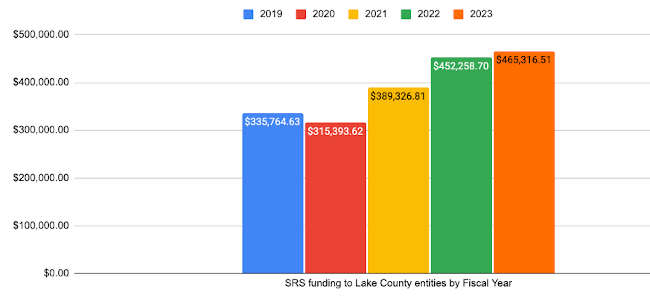
Lake County, with 258,602 acres of the Mendocino National Forest, received $465,316.51.

Affected rural communities in California have been raising concerns over the loss of the funding — and Lake County is no exception.

“Our county is not being hit as hard as other counties in Northern California that have bigger areas, larger tracks of forest lands, but it is significant,” said District 5 Supervisor Jessica Pyska. “It’s significant enough for us to really have concerns and see the impact to our schools.”

The funding is usually split into half between the county and the schools, said Falkenberg, who went on to explain the impact of the funding cuts on Lake County schools.

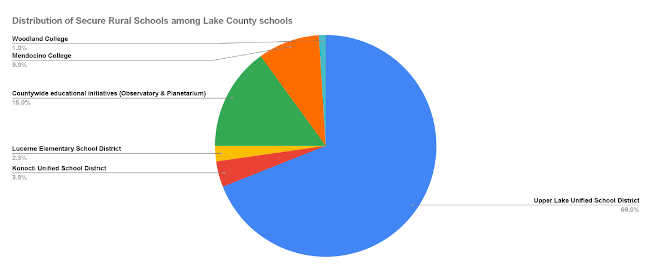
“If we were not to receive this funding, ultimately we would have to answer the question of how do we continue to fund the observatory, the planetarium, and the funds that are passed through to the school districts, which would equal about two and a half full time equivalent teaching positions,” he said, adding that the Upper Lake Unified School District will take the hardest hit as it has the largest acreage of federal land.

Falkenberg said the schools received roughly $200,000 to $250,000 each year over the last few years. “The bulk of that money goes to the Upper Lake Unified School District,” he later told Lake County News. “So for them, it's significant. It might not be huge, but it's significant.”


On the county’s road projects, the Secure Rural Schools funding “would be used for school area signage and for pavement markings and speed studies,” said Chief Deputy County Administrative Officer Matthew Rothstein at the meeting, drawing from notes given by Public Works Director Glen March who was absent.

The project is meant to mitigate concerns over traffic patterns around schools and to “encourage people to slow down in the areas of our schools,” Rothsten said.

“The infrastructure piece from the county is to make our schools safer. So that's why I thought it was urgent to bring this to us,” Supervisor Pyska said. “This funding cut directly impacts us in Lake County.”

“This is a bipartisan issue,” said Sabatier, recalling a recent meeting with Modoc County officials at Washington D.C.

“I sat down in the White House with Modoc County, who is very red, very conservative and they were very concerned about their losses as well,” said Sabatier. “So I think this goes across the board, that people are not wanting to see this go away.”

“Federal funding is absolutely critical for our local schools in Lake County. This funding ensures Lake County teachers and students have the resources they need to succeed and helps fund repairs for our local roads,” Thompson said in response to Lake County News’ request for comment.

“Any cuts to the Secure Rural Schools program, or to any other federal education funding, would hurt our kids. I will continue to work to renew this program and to protect all of the federal programs Lake County residents rely on every day,” he added.

The history of Secure Rural Schools funding in Lake County

For more than a century, the federal government has been subsidizing counties with large federal forest land.

Since 1908, the Forest Service Act has been enacted to set a portion — 25% of the revenue generated from activities like timber production and special permit use — to the local governments as compensation for not collecting tax on the federal land.

After the agency’s revenue declined for decades, in 2000, Congress passed the Secure Rural Schools and Community Self Determination Act to “help stabilize the funds available to rural counties,” according to the Forest Service under the U.S. Department of Agriculture.

During the board meeting, Falkenberg explained that the timber sale declined because the Endangered Species Act had started to “limit or make it much more difficult to harvest timber on national forest land.”

The Secure Rural Schools Act, then, was established as “a temporary, short term funding model,” while Congress tried to reconcile the tension between the two acts, Falkenberg said. “They have never been able to come to a consensus on how to manage that.”

With the new source of funding, counties could choose one of the two funding channels: either through the 1908 Act that pays 25% of timber revenues, or through Secure Rural Schools.

“The local county can elect to receive the greater of the two,” Falkenberg explained over a phone call with Lake County News.

Congress periodically allows counties to choose between the two payment types, with the last selection in 2013 and the choice locked.

In an approved 2012 resolution provided by Rothstein, Lake County opted for Secure Rural Schools.

“So for the last 25 years, counties and schools have continued to receive the secure rural schools funding in lieu of the 25% payment passed through with the exception of 2015/16—there was not a reauthorization,” Falkenberg said during the meeting. “So that particular year … we went from roughly half a million dollars to $14,000.”

The Secure Rural School funding allocates dollars under three titles: Title I for roads and schools, Title II for projects on federal lands and TITLE III for county projects. While Title II funds are retained by Forest Service, Title I and II go to local entities.

The chart below shows the total funding distributed to Lake County entities in the past five years under Title I and III.

“Distribution for the payments is off by a year,” explained Lauren Ott of Congressman Thompson’s office. So the Fiscal Year 2023 figures reflect money distributed in Fiscal Year 2024, she added.


Falkenberg is concerned that Lake County will receive even less than 2015/16 if Secure Rural Schools does not get reauthorized.

“If we revert back to the 25% funding rule, we're going to see that number drop to, I don't know, less than 10% or less than $10,000,” he told Lake County News.

Email staff reporter Lingzi Chen at This email address is being protected from spambots. You need JavaScript enabled to view it.. 


  • 216
  • 217
  • 218
  • 219
  • 220
  • 221
  • 222
  • 223
  • 224
  • 225

Community

  • Lake County Wine Alliance offers sponsor update; beneficiary applications open 

  • Mendocino National Forest announces seasonal hiring for upcoming field season

Public Safety

  • Lakeport Police logs: Thursday, Jan. 15

  • Lakeport Police logs: Wednesday, Jan. 14

Education

  • Woodland Community College receives maximum eight-year reaffirmation of accreditation from ACCJC

  • SNHU announces Fall 2025 President's List

Health

  • California ranks 24th in America’s Health Rankings Annual Report from United Health Foundation

  • Healthy blood donors especially vital during active flu season

Business

  • Two Lake County Mediacom employees earn company’s top service awards

  • Redwood Credit Union launches holiday gift and porch-to-pantry food drives

Obituaries

  • Rufino ‘Ray’ Pato

  • Patty Lee Smith

Opinion & Letters

  • The benefits of music for students

  • How to ease the burden of high electric bills

Veterans

  • CalVet and CSU Long Beach team up to improve data collection related to veteran suicides

  • A ‘Big Step Forward’ for Gulf War Veterans

Recreation

  • Wet weather trail closure in effect on Upper Lake Ranger District

  • Mendocino National Forest seeking public input on OHV grant applications

  • State Parks announces 2026 Anderson Marsh nature walk schedule 

  • BLM lifts seasonal fire restrictions in central California

Religion

  • Kelseyville Presbyterian to host Ash Wednesday service and Lenten dinner Feb. 18

  • Kelseyville Presbyterian Church to hold ‘Longest Night’ service Dec. 21

Arts & Life

  • Auditions announced for original musical ‘Even In Shadow’ set for March 21 and 28

  • ‘The Rip’ action heist; ‘Steal’ grounded in a crime thriller

Government & Politics

  • Lake County Democrats issue endorsements in local races for the June California Primary

  • County negotiates money-saving power purchase agreement

Legals

  • March 3 hearing on ordinance amending code for commercial cannabis uses

  • Feb. 12 public hearing on resolution to establish standards for agricultural roads

How to resolve AdBlock issue?
Refresh this page