LAKE COUNTY, Calif. – Lake County Animal Care and Control a new group of big dogs waiting for their new homes this week.
Dogs available for adoption this week include mixes of husky, mastiff and pit bull.
Dogs that are adopted from Lake County Animal Care and Control are either neutered or spayed, microchipped and, if old enough, given a rabies shot and county license before being released to their new owner. License fees do not apply to residents of the cities of Lakeport or Clearlake.
If you're looking for a new companion, visit the shelter. There are many great pets hoping you'll choose them.
The following dogs at the Lake County Animal Care and Control shelter have been cleared for adoption (additional dogs on the animal control Web site not listed are still “on hold”).
“Alex” is a male husky in kennel No. 20, ID No. 10154. Photo courtesy of Lake County Animal Care and Control. ‘Alex’
“Alex” is a handsome male husky with a long gray and white coat.
Shelter staff said he is a great companion who gets along with other dogs, small or large, male or female. Anyone interested in adopting him is asked to bring their dogs for a meet and greet with Alex.
Alex walks well on a leash, has very good manners and will roll over for belly. Staff recommends a secure fence to keep him from getting loose to go explore.
Alex is in kennel No. 20, ID No. 10154.
“Leah” is a female pit bull terrier in kennel No. 24, ID No. 10124. Photo courtesy of Lake County Animal Care and Control. ‘Leah’
“Leah” is a female pit bull terrier with a short black and white coat.
She already has been spayed.
She’s in kennel No. 24, ID No. 10124.
This male mastiff mix is in kennel No. 25, ID No. 10189. Photo courtesy of Lake County Animal Care and Control. Male mastiff mix
This male mastiff mix has a short brown and black coat.
He’s in kennel No. 25, ID No. 10189.
This male mastiff mix is in kennel No. 26, ID No. 10191. Photo courtesy of Lake County Animal Care and Control. Male mastiff mix
This male mastiff mix has a short tan and white coat.
He’s in kennel No. 26, ID No. 10191.
This male mastiff mix is in kennel No. 27, ID No. 10192. Photo courtesy of Lake County Animal Care and Control. Male mastiff mix
This male mastiff mix has a short tan and white coat.
He’s in kennel No. 27, ID No. 10192.
This male pit bull terrier is in kennel No. 29, ID No. 10217. Photo courtesy of Lake County Animal Care and Control. Male pit bull terrier
This male pit bull terrier has a short black and white coat.
He’s in kennel No. 29, ID No. 10217.
Lake County Animal Care and Control is located at 4949 Helbush in Lakeport, next to the Hill Road Correctional Facility.
Office hours are Monday through Friday, 11 a.m. to 5 p.m., and 11 a.m. to 3 p.m., Saturday. The shelter is open from 11 a.m. to 4 p.m. Monday through Friday and on Saturday from 11 a.m. to 3 p.m.
For more information call Lake County Animal Care and Control at 707-263-0278.
Email Elizabeth Larson at This email address is being protected from spambots. You need JavaScript enabled to view it.. Follow her on Twitter, @ERLarson, or Lake County News, @LakeCoNews.
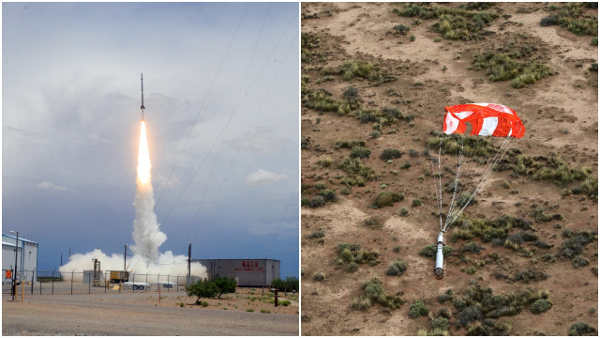
Launch (left) and payload with parachute (right) of the EVE sounding rocket from its flight on June 1, 2016. Credits: NASA/CU-LASP. Tom Woods knows about space gunk.
As the principal investigator for the Extreme Ultraviolet Variability Experiment, or EVE, instrument aboard NASA’s Solar Dynamics Observatory, he’s all too familiar with the ways that exposure to the harsh space environment can lead to a spacecraft instrument’s degradation.
“Since its launch in 2010, EVE’s sensitivity has degraded by about 70 percent at some wavelengths,” Woods said.
When your job is to measure subtle variability in extreme ultraviolet, or EUV, light emitted by the Sun, that amount of degradation, left unchecked, can be a big problem.
But all is not lost: To correct for the effects of degradation, Woods uses calibration sounding rockets. The seventh such rocket will launch from the White Sands Missile Range in White Sands, New Mexico. The launch window opens at 1 p.m. Mountain Time on June 18.
EVE calibration sounding rockets carry a copy of the EVE instrument to approximately 180 miles above Earth, where it measures EUV light from the Sun for about 10 minutes before parachuting back down to Earth for recovery.
The measurements, made by the rocket instruments unaffected by degradation, are compared to the those from the degraded satellite EVE instrument, so Woods and his team can correct for any discrepancies.
“That’s why the sounding rockets are so important – they’re like a second channel, to calibrate the channel that is seeing the Sun all the time.”
The EVE sounding rockets are a critical part of the mission. “Without the calibration, EVE wouldn’t be able to do its job,” Woods continued. “We really wouldn’t know what the brightness of the Sun is, because we wouldn’t know how much the instrument has degraded.”
Measurements from the EVE sounding rocket are used to calibrate extreme ultraviolet instruments aboard several other spacecrafts, including NASA's Thermosphere Ionosphere Mesosphere Energetics and Dynamics; Solar Radiation and Climate Experiment; Solar Terrestrial Relations Observatory; the European Space Agency and NASA's Solar and Heliospheric Observatory; the National Oceanic and Atmospheric Administration and NASA's Geostationary Operational Environmental Satellite Program; and the Japan Aerospace Exploration Agency and NASA's Hinode.
Thanks to calibration sounding rockets like EVE we can keep our space instruments working at full capacity — and through them, keep our eyes continuously on the skies.
Miles Hatfield works for NASA’s Goddard Space Flight Center in Greenbelt, Md.
LAKEPORT, Calif. – The Lakeport McDonald’s restaurant has been allowed to reopen after it was closed temporarily earlier this week due to a sewer system issue, with ongoing repairs required for a water leak.
James Scott of Lake County Environmental Health told Lake County News that county staff responded to the restaurant on Monday in response to a significant backup in the restaurant’s sewer lines.
When county staff arrived, the restaurant was still in operation, and there was standing water – specifically sewage – and debris on the floors, with every drain backed up, he said.
The restaurant staff thought it was compliant but Environmental Health informed them that they were required to close due to the circumstances.
“Our goal is to protect the public,” Scott said.
He said at that time there were objects found in the sewer laterals, which were cleaned out. That pipe, he said, appeared to have had a liner put in it and also has a low spot which may have contributed to the problem.
Restaurant staff had to do extensive cleanup inside the restaurant, including washing, rinsing and sanitizing floors and all equipment, Scott said.
During the middle of the week Lake County News heard from community members who said they found the restaurant’s driveway was blocked off and diners weren’t allowed inside.
On the followup inspection, Environmental Health staff found a soggy area in the floor in and around the women’s bathroom. Scott said water would come up out of the flooring when they walked on it.
The restaurant called out Roto-Rooter, which helped find a water leak that had been going for some time, he said.
Repairs of the area where the water leak was discovered are continuing. Scott said the restaurant is keeping that area isolated and sealed off with a tent-like area with plastic sheeting around the women’s restroom and the hallway in front of it.
By Friday the restaurant had reopened, despite repairs continuing. “They’re permitted to operate,” he said.
Scott said the city of Lakeport Building Official Tom Carlton is working with the restaurant, which may need a new sewer lateral.
Environmental Health also remains involved. “We’re working very closely with the management there,” Scott said.
The closure gave rise to conjecture and a number of theories circulating on social media about the possible reasons, including feces in kitchen equipment.
“That’s all fantasy,” said Scott.
Email Elizabeth Larson at This email address is being protected from spambots. You need JavaScript enabled to view it.. Follow her on Twitter, @ERLarson, or Lake County News, @LakeCoNews.
CLEARLAKE, Calif. – The city of Clearlake is receiving a federal grant to help it be better prepared for natural disasters.
Clearlake City Manager Greg Folsom announced that the city will receive up to $112,000 through the Federal Emergency Management Agency Hazard Mitigation Grant Program.
The grant will enable the city to lay out a mitigation strategy that identifies specific projects aimed at reducing and eliminating risk from future natural disasters.
Following the completion of a Local Hazards Mitigation Plan, the city would be eligible for additional FEMA funding for the completion of those projects identified within the plan, Folsom said.
"While we are not able to prevent the drought conditions and natural disasters that have devastated our community in recent years, we can commit to do what we can to reduce the threat by supporting and implementing projects to lessen future risk to lives and property," Folsom said.
The California Department of Public Health announced the first confirmed illnesses in California this year due to West Nile virus, or WNV.
The four illnesses occurred in Los Angeles, Kern and Riverside counties.
“West Nile virus activity in the state is increasing, so I urge Californians to take every possible precaution to protect against mosquito bites,” said CDPH Director and State Public Health Officer Dr. Karen Smith.
West Nile virus is transmitted to humans and animals by the bite of an infected mosquito. As of June 8, WNV has been detected in 14 dead birds from seven counties and four mosquito samples from three counties.
No dead birds or mosquito samples have so far been found in Lake County, based on state data.
Hot temperatures this month are contributing to increasing numbers of mosquitoes and the increased risk of virus transmission to humans, officials said.
So far this season, activity is within expected levels. The risk of disease due to WNV usually increases at this time of year and is highest throughout the summer and early fall, CDPH reported.
West Nile virus is influenced by many factors, including climate, the number and types of birds and mosquitoes in an area, and the level of WNV immunity in birds. The risk of serious illness to most people is low. However, some individuals – less than 1 percent – can develop serious neurologic illnesses such as encephalitis or meningitis.
In 2017, there were 553 reported WNV cases in California, including 44 deaths.
People 50 years of age and older, and individuals with diabetes or hypertension, have a higher chance of getting sick and are more likely to develop complications from WNV infection.
CDPH recommends that individuals protect against mosquito bites and WNV by practicing the “Three Ds”:
1. DEET – Apply insect repellent containing DEET, picaradin, oil of lemon eucalyptus or IR3535 according to label instructions. Repellents keep the mosquitoes from biting you. Insect repellents should not be used on children under two months of age.
2. DAWN AND DUSK – Mosquitoes that transmit WNV usually bite in the early morning and evening so it is important to wear proper clothing and repellent if outside during these times. Make sure that your doors and windows have tight-fitting screens to keep out mosquitoes. Repair or replace screens that have tears or holes.
3. DRAIN – Mosquitoes lay their eggs on standing water. Eliminate all sources of standing water on your property by emptying flower pots, old car tires, buckets, and other containers. If you know of a swimming pool that is not being properly maintained, please contact your local mosquito and vector control agency. Click here for audio
California’s West Nile virus Web site includes the latest information on WNV activity in the state. Californians are encouraged to report dead birds on the website or by calling toll-free 1-877-WNV-BIRD (968-2473).
When a person dies other persons may be living in the decedent’s residence and/or other real properties owned by the decedent.
This may include the decedent’s spouse, child, significant other, caregiver, rent-paying tenant or simply a friend.
What happens when such persons assert that they are entitled to live at the decedent’s residence and refuse to leave when asked to do so by the person administering the decedent’s estate?
This scenario often creates an expensive and time consuming problem for the person administering the decedent’s estate because it usually entails going to court.
The trustee administering the decedent’s trust, or the personal representative administering the probate estate, as relevant, is legally required to safeguard and to make productive the estate’s assets, and ultimately to carry out the terms of the decedent’s trust or will.
If the trustee, or personal representative, wrongly allows for persons living in the decedent’s residence to live rent free and/or to damage the premises then the trustee of personal representative has failed to carry out his or her legal duties. If so, the trustee, or personal representative, can be removed and can be penalized.
Sometimes, however, the occupants may have a legal right to remain in the decedent’s residence.
A person may have legal rights to remain at the residence either because they were already lawful “tenants” when the decedent died or because they became lawful tenants afterwards.
A person can become a tenant either formally, i.e., signing a lease agreement, or informally by oral agreement.
Accepting rent from an occupant will create a periodic tenancy at will and give them occupancy rights that will make removing them later more difficult.
Tenancies can also be inadvertently created. It is important to have legal counsel prior to negotiating with occupants.
A surviving spouse and/or dependent minor child (under age 18) who lived with the decedent have special protection.
California law allows for a so-called “probate homestead” to be established if a probate estate is opened that includes a residence if other requirement are met.
A probate homestead can allow the surviving spouse and/or minor children to remain in the residence for a significant period of time.
Also, if the decedent owned the real property in a trust, the trust may allow certain persons to reside at the residence.
The trust might allow a person to remain in the residence while it is being sold or it might allow for the person to have a life estate or a term of years to live in the residence.
The trust should also say what responsibilities the occupant has for maintenance and expenses (insurance, taxes, and utilities).
Otherwise, if persons are occupying the residence and not paying rent, the trustee or personal representative will have to proceed with an appropriate legal action.
In the case of a hold over tenant that would usually mean a civil action for unlawful detainer or an ejectment.
Otherwise, an action for ejectment or a so-called “850 petition” might apply. Which approach applies and is best in any given situation is an important decision to be made in consultation with a qualified attorney prior to proceeding.
Dennis A. Fordham, attorney, is a State Bar-Certified Specialist in estate planning, probate and trust law. His office is at 870 S. Main St., Lakeport, Calif. He can be reached at This email address is being protected from spambots. You need JavaScript enabled to view it. and 707-263-3235. His Web site is www.DennisFordhamLaw.com.
 How to resolve AdBlock issue?