LAKE COUNTY, Calif. – Lake County Animal Care and Control is offering a group of mixed-breed dogs this week.
Dogs available for adoption this week include mixes of German Shepherd, husky, Labrador Retriever, pit bull and Rottweiler.
Dogs that are adopted from Lake County Animal Care and Control are either neutered or spayed, microchipped and, if old enough, given a rabies shot and county license before being released to their new owner. License fees do not apply to residents of the cities of Lakeport or Clearlake.
If you're looking for a new companion, visit the shelter. There are many great pets hoping you'll choose them.
The following dogs at the Lake County Animal Care and Control shelter have been cleared for adoption (additional dogs on the animal control Web site not listed are still “on hold”).
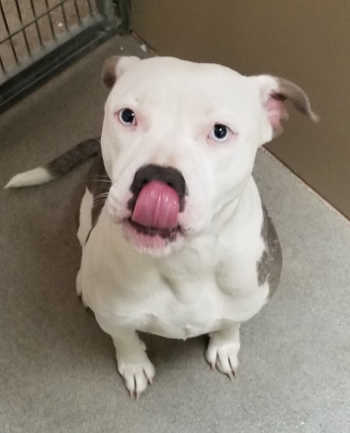
This female pit bull terrier is in kennel No. 8, ID No. 11074. Photo courtesy of Lake County Animal Care and Control. Female pit bull terrier
This female pit bull terrier has a short white and gray coat.
She’s in kennel No. 8, ID No. 11074.
“Hashi” is a male pit bull terrier-shepherd mix in kennel No. 13, ID No. 7499. Photo courtesy of Lake County Animal Care and Control. ‘Hashi’
“Hashi” is a male pit bull terrier-shepherd mix.
He has a short tan coat.
He’s already been neutered.
He’s in kennel No. 13, ID No. 7499.
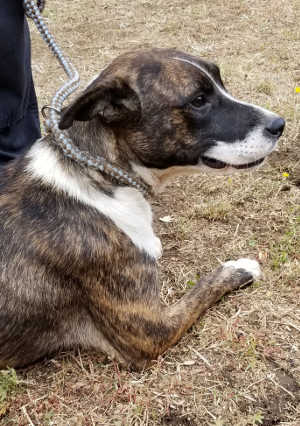
This female pit bull terrier is in kennel No. 14, ID No. 11152. Photo courtesy of Lake County Animal Care and Control. Female pit bull terrier
This female pitbull terrier has a brindle and white coat.
She’s in kennel No. 14, ID No. 11152.
This male pit bull terrier is in kennel No. 21, ID No. 11193. Photo courtesy of Lake County Animal Care and Control. Male pit bull terrier
This male pit bull terrier has a short black and white coat.
He’s in kennel No. 21, ID No. 11193.
This female pit bull terrier is in kennel No. 22, ID No. 11192. Photo courtesy of Lake County Animal Care and Control. Female pit bull terrier
This female pit bull terrier has a short brown coat.
She’s in kennel No. 22, ID No. 11192.
This male German Shepherd-husky mix is in kennel No. 23, ID No. 11051. Photo courtesy of Lake County Animal Care and Control. German Shepherd-husky mix
This male German Shepherd-husky mix has a short black and tan coat.
He’s in kennel No. 23, ID No. 11051.
This male pit bull terrier is in kennel No. 25, ID No. 11082. Photo courtesy of Lake County Animal Care and Control. Male pit bull terrier
This male pit bull terrier has a short brindle and white coat.
He’s in kennel No. 25, ID No. 11082.
“Naquysa” is a female husky-shepherd mix in kennel No. 27, ID No. 11000. Photo courtesy of Lake County Animal Care and Control. ‘Naquysa’
“Naquysa,” which means “Star,” is a female husky-shepherd mix with a long black and tan coat.
She’s in kennel No. 27, ID No. 11000.
“Winston” is a male pit bull terrier-Rottweiler in kennel No. 34, ID No. 10970. Photo courtesy of Lake County Animal Care and Control. ‘Winston’
“Winston” is a male pit bull terrier and Rottweiler mix with a short black and brown coat.
He was taken in during the Mendocino Complex in the city of Lakeport.
He’s in kennel No. 34, ID No. 10970.
Lake County Animal Care and Control is located at 4949 Helbush in Lakeport, next to the Hill Road Correctional Facility.
Office hours are Monday through Friday, 11 a.m. to 5 p.m., and 11 a.m. to 3 p.m., Saturday. The shelter is open from 11 a.m. to 4 p.m. Monday through Friday and on Saturday from 11 a.m. to 3 p.m.
For more information call Lake County Animal Care and Control at 707-263-0278.
Email Elizabeth Larson at This email address is being protected from spambots. You need JavaScript enabled to view it.. Follow her on Twitter, @ERLarson, or Lake County News, @LakeCoNews.
LAKE COUNTY, Calif. – Today’s home fires burn faster than ever. In a typical home fire, you may have as little as one to two minutes to escape safely from the time the smoke alarm sounds.
Knowing how to use that time takes planning and practice. Although people feel safest in their home, it is also the place people are at greatest risk fire. Overconfidence contributes to a complacency toward home escape planning and practice.
“As we approach Fire Prevention Week, now is the time to take a look around your home and see where your hidden hazards are,” said Chief Dennis Mathisen, California State fire marshal. “That means go room by room, and really look closely at where you have items placed, stored, and plugged in. We all can do a better job of reducing our risks by being more fire aware and creating a potentially life-saving escape plan and then practicing it.”
Smoke alarms are the eyes and ears to alert people to a fire. Smoke alarms can mean the difference between life and death as working smoke alarms cut the risk of dying in a home fire in half. Install smoke alarms in every sleeping room, outside each separate sleeping area, and on every level of the home, including the basement.
Take the time to plan an escape route for everyone in the home, designating a “meeting spot” outside. What good is an escape route, if no one remembers it? The answer is simple: practice, practice, practice and make it fun! The more often you practice (day and night), the more comfortable your children will be in escaping, and less likely to hide.
Heating equipment is one of the leading causes of home fires during the winter months. Space heaters are the type of equipment most often involved in home heating equipment fires. All heaters need space.
Keep anything that can burn at least three feet away from heating equipment. Have a 3-foot “kid-free zone” around open fires and space heaters. Purchase and use only portable space heaters listed by a qualified testing laboratory. Maintain heating equipment and chimneys by having them cleaned on a regular basis.
Remember these three easy things when making your home safe:
– Look for possible fire hazards in your home and eliminate them. Are your outlets overloaded? Check the circuit loads of your electrical appliances and devices and unplug when not in use. Inspect your appliance cords. If any are torn, ripped, or damaged in any way, replace them immediately. If a cord or plug ever feels hot, unplug it. – Listen for the sound of the smoke alarm. Know that you may have only minutes to get out if a fire starts. – Learn two ways out of every room. Exits should be easy to access and free of clutter. After leaving the home, go to your family’s designated meeting spot that was created when you set up your home fire escape plan.
MENDOCINO NATIONAL FOREST, Calif. – Fire restrictions will be lifted on the Mendocino National Forest at 12 a.m. Monday, Oct. 8, forest officials announced.
Beginning Monday, forest visitors may have open campfires and camp stoves outside of designated campgrounds providing they are in possession of a valid California Campfire Permit.
Campfire Permits are free and are available at all Forest Service, BLM, or Cal Fire offices, or online at www.PreventWildfireCA.org.
“The cooler temperatures, longer nights, higher humidity and some precipitation have reduced the threat of extreme fire danger. Enjoy the forest but remember it is everyone’s responsibility to constantly practice fire safety and help prevent wildfires,” said Forest Supervisor Ann Carlson.
Fireworks are never allowed on public lands. Check with local offices for current information before traveling to the forest.
Follow these campfire guidelines:
· Clear all flammable material away from the fire for a minimum of five feet in all directions.
· Make a fire only if you have a shovel and sufficient water to put it out.
· Have a responsible person in attendance at all times.
· Never leave your campfire unattended.
· Never build a campfire on a windy day.
· To make sure your campfire is out, drown with water and stir with dirt, making sure all burned materials are extinguished. Feel with your hand to make sure it’s out cold.
· Every campfire will be put dead out before leaving it.
On Oct. 3, 2018, Parker Solar Probe performed the first significant celestial maneuver of its seven-year mission. As the orbits of the spacecraft and Venus converged toward the same point, Parker Solar Probe slipped in front of the planet, allowing Venus' gravity – relatively small by celestial standards – to twist its path and change its speed.
This maneuver, called a gravity assist, reduced Parker's speed relative to the Sun by 10 percent – amounting to 7,000 miles per hour – drawing the closest point of its orbit, called perihelion, nearer to the star by 4 million miles.
Performed six more times over the course of the seven-year mission, these gravity assists will eventually bring Parker Solar Probe's closest approach to a record 3.83 million miles from the Sun's surface – about a seventh the distance of the current record-holder, Helios 2, which achieved a pass of 27 million miles from the Sun in 1976.
Even before its closest approach, Parker Solar Probe is expected to overtake this record and become the closest human-made object to the Sun in late October 2018.
A long-held dream
A solar probe has been on the minds of scientists and engineers for decades, since the late '50s, when a new theory and the first satellite measurements of the Sun's constant outflow of material, called the solar wind, pointed towards previously unsuspected complexity.
But if you'd asked anyone before 2007 – well after serious planning for such a mission began – Venus would not have come up as the key to the mission puzzle.
For the three-plus decades that various committees and teams worked on different concepts for the solar probe mission, it was widely agreed that the only way to dive into the solar atmosphere required sending the spacecraft to Jupiter first.
"No one believed using Venus gravity assists would be possible, because the gravity assist a planetary body can provide is proportional to the body’s mass, and Venus’ mass is so much smaller – only 0.3 percent of Jupiter’s," said Yanping Guo, mission design and navigation manager for the Parker Solar Probe mission at the Johns Hopkins University Applied Physics Lab in Laurel, Maryland. "You compare the gravity assist Venus can provide to what Jupiter can provide, and you have to do repeated flybys to achieve the same change. Then you're getting a very long mission duration."
Getting close to the Sun is more difficult than one might think. Any spacecraft launched from Earth starts off traveling at our planet's 67,000-mile-per-hour sideways pace, speed that it must counteract before it can get anywhere near the Sun.
Gravity assists are one of the most powerful tools in an orbit designer's toolbox to solve this problem: Instead of using expensive, precious fuel to change direction or speed (or both), gravity assists let you harness the natural pull of a planet, with time as the only cost.
Most deep-space missions that use planetary gravity assists use them to gain speed – like OSIRIS-Rex, which used Earth's gravity to rocket towards asteroid Bennu – or to change direction, like Voyager 2, which performed a gravity assist after its final planetary flyby at Neptune to bank toward its moon, Triton.
The idea for a solar probe gravity assist was a little different. In the original orbit plans, the primary functions of the Jupiter gravity assist were to slow the spacecraft's speed to almost nothing and fling it upwards, out of the nearly-flat plane that contains all of the known planets of the solar system, called the ecliptic plane.
This would put the solar probe on a path to get a rare and better-than-ever look at the Sun's polar regions, which are difficult to image, but important scientifically as they produce some of the Sun's high-speed solar wind. Nearly all of our solar observatories have orbited in the ecliptic plane, with the exception of Ulysses, which used a Jupiter gravity assist to achieve polar passes more than 200 million miles from the Sun.
But sending a spacecraft out to Jupiter and bringing it back into the inner solar system is hard. First, no matter how you plan the journey, it's a long mission, with a minimum of nearly half a decade between meaningful events. Most of the time would be spent cruising in deep space.
Second, traveling that far from the Sun means you have to get creative with power. Near Jupiter, the sunlight is about 25 times dimmer than what we experience at Earth, so the only options are huge solar panels to make the most of the sparse sunlight, or some other source of power, like nuclear.
Large solar panels pose a problem for a solar probe, though, because the panels would need to be shielded during solar encounters to avoid overheating.
The size of a solar panel required to power the spacecraft out near Jupiter is too big to effectively stow near the Sun, so they'd have to be jettisoned at perihelion – and that limits you to just one solar pass, once you've lost your source of power. With nuclear power – a radioisotope thermoelectric generator, or RTG, the same source that powers deep-space missions like Cassini and New Horizons – performing a Jupiter gravity assist is a viable option.
Changing the mission paradigm
But the mission design was soon to change. David McComas, chair of the definition committee, remembers a call from Andy Dantzler, then project manager for the Solar Probe mission at APL. Dantzler passed away in 2011 at age 49; the Delta IV Heavy rocket that carried Parker Solar Probe to space was dedicated to him.
"Andy asked if there was any way the committee might go for a mission where you stay in the ecliptic plane but have lots of passes by the Sun and slowly reduce the perihelion," said McComas, who is now the principal investigator of the mission's Integrated Science Investigation of the Sun, or ISʘIS, suite and a professor of astrophysical sciences at Princeton University in New Jersey.
This was an entirely new paradigm for the mission. A hallmark of the original plan was passing over the Sun's poles, the source of the Sun's fast solar wind but a region of relative mystery to scientists. Additionally, staying in the ecliptic plane would almost certainly mean ending up farther from the Sun than had previously been anticipated.
"If you're trading perihelion distance, you have to swap it for something that will give you opportunities to fill in the science in some other way," said McComas.
Subsequently, two developments supported the choice to make these changes to the orbit and create the Parker Solar Probe mission we know today.
The first was new research published in 2009 by Thomas Zurbuchen – then a scientist at the University of Michigan and now the associate administrator for the Science Mission Directorate at NASA Headquarters in Washington.
This research showed that the solar wind that could be measured from the ecliptic plane was actually from a diverse mix of sources.
It was not only the slower solar wind known to be more common near the Sun's equator, but also the high-speed solar wind that often originates closer to the Sun's poles.
By sampling the solar wind from the ecliptic plane over a period of years, scientists could learn about this fast solar wind in ways they hadn't previously anticipated.
The second development was the shift that made such sampling possible: the design of Parker Solar Probe's current trajectory.
"When starting, I had no clue if I could find a solution," said Guo, the mission trajectory designer. "Everybody thought Jupiter was the only practical way you could get closer to the Sun, within 10 solar radii."
In 2007, she came up with five alternative options that would keep the spacecraft near the ecliptic plane and would not require traveling out to Jupiter.
These trajectory options used some combination of Earth and Venus gravity assists to gradually draw the spacecraft closer to the Sun over the course of a number of years.
One fulfilled all the requirements for the Solar Probe mission – a total mission duration under 10 years, with a final close approach clocking in under 10 solar radii (equivalent to 4.3 million miles). This was chosen as the trajectory of the current mission, now called Parker Solar Probe after Dr. Eugene Parker, including seven Venus gravity assists that spiral the orbit in closer and closer to the Sun over the mission's seven-year lifetime.
The biggest hurdle to overcome for a trajectory with such repeated gravity assists is phasing. Of course, Venus is in constant motion around the Sun, so every time the spacecraft passes the planet and swings around our star, Venus is in a completely different place.
But Guo's design solves that problem, with multiple opportunities for launch. This trajectory design carries the spacecraft through 24 orbits around the Sun.
The seven Venus gravity assists happen at different points in the spacecraft's orbit, to account for the phasing problem – some, like the one on Oct. 3, happen as the spacecraft heads towards the Sun, while the others happen as Parker Solar Probe speeds away from the Sun.
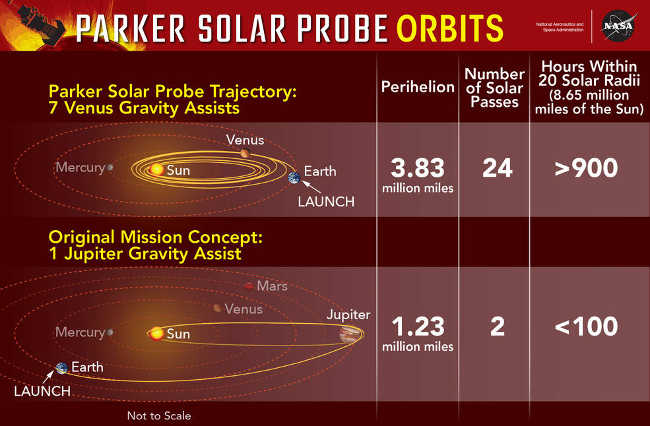
This orbit is decidedly different than the original single-Jupiter-gravity-assist concept. Rather than two passes over the Sun's poles, coming within 1.23 million miles of the surface, this version of the mission provides 24 passes around the Sun near its equator, coming within 3.83 million miles of the Sun's surface.
Though Parker Solar Probe doesn't get as close to the Sun, this version of the trajectory provides the spacecraft with more than 900 hours in this critical inner region of the Sun's corona, within 20 solar radii (about 8.65 million miles). In comparison, earlier designs using Jupiter gravity assists provided less than 100 hours in this region.
"Here was this technical solution that was safer and cheaper and a better scientific mission because of all the samples we’d be getting," said McComas. "The Sun isn't a stable object – it's variable – so this would let us do a better scientific job."
This change to the mission also solved the power problem. Instead of requiring an RTG or unmanageably-large solar panels, Parker Solar Probe is powered by a pair of articulated solar panels that are slowly drawn into the shadow of the heat shield as the spacecraft approaches the Sun. At closest approach, only a small area remains exposed to generate the needed power for the spacecraft, cooled by the mission's first-of-its-kind solar array cooling system.
But though it solved a major problem, rethinking the mission in this way also required a complete rethinking of the spacecraft itself.
"The whole spacecraft design changed dramatically," said Nicola Fox, formerly the mission's project scientist at APL. Fox is now the director of the heliophysics division at NASA Headquarters. "With the earlier trajectory, the heat shield was the spacecraft. It was like a cone, with the pointed end facing the Sun, because when you're doing such a fast polar orbit it's tough to keep a shield oriented correctly."
"We aren't going in as far with the new trajectory, so we could go to a simpler shape for the heat shield, because it's possible to keep the heat shield oriented between the spacecraft and the Sun at all times. The whole thing looks really different."
The mission team credits Andy Dantzler with guiding them through this fundamental change in the mission's design that led to the mission we know today.
"When Andy called and asked if the definition team would go for it, I really didn't know the answer," said McComas. "As our definition team worked through the science, I became convinced that it wasn't just an equivalent mission, but actually a better scientific mission, because we get so much more time close to the Sun and so many more samples at different times."
The first flyby
During the Oct. 3 gravity assist, Parker Solar Probe came within about 1,500 miles of Venus' surface, reaching this closest point at about 4:45 a.m. EDT.
Venus is an interesting case for heliophysicists, who study not only the Sun, but also its effects on planets. Unlike Earth, Venus doesn't have an internal magnetic field – instead, a weak magnetic field is induced over the surface by the constant barrage of solar charged particles flowing over the planet and interacting with its very dense atmosphere.
This first flyby offered a unique opportunity for calibration, as Parker Solar Probe flew through the trailing end of Venus' magnetic field, called the magnetotail. Three of Parker Solar Probe's four instrument suites – SWEAP, ISʘIS and FIELDS – gathered data during the flyby on particles and fields in this region.
Though the data is still making its way back to Earth, the science team hopes to analyze it before they set their sights on Parker Solar Probe's next major celestial encounter: its first close approach to the Sun. Parker Solar Probe's first solar encounter will happen Oct. 31 – Nov. 11, with the closest approach happening on Nov. 5 at a distance of 15 million miles from the Sun. The science data from this encounter will start downlinking to Earth in early December.
Parker Solar Probe is part of NASA’s Living with a Star program to explore aspects of the Sun-Earth system that directly affect life and society. The Living with a Star program is managed by the agency’s Goddard Space Flight Center in Greenbelt, Maryland, for NASA’s Science Mission Directorate in Washington. APL designed, built and operates the spacecraft.
Sarah Frazier works for NASA's Goddard Space Flight Center, Greenbelt, Md.
The final orbit for the Parker Solar Probe mission uses seven Venus gravity assists to rack up more than 900 hours close to the Sun. The original mission concept, using a single Jupiter gravity assist, got the spacecraft closer to the Sun, but gave scientists less than 100 hours in key areas. Credits: NASA's Goddard Space Flight Center/Mary Pat Hrybyk-Keith.
Julie Scribner’s quilt “Incandescence” has been awarded “Best of Show” at the Ladies of the Lake Falling Leaves Quilt Show. The show will be held at the Lake County Fairgrounds in Lakeport from 10 a.m. to 5 p.m. Saturday, October 6, from 10 a.m. to 4 p.m. Sunday, October 7, 2018. Photo by Barbara Haddon. LAKEPORT, Calif. – The Ladies of the Lake Quilt Guild present the 17th annual Falling Leaves Quilt Show at Lake County Fairgrounds in Lakeport on Saturday, Oct. 6, and Sunday, Oct. 7.
The show will be held in two buildings, Fritch Hall and Little Theater at the fairgrounds, 401 Martin St. The hours on Saturday are 10 a.m. to 5 p.m. and on Sunday 10 a.m. to 4 p.m.
As one wanders through the exhibits, you will find a colorful array of quilts and a bustle of activity.
The quilting techniques used in making these beautiful treasures vary wildly. A few quilters use very traditional methods of piecing and quilting by hand.
Most quilters use a combination of techniques including machine piecing, applique and quilting.
While many of the quilts are traditional bed quilts, you will also find many innovative pieces in all sizes from bed quilts to miniatures.
Community leaders choosing their favorite quilt give VIP Awards. The VIP community leaders are Ariel Carmona, Editor, Record-Bee; Cindy Hutchison, personal trainer; Jan Kespohl, retired sheriff sergeant; Meredith Lahmann, retired teacher and writer; Elizabeth Larson, editor and publisher, Lake County News; and Tammy Renfro-Myers, registered nurse.
Watch for the purple and white ribbons and stories telling why the quilts were chosen.
Don’t forget to check out the outside edges of the rooms where you will find 10 vendors from as far away as Florida and Hawaii. They will be showing the latest in fabrics, patterns, sewing workstations, long arm quilting and sewing machines.
Visit the Country Store in the Little Theater where you can find some handmade items from guild members as well as recycled quilting, sewing and craft items. Stop by frequently as the items change often.
Stop by the theme baskets in front of the stage at the Little Theater and take a chance winning one of 10 baskets this year. Themes include books, fall holidays, party time, baby girl, birthday, birds, baking, dogs, barbecue and quilting.
The silent auction includes a variety of items to tempt you from fabric bundles to an embroidery machine. There will also be a Showtime rotisserie, a serger, an Altos QuiltCut and much more.
The 2018 Opportunity Quilt will find a home on Sunday afternoon when the winning ticket will be drawn. Tickets will be available at the table in front of the stage in the Little Theater throughout the show. This scrappy quilt with a traditional look called “Kentucky Log Cabin” is an original design by Judy Martin. This quilt was pieced by guild members and quilted by Cindy Jo of Fort Bragg.
There are four door prizes: A sewing machine donated by John Furtado of Village Sewing; Stitched 2 Last donated potholders; A Designing Woman and Bolt Fabric + Home in Cloverdale have donated gift certificates. Door prizes will be announced at 3 p.m on Sunday. Winners need not be present to win.
Demonstrations are scheduled throughout the show.
Saturday, Oct. 6:
11 a.m.: “Embellishments GALORE” with Luc Roelen. Noon: “Almost Instant Place Mats” by Colleen Granger. 1 p.m.: “Freehand Raw Edge Collage” with Laura Fogg. 2 p.m.: “Needleturn Hand Applique” by Jill Rixman.
Sunday, Oct. 7:
11 a.m.: “Freehand Raw Edge Collage” with Laura Fogg. Noon: “Doodle This” by Colleen Granger. 1 p.m.: “Needleturn Hand Applique” by Jill Rixman.
Suzanne Lee is a member of the Ladies of the Lake Quilt Guild and publicity chair for the quilt show.
The 2018 Opportunity Quilt, “Kentucky Log Cabin” will find a home on Sunday, October 7, 2018 at 3 p.m when the winning ticket will be drawn. Photo by Barbara Haddon.
The NEA Big Read selection, Into the Beautiful North, inspires an array of events around Lake County, Calif., in October 2018. Courtesy photo. LAKE COUNTY, Calif. – The Big Read comes to Lake County in October with events centered around Luis Alberto Urrea’s book “Into the Beautiful North.”
All events are free; some require registration. Free copies of the Big Read selection will be available at Big Read events while supplies last.
In Lakeport events will include book discussions, a film showing and a rural skills fair.
The Big Read kick-off event, the Rural Skills Fair takes place at the Historic Courthouse Museum, 225 N. Main St. on Saturday, Oct. 6, from 11 a.m. to 1 p.m. during Oktoberfest.
Come watch “The Magnificent Seven,” the classic 1960 movie that inspires Nayeli in Into the Beautiful North to create her own Magnificent Seven. Yul Brynner, Steve McQueen, Charles Bronson and others star in the story of a town that fights back against marauding bandits. A discussion of the book will accompany the film.
Local author Richard Schmidt will address “Into the Beautiful North from a writer’s perspective during a discussion on Wednesday, Oct. 17, at 5:30 p.m. at Lakeport Library.
The Big Read’s keynote speaker, local professor Jabez “Bill” Churchill will present his address “From South to North and Back Again” at the Lake Center of Mendocino College, 2565 Parallel Drive in Lakeport. This event is in partnership with the Lake County Friends of Mendocino College.
The Main Street Gallery in Lakeport will be the scene of a poets and authors discussion on Wednesday, Oct. 24, from 6 to 8 p.m.
Clearlake will see several Big Read events. The Redbud Library book club will discuss the book at its meeting Thursday, Oct. 11, from 2 to 3 p.m. at the library 14785 Burns Valley Road.
A cultural celebration in partnership with La Voz de la Esperanza Centro Latino is scheduled for Tuesday, Oct. 16, 3 to 5 p.m., at Redbud Library, 14785 Burns Valley Road in Clearlake.
Also on Oct. 16 at noon a Mexican-themed lunch will be sold on the Woodland Community College Clearlake Campus, 15880 Dam Road Extension in Clearlake, with a book discussion following the lunch.
Middletown celebrates the Big Read action with two events.
On Sunday, Oct. 7, from 1 to 5 p.m. come explore the characters of “Into the Beautiful North” through art at the Middletown Art Center, 21456 Highway 175. Make a pop-up village and populate it with characters from the book. Learn more and register at www.middletownartcenter.org.
On Wednesday, Oct. 10, at 3:30 p.m., the Middletown Library book club will discuss the book at its meeting in the library at 21256 Washington St.
The Big Read concludes with an on-air discussion between county librarian Christopher Veach and radio host Susan Krones on KPFZ 88.1 on Saturday, Oct. 27, from 4 to 5 p.m.
 How to resolve AdBlock issue?