 How to resolve AdBlock issue?
News
California Attorney General Xavier Becerra, in a letter to the U.S. Department of Agriculture Secretary Sonny Perdue and Chief of the U.S. Forest Service Vicki Christiansen, on Friday urged the secretary and the chief to reverse their decision allowing the U.S. Forest Service to offer California’s wild horses for sale without restriction.
California law prohibits the possession or sale of horses with the intent of using them for human consumption.
Additionally, federal law prohibits the Department of the Interior, which manages most of the country’s wild horses, from selling horses to be used in commercial products.
The Forest Service has traditionally followed the practice of the Department of the Interior and has historically respected California’s law. However, the Forest Service is now changing its policy, stating that some of the horses under its management may be put up for unconditional sale after 90 days.
“To slaughter for commercial consumption mustangs that have roamed California for over a century is not only atrocious, but unlawful,” said Attorney General Xavier Becerra. “These majestic animals captivate the imagination and symbolize the rugged independence of the American West. We urge the federal government to treat the Modoc National Forest and its wildlife with the respect that it is due by protecting these beautiful wild horses from the commercial slaughterhouse.”
In California, wild horses roam public lands throughout the state, including the Devil’s Garden Plateau Wild Horse Territory, an area of more than 250,000 acres in Modoc National Forest. Occasional roundups of wild horses are a typical part of wildlife and land management.
The Forest Service initiated the current wild horse roundup in October to reduce the horse populations in Modoc National Forest. In the roundup, the U.S. Forest Service will gather 1,000 protected wild horses.
Attorney General Becerra cautions in the letter that selling the horses to a buyer planning to use the animals for human consumption is a felony under California law with a potential penalty of up to three years in prison.
Under management by the Forest Service, the auction of protected horses will be offered in two phases: in the first phase of sales, the Forest Service will prioritize the adoption of wild horses by members of the public who are able to care for them, and will impose conditions to require buyers follow California law. However, after January 10, 2019, the Forest Service will offer the remaining horses for sale unconditionally, including without the conditions imposed by California law.
In the letter, the Attorney General warns Secretary Perdue that by reversing the department’s policy and allowing sales without restrictions, the Forest Service and buyers risk violating California law.
California law prohibits the possession or sale of horses with the intent of using them for human consumption.
Additionally, federal law prohibits the Department of the Interior, which manages most of the country’s wild horses, from selling horses to be used in commercial products.
The Forest Service has traditionally followed the practice of the Department of the Interior and has historically respected California’s law. However, the Forest Service is now changing its policy, stating that some of the horses under its management may be put up for unconditional sale after 90 days.
“To slaughter for commercial consumption mustangs that have roamed California for over a century is not only atrocious, but unlawful,” said Attorney General Xavier Becerra. “These majestic animals captivate the imagination and symbolize the rugged independence of the American West. We urge the federal government to treat the Modoc National Forest and its wildlife with the respect that it is due by protecting these beautiful wild horses from the commercial slaughterhouse.”
In California, wild horses roam public lands throughout the state, including the Devil’s Garden Plateau Wild Horse Territory, an area of more than 250,000 acres in Modoc National Forest. Occasional roundups of wild horses are a typical part of wildlife and land management.
The Forest Service initiated the current wild horse roundup in October to reduce the horse populations in Modoc National Forest. In the roundup, the U.S. Forest Service will gather 1,000 protected wild horses.
Attorney General Becerra cautions in the letter that selling the horses to a buyer planning to use the animals for human consumption is a felony under California law with a potential penalty of up to three years in prison.
Under management by the Forest Service, the auction of protected horses will be offered in two phases: in the first phase of sales, the Forest Service will prioritize the adoption of wild horses by members of the public who are able to care for them, and will impose conditions to require buyers follow California law. However, after January 10, 2019, the Forest Service will offer the remaining horses for sale unconditionally, including without the conditions imposed by California law.
In the letter, the Attorney General warns Secretary Perdue that by reversing the department’s policy and allowing sales without restrictions, the Forest Service and buyers risk violating California law.
110918 Becerra letter to USDA regarding wild horse slaughter by LakeCoNews on Scribd
There are many and varied situations when a person needs someone else to sign for, and/or to represent, their interests.
These situations can arise because the person is a minor (under age 18), is physically or mentally incapacitated, is unavailable (e.g., incarcerated), or is subject to a conservatorship.
Persons under age 18 are unable to sign for and unable to represent their legal interests due to their minority, a legal disability. Minors need a parent – or a court appointed guardian -- to control and manage their health care and legal affairs.
A parent can only accept delivery of money or other property for a child in very limited circumstances that do not exceed $5,000. Otherwise a guardian of the minor’s estate, often a parent, needs to be appointed by the court to manage the minor’s assets.
A foster parent may only consent to ordinary medical and dental treatment for their foster child (e.g., immunizations, physical exams, and x-rays).
Alternatively, with advanced planning, assets – such as gifts and inheritances – can be held for the minor’s benefit if they are titled to a custodial account (under California’s Uniform Transfers to Minor’s Act) or to a trust.
A person who is physically unable to sign documents – but still understands the nature and effect of the document – can direct another person, called an Amanuensis, to sign the incapacitated person’s own name on the document in the incapacitated person’s presence.
Because the amanuensis is merely performing a ministerial task, at the will and the direction of the person whose name they sign, the amanuensis is not acting as an agent with delegated authority. The amanuensis should be a disinterested person, i.e., with nothing to gain or to lose.
For example, a paralyzed person with understanding can direct an amanuensis to sign the paralyzed person’s will in their presence. The amanuensis would sign the paralyzed person’s name, and not mark an “X.” The amanuensis should not be a beneficiary; otherwise a rebuttable presumption applies that any gift to amanuensis is invalid.
Preferably, however, if paralyzed person who can still scribble their signature they should sign their name – albeit totally illegibly – with their own hands or mouth to hold the pen.
An adult person who is not competent to sign a document or to control and manage their assets, finances and legal affairs usually requires an agent, acting under a duly executed power of attorney, or else a court appointed conservator.
The agent under the power of attorney can sign documents and can approve actions if they are within their delegated authority. A conservator likewise can sign documents and can approve actions within the scope of their court granted powers, or pursuant to a court order authorizing a particular transaction.
Only a conservator of the estate of an incapacitated person can sign a will on behalf of the conserved person. Doing so first requires a substituted judgment order approving the will to be signed.
An agent under a power of attorney, however, cannot sign a will. an agent can establish a trust or can either amend or revoke an existing trust, if such authority was delegated to the agent inside the incapacitated person’s durable power of attorney.
Furthermore, if an incapacitated person is married the incapacitated person’s spouse can control and manage the couple’s community property assets.
The spouse’s authority to manage community property assets overrides any delegated authority given to an agent to manage assets; the power of attorney still applies to the incapacitated person’s separate property assets.
Physical and mental incapacity can arise suddenly and unexpectedly. Delegating authority to an agent under a power of attorney and to an agent for health care decisions under an advance health care directive may avoid a court supervised conservatorship.
The potential benefits, not to mention peace of mind, makes having both a well drafted durable power of attorney and an advance health care directive prepared by a qualified attorney a wise investment.
Dennis A. Fordham, attorney, is a State Bar-Certified Specialist in estate planning, probate and trust law. His office is at 870 S. Main St., Lakeport, Calif. He can be reached atThis email address is being protected from spambots. You need JavaScript enabled to view it. and 707-263-3235. His Web site is www.DennisFordhamLaw.com.
These situations can arise because the person is a minor (under age 18), is physically or mentally incapacitated, is unavailable (e.g., incarcerated), or is subject to a conservatorship.
Persons under age 18 are unable to sign for and unable to represent their legal interests due to their minority, a legal disability. Minors need a parent – or a court appointed guardian -- to control and manage their health care and legal affairs.
A parent can only accept delivery of money or other property for a child in very limited circumstances that do not exceed $5,000. Otherwise a guardian of the minor’s estate, often a parent, needs to be appointed by the court to manage the minor’s assets.
A foster parent may only consent to ordinary medical and dental treatment for their foster child (e.g., immunizations, physical exams, and x-rays).
Alternatively, with advanced planning, assets – such as gifts and inheritances – can be held for the minor’s benefit if they are titled to a custodial account (under California’s Uniform Transfers to Minor’s Act) or to a trust.
A person who is physically unable to sign documents – but still understands the nature and effect of the document – can direct another person, called an Amanuensis, to sign the incapacitated person’s own name on the document in the incapacitated person’s presence.
Because the amanuensis is merely performing a ministerial task, at the will and the direction of the person whose name they sign, the amanuensis is not acting as an agent with delegated authority. The amanuensis should be a disinterested person, i.e., with nothing to gain or to lose.
For example, a paralyzed person with understanding can direct an amanuensis to sign the paralyzed person’s will in their presence. The amanuensis would sign the paralyzed person’s name, and not mark an “X.” The amanuensis should not be a beneficiary; otherwise a rebuttable presumption applies that any gift to amanuensis is invalid.
Preferably, however, if paralyzed person who can still scribble their signature they should sign their name – albeit totally illegibly – with their own hands or mouth to hold the pen.
An adult person who is not competent to sign a document or to control and manage their assets, finances and legal affairs usually requires an agent, acting under a duly executed power of attorney, or else a court appointed conservator.
The agent under the power of attorney can sign documents and can approve actions if they are within their delegated authority. A conservator likewise can sign documents and can approve actions within the scope of their court granted powers, or pursuant to a court order authorizing a particular transaction.
Only a conservator of the estate of an incapacitated person can sign a will on behalf of the conserved person. Doing so first requires a substituted judgment order approving the will to be signed.
An agent under a power of attorney, however, cannot sign a will. an agent can establish a trust or can either amend or revoke an existing trust, if such authority was delegated to the agent inside the incapacitated person’s durable power of attorney.
Furthermore, if an incapacitated person is married the incapacitated person’s spouse can control and manage the couple’s community property assets.
The spouse’s authority to manage community property assets overrides any delegated authority given to an agent to manage assets; the power of attorney still applies to the incapacitated person’s separate property assets.
Physical and mental incapacity can arise suddenly and unexpectedly. Delegating authority to an agent under a power of attorney and to an agent for health care decisions under an advance health care directive may avoid a court supervised conservatorship.
The potential benefits, not to mention peace of mind, makes having both a well drafted durable power of attorney and an advance health care directive prepared by a qualified attorney a wise investment.
Dennis A. Fordham, attorney, is a State Bar-Certified Specialist in estate planning, probate and trust law. His office is at 870 S. Main St., Lakeport, Calif. He can be reached at
What's up for November? Planets, asteroid Juno, comet 46P, and a morning meteor shower.
You can't miss bright Venus in the predawn sky. It appears next to Spica, Virgo's brilliantly white star, all month.
You can catch Saturn at sunset this month. On the 11th the crescent Moon is less than 2 degrees (or four Moon widths) away from the ringed planet.
For Northern Hemisphere observers, Jupiter is visible at sunset for the first week of November. But then it becomes lost to view on Nov. 26 as it reaches solar conjunction.
"Solar conjunction" is when the Sun is directly in between Earth and another planet. Next month Jupiter will reappear as a morning planet.
Mars has its own meetup with the Moon. It continues to be brightly visible in the evening sky. As it moves farther from Earth in its orbit, it will fade in magnitude and shrink in apparent size. Mars will be easy to see on Nov. 26, when NASA's Insight mission lander touches down on the Red Planet.
Asteroid 3 Juno, the third asteroid ever discovered, but only the 11th brightest, is visible in telescopes this month, shining at magnitude 7.5.
Comet 46P, also at magnitude 7.5, may brighten to naked eye visibility. Observers in both the Northern and Southern Hemispheres should be able to see it.
Finally, the Leonid meteor shower peaks Nov. 17 as dust from comet 55P Tempel-Tuttle passes close to Earth. The Leonids are best seen after midnight your local time, once the Moon has set. You should also be able to see some Leonids on Nov. 18, 19 and 20. The maximum for any of these nights is only 10 Leonids per hour.
You can catch up on all of NASA's current-and future-missions at www.nasa.gov.
Jane Houston Jones works for NASA's Jet Propulsion Laboratory in Pasadena, Calif.
LAKE COUNTY, Calif. – With air quality seriously degraded due to smoke from the Camp fire in Butte County, on Thursday night two Lake County school districts announced their plans to be closed on Friday, another said it would be in session while others are waiting to make a decision on Friday morning.
Smoke from the Camp fire, which began early Thursday morning, started pouring into Lake County’s air basin and other parts of the North Coast later in the morning, turning the sky red and even resulting in some falling ash.
By Thursday night, the fire had reached 20,000 acres, had cut a destructive swath through the town of Paradise, and was headed toward both Chico and Magalia, according to radio reports. Reports on the numbers of possible deaths and structures destroyed so far haven’t been verified.
The Lake County Air Quality Management District had warned of worsening air quality conditions, and by Thursday evening air sensor readings reported on the PurpleAir Web site showed that Lake County had air quality readings in the “hazardous” range that were the worst in the state.
School district officials throughout the day Thursday reported monitoring air conditions.
In Kelseyville Unified, district officials said the poor air quality conditions led to them keeping students indoors on Thursday.
Similarly, Lakeport Unified Superintendent April Leiferman said that students were kept inside for their breaks and physical education activities, with Middletown Unified also reporting that children were being kept indoors.
Just before 9 p.m., both the Kelseyville and Lakeport districts reported that schools would be closed on Friday due to poor air quality still in the hazardous range. The Lake County Office of Education’s Hance Community School also is reported to be closing for Friday.
Middletown Unified said Thursday that it would cancel school on Friday if air quality remained unhealthy.
The district posted on its Facebook page a chart of air quality guidelines that showed that conditions in the “very unhealthy” and “hazardous” range trigger closures, while the “unhealthy” range is at district discretion.
As of early Friday, PurpleAir showed conditions in Middletown to be in the “unhealthy” range, with the Lakeport and Kelseyville areas showing “hazardous” readings.
Late Thursday night, Upper Lake Unified Superintendent Dr. Giovanni Annous said the district was “on high alert and monitoring the situation closely” but that schools will remain open with no outside activities due to the poor air quality, which PurpleAir showed to be in the hazardous range.
“Our classrooms are safe and equipped with A/C units that filter the air, providing a healthy and clean environment for our students. We intend to stay open as long as safety is not compromised in support of our parents, guardians and other stakeholders who are attending to the need of their loved ones and others who are affected by the local fires,” Annous said.
Konocti Unified had not announced a decision late Thursday, and is expected to notify parents early Friday of a closure if one is called for, but air quality results from the Clearlake and Lower Lake area were in the “moderate” range overnight.
Lucerne Elementary also had not indicated a potential closure as of Thursday night.
Additional closure notices, if warranted, will be reported early Friday.
Lt. Gov. Gavin Newsom, acting as the governor while Jerry Brown is out of state, on Thursday requested a presidential emergency declaration for direct federal assistance for not just the Camp fire but also the Hill and Woolsey fires in Ventura County, the Nurse Fire in Solano County and fires in several other counties, including Lassen and Mendocino.
“These statewide weather conditions are predicted to remain in California for several days,” said Acting Governor Newsom in the letter. “As such, these fires will continue to grow and pose further threat to the health and safety of residents throughout California.”
Newsom on Thursday also issued an emergency proclamation for Butte County due to the effects of the Camp Fire.
At the same time, the Governor’s Office of Emergency Services activated the State Operations Center in Mather to its highest level and is coordinating with other local, state and federal emergency response officials to address emergency management needs.
Email Elizabeth Larson at
LAKEPORT, Calif. – While preliminary election results were reported on Tuesday night, thousands of ballots still remain to be counted, the Lake County Registrar of Voters Office confirmed on Thursday.
Registrar Diane Fridley said that approximately 11,261 ballots – a mix of absentees and provisionals – received by her office are still to be processed, and more could still be on the way in the mail.
Fridley and her staff are now tallying those ballots as part of the 30-day official canvass period.
The breakdown of the 11,261 ballots still to be counted is as follows:
– Vote-by-mail, or absentee, ballots, received between Nov. 5 and Election Day, Nov 6: 2,526.
– Vote-by-mail ballots postmarked on or before Nov. 6 and received on Nov. 7: 314.
– Vote-by-mail ballots dropped off at the polls on Election Day: 3,379.
– Polls provisional ballots voted at the polls on Election Day: 3,392.
– Conditional voter registration provisional ballots voted at the Elections Office: 1,236.
– Vote-by-mail ballots that require further review for various reasons: 414.
There could be still more absentee ballots on their way to the Registrar of Voters Office that aren’t included in that tally.
That’s because Elections Code says that vote-by-mail ballots that are postmarked on or before Election Day shall be timely cast if the voter’s ballot is received by the voter’s elections official no later than three days after Election Day, in this case, Friday, Nov. 9, Fridley explained.
Fridley said said that “polls provisional ballots” are cast at the polling places on Election Day. Some of the reasons a voter is issued a Provisional Ballot:
– The voter’s name is listed on the Active Voter Roster List as a Vote-by-Mail Voter and the voter is unable to surrender his/her VBM ballot in order to be issued a polls ballot.
– The voter has moved within the county and did not re-register to vote at his/her new residence address.
– A voter is voting in the wrong voting precinct and not his/her assigned voting precinct.
– A first time voter who is required to provide ID, but is unable to do so.
– The voter’s eligibility to vote cannot be determined by the poll worker.
“Conditional voter registration provisional ballots” can only be issued to a person personally visiting the Lake County Registrar of Voters Office no later than the close of the polls (prior to 8 p.m.) on Election Day. These voters are Lake County residents who missed the regular voter registration deadline of Oct. 22 but they still have the option to vote in an election by conditionally registering to vote and casting a conditional provisional ballot, Fridley said.
Fridley said polls provisional ballots, conditional voter registration provisional ballots and vote-by-mail ballots requiring further review may be entirely counted, partially counted or not counted.
She said her office will issue a report with an updated total number of ballots to be counted as well as a breakdown of ballots to be counted by unincorporated county and district contests on the ballot as soon as the information is available.
Registrar Diane Fridley said that approximately 11,261 ballots – a mix of absentees and provisionals – received by her office are still to be processed, and more could still be on the way in the mail.
Fridley and her staff are now tallying those ballots as part of the 30-day official canvass period.
The breakdown of the 11,261 ballots still to be counted is as follows:
– Vote-by-mail, or absentee, ballots, received between Nov. 5 and Election Day, Nov 6: 2,526.
– Vote-by-mail ballots postmarked on or before Nov. 6 and received on Nov. 7: 314.
– Vote-by-mail ballots dropped off at the polls on Election Day: 3,379.
– Polls provisional ballots voted at the polls on Election Day: 3,392.
– Conditional voter registration provisional ballots voted at the Elections Office: 1,236.
– Vote-by-mail ballots that require further review for various reasons: 414.
There could be still more absentee ballots on their way to the Registrar of Voters Office that aren’t included in that tally.
That’s because Elections Code says that vote-by-mail ballots that are postmarked on or before Election Day shall be timely cast if the voter’s ballot is received by the voter’s elections official no later than three days after Election Day, in this case, Friday, Nov. 9, Fridley explained.
Fridley said said that “polls provisional ballots” are cast at the polling places on Election Day. Some of the reasons a voter is issued a Provisional Ballot:
– The voter’s name is listed on the Active Voter Roster List as a Vote-by-Mail Voter and the voter is unable to surrender his/her VBM ballot in order to be issued a polls ballot.
– The voter has moved within the county and did not re-register to vote at his/her new residence address.
– A voter is voting in the wrong voting precinct and not his/her assigned voting precinct.
– A first time voter who is required to provide ID, but is unable to do so.
– The voter’s eligibility to vote cannot be determined by the poll worker.
“Conditional voter registration provisional ballots” can only be issued to a person personally visiting the Lake County Registrar of Voters Office no later than the close of the polls (prior to 8 p.m.) on Election Day. These voters are Lake County residents who missed the regular voter registration deadline of Oct. 22 but they still have the option to vote in an election by conditionally registering to vote and casting a conditional provisional ballot, Fridley said.
Fridley said polls provisional ballots, conditional voter registration provisional ballots and vote-by-mail ballots requiring further review may be entirely counted, partially counted or not counted.
She said her office will issue a report with an updated total number of ballots to be counted as well as a breakdown of ballots to be counted by unincorporated county and district contests on the ballot as soon as the information is available.
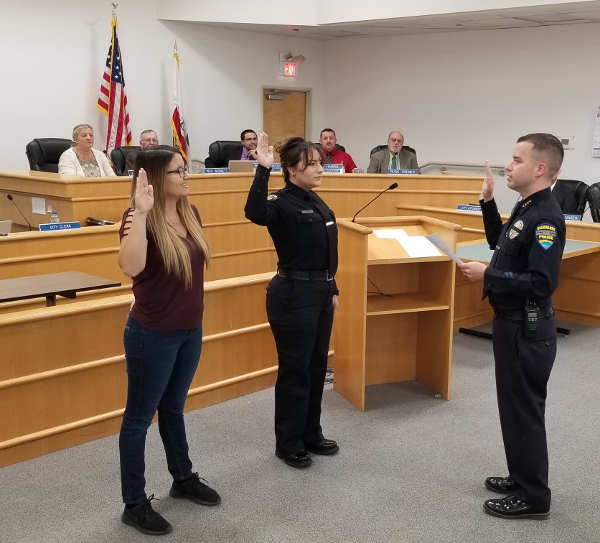
CLEARLAKE, Calif. – The city of Clearlake welcomed its newest police officer and dispatcher at Thursday night’s city council meeting.
During the meeting, Clearlake Police Chief Andrew White administered the oath to Officer Britanya Shores and dispatcher Taylor Mackey.
Officer Shores is a Clearlake native. Early on, she set her goal to becoming a law enforcement officer.
She was initially hired as a Community Services Officer with the Clearlake Police Department in 2017 and in the meantime attended the Basic Police Academy at the Santa Rosa Junior College Public Safety Training Center.
“Ms. Shores is a valuable member of this organization and we look forward to seeing her serve in her new capacity as police officer,” said Chief White.
After Shores took the oath, her mother pinned on her new badge.
Mackey was born in Santa Rosa and grew up in Middletown. She graduated from Middletown High School and was active in softball, soccer, baseball, volleyball and cheerleading.
After high school, Mackey took college courses and worked several jobs, including in a restaurant, as an instructional aid and a medical assistant.
“Taylor became interested in the career field of dispatching and did several sit-alongs with the Clearlake Police Department. We are excited to have Taylor join our dispatch team,” White said.
City Manager, Greg Folsom, added, “We continue to add quality personnel to our police department and we are pleased to have Officer Shores and Dispatcher Mackey join our Clearlake team.”