 How to resolve AdBlock issue?
News
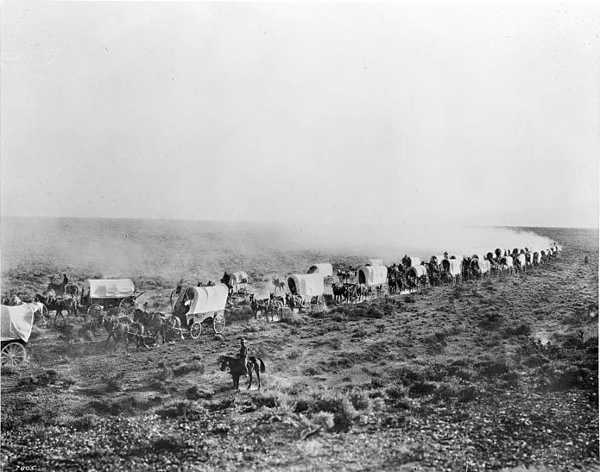
“Every man will fit himself for the trip with a horse, a good rifle and as much ammunition as the company may think necessary,” read the advertisement in the “Missouri Intelligencer” in the late summer of 1821. “Every man will furnish an equal part of the fitting out for trade, and receive an equal part of the product.”
A certain William Becknell placed the ad. An enigmatic figure whose past is still to this day buried deep in the Ozark Mountains where he lived, he was typical of the type of men who moved out west as part of the first migration following the Louisiana Purchase.
That purchase, in a single swipe of a pen, opened the vast heartlands of America to enterprising sojourners like Becknell.
We know he was born in Virginia, but lived his adult life in the Missouri country, having moved there with his wife sometime in 1810. He served as a Ranger for about a year during the War of 1812 and afterward settled in Boone’s Lick in central Missouri.
Like many who lived on the frontier in those days, Becknell sought his fortune where he could, becoming a salt trader and peddler in other goods, buying and selling what he could.
Also like many of his fellow frontiersmen, Becknell foundered terribly and racked up a significant debt – a debt he hoped to wipe clean with this latest trading venture of his.
In his advertisement, Becknell sought hardy men willing to travel with him southwestward, in the wilds of the southern Rockies, "for the purpose of trading for Horses and Mules and catching Wild Animals of every description.”
His real intention was more daring than a simple hunting trip. News travelled fast along the porous border of America and the Spanish territories in the southwest, an interaction between countries that the Spanish government, for one, had been relentlessly trying to control ever since the first Americans began nosing around New Mexico in 1806.
The news that reached William Becknell in 1821 was that Spanish authorities were too busy dealing with a rebellion within their Mexican territories to worry overly much about a trading caravan of Americans.
Seeing potential profits to be had, Becknell began organizing just such a caravan.
Only four men took him up on his offer to head west, but that was enough for Becknell, who was happy to get anywhere outside the clutches of the persistent debt collectors. In September 1821, he and his brave few set out towards Santa Fe.
After a difficult journey along the Arkansas River, which cut into southeastern Colorado, Becknell and his party turned south. Shortly after making it through the Raton Pass, the beleaguered travelers encountered a troop of 400 soldiers – not the sort of welcome they had hoped for.
Fortunately for them, these soldiers were now part of the new Mexican government, which had overthrown the Spanish.
They informed Becknell and his party that Santa Fe, which had been kept isolated by the Spanish, would now welcome their trade. Hurrying on, Becknell arrived in Santa Fe on Nov. 16, 1821, becoming the very first American to open up what would become known as the Santa Fe Trail – a thoroughfare that connected Missouri and the rest of America to the isolated southwest.
His daring paid off in a big way. His $300 in tradable goods, which he had hauled with him, sold for $6,000 in gold and silver coin. When he returned to Missouri in January of 1822 and paid off the entirety of his debt, other men took notice. It wasn’t long before regular caravans made their way to the golden country of Santa Fe.
Becknell himself would make three additional trips along the route he had blazed, serving as an official for the U.S. Congress during his final trip and marking off for the record the Santa Fe Trail.
He later retired with his family to the Texas territory and played a role in the Texas War for Independence that followed.
He died in 1856, having earned the title “the Father of the Santa Fe Trail.”
Antone Pierucci is curator of history at the Riverside County Park and Open Space District and a freelance writer whose work has been featured in such magazines as Archaeology and Wild West as well as regional California newspapers.
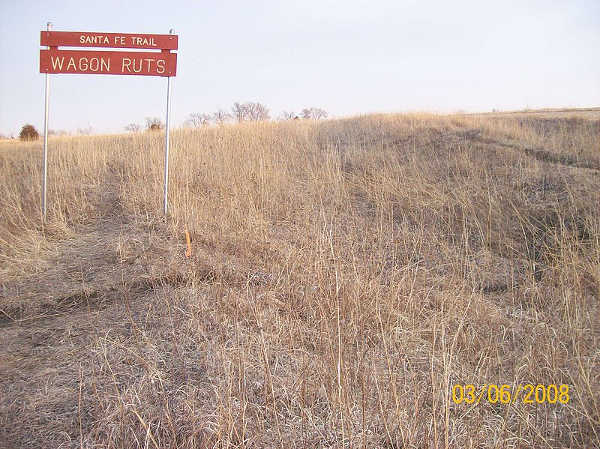

The presence of water on Mars has been theorized for centuries. Early telescopes revealed ice caps, and early astronomers noted channels that were hypothesized to be natural rivers or creature-created canals.
Over the past two decades, rovers Sojourner, Spirit, Opportunity, and Curiosity have sent back invaluable data to scientists who are trying to interpret the planet’s surface and uncover evidence of past or present water.
Since its landing on the “Red Planet” in August of 2012, Curiosity Rover has traveled about 20 kilometers within Gale Crater. The rover has examined about 400 meters of sedimentary rock that exists in the crater, says Ezat Heydari of Jackson State University in Jackson, Mississippi – including rocks thought to be 3.7 to 4.1 billion years old (Noachian time).
Heydari and colleagues used these images of sedimentary rocks to interpret the geologic processes that occurred billions of years ago on Mars. He presented their findings on Sunday at the Geological Society of America Annual Meeting in Indianapolis, Indiana.
Within those 400 meters of rock, the researchers identified four different units that represent different types of deposition, and Heydari says that “in my opinion, deposition of all of these packages involved water.”
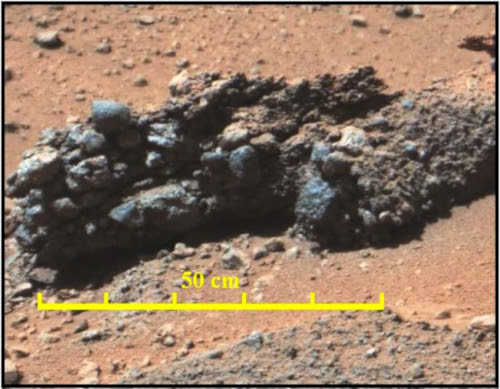
One of those packages, called the Hummocky Plain Unit, is a conglomerate with grains up to 20 centimeters in size. The Curiosity images showed ridges in the Hummocky Plain Unit, filled with rounded cobbles and cross beds reaching 4 meters high – indications that deposition was done by moving water.
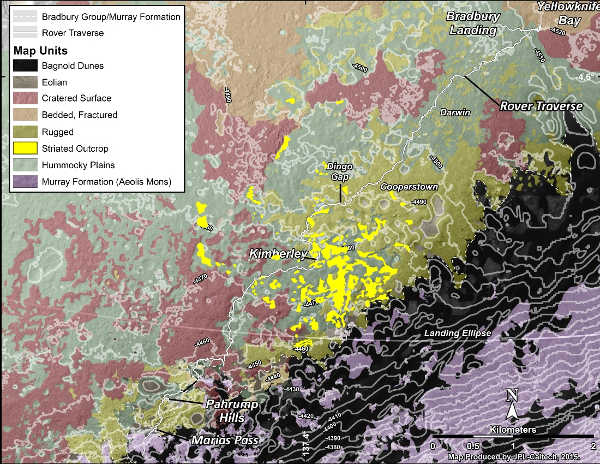
In addition, some of the images have height information that can create a topographic profile of the surface, revealing the profiles of the ridges. “These ridges are asymmetric,” says Heydari. “In other words, they were formed by one directional current.”
After seeing the images, Heydari says he immediately thought of the Channelized Scablands in Washington State. The Mars ridges are equally spaced, he says, adding that they are about twice the size of those in the Scablands. The ridges on Mars and Earth had similar characteristics, but it wasn’t until he saw the cross beds that Heydari concluded the Mars deposits were made by large-scale flooding.
Using comparisons to Earth rivers, Heydari notes that to create cross beds 4 meters high, the flowing water would have been about 10 to 20 meters deep. “That’s one of the reasons I say these deposits are related to floods, rather than a puny river,” he says.
Heydari says that the Noachian sedimentary rocks found in Gale Crater may have been deposited in a similar setting as Pleistocene Earth (about 2 million years to 12,000 years ago), with large-scale global ice and dramatic outburst floods.
“On both planets, one hemisphere was covered by ice – northern Hemisphere on Earth, versus the Southern Hemisphere in Mars – and the other hemisphere was warm,” says Heydari. He adds that this comparison is important because it shows that ancient Mars appears to be very similar to Pleistocene Earth, where liquid water is stable and able to support life.
NORTH COAST, Calif. – The California Highway Patrol is investigating a vehicle crash that claimed the life of the driver near Hopland on Friday evening.
The CHP’s Ukiah area office did not release the name or city of residence of the male driver pending notification of next of kin.
The CHP report said that at approximately 6:45 p.m. Friday its officers responded to the report of a solo vehicle crash on Old River Road near mile post marker 4.52 just north of Hopland.
During the initial investigation, officers determined that a 2016 Honda Accord driven by a male had been traveling north on Old River Road at an unknown speed when the car went off the west roadway edge and hit a tree, the CHP said.
The driver sustained fatal injuries and died at the scene, according to the report.
The report stated that the man was wearing a seat belt.
The CHP said the crash’s cause remains under investigation, and as of the time of the report late Friday night it was not known whether or alcohol or drugs had contributed to the fatal wreck.
Email Elizabeth Larson atThis email address is being protected from spambots. You need JavaScript enabled to view it. . Follow her on Twitter, @ERLarson, or Lake County News, @LakeCoNews.
The CHP’s Ukiah area office did not release the name or city of residence of the male driver pending notification of next of kin.
The CHP report said that at approximately 6:45 p.m. Friday its officers responded to the report of a solo vehicle crash on Old River Road near mile post marker 4.52 just north of Hopland.
During the initial investigation, officers determined that a 2016 Honda Accord driven by a male had been traveling north on Old River Road at an unknown speed when the car went off the west roadway edge and hit a tree, the CHP said.
The driver sustained fatal injuries and died at the scene, according to the report.
The report stated that the man was wearing a seat belt.
The CHP said the crash’s cause remains under investigation, and as of the time of the report late Friday night it was not known whether or alcohol or drugs had contributed to the fatal wreck.
Email Elizabeth Larson at
LAKE COUNTY, Calif. – Health and air quality officials in Lake and neighboring counties have issued new warnings about hazardous air conditions due to the deadly Camp fire burning in Butte County.
The Camp fire began early Thursday, and has since resulted in nine confirmed fatalities, the destruction of 6,453 residences and 260 commercial structures, and the burning of 90,000 acres in and around the towns of Paradise and Magalia.
Lake County Air Pollution Control Officer Doug Gearhart said that smoke from the Camp fire had caused conditions ranging from unhealthy to very unhealthy.
Conditions had cleared in some areas, resulting in the Lake County Quality Management District’s most recent forecast putting air quality conditions in the “unhealthy” range for most of the north county and “moderate” to “unhealthy for sensitive individuals” in the south county.
Though conditions are expected to improve, all residents should be prepared for smoke to settle into the area during the overnight hours until the fire is out, Gearhart said.
He said the overnight forecast indicates a potential for settling of smoke into the basin. In areas that become impacted by smoke “Moderate” to “Unhealthy” air quality may be experienced. Mostly clear conditions with periods of smoke impact are expected through the weekend. Slight variations in the wind direction can result in significant smoke impacts.
At the same time, the Web site PurpleAir showed conditions ranging from “warning” to “very unhealthy.”
Gearhart said conditions can change quickly from “good” to “unhealthy”, and this may be the pattern for the next few days. Localized areas may experience intermittent particulate levels in the “moderate” to “unhealthy” range. All areas of Lake County may be significantly impacted should meteorological conditions worsen.
Lake County Public Health Officer Dr. Erin Gustafson advises residents to be cautious in resuming normal outdoor activities when smoke is present in your area.
“Variable weather conditions and ongoing fire activity may result in localized areas of reduced air quality, which could still pose health risks to people with underlying health conditions. Since we can’t always predict when and where “pockets” of poor air quality may occur, it is prudent to be careful until conditions stabilize,” Gustafson said.
Smokey conditions can cause irritation of the eyes, nose and air passages, which can be hazardous in young children, the elderly, individuals with heart conditions or chronic lung disease such as asthma, bronchitis and other respiratory conditions.
Individuals with asthma, bronchitis, emphysema and other lung or heart diseases should carefully adhere to their medical treatment plans and maintain at least a five-day supply of prescribed medications. They should limit outdoor activity and unnecessary physical exertion. Air conditioning that recirculates indoor air should be used, when available. Drinking plenty of water to avoid drying of the airways is recommended, unless restricted for medical reasons.
Dust masks are not protective against the most harmful pollutants caused by wildfire smoke that drifts to nearby areas. They are useful in filtering out the ash and larger particles that are encountered in burn areas. Air purifying respirators, such as N-95 filtering face pieces, may be effective in reducing harmful particulate matter, but also increase the work of breathing, can lead to physiologic stress, and are not recommended as a general protective measure.
The “moderate” to “unhealthy” air quality forecast results from fine particulates in the smoke and the possibility of increased ground level ozone. These are generated when combustion products in the smoke combine with the high temperatures, sunlight, and humidity. Other chemical reactions reduce visibility by forming secondary particulates. Unhealthy air, regional haze, and particulate from this fire can be expected throughout the County until the fire is out.

CLEARLAKE, Calif. – Several men were arrested last week during the service of a search warrant at a Clearlake property where an illegal marijuana grow was discovered.
On Friday, Nov. 2, Lake County Sheriff’s narcotics detectives served a search warrant at a residence located within the 3700 Block of Fillmore Ave. in Clearlake, according to Lt. Corey Paulich.
While making entry into the structure, Paulich said detectives contacted and detained six Hispanic male adults processing and trimming approximately 340 pounds of processed marijuana.
Paulich said the men were identified as Clearlake residents Edi Avila-Castaneda, 23; Alejandro Cortez-Cornejo, 24; Jose Trinidad Cruz-Solorio, 19; Edgar Garcia-Ramirez, 21; and Gilberto Ramirez-Pineda, 22; and Roberto Villasenor, 42 of Atwater.
Another man, Jesus Aleman-Sosa, 18, of Clearlake attempted to flee out of a bedroom window and was apprehended inside a marijuana hoop greenhouse in the backyard, Paulich said.
Detectives located a loaded AR-15 .223 caliber assault rifle in the only bedroom of the house along with body armor, a large quantity of high-capacity pistol and rifle magazines, Paulich said. Military clothing, equipment and firearm components, including two rifle suppressors, were also located.
Paulich said a sheriff’s office narcotics detection canine conducted a search of the residence and surrounding property, ultimately alerting to an area in the backyard near the two hoop style marijuana greenhouses.
He said then detectives then discovered a series of 4-inch PVC pipes buried vertically in the ground. Upon inspection of those pipes, detectives located approximately 4 pounds of crystal methamphetamine and half an ounce of black tar heroin.
The narcotics, along with a total of 238 growing marijuana plants and 340 pounds of processed marijuana, were seized from the property during the service of the warrant, Paulich said.
Paulich said all of the subjects were placed under arrest and booked at the Lake County Jail for violations of possession of controlled substance for sale, possession of narcotics for sale, possession of a controlled substance while armed, committing a felony while armed, cultivation of marijuana, and possession of marijuana for sale. All of them were later released after posting bail.
LAKE COUNTY, Calif. – The county of Lake reported that the presence of a US EPA severely restricted pesticide has been confirmed at additional sites in the Lower Lake area.
County officials first issued a report on the pesticide sampling last week.
During searches conducted by the California Department of Fish and Wildlife and the Lake County Sheriff’s Office of cannabis grow sites on private property on Sept. 18 and 21, samples of an unknown substance were obtained that were confirmed on Oct. 31 as a US EPA severely restricted pesticide.
There are now six sites with confirmed presence of the pesticide, the county reported.
Results for two of the sites came back on Oct. 31, which was the basis for the county’s first report last week.
Results for the other four sites came back on Nov. 7. Five of the sites also had presence of additional chemical pesticides, the county reported.
Officials said the known sites are in the Lower Lake area: three are off of Morgan Valley Road; two are off of Rocky Creek Road the other is on Spruce Grove Road south of Lower Lake.
Warning signs to avoid the areas will be posted at the entrances to the affected properties, according to the county.
The pesticide confirmed is Carbofuran, which is an organophospahate, a harmful pesticide to the public and the environment. A bird on one site was confirmed dead due to organophosphate poisoning. These chemicals can cause reproductive harm, acute poisoning, and have possible long-term effects.
Seek medical treatment if you believe you have been in contact with these chemicals or are experiencing the following symptoms: blurred vision, pinpoint pupils, tearing, excessive respiratory secretions; salivation; sweating; abdominal cramps, headache, nausea, vomiting, diarrhea; lightheadedness; chest tightness, epigastric pain, labored breathing; cyanosis; muscle twitching; incoordination; convulsions; unconsciousness; respiratory failure; skin irritation.
The county said it will continue to notify the public until the spill has been remediated.
If you have a shallow well in the area, consider filtering your water with a granular activated carbon filter and non-ionic polymeric resin filters. Individuals can Google NSF 42, 53, and 401 point-of-use or point-of-entry filters.
Contact the Lake County Health Department with questions at 707-263-1090. After hours, please dial 9 to be connected.
County officials first issued a report on the pesticide sampling last week.
During searches conducted by the California Department of Fish and Wildlife and the Lake County Sheriff’s Office of cannabis grow sites on private property on Sept. 18 and 21, samples of an unknown substance were obtained that were confirmed on Oct. 31 as a US EPA severely restricted pesticide.
There are now six sites with confirmed presence of the pesticide, the county reported.
Results for two of the sites came back on Oct. 31, which was the basis for the county’s first report last week.
Results for the other four sites came back on Nov. 7. Five of the sites also had presence of additional chemical pesticides, the county reported.
Officials said the known sites are in the Lower Lake area: three are off of Morgan Valley Road; two are off of Rocky Creek Road the other is on Spruce Grove Road south of Lower Lake.
Warning signs to avoid the areas will be posted at the entrances to the affected properties, according to the county.
The pesticide confirmed is Carbofuran, which is an organophospahate, a harmful pesticide to the public and the environment. A bird on one site was confirmed dead due to organophosphate poisoning. These chemicals can cause reproductive harm, acute poisoning, and have possible long-term effects.
Seek medical treatment if you believe you have been in contact with these chemicals or are experiencing the following symptoms: blurred vision, pinpoint pupils, tearing, excessive respiratory secretions; salivation; sweating; abdominal cramps, headache, nausea, vomiting, diarrhea; lightheadedness; chest tightness, epigastric pain, labored breathing; cyanosis; muscle twitching; incoordination; convulsions; unconsciousness; respiratory failure; skin irritation.
The county said it will continue to notify the public until the spill has been remediated.
If you have a shallow well in the area, consider filtering your water with a granular activated carbon filter and non-ionic polymeric resin filters. Individuals can Google NSF 42, 53, and 401 point-of-use or point-of-entry filters.
Contact the Lake County Health Department with questions at 707-263-1090. After hours, please dial 9 to be connected.