LAKE COUNTY, Calif. – Lake County Animal Care and Control has another group of mostly big dogs – plus a dachshund – waiting to go to new homes this week.
Dogs available for adoption this week include mixes of Dachshund, German Shepherd, Labrador Retriever, pit bull and shepherd.
Dogs that are adopted from Lake County Animal Care and Control are either neutered or spayed, microchipped and, if old enough, given a rabies shot and county license before being released to their new owner. License fees do not apply to residents of the cities of Lakeport or Clearlake.
If you're looking for a new companion, visit the shelter. There are many great pets hoping you'll choose them.
The following dogs at the Lake County Animal Care and Control shelter have been cleared for adoption (additional dogs on the animal control Web site not listed are still “on hold”).
This young male shepherd is in kennel No. 6, ID No. 11600. Photo courtesy of Lake County Animal Care and Control. Male shepherd
This young male shepherd has a medium-length tricolor coat.
He’s in kennel No. 6, ID No. 11600.
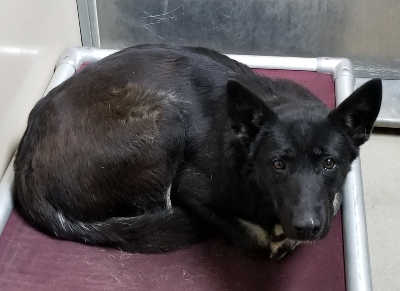
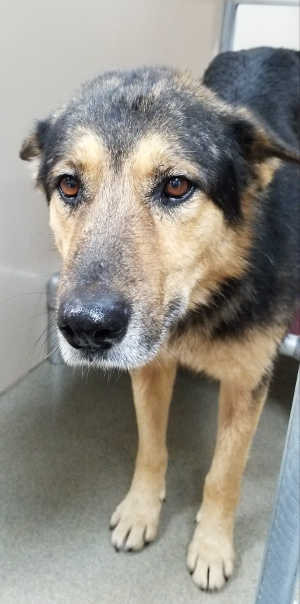
This female shepherd is in kennel No. 7a, ID No. 11602. Photo courtesy of Lake County Animal Care and Control. Female shepherd
This female shepherd has a medium-length black and brown coat.
She’s in kennel No. 7a, ID No. 11602.
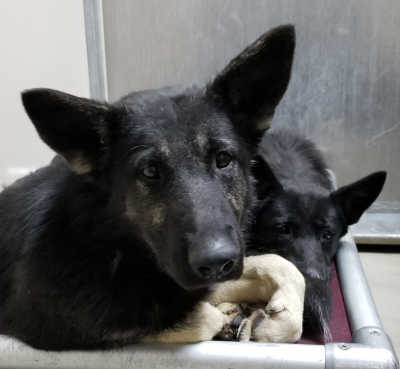
This female German Shepherd is in kennel No. 7b, ID No. 11604. Photo courtesy of Lake County Animal Care and Control. Female German Shepherd
This female German Shepherd has a medium-length black and tan coat.
She’s in kennel No. 7b, ID No. 11604.
This male Labrador Retriever is in kennel No. 9a, ID No. 11588. Photo courtesy of Lake County Animal Care and Control. Male Labrador Retriever
This male Labrador Retriever has a short black coat.
He’s in kennel No. 9a, ID No. 11588.
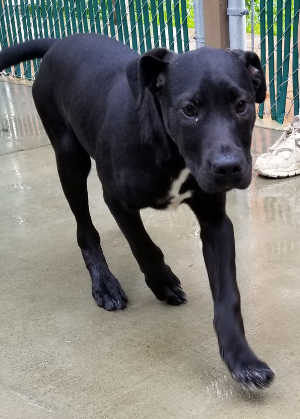
This male Labrador Retriever is in kennel No. 9b, ID No. 11589. Photo courtesy of Lake County Animal Care and Control. Male Labrador Retriever
This male Labrador Retriever has a short black coat with white markings.
He’s in kennel No. 9b, ID No. 11589.
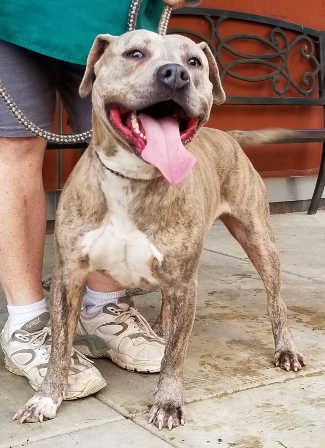
“Tank” is a male pit bull terrier in kennel No. 21, ID No. 7002. Photo courtesy of Lake County Animal Care and Control. ‘Tank’
“Tank” is a male pit bull terrier with a short brown brindle coat.
He already has been neutered.
He’s in kennel No. 21, ID No. 7002.
This male dachshund is in kennel No. 27, ID No. 11608. Photo courtesy of Lake County Animal Care and Control. Male dachshund
This male dachshund has a short black coat.
He’s in kennel No. 27, ID No. 11608.
This male German Shepherd is in kennel No. 33, ID No. 11564. Photo courtesy of Lake County Animal Care and Control. Male German Shepherd
This male German Shepherd has a medium-length tricolor coat.
He’s in kennel No. 33, ID No. 11564.
This male German Shepherd is in kennel No. 34, ID No. 11605. Photo courtesy of Lake County Animal Care and Control. Male German Shepherd
This male German Shepherd as a medium-length black and tan coat.
He has been neutered.
He’s in kennel No. 34, ID No. 11605.
Lake County Animal Care and Control is located at 4949 Helbush in Lakeport, next to the Hill Road Correctional Facility.
Office hours are Monday through Friday, 11 a.m. to 5 p.m., and 11 a.m. to 3 p.m., Saturday. The shelter is open from 11 a.m. to 4 p.m. Monday through Friday and on Saturday from 11 a.m. to 3 p.m.
For more information call Lake County Animal Care and Control at 707-263-0278.
Email Elizabeth Larson at This email address is being protected from spambots. You need JavaScript enabled to view it.. Follow her on Twitter, @ERLarson, or Lake County News, @LakeCoNews.
NORTH COAST, Calif. – The Diocese of Santa Rosa has produced a list of its priests and deacons who have been accused of sexual abuse, with the allegations spanning more than six decades.
Bishop Robert F. Vasa released the list of 39 men on Saturday on the diocese’s Web site and in its newspaper, North Coast Catholic.
The diocese will hold a press conference about the list at 10 a.m. Monday. The event will be livestreamed on the diocese Facebook page at www.facebook.com/dioceseofsantarosa.
The list includes the late Father Ted Oswald, who served in Lake County and was the focus of two lawsuits alleging abuse.
The first suit, filed in 2008, alleged Oswald had sexually abused a young man between 1988 and 1995.
Oswald, who served as priest at St. Mary Immaculate Catholic Church in Lakeport for 20 years, took a leave of absence in June 2008 and didn’t return to ministry.
That suit was settled in March 2009 and Oswald died the following year.
It’s unclear, based on the information provided by the diocese, if any of the other priests served at any time in Lake County.
Vasa prefaced the list with a statement in which he expressed “sincere sorrow that so many have been subjected to the evil actions of priests and bishops,” and he apologized for anyone who has been injured by the clergy on the list.
“While the Church has taken some very significant actions over the past 20 years, those actions are significant in terms of the present and future protection of children. However, they do not touch the very real trauma which the evil actions of deacons, priests and bishops have caused in the lives of thousands of young people in our nation,” Bishop Vasa said.
“My primary goal in releasing the names of accused priests and deacons who served in Santa Rosa in this public fashion is to give to all the victims of clerical sexual abuse the assurance that they have been heard and that the Church is very much concerned for their well-being and healing,” Vasa said.
He added, “It is my deepest prayer and hope that this release of names in a consolidated fashion says to any of you who are victims, we have heard you, we believe you, we affirm you in your trauma and we want to help with a healing process. Bringing difficult things to light is painful. It is painful for victims of childhood sexual abuse, for the People of God, for our priests, and for me. I know of no other way to bring light to this distressing moment in the Church.”
Based on the list, abuses were committed from 1957 to 2006.
The list includes 17 who have no known allegations against them during the time of their service or presence in the Diocese of Santa Rosa.
Also listed are seven whose names were released officially by the diocese in January 2004; 14 who “whose names have become a part of a public record, mostly by way of public expressions in the media or on the internet,” in which Oswald was included; four who were prosecuted and convicted; and 22 who are deceased.
The diocese reported in its newspaper, “No priest with a credible accusation of sexual abuse of a minor or vulnerable adult is currently serving in public ministry in the Diocese of Santa Rosa. In keeping with the Charter for the Protection of Children and Young People, when a member of the clergy is found to be guilty of a crime against children or young people, he is permanently removed from ministry.”
Vasa said that, despite the fact that he wants to be entirely open about accusations against diocesan clergy, the names of six additional individuals against whom allegations have been made are not being released.
He said those accusations lack sufficient substantiation to justify a release or the Diocesan Review Board believes they may not be released without a court order authorizing the diocese to do so.
In three cases the proper authorities investigated and found the allegations not substantiated, Vasa said. One of these individuals remains in ministry.
Vasa said that, in two cases, the allegations came to the diocese or religious community to which the accused belonged, and those entities have not yet determined the suitability of releasing the names. In one case the nature of the event described does not indicate that abuse occurred.
The Diocesan Review Board has openly discussed all six, and all but two of the names have been revealed to the Sonoma County district attorney. The two remaining have been reported to police in a timely fashion and investigated, and so Vasa said the presumption of innocence and the right to a presumption of innocence must be fully respected.
“The Diocese does not desire to hide or cover-up anything,” he wrote.
Vasa said the list doesn’t include two other names of individuals who have been the subject of news stories: Bishop G. Patrick Ziemann and Archbishop John Nienstedt.
Ziemann formerly headed the Santa Rosa Diocese until he was sued in 1999 by a young priest who said Ziemann forced him to have sex. Ziemann died in 2009.
Niensted, who came to California in 2015 after serving as archbishop of St. Paul and Minneapolis, has worked at the Napa Institute in Napa County and presided over Mass at the Meritage chapel.
In a statement, Niensted said that in December he became aware that an allegation had been brought to the Ramsey County, Minnesota prosecutor in 2016 by a man in the Diocese of New Ulm. That man said that when he was a minor in 2005 he met Niensted during the 2005 World Youth Day in Cologne, Germany.
The man said he and a friend and Niensted got caught in a rainstorm, and that Niensted invited the two of them to his hotel room, where he changed his clothes in front of them and invited them to remove their clothes so that those articles of clothing could be dry cleaned.
“It’s my understanding the man does not claim any physical touching, hence an allegation of misconduct as opposed to abuse,” Niensted said in his response.
“Having lived through the Dallas charter meeting of the USCCB in 2002 which dealt with the crisis in Boston over the sexual abuse of minors by clergy, I would have known enough never to be alone with minors in a hotel room precisely so that such allegations could not be made. Moreover, my own sense of personal modesty would not permit me to undress in front of others. This allegation was not known to me when I petitioned to minister in the Diocese of Santa Rosa in 2016. I only learned of it on December 13, 2018,” Niensted said.
He said the allegation is false and that he welcomes an impartial look at the facts and the opportunity to defend himself “at the earliest opportunity.”
Vasa said Niensted’s case remains under review by the Holy See.
“The naming of Bishops accused is exclusively under the authority of the Holy See and I am not authorized to make any revelations regarding them,” Vasa said.
Vasa also recognized the Diocesan Review Board, the involvement of which “is one of the strongest measures taken by the Diocese to help assure the fullest degree of transparency permitted by law.”
He said the board has access to everything that he has seen and heard regarding child sexual abuse in the Diocese of Santa Rosa.
“This is not a body of men and women who simply rubber stamp whatever the Bishop wants. They are conscientious, dedicated men and women with areas of expertise which uniquely qualify them as advisors to the Bishop on these most significant matters. I am most grateful to them for their dedicated service and rely greatly upon their expert advice,” Vasa said.
The Diocesan Review Board includes Richard Ortiz, a retired probation officer; George Berg, a police officer; John Storm, a permanent deacon, Catholic Restorative Justice Ministry; psychologist Dr. Alisa Liguori Stratton; psychotherapist Dr. Mary Killeen Lyons, Ph. D.; retired Superior Court Judge Charlotte Walter Woolard; and retired California Court of Appeal Justice Daniel (Mike) Hanlon.
The board’s advisors include Dan Galvin, the diocesan attorney; Monsignor Daniel Whelton, vicar for clergy; and Julie Sparacio, diocesan director of the Office of Child and Youth Protection.
The full list of accused deacons and priests follows.
Joseph Alzugaray
Ordained for the Archdiocese of Los Angeles April 29, 1967 Incardinated in the Diocese of Santa Rosa June 17, 1996 Accused in 1993 for 1967-1972 abuse in Los Angeles Cleared by LA / Retired 10-31-11 Deceased 1-31-14 No known accusations in the Diocese of Santa Rosa
Carmelo Baltazar
Ordained for the Diocese of Malolos, Philippines June 6, 1960 Chaplain Queen of the Valley Hospital 1981-82 Left the Diocese of Santa Rosa 11-24-82 Arrested and sentenced 1985 Deceased (San Diego Diocese Web site)
Edward F. Beutner
Ordained for the Diocese of Superior 1965 Assigned to Mont LaSalle in Napa in 1987 There are no specific details about allegations against him Deceased 2008 No known accusations in the Diocese of Santa Rosa
Anthony Bolger
Ordained for the Diocese of Santa Rosa December 19, 1969 Excardinated to Honolulu 6-18-84 Accused in 1994 for abuse of a minor in 1972-1973 In 1994 notified Honolulu of accusation Deceased 1-7-2015
David Brusky
Religious Priest Ordained June 9, 1952 Served in the Diocese of Santa Rosa 1981-1985 Allegation made in 2002 for abuse in 1980s Reported to DA in 2002 Deceased 2-1-2014
John Crews
Ordained for the Diocese of Santa Rosa Feb. 14, 1971 Accusation raised by man’s widow 2-1-2013 for 1971-75 actions Reported to Police February 2013 No assignment / Retired 2013
Kevin Dunne
Religious brother Accused in 2002 for 1993 abuse elsewhere Lived at Franciscan Hermitage, Sebastopol 11-19-04 to 7-31-05 Current status unknown No known accusations in the Diocese of Santa Rosa
Don Eagleson
Ordained for the Diocese of Santa Rosa April 13, 1985 Accused in 2002 of abuse in 1971 prior to ordination Out of ministry 4-30-02 Deceased 10-22-2004 No known accusations in the Diocese of Santa Rosa
Don D. Flickinger
Ordained for the Diocese of Fresno 1964 Civil suit filed 8-9-11 Chaplain to Christian Brothers Novitiate 1981 to 1983 Retired / No known accusations in the Diocese of Santa Rosa
J. Patrick Foley
Ordained for the Diocese of San Diego 1973 Listed by the San Diego Diocese in 2018 Provided many missions and parish retreats 1998-2006 No known accusations in the Diocese of Santa Rosa
Francis (John) Ford
Incardinated in the Diocese of Santa Rosa January 21, 1971 Belated claim of abuse as a Franciscan prior to 1971 Abuse occurrence in Diocese of Santa Rosa 1974 On leave Jan. 1, 1979 Deceased 10-21-84
Ruben Garcia
Ordained for the Diocese of Boise 1972 Named in a civil suit 2-21-94 Served in Diocese of Santa Rosa beginning 11-1973 No known accusations in the Diocese of Santa Rosa Deceased
Patrick Gleeson
Ordained for the Diocese of Sacramento June 10, 1947 Incardinated with the Diocese of Santa Rosa when established on 2-21-62 Accused in 2004 of abuse 1968-72 Retired 8-21-89 Deceased 4-15-91
Patrick A. Hannon
Religious priest ordained July 10, 1949 Served in the Diocese of Santa Rosa 1980 to 1981 Accused in 2000 of abuse 1981 Deceased 1993
Austin Peter Keegan
Ordained for the Archdiocese of San Francisco June 9, 1962 Served in the Diocese of Santa Rosa 1976-81 Accused in 2000 of abuse 1976-81 Removed / Moved to Mexico 1981 Stripped of duties by San Francisco 1982
Michael Emmet Kelly
Ordained for the Diocese of Santa Rosa May 15, 1971 Accused in 1999 of abuse 1971-99 Suspended 10-24-99 / Laicized 10-15-04
Don Kimball
Ordained for the Diocese of Santa Rosa May 24, 1969 Accused in 1990 of abuse in the 1980s On Leave / Removed 1990 Convicted in 2002 Deceased 9-15-2006
Bruce Maxwell
Religious priest ordained 1975 Accused in 2002 and removed from all ministry 2002 Chaplain at USCG Training Center Petaluma 1989 to 1992 In residence at Saint James, Petaluma at that same time No known accusations in the Diocese of Santa Rosa
Patrick McCabe
Ordained for the Archdiocese of Dublin May 21, 1961 Served in Diocese of Santa Rosa 1983-86 Abuse occurrence in the Diocese of Santa Rosa 1980s Removed 2-27-1986 / Laicized 3-11-1988
John A. Meenan
Ordained for the Diocese of Santa Rosa June 5, 1965 Accusation 1960s On Leave 1971 / Laicized 5-23-1975 Deceased 4-21-2009
John Moriarty
Religious brother Christian Brothers’ Retreat House in St. Helena from 1974-78 The Diocese of Santa Rosa has no record of his presence No known accusations in the Diocese of Santa Rosa
Francis E. Neville
Ordained for the Diocese of Colombo, Sri Lanka about 1973 Served in the Diocese of Santa Rosa 1983-84 Accused in 1993 of abuse in 1983 Deceased 10-2002
Mark O'Leary
Religious priest ordained May 19, 1985 Accused in 2002 of acts in Southern California from 1974-1977 Chaplain at Santa Rosa Memorial Hospital 1993-2002 Permanently removed from ministry 4-30-2002 No known accusations in the Diocese of Santa Rosa
Vincent O’Neill
Ordained for the Diocese of Santa Rosa May 21, 1971 Accused of abuse in the late 1970s Dismissed / Retired 1996 Deceased 11-12-1998
Francisco Javier Ochoa
Ordained for the Jesuits July 4, 1969 Incardinated with the Diocese of Santa Rosa 7-11-1991 Abuse occurrence 2006 Laicized 6-29-2009 Deceased 11-30-2009
Ted Oswald
Ordained for the Diocese of Santa Rosa June 6, 1984 Accused in 2008 Permanently removed from ministry 2008 Deceased 7-4-2013
Xavier Pallathuparambil
Ordained for the Diocese of Vijayapuram, India Dec. 22, 1952 Served in the Diocese of Santa Rosa 2-2-84 to 4-13-84 Dismissed from the Diocese of Santa Rosa 4-13-84 Deceased (India) 5-29-2004
Thomas Parker
Ordained for the Diocese of Santa Rosa April 13, 1985 Accused in 2007 of abuse in 1988-89 Police Report 7-10-2007 / Laicized May 2008
Daniel Polizzi
Ordained for the Diocese of Santa Rosa June 7, 1969 Transferred to the Diocese of San Diego 5-30-70 Accused in 1996 / Removed from ministry 1997 Deceased 2003 No known accusations in the Diocese of Santa Rosa
Celestine Quinlan
Religious priest ordained 1957 Named in 2003 civil suit for abuse between 1957-1962 Served in the Diocese of Santa Rosa 1962 to 1968 Deceased 1970 No known accusations in the Diocese of Santa Rosa
John Rogers
Ordained for the Diocese of Santa Rosa May 23, 1976 Served in the Diocese of Santa Rosa to 9-95 / Accused in 1995 Deceased 11-8-1995
Anthony J. Ross
Ordained for the Diocese of Joliet November 11, 1972 Incardinated with the Diocese of Santa Rosa 8-1-97 Accused in 2002 for abuse in Joliet in 1981 Permanently removed April 2002 No known accusations in the Diocese of Santa Rosa
Alfredo Sobalvarro
Ordained for Archdiocese of Washington, DC May 8, 1971 Served in the Diocese of Santa Rosa 1972 to 1976 Out of ministry since 2003
Gary Timmons
Ordained for the Diocese of Santa Rosa May 6, 1967 Served 6-67 to 3-94 Arrested and imprisoned 10-1995 / Laicized 5-15-2001
Francis Verngren
Religious brother Mont LaSalle 1969-84 and at Justin Siena 1984 Retired 2002 Tutored in math at Saint Apollinaris 1990 - 2002 Deceased 12-2-2003 No known accusations in the Diocese of Santa Rosa
James Walsh
Ordained for Archdiocese of San Francisco March 20, 1943 Incardinated with the Diocese of Santa Rosa when established on 2-21-62 Deceased 12-3-93 Accusation made in 2005 of abuse in 1965
Bernie Ward
Religious priest ordained 1977 Served in the Diocese of Santa Rosa 1978-1979 Accusation made in 2008 Convicted of child pornography related crime 8-2008 Left priesthood 1979 or 80 / Present ecclesial status unknown
Ron Wiecek
Religious priest ordained 1971 Served in the Diocese of Santa Rosa 1970s Accusation made to his religious community in 2010 Present status unknown
Vincent A. Yzermans
Ordained for the Diocese of St Cloud June 2, 1951 Listed as: On duty at the Diocese of Santa Rosa 1975-1976 File shows correspondence with Bishop Hurley in 1975 No record of any assignment in the Diocese of Santa Rosa Deceased 5-4-95 No known accusations in the Diocese of Santa Rosa
Email Elizabeth Larson at This email address is being protected from spambots. You need JavaScript enabled to view it.. Follow her on Twitter, @ERLarson, or Lake County News, @LakeCoNews.
The Fanny Farmer Cookbook. OttawaAC [CC BY-SA 3.0 (https://creativecommons.org/licenses/by-sa/3.0)], from Wikimedia Commons. Every family has a family recipe – whether it be Aunt Linda’s lemon tart recipe, or the instructions for making great grandma Carolynn’s chicken pot pie.
If you’re lucky, you have a legible copy of the recipe, with the ingredients clearly marked, and their portions easy to read. Each time you pull the recipe out to recreate the family favorite, it’s like sitting down to dinner with great grandma Carolynn all over again.
But for the rest of us, that’s not how it usually goes.
Instead, we usually have a grungy scrap of paper – crusted with bits of unidentifiable food – that looks like it could be part of the Dead Sea Scroll, and it certainly smells like it could.
This recipe is invariably written in a hand that suggests great grandma had had just enough time to jot down the recipe before the paramedics took her away, and would indeed make any doctor proud.
But don’t sweat it; it doesn’t really matter if you can read the chicken scratch, because from the looks of it, great grandma never heard of teaspoons, tablespoons or cups. Instead, her dish apparently requires several pinches of this, a goodly amount of that, and a handful of something else.
In life, your great grandma was 5 foot 2 and 110 pounds sopping wet. You, on the other hand, are 6 foot, easily pushing 200 (it’s the holidays, so 210) and have hands the size of a dinner ham. Your pinches and handfuls sure aren’t the same has hers, and you have no clue how much a “goodly amount” really is.
You love your great grandma, sure. But by now, you’re probably shooting dirty looks towards that picture of her that hangs in the hallway, and you’re beginning to think the old goat had no intention of anyone else cooking her dish, even if they were family.
Before you throw in the towel – and say some things you’ll later regret – understand that your great grandma might not have meant to be so obtuse after all. Depending on when the recipe was written, she might have simply been passing down the recipe as she herself had been taught it.
Before the turn of the 19th and 20th centuries, home cooking was an imprecise art form. It relied on the oral transmission of knowledge, from one generation of women to the next. Those women who lacked such an important mother figure in their lives loss out on this teaching, and their cooking usually suffered.
All of that changed in the 1890s when home economics teacher and revolutionary chef, Fannie Farmer, published her cookbook – the Boston Cooking-School Cookbook.
In it, Fannie presented to the world, for the first time ever, the modern recipe. No more “pinches and “handfuls” in the kitchen, thank you very much. Instead, as she wrote in her book, “Correct measurements are absolutely necessary to ensure the best results.”
Although she didn’t invent the teaspoon and tablespoon, she was the one responsible for popularizing the use of such precise measuring devices for cooking. She was, by all accounts, the 19th century’s version of Julia Child. In fact, Ms. Child recalled using Fannie’s cookbook as a young girl, whipping up pancakes, popovers and fudge.
When she published the cookbook, Fannie Farmer was working as a teacher at the Boston Cooking School – a school that was created to enable women of modest means to find work as cooks in private homes and institutions.
Although Farmer herself didn’t come from modest means – she hailed from a genteel family in nearby Medford – she did understand the power cooking had to elevate the status of women in society.
When she was just 16 years old, Farmer suffered partial paralysis in her legs, likely due to polio. Before this, she had intended to attend university and become a schoolteacher, but her handicap effectively ended those dreams. Looking at a long, unremarkable life as an old spinster bereft of useful employment, Farmer was distraught.
All of this changed when her father finally allowed her to leave the house to go work as a governess for a family friend. While there, her new employers encouraged her to take up cooking – a pursuit in which Farmer had already shown some promise.
Over the next several years, the young woman spent as much time in the kitchen as possible. She had finally found something worth pursuing; something she could see herself doing for the rest of her life, despite her handicap. At the age of 31, she left work as a governess and enrolled in the Boston Cooking School.
Immediately upon graduation in 1889, she returned to the school as staff. It was during her years as a teacher there that she developed the technique of precise cooking that would lead to the publication of her internationally famous cookbook.
Like the great celebrity chefs of the 20th and 21st century, Fannie Farmer took advantage of the success of her cookbook, and began touring the nation as a lecturer. In 1902, she opened her own cooking school, Miss Farmer’s School of Cookery, which became so profitable that she was able to buy land, build a large house and support her elderly parents.
It came as a shock to all when Miss Farmer died of a stroke on Jan. 15, 1915. She was only 57 years old. Although her life was cut short, her legacy lived on – and continues to live on to this day. To date, more than seven million copies of her cookbook have been sold.
Which begs the question – what was great grandma thinking when she wrote down that recipe?
Then again, we can’t all be Julia Childs – or Fannie Farmers.
Antone Pierucci is curator of history at the Riverside County Park and Open Space District and a freelance writer whose work has been featured in such magazines as Archaeology and Wild West as well as regional California newspapers.
Cash and drugs seized during the arrest on Friday, January 11, 2019, of Roger Vigil of Clearlake, Calif. Photo courtesy of Clearlake Police Department.
CLEARLAKE, Calif. – A Clearlake man was arrested on Friday after a Clearlake Police Officer found him with a large amount of money as well as methamphetamine in his vehicle.
Roger Vigil, 56, was taken into custody on Friday morning, according to Sgt. Rodd Joseph.
Joseph said that at 11 a.m. Friday Officer Mauricio Barreto stopped Vigil’s vehicle for a simple vehicle code violation.
From outside the vehicle, the officer observed a bag of methamphetamine in plain view near the center console, Joseph said.
Vigil was immediately arrested. During a search of Vigil’s clothing, Joseph said additional methamphetamine was located to include a significant amount of US currency.
During a further search of the vehicle, more methamphetamine was located inside to include drug paraphernalia, Joseph said.
Joseph said Vigil admitted some of the methamphetamine that was located – which was over an ounce – was possessed for sales.
The vehicle Vigil had been driving was later found to have false license plates on it and was towed, Joseph said.
Vigil was later booked into the Lake County Jail on felony charges of possession of narcotics for sale, transportation of narcotics and forged vehicle registration, according to Joseph.
A new analysis shows that ocean temperatures are on the rise, and they are going up faster than once thought. Image courtesy of UC Berkeley. Heat trapped by greenhouse gases is raising ocean temperatures faster than previously thought, concludes an analysis of four recent ocean heating observations.
The results provide further evidence that earlier claims of a slowdown or “hiatus” in global warming over the past 15 years were unfounded.
“If you want to see where global warming is happening, look in our oceans,” said Zeke Hausfather, a graduate student in the Energy and Resources Group at the University of California, Berkeley, and co-author of the paper. “Ocean heating is a very important indicator of climate change, and we have robust evidence that it is warming more rapidly than we thought.”
Ocean heating is critical marker of climate change because an estimated 93 percent of the excess solar energy trapped by greenhouse gases accumulates in the world’s oceans. And, unlike surface temperatures, ocean temperatures are not affected by year-to-year variations caused by climate events like El Nino or volcanic eruptions.
The new analysis, appears online today in Science, shows that trends in ocean heat content match those predicted by leading climate change models, and that overall ocean warming is accelerating.
Assuming a “business-as-usual” scenario in which no effort has been made to reduce greenhouse gas emissions, the Coupled Model Intercomparison Project 5 (CMIP5) models predict that the temperature of the top 2,000 meters of the world’s oceans will rise 0.78 degrees Celsius by the end of the century.
The thermal expansion caused by this bump in temperature would raise sea levels 30 centimeters, or around 12 inches, on top of the already significant sea level rise caused by melting glaciers and ice sheets. Warmer oceans also contribute to stronger storms, hurricanes and extreme precipitation.
“While 2018 will be the fourth warmest year on record on the surface, it will most certainly be the warmest year on record in the oceans, as was 2017 and 2016 before that,” Hausfather said. “The global warming signal is a lot easier to detect if it is changing in the oceans than on the surface.”
The four studies, published between 2014 and 2017, provide better estimates of past trends in ocean heat content by correcting for discrepancies between different types of ocean temperature measurements and by better accounting for gaps in measurements over time or location.
“The Intergovernmental Panel on Climate Change’s (IPCC) Fifth Assessment Report, published in 2013, showed that leading climate change models seemed to predict a much faster increase in ocean heat content over the last 30 years than was seen in observations,” Hausfather said. “That was a problem, because of all things, that is one thing we really hope the models will get right.”
“The fact that these corrected records now do agree with climate models is encouraging in that is removes an area of big uncertainty that we previously had,” he said.
Deep divers
A fleet of nearly 4,000 floating robots drift throughout the world’s oceans, every few days diving to a depth of 2000 meters and measuring the ocean’s temperature, pH, salinity and other bits of information as they rise back up. This ocean-monitoring battalion, called Argo, has provided consistent and widespread data on ocean heat content since the mid-2000s.
Prior to Argo, ocean temperature data was sparse at best, relying on devices called expendable bathythermographs that sank to the depths only once, transmitting data on ocean temperature until settling into watery graves.
Three of the new studies included in the Science analysis calculated ocean heat content back to 1970 and before using new methods to correct for calibration errors and biases in the both the Argo and bathythermograph data. The fourth takes a completely different approach, using the fact that a warming ocean releases oxygen to the atmosphere to calculate ocean warming from changes in atmospheric oxygen concentrations, while accounting for other factors, like burning fossil fuels, that also change atmospheric oxygen levels.
“Scientists are continually working to improve how to interpret and analyze what was a fairly imperfect and limited set of data prior to the early 2000s,” Hausfather said. “These four new records that have been published in recent years seem to fix a lot of problems that were plaguing the old records, and now they seem to agree quite well with what the climate models have produced.”
Lijing Cheng of the Chinese Academy of Sciences is the lead author on the paper. Co-authors include John Abraham of the University of St. Thomas and Kevin E. Trenberth of the National Center for Atmospheric Research.
This study was supported by the National Key R&D Program of China (2017YFA0603202). The National Center for Atmospheric Research is sponsored by the National Science Foundation.
Kara Manke writes for the UC Berkeley News Center.
NASA’s Transiting Exoplanet Survey Satellite, called TESS for short, has found three confirmed exoplanets, or worlds beyond our solar system, in its first three months of observations.
The mission’s sensitive cameras also captured 100 short-lived changes – most of them likely stellar outbursts – in the same region of the sky.
They include six supernova explosions whose brightening light was recorded by TESS even before the outbursts were discovered by ground-based telescopes.
The new discoveries show that TESS is delivering on its goal of discovering planets around nearby bright stars. Using ground-based telescopes, astronomers are now conducting follow-up observations on more than 280 TESS exoplanet candidates.
The first confirmed discovery is a world called Pi Mensae c about twice Earth’s size. Every six days, the new planet orbits the star Pi Mensae, located about 60 light-years away and visible to the unaided eye in the southern constellation Mensa. The bright star Pi Mensae is similar to the Sun in mass and size.
“This star was already known to host a planet, called Pi Mensae b, which is about 10 times the mass of Jupiter and follows a long and very eccentric orbit,” said Chelsea Huang, a Juan Carlos Torres Fellow at the Massachusetts Institute of Technology’s (MIT) Kavli Institute for Astrophysics and Space Research (MKI) in Cambridge. “In contrast, the new planet, called Pi Mensae c, has a circular orbit close to the star, and these orbital differences will prove key to understanding how this unusual system formed.”
Next is LHS 3884b, a rocky planet about 1.3 times Earth’s size located about 49 light-years away in the constellation Indus, making it among the closest transiting exoplanets known.
The star is a cool M-type dwarf star about one-fifth the size of our Sun. Completing an orbit every 11 hours, the planet lies so close to its star that some of its rocky surface on the daytime side may form pools of molten lava.
The third – and possibly fourth – planets orbit HD 21749, a K-type star about 80 percent the Sun’s mass and located 53 light-years away in the southern constellation Reticulum.
The confirmed planet, HD 21749b, is about three times Earth’s size and 23 times its mass, orbits every 36 days, and has a surface temperature around 300 degrees Fahrenheit (150 degrees Celsius).
“This planet has a greater density than Neptune, but it isn’t rocky. It could be a water planet or have some other type of substantial atmosphere,” explained Diana Dragomir, a Hubble Fellow at MKI and lead author of a paper describing the find. It is the longest-period transiting planet within 100 light-years of the solar system, and it has the coolest surface temperature of a transiting exoplanet around a star brighter than 10th magnitude, or about 25 times fainter than the limit of unaided human vision.
What’s even more exciting are hints the system holds a second candidate planet about the size of Earth that orbits the star every eight days. If confirmed, it could be the smallest TESS planet to date.
TESS’s four cameras, designed and built by MKI and MIT’s Lincoln Laboratory in Lexington, Massachusetts, spend nearly a month monitoring each observing sector, a single swath of the sky measuring 24 by 96 degrees.
The primary aim is to look for exoplanet transits, which occur when a planet passes in front of its host star as viewed from TESS’s perspective. This causes a regular dip in the measured brightness of the star that signals a planet’s presence.
In its primary two-year mission, TESS will observe nearly the whole sky, providing a rich catalog of worlds around nearby stars. Their proximity to Earth will enable detailed characterization of the planets through follow-up observations from space- and ground-based telescopes.
But in its month-long stare into each sector, TESS records many additional phenomena, including comets, asteroids, flare stars, eclipsing binaries, white dwarf stars and supernovae, resulting in an astronomical treasure trove.
In the first TESS sector alone, observed between July 25 and Aug. 22, 2018, the mission caught dozens of short-lived, or transient, events, including images of six supernovae in distant galaxies that were later seen by ground-based telescopes.
“Some of the most interesting science occurs in the early days of a supernova, which has been very difficult to observe before TESS,” said Michael Fausnaugh, a TESS researcher at MKI. “NASA’s Kepler space telescope caught six of these events as they brightened during its first four years of operations. TESS found as many in its first month.”
These early observations hold the key to understanding a class of supernovae that serve as an important yardstick for cosmological studies. Type Ia supernovae form through two channels. One involves the merger of two orbiting white dwarfs, compact remnants of stars like the Sun.
The other occurs in systems where a white dwarf draws gas from a normal star, gradually gaining mass until it becomes unstable and explodes.
Astronomers don’t know which scenario is more common, but TESS could detect modifications to the early light of the explosion caused by the presence of a stellar companion.
All science data from the first two TESS observation sectors were recently released to the scientific community through the Mikulski Archive for Space Telescopes (MAST) at the Space Telescope Science Institute in Baltimore.
More than a million TESS images were downloaded from MAST in the first few days,” said Thomas Barclay, a TESS researcher at NASA’s Goddard Space Flight Center in Greenbelt, Maryland, and the University of Maryland, Baltimore County. “The astronomical community’s reaction to the early data release showed us that the world is ready to jump in and add to the mission’s scientific bounty.”
George Ricker, the mission’s principal investigator at MKI, said that TESS’s cameras and spacecraft were performing superbly.
“We’re only halfway through TESS’s first year of operations, and the data floodgates are just beginning to open,” he said. “When the full set of observations of more than 300 million stars and galaxies collected in the two-year prime mission are scrutinized by astronomers worldwide, TESS may well have discovered as many as 10,000 planets, in addition to hundreds of supernovae and other explosive stellar and extragalactic transients.”
TESS is a NASA Astrophysics Explorer mission led and operated by MIT in Cambridge, Massachusetts, and managed by NASA's Goddard Space Flight Center. Additional partners include Northrop Grumman, based in Falls Church, Virginia; NASA’s Ames Research Center in California’s Silicon Valley; the Harvard-Smithsonian Center for Astrophysics in Cambridge, Massachusetts; MIT’s Lincoln Laboratory; and the Space Telescope Science Institute in Baltimore. More than a dozen universities, research institutes and observatories worldwide are participants in the mission.
Francis Reddy works for NASA’s Goddard Space Flight Center.
 How to resolve AdBlock issue?