How to resolve AdBlock issue?
News
For the first time in NASA’s history, women are in charge of three out of four science divisions at the agency.
The Earth Science, Heliophysics and Planetary Science divisions now all have women at the helm.
Each hails from a different country and brings unique expertise to NASA’s exploration efforts.
“We have an extraordinary group of women responsible for the success of dozens of NASA space missions and research programs, revealing new insights about our planet, Sun and solar system,” said Thomas Zurbuchen, associate administrator of NASA’s Science Mission Directorate at NASA Headquarters. “They are inspiring the next generation of women to become leaders in space exploration as we move forward to put the first woman on the Moon.”
Sandra Cauffman, acting director of the Earth Science division, leads the agency’s efforts to understand the intricacies of our home planet – the only one where we know life can survive. Her journey to NASA has been one full of determination and persistence.
As a child in Costa Rica, Cauffman loved reading science fiction books such as Jules Verne’s “From the Earth to the Moon” and Isaac Asimov’s novels. Her mother, whom Cauffman considers her hero and inspiration, constantly struggled to make ends meet for her children, but maintained an upbeat attitude.
“Even when we didn’t have anything, even when we got kicked out of places, even when we ended up living in an office because we had no place to go, she was always positive,” Cauffman said. Her mother told her: “You can do anything that you want, you just have to put your mind to it.”
Because the family had no television, they went to a neighbor’s house to watch the Apollo 11 landing in 1969. “I just remember telling Mom I wanted to go to the Moon,” Cauffman said.
Fascinated by physics in high school, Cauffman wanted to continue her studies in college. She worked in a hardware store to help pay for her undergraduate education in physics and electrical engineering at George Mason University in Fairfax, Virginia.
As a native Spanish speaker, she struggled daily with English – first learning words like “hammer,” “nail” and “bolt” through her job at the shop. She barely passed her test of English as a second language. But she kept going, eventually earning a master’s in electrical engineering.
She joined NASA in February 1991 as the ground systems manager for the Satellite Servicing Project at Goddard Space Flight Center in Greenbelt, Maryland.
She worked on Hubble’s first servicing mission, the Upper Atmosphere Research Satellite, the Explorer Platform/Extreme Ultraviolet Explorer and others. She also contributed to the weather satellite program Geostationary Operational Environmental Satellite I/M, N/P and R Series, as well as the Mars Atmosphere and Volatile Evolution mission.
After 25 years at Goddard, she moved to NASA Headquarters in 2016, and became deputy director for the Earth Science Division in the Science Mission Directorate.
In February 2019, upon the retirement of Michael Freilich, she was named acting director of the Earth Science Division.
In her early NASA career, she was often the only woman or one of very few in the room, and developed the courage to speak up for herself.
These days, with many more women contributing to NASA, Cauffman looks for opportunities to make sure everyone’s voice is heard.
If a young female colleague’s opinion is being overstepped in a meeting, Cauffman will intervene: “Hey, she spoke, can we listen to what she has to say?”
Though she had a brief foray into Mars missions, Earth is Cauffman’s favorite planet. And she enjoys knowing that Earth science has real benefits to society.
“What we do in observing Earth as a system gives us the additional benefit of helping humans here on Earth survive hurricanes, tornadoes, pollution, fires, and help public health,” she said. “Understanding the oceans, the algae blooms – all of those things help humans right here on Earth.”
Her message to young people who aspire to a career like hers reflects her mother’s message to her: “Don’t give up at the first ‘no.’ With determination and perseverance, we can become what we dream we can become.”
Nicola Fox, director of the Heliophysics division, leads NASA’s efforts to explore the star that makes life possible on Earth: our sun.
Scientists who study heliophysics are looking at how the sun impacts our planet and the rest of the solar system, as well as how we can protect astronauts, satellites and robotic missions from its harsh radiation. Scientists can also compare the sun to other stars that host planets, leading to insights about which distant worlds might be able to host life.
“Ever since people first looked up, they’ve been looking at the bright light in the sky,” she said. “We are really the oldest science branch.”
A native of Hitchin, a small English market town, Fox also has a special connection to the Apollo 11 Moon landing. When she was just 8 months old, her father took her out of her crib, propped her up at the television and gave her a running commentary of the historic event.
“Dad takes credit (for my space science career),” Fox said. “To him, the best thing you could do in life was to work at NASA.”
But since England didn’t have a space program, this seemed to Fox like a distant “pipe dream,” akin to winning a Grammy or an Oscar.
Fox attended an all-girls school where students were encouraged to follow their interests. Her mother also made sure she had opportunities try a wide variety of hobbies and pursuits. She never had the sense that particular subjects were “for boys” or “for girls.”
In college, however, Fox was frequently one of the only women in her science classes. After earning a bachelor’s degree in physics, Fox entered a master’s program in telematics (satellite and computer engineering), where she was in a cohort of four women out of 280 students. She then went on to complete a Ph.D. in space and atmospheric physics.
She moved to the United States for her postdoctoral fellowship at Goddard. The late Mario Acuña, a pioneer in the study of planetary magnetic fields, was a mentor there to Fox, and “really pushed me to do things that were outside my comfort zone,” she said.
In 1998, she moved to the Johns Hopkins University/Applied Physics Laboratory. Recently, she served as the project scientist for NASA’s Parker Solar Probe, which launched in 2018 as the first mission to “touch” the Sun.
One of her more personal connections with the sun was the 2017 solar eclipse, which she viewed from a field in Nebraska with her parents, who flew over from England, and her children.
Her hopes of seeing the sun blocked out by the moon were nearly crushed by clouds and rain. But right at the big moment, the clouds parted and framed the sun’s corona – its outer plasma layer – in all its splendor.
“It was my first eclipse. It was doubly exciting,” she said.
She moved to NASA Headquarters to lead the Heliophysics division in September 2018. She has loved how everyone, from rocket engineers to custodians, are part of NASA exploration missions, and “Taking part in something so much greater than you.” Her message to the next generation of space fans is: There’s a career for everyone at NASA.
“If you think about the diversity of roles that take getting a mission into space, all different types of jobs come together,” she said. “If you want to work at NASA, there’s a job for you.”
Lori Glaze leads the Planetary Science division, which focuses on space missions and research that seek to answer questions fundamental to how our solar system formed and evolved, and whether there are other worlds that could, or could have in the past, supported life.
When Glaze was growing up, her mother worked as an aeronautical engineer, and was very passionate about her work.
From mechanical work on commercial airliners to the space shuttle program, Glaze’s mother persisted in what was a male-dominated field and didn’t think twice about it. She worked and grew in a field she loved, making a big impression on Glaze.
“That was a tremendous inspiration for me, as a young woman, seeing that a technical career, a career in leadership in a mathematical or scientific field, was possible,” Glaze said.
In 1980, when Glaze was a high school student in Seattle, she heard the blast of Mount St. Helens erupting. Silicate ash shards rained down on houses and cars, scratching windows like little pieces of glass. Between this experience and an exhibit about the eruption that blanketed Pompeii in 79 AD, Glaze became transfixed by volcanoes.
In college, she learned that volcanoes aren’t just on Earth. NASA’s Voyager mission had revealed the first proof of volcanic activity beyond our planet at Jupiter’s moon Io in 1979. Mars has the giant dormant volcano Olympus Mons, the tallest in the solar system.
Venus holds our planetary neighborhood’s record for most volcanoes, although the jury is still out whether any are still active today.
Glaze’s curiosity led her to wonder about the way lava flows, how eruptions happen and differences among volcanoes on different planets.
She ended up getting bachelor’s and master’s degree in physics at the University of Texas, Arlington. While working at NASA’s Jet Propulsion Laboratory, she earned a Ph.D. in environmental science from Lancaster University in the United Kingdom.
At JPL she worked on a concept for an orbiting volcano observatory and other Earth remote sensing research projects.
After that, she spent over 10 years working for a private company, then moved to NASA Goddard. She continued pursuing her interest in how satellites can track volcanic eruptions on Earth and reveal the volcanic histories of worlds beyond our own.
Glaze has been involved with many NASA-sponsored Venus mission concept formulation studies, including as a member of the Venus Flagship Science and Technology Definition Team, as Science Champion for the Venus Mobile Explorer (2010), and Co-Science Champion for the Venus Intrepid Tessera Lander (2010).
Before her move to NASA Headquarters in 2018, she also was the principal investigator of a Venus atmospheric entry probe concept called Deep Atmosphere Investigation of Noble gases, Chemistry, and Imaging.
Over the last 10 to 15 years, Glaze has witnessed a huge growth in opportunities for women like herself to work in leadership positions. As recently as two years ago, Glaze realized she was the only woman at a particular study meeting, but said she still felt her contributions were respected and valued. She has found NASA’s Science Mission Directorate especially welcoming.
“It’s the most diverse group of people I’ve ever worked with and it’s the kind of place where you feel like everyone’s ideas are being heard; and really moving along and advancing our understanding in how we want to go about doing science at NASA,” Glaze said. “I think it’s a great place to be today.”
Astrophysics, the other science division at NASA, is led by Paul Hertz.
MIDDLETOWN, Calif. – The Middletown Cemetery District will hold Memorial Day services to honor our veterans on Monday, May 27, at 9 a.m. on the cemetery grounds at 16357 Butts Canyon Road.
Join them at the Mary Hardesty Building, on the top of the hill for the festivities and refreshments where parking is provided.
The ceremonies include colorful flowered wreaths, made by the floral design class from the Middletown High School. The wreaths are presented in honor of our veterans who have given so much to our country.
Commander Rich Feiro and Sergeant of the Guard Larry Mick from the Lake County Military Honors Team will begin the ceremonies and veteran Bill Larry Ward will do the Church Calling and Taps. Veteran Chaplin Woody Hughes will do the invocation.
The Lake County Military Honors Team will perform the 21 gun salute. They will be ushered in by the Patriot Guard Riders.
The 4-H Club is in charge of the flag ceremony. Girl Scouts Troop No. 10403 with leader Rebecca Crawford will help with wreath placement and programs and will place the flags on the 207 veterans’ graves. Daisy troop No. 10917, with leader Adel Peterson, will help.
District 1 Supervisor Moke Simon, who also is tribal chair of Middletown Rancheria, will be the guest speaker and read the names of the veterans buried at Middletown Rancheria.
Jim Comstock, former District 1 supervisor and a Vietnam veteran, will read the names of the veterans buried in the Middletown Cemetery.
Linda Diehl Darms, vice chair of the Middletown Cemetery District, will act as mistress of ceremonies. The benediction will be given by Voris Brumfield, president of the Historical Society. David Neft will provide the sound and keyboard, accompanying Kathleen Escude vocalist.
The Lion’s Club faithfully provides the chairs and helps with many set up items on this special day.
Join them at the Mary Hardesty Building, on the top of the hill for the festivities and refreshments where parking is provided.
The ceremonies include colorful flowered wreaths, made by the floral design class from the Middletown High School. The wreaths are presented in honor of our veterans who have given so much to our country.
Commander Rich Feiro and Sergeant of the Guard Larry Mick from the Lake County Military Honors Team will begin the ceremonies and veteran Bill Larry Ward will do the Church Calling and Taps. Veteran Chaplin Woody Hughes will do the invocation.
The Lake County Military Honors Team will perform the 21 gun salute. They will be ushered in by the Patriot Guard Riders.
The 4-H Club is in charge of the flag ceremony. Girl Scouts Troop No. 10403 with leader Rebecca Crawford will help with wreath placement and programs and will place the flags on the 207 veterans’ graves. Daisy troop No. 10917, with leader Adel Peterson, will help.
District 1 Supervisor Moke Simon, who also is tribal chair of Middletown Rancheria, will be the guest speaker and read the names of the veterans buried at Middletown Rancheria.
Jim Comstock, former District 1 supervisor and a Vietnam veteran, will read the names of the veterans buried in the Middletown Cemetery.
Linda Diehl Darms, vice chair of the Middletown Cemetery District, will act as mistress of ceremonies. The benediction will be given by Voris Brumfield, president of the Historical Society. David Neft will provide the sound and keyboard, accompanying Kathleen Escude vocalist.
The Lion’s Club faithfully provides the chairs and helps with many set up items on this special day.
LAKEPORT, Calif. – Mendocino College Superintendent/President Arturo Reyes announced that the Mendocino College Board of Trustees has confirmed Judy Kanavle as director of the Lake Center in Lakeport.
Kanavle’s permanent appointment to the job becomes effective June 1.
She came to the Lake Center in February 2018 as its interim director.
In her time at the center, Kanavle has been reported to be an effective advocate for students and programs in Lake County.
She has been working at Mendocino College since July of 2016 when she began as the college’s first Adult Education Block Grant director.
She led a consortium of adult educators very successfully until she became the interim Lake Center director in 2018.
Her education includes a master's degree in public administration from Columbia University, a bachelor’s from U.C. Berkeley in environmental economics and an associate’s degree from Mendocino College.
Before she joined Mendocino College, Kanavle held a variety of positions in project management, community development and program facilitation. She is highly trained as a facilitator and brings that skill and many others to her work at the college.
Kanavle’s permanent appointment to the job becomes effective June 1.
She came to the Lake Center in February 2018 as its interim director.
In her time at the center, Kanavle has been reported to be an effective advocate for students and programs in Lake County.
She has been working at Mendocino College since July of 2016 when she began as the college’s first Adult Education Block Grant director.
She led a consortium of adult educators very successfully until she became the interim Lake Center director in 2018.
Her education includes a master's degree in public administration from Columbia University, a bachelor’s from U.C. Berkeley in environmental economics and an associate’s degree from Mendocino College.
Before she joined Mendocino College, Kanavle held a variety of positions in project management, community development and program facilitation. She is highly trained as a facilitator and brings that skill and many others to her work at the college.

LOWER LAKE, Calif. – The Fults Family Vineyard quilt block has been added to the Lake County Quilt Trail.
The 4-foot by 4-foot quilt block has been installed on the metal barn located on the Fults Family Vineyard property at 11441 Highway 29 outside of Lower Lake near Clayton Creek.
Fults Family Vineyard is a family owned boutique vineyard and wine tasting room.
The 150-year-old ranch and former stage stop was purchased in 2001.
What began as a hobby soon turned into a full-fledged business for the Fults family.
The quilt block was designed to represent the family vineyards and the colors represent the University of Nebraska of which many family members are alumni.
Fults Family Vineyard produces a variety of red and white wines made by son, Dustin Fults.
After many devastating fires in the region, Fults Family Vineyard began a fundraising effort using their previously named label, “Wildfire.”
Originally named for the chaotic nature of red wine making, “Wildfire” ironically became the label to help give back to the community with Fults Family Vineyard’s generous fundraising efforts.
The Lake County Quilt Trail is an agricultural and tourism project designed to promote community pride.
The quilt block was drawn and painted by the Lake County Quilt Trail team.
For more information about the Lake County Quilt Trail visit its Web site or Facebook page.

A San Francisco judge on Friday ordered California Attorney General Xavier Becerra to begin disclosing police-misconduct files sought by the First Amendment Coalition.
The group hailed the decision as a victory for government transparency against one of the few remaining police agencies in the state to refuse to comply with Senate Bill 1421, California’s new landmark police transparency bill that went into effect on Jan. 1.
San Francisco Superior Court judge Richard B. Ulmer Jr. rejected the attorney general’s claim that he could not release pre-2019 files until the courts decided whether SB 1421 was “retroactive,” i.e., whether it required the disclosure of records created before the bill went into effect.
That issue has already been resolved, specifically by the California Court of Appeal, which as Ulmer noted is binding on the attorney general.
Friday’s order was tentative, but the judge indicated in court that the final order would be substantively the same.
“Judge Ulmer’s order sends the clear message that the Attorney General is not above California law,” said FAC Executive Director David Snyder. “Like every other police agency in the state, his department must produce records of police misconduct covered by SB 1421 and can no longer delay.”
The judge ordered the attorney general to meet with FAC and its co-plaintiff KQED to work out the specifics of when the department will begin releasing records.
“Transparency and accountability in policing are fundamental components to building safe and secure communities for all Californians,” said Attorney General Xavier Becerra in a statement released on Friday. “With this court’s ruling, my office now has much of the clarity we have sought in our efforts to appropriately follow the letter of the law. At the California Department of Justice, we know that the work does not stop here, and we will continue our efforts to strengthen the trust that must exist between peace officers and those they serve.”
After SB 1421 went into effect on Jan. 1, numerous police unions across the state tried to resist disclosing records by arguing the bill was not “retroactive” and that they only needed to release documents created post-Jan. 1. Those arguments have, one by one, failed.
FAC led media coalitions in courts across California – specifically, Los Angeles County Superior Court, Contra Costa County Superior Court and the California Supreme Court – to defeat the unions’ arguments.
In each instance, courts rejected the unions’ claims, with the LA and Contra Costa courts concluding that the bill does, in fact, apply to documents before Jan. 1 of this year. FAC also filed amicus briefs in similar actions in Santa Barbara County, Ventura County and Riverside County.
Despite the bill’s clear intention and the courts’ clear rulings about its “retroactive” effect, the California Department of Justice, under the authority of the Attorney General, has steadfastly refused to comply with the law. FAC requested records from the department under SB 1421 on January 4, but it refused to disclose the records in a response sent on January 28.
The refusal to comply prompted FAC to file suit in the San Francisco Superior Court on Feb. 21, with KQED later joining FAC.
The FAC-KQED suit seeks the release of records regarding four categories of serious police misconduct, which Senate Bill 1421 requires all state and local agencies to disclose.
View FAC and KQED’s lawsuit against AG Xavier Becerra.
View Friday's order by Judge Richard B. Ulmer, Jr.
FAC is represented in this matter by attorney Michael Risher.
The group hailed the decision as a victory for government transparency against one of the few remaining police agencies in the state to refuse to comply with Senate Bill 1421, California’s new landmark police transparency bill that went into effect on Jan. 1.
San Francisco Superior Court judge Richard B. Ulmer Jr. rejected the attorney general’s claim that he could not release pre-2019 files until the courts decided whether SB 1421 was “retroactive,” i.e., whether it required the disclosure of records created before the bill went into effect.
That issue has already been resolved, specifically by the California Court of Appeal, which as Ulmer noted is binding on the attorney general.
Friday’s order was tentative, but the judge indicated in court that the final order would be substantively the same.
“Judge Ulmer’s order sends the clear message that the Attorney General is not above California law,” said FAC Executive Director David Snyder. “Like every other police agency in the state, his department must produce records of police misconduct covered by SB 1421 and can no longer delay.”
The judge ordered the attorney general to meet with FAC and its co-plaintiff KQED to work out the specifics of when the department will begin releasing records.
“Transparency and accountability in policing are fundamental components to building safe and secure communities for all Californians,” said Attorney General Xavier Becerra in a statement released on Friday. “With this court’s ruling, my office now has much of the clarity we have sought in our efforts to appropriately follow the letter of the law. At the California Department of Justice, we know that the work does not stop here, and we will continue our efforts to strengthen the trust that must exist between peace officers and those they serve.”
After SB 1421 went into effect on Jan. 1, numerous police unions across the state tried to resist disclosing records by arguing the bill was not “retroactive” and that they only needed to release documents created post-Jan. 1. Those arguments have, one by one, failed.
FAC led media coalitions in courts across California – specifically, Los Angeles County Superior Court, Contra Costa County Superior Court and the California Supreme Court – to defeat the unions’ arguments.
In each instance, courts rejected the unions’ claims, with the LA and Contra Costa courts concluding that the bill does, in fact, apply to documents before Jan. 1 of this year. FAC also filed amicus briefs in similar actions in Santa Barbara County, Ventura County and Riverside County.
Despite the bill’s clear intention and the courts’ clear rulings about its “retroactive” effect, the California Department of Justice, under the authority of the Attorney General, has steadfastly refused to comply with the law. FAC requested records from the department under SB 1421 on January 4, but it refused to disclose the records in a response sent on January 28.
The refusal to comply prompted FAC to file suit in the San Francisco Superior Court on Feb. 21, with KQED later joining FAC.
The FAC-KQED suit seeks the release of records regarding four categories of serious police misconduct, which Senate Bill 1421 requires all state and local agencies to disclose.
View FAC and KQED’s lawsuit against AG Xavier Becerra.
View Friday's order by Judge Richard B. Ulmer, Jr.
FAC is represented in this matter by attorney Michael Risher.
The moon is shrinking as its interior cools, getting more than about 150 feet (50 meters) skinnier over the last several hundred million years.
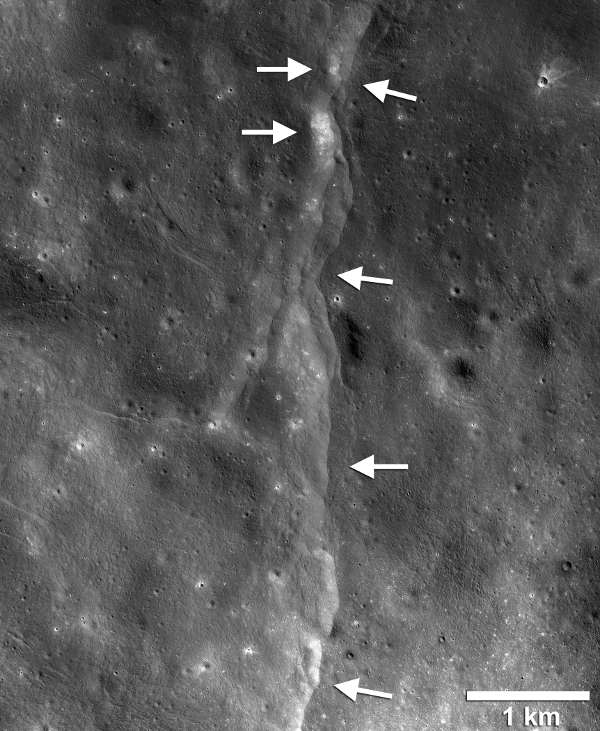
Just as a grape wrinkles as it shrinks down to a raisin, the moon gets wrinkles as it shrinks. Unlike the flexible skin on a grape, the moon’s surface crust is brittle, so it breaks as the moon shrinks, forming “thrust faults” where one section of crust is pushed up over a neighboring part.
“Our analysis gives the first evidence that these faults are still active and likely producing moonquakes today as the moon continues to gradually cool and shrink,” said Thomas Watters, senior scientist in the Center for Earth and Planetary Studies at the Smithsonian’s National Air and Space Museum in Washington. “Some of these quakes can be fairly strong, around five on the Richter scale.”
These fault scarps resemble small stair-step shaped cliffs when seen from the lunar surface, typically tens of yards (meters) high and extending for a few miles.
Astronauts Eugene Cernan and Harrison Schmitt had to zig-zag their lunar rover up and over the cliff face of the Lee-Lincoln fault scarp during the Apollo 17 mission that landed in the Taurus-Littrow valley in 1972.
Watters is lead author of a study that analyzed data from four seismometers placed on the moon by the Apollo astronauts using an algorithm, or mathematical program, developed to pinpoint quake locations detected by a sparse seismic network. The algorithm gave a better estimate of moonquake locations.
Seismometers are instruments that measure the shaking produced by quakes, recording the arrival time and strength of various quake waves to get a location estimate, called an epicenter. The study was published May 13 in Nature Geoscience.
Astronauts placed the instruments on the lunar surface during the Apollo 11, 12, 14, 15, and 16 missions. The Apollo 11 seismometer operated only for three weeks, but the four remaining recorded 28 shallow moonquakes – the type expected to be produced by these faults – from 1969 to 1977. The quakes ranged from about 2 to around 5 on the Richter scale.
Using the revised location estimates from the new algorithm, the team found that eight of the 28 shallow quakes were within 30 kilometers (18.6 miles) of faults visible in lunar images. This is close enough to tentatively attribute the quakes to the faults, since modeling by the team shows that this is the distance over which strong shaking is expected to occur, given the size of these fault scarps.
Additionally, the new analysis found that six of the eight quakes happened when the moon was at or near its apogee, the farthest point from Earth in its orbit. This is where additional tidal stress from Earth’s gravity causes a peak in the total stress, making slip-events along these faults more likely.
“We think it’s very likely that these eight quakes were produced by faults slipping as stress built up when the lunar crust was compressed by global contraction and tidal forces, indicating that the Apollo seismometers recorded the shrinking moon and the moon is still tectonically active,” said Watters.
The researchers ran 10,000 simulations to calculate the chance of a coincidence producing that many quakes near the faults at the time of greatest stress. They found it is less than 4 percent.
Additionally, while other events, such as meteoroid impacts, can produce quakes, they produce a different seismic signature than quakes made by fault slip events.
Other evidence that these faults are active comes from highly detailed images of the moon by NASA’s Lunar Reconnaissance Orbiter spacecraft, also known as LRO.
The Lunar Reconnaissance Orbiter Camera, or LROC, has imaged over 3,500 of the fault scarps. Some of these images show landslides or boulders at the bottom of relatively bright patches on the slopes of fault scarps or nearby terrain.
Weathering from solar and space radiation gradually darkens material on the lunar surface, so brighter areas indicate regions that are freshly exposed to space, as expected if a recent moonquake sent material sliding down a cliff.
Examples of fresh boulder fields are found on the slopes of a fault scarp in the Vitello cluster and examples of possible bright features are associated with faults that occur near craters Gemma Frisius C and Mouchez L.
Other LROC fault images show tracks from boulder falls, which would be expected if the fault slipped and the resulting quake sent boulders rolling down the cliff slope. These tracks are evidence of a recent quake because they should be erased relatively quickly, in geologic time scales, by the constant rain of micrometeoroid impacts on the moon.
Boulder tracks near faults in Schrödinger basin have been attributed to recent boulder falls induced by seismic shaking.
Additionally, one of the revised moonquake epicenters is just 13 kilometers (8 miles) from the Lee-Lincoln scarp traversed by the Apollo 17 astronauts.
The astronauts also examined boulders and boulder tracks on the slope of North Massif near the landing site. A large landslide on South Massif that covered the southern segment of the Lee-Lincoln scarp is further evidence of possible moonquakes generated by fault slip events.
“It’s really remarkable to see how data from nearly 50 years ago and from the LRO mission has been combined to advance our understanding of the moon while suggesting where future missions intent on studying the moon’s interior processes should go,” said LRO Project Scientist John Keller of NASA’s Goddard Space Flight Center in Greenbelt, Maryland.
Since LRO has been photographing the lunar surface since 2009, the team would like to compare pictures of specific fault regions from different times to see if there is any evidence of recent moonquake activity.
Additionally, “Establishing a new network of seismometers on the lunar surface should be a priority for human exploration of the moon, both to learn more about the moon’s interior and to determine how much of a hazard moonquakes present,” said co-author Renee Weber, a planetary seismologist at NASA's Marshall Space Flight Center in Huntsville, Alabama.
The moon isn’t the only world in our solar system experiencing some shrinkage with age. Mercury has enormous thrust faults – up to about 600 miles (1,000 kilometers) long and over a mile (3 kilometers) high – that are significantly larger relative to its size than those on the moon, indicating it shrank much more than the moon.
Since rocky worlds expand when they heat up and contract as they cool, Mercury’s large faults reveal that is was likely hot enough to be completely molten after its formation.
Scientists trying to reconstruct the moon’s origin wonder whether the same happened to the moon, or if instead it was only partially molten, perhaps with a magma ocean over a more slowly heating deep interior. The relatively small size of the moon’s fault scarps is in line with the more subtle contraction expected from a partially molten scenario.
NASA will send the first woman, and next man, to the Moon by 2024. These American astronauts will take a human landing system from the Gateway in lunar orbit, and land on the lunar South Pole. The agency will establish sustainable missions by 2028, then we’ll take what we learn on the Moon, and go to Mars.
This research was funded by NASA’s LRO project, with additional support from the Natural Sciences and Engineering Research Council of Canada. LRO is managed by NASA Goddard for the Science Mission Directorate at NASA Headquarters in Washington. The LROC is managed at Arizona State University in Tempe.