LAKE COUNTY, Calif. – Lake County Animal Care and Control has a fluffy assortment of kittens waiting to meet you.
The following cats at the Lake County Animal Care and Control shelter have been cleared for adoption.
This female gray tabby kitten is in cat room kennel No. 10a, ID No. 12517. Photo courtesy of Lake County Animal Care and Control. Gray tabby kitten
This female gray tabby kitten has a short coat and gold eyes.
She’s in cat room kennel No. 10a, ID No. 12517.
This female brown tabby kitten is in cat room kennel No. 10b, ID No. 12518. Photo courtesy of Lake County Animal Care and Control. Brown tabby kitten
This female brown tabby kitten has a short coat and gold eyes.
She is in cat room kennel No. 10b, ID No. 12518.
This male brown tabby kitten is in cat room kennel No. 10c, ID No. 12519. Photo courtesy of Lake County Animal Care and Control. Brown tabby kitten
This male brown tabby kitten has a short coat and gold eyes.
He is in cat room kennel No. 10c, ID No. 12519.
This female brown tabby kitten is in cat room kennel No. 10d, ID No. 12521. Photo courtesy of Lake County Animal Care and Control. Brown tabby kitten
This female brown tabby kitten has a short coat and gold eyes.
She is in cat room kennel No. 10d, ID No. 12521.
This male brown tabby kitten is in cat room kennel No. 28a, ID No. 12431. Photo courtesy of Lake County Animal Care and Control. Brown tabby kitten
This male brown tabby kitten has a medium-length coat and gold eyes.
He is in cat room kennel No. 28a, ID No. 12431.
This female domestic medium hair kitten is in cat room kennel No. 28c, ID No. 12433. Photo courtesy of Lake County Animal Care and Control. Domestic medium hair kitten
This female domestic medium hair kitten has a black and white coat and gold eyes.
He is in cat room kennel No. 28c, ID No. 12433.
This female domestic medium hair kitten is in cat room kennel No. 28d, ID No. 12434. Photo courtesy of Lake County Animal Care and Control. Domestic medium hair kitten
This female domestic medium hair kitten has a white and lynx point coat and blue eyes.
She is in cat room kennel No. 28d, ID No. 12434.
This female domestic longhair kitten is in cat room kennel No. 28e, ID No. 12435. Photo courtesy of Lake County Animal Care and Control. Domestic longhair kitten
This female domestic longhair kitten has a torbie coat and gold eyes.
She is in cat room kennel No. 28e, ID No. 12435.
This female domestic short hair kitten is in cat room kennel No. 58, ID No. 12467. Photo courtesy of Lake County Animal Care and Control. Domestic short hair kitten
This female domestic short hair kitten has a white and tabby coat and green eyes.
She is in cat room kennel No. 58, ID No. 12467.
This male domestic short hair kitten is in cat room kennel No. 133, ID No. 12492. Photo courtesy of Lake County Animal Care and Control. Domestic short hair kitten
This male domestic short hair kitten has a buff and white coat and gold eyes.
He is in cat room kennel No. 133, ID No. 12492.
This female domestic short hair kitten is in cat room kennel No. 136a, ID No. 12490. Photo courtesy of Lake County Animal Care and Control. Domestic short hair kitten
This female domestic short hair kitten has a gray tabby and white coat and blue eyes.
She is in cat room kennel No. 136a, ID No. 12490.
This female domestic short hair kitten is in cat room kennel No. 136b, ID No. 12491. Photo courtesy of Lake County Animal Care and Control. Domestic short hair kitten
This female domestic short hair kitten has a brown tabby coat and gold eyes.
She is in cat room kennel No. 136b, ID No. 12491.
This female domestic short hair kitten is in cat room kennel No. 139, ID No. 12481. Photo courtesy of Lake County Animal Care and Control. Domestic short hair kitten
This female domestic short hair kitten has a gray and white coat and gold eyes.
She is in cat room kennel No. 139, ID No. 12481.
Lake County Animal Care and Control is located at 4949 Helbush in Lakeport, next to the Hill Road Correctional Facility.
Office hours are Monday through Friday, 11 a.m. to 5 p.m., and 11 a.m. to 3 p.m., Saturday. The shelter is open from 11 a.m. to 4 p.m. Monday through Friday and on Saturday from 11 a.m. to 3 p.m.
For more information call Lake County Animal Care and Control at 707-263-0278.
Email Elizabeth Larson at This email address is being protected from spambots. You need JavaScript enabled to view it.. Follow her on Twitter, @ERLarson, or Lake County News, @LakeCoNews.
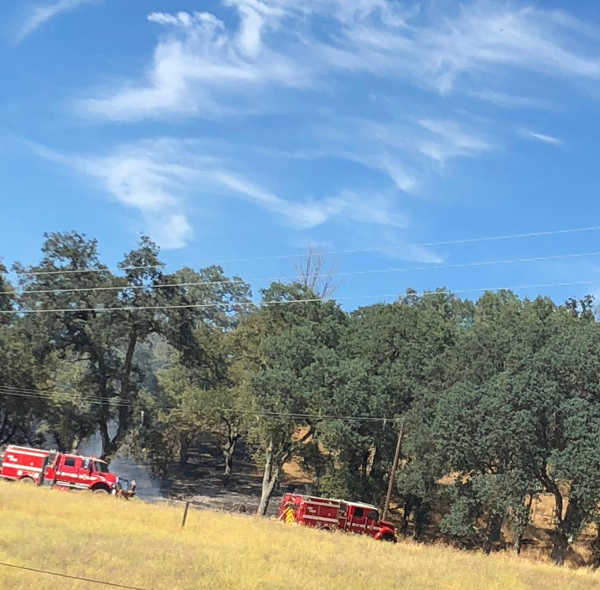
Firefighters work at the fire near Lower Lake, Calif., on Sunday, July 21, 2019. Photo by Danielle Noble.
LOWER LAKE, Calif. – The efforts of firefighters prevented a wildland blaze on Sunday from doing serious damage despite winds pushing the fire toward the Lower Lake community.
The fire at Highway 29 and Highway 53 was dispatched at approximately 2:45 p.m. Sunday, according to an evening report from Cal Fire.
Incident commanders implemented a fast and aggressive response that called in resources from around the county.
Lake County Fire, South Lake County Fire, Cal Fire, Northshore Fire, the California Highway Patrol, the Lake County Sheriff’s Office, California State Parks and Pacific Gas and Electric Co. responded to the incident, Cal Fire said.
Cal fire said the fire burned in grass and oak woodland, with a west wind of between 2 and 7 miles per hour hitting the blaze. Reports from the scene indicated that the fire, burning along the highway, was pushed by the wind toward Lower Lake.
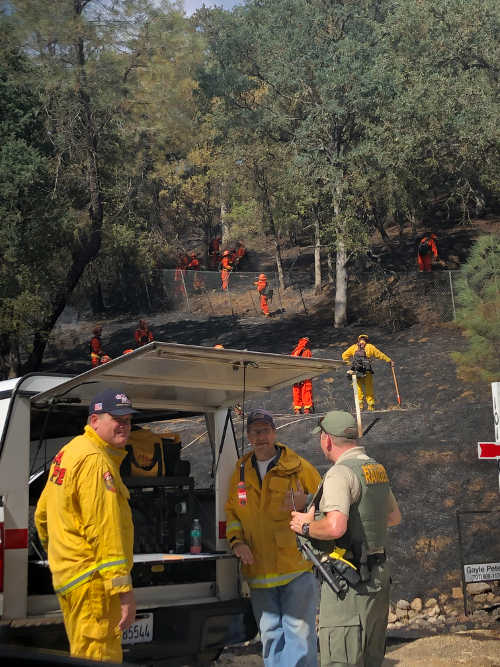
Incident commanders at the scene of the fire in Lower Lake, Calif., on Sunday, July 21, 2019. Photo by Danielle Noble.
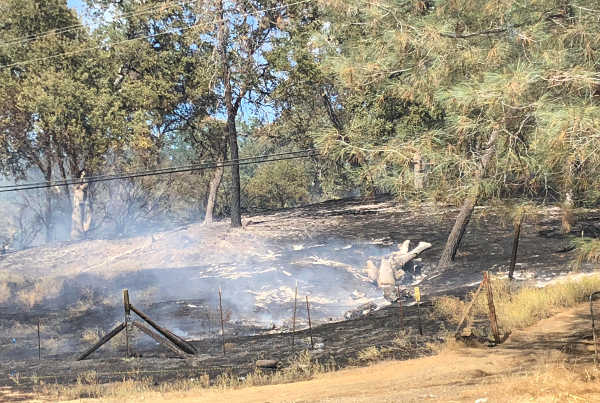
Aircraft, engines and fire crews held the fire to six acres. Cal Fire said two structures were damaged but none were destroyed. No evacuations outside of the immediate area took place.
Highway 29 southbound at the Highway 53 intersection was closed to traffic for a few hours before being reopened, according to scene reports.
On Sunday evening, Cal Fire said Morgan Valley Road from Highway 29 to Clayton Creek Road remained closed.
There were 66 firefighters, two overhead or command personnel, 11 engines, two fire crews, two bulldozers, one water tender, one helicopter and three air tankers assigned, Cal Fire said.
Cal Fire said the cause of the fire remains under investigation.
Email Elizabeth Larson at This email address is being protected from spambots. You need JavaScript enabled to view it.. Follow her on Twitter, @ERLarson, or Lake County News, @LakeCoNews.
The fire in Lower Lake, Calif., on Sunday, July 21, 2019, scorched six acres. Photo by Danielle Noble.
LAKE COUNTY, Calif. – Firefighters have contained a structure and wildland fire in the Cobb area that is reported to have led to one fatality.
The fire on Rockys Road in Cobb was dispatched before 3:30 p.m. Sunday, about 45 minutes after firefighters were sent to battle a fire at Highway 29 and 53 in Lower Lake, as Lake County News previously reported.
The Cobb fire originally had been reported as being located on Airstrip Road, with the address later corrected.
Resources were diverted from the Lower Lake fire to respond to Cobb, where they found a fully engulfed home and a small wildland fire with a fast rate of spread, according to radio reports.
By 4 p.m., air attack reported that a containment line had been established around the fire, with the structure continuing to burn.
Live power lines also were down and arcing, with Pacific Gas and Electric responding to the scene just before 4:45 p.m., according to radio reports.
Incident command reported just before 5 p.m. that the fire was contained, with a tenth of an acre of wildland burned and heavy mop up required on the structure.
At that point, incident command requested the Lake County Sheriff’s Office send a coroner, as firefighters had confirmed one fatality.
Forward progress on the fire in Lower Lake had been stopped by that time. Traffic at the Highway 29 and 53 intersection was closed down shortly after firefighters arrived, and one-way traffic was reported to be in effect at around 4:30 p.m.
More information will be posted as it becomes available.
Email Elizabeth Larson at This email address is being protected from spambots. You need JavaScript enabled to view it.. Follow her on Twitter, @ERLarson, or Lake County News, @LakeCoNews.
LAKE COUNTY, Calif. – Firefighters are working to contain a wildland fire near Lower Lake and a structure fire in the Cobb area.
The Lower Lake fire was first dispatched at around 2:45 p.m. Sunday in the area of Highway 29 and Highway 53, according to radio reports.
The fire is reported to be burning just off the highway.
Initial reports at the scene put the fire at between one and two acres, with the estimate quickly growing to five to six acres as the blaze moved uphill. The fire also is spotting due to the wind.
Incident command reported that structures are threatened, with a west wind pushing the fire toward the community of Lower Lake.
Law enforcement has been requested to close Highway 29 to southbound traffic at the intersection with Highway 53.
Two full wildland dispatches of five engines each, plus crews, air attack, air tankers and Copter 104, plus an in-county strike team of five engines are part of the response, according to radio reports.
Power lines in the area are down, but as of 3:30 p.m., Pacific Gas and Electric was not reporting outages in the fire area.
Incident command reported that firefighters are making good progress on the fire, and at about 3:45 p.m. the forward progress on the fire had been stopped, and was holding at six acres.
Just before 3:30 p.m., a structure fire with an explosion was reported on Airstrip Road in Cobb.
Firefighters arriving at just less than 10 minutes later said they found a fully involved structure on Rockys Road, with one to one and a half acres of vegetation burning with a fast rate of spread and locals working to stop it.
Firefighters and resources from the Lower Lake fire are being redirected to the Cobb fire, according to radio reports.
More information will be posted as it becomes available.
Email Elizabeth Larson at This email address is being protected from spambots. You need JavaScript enabled to view it.. Follow her on Twitter, @ERLarson, or Lake County News, @LakeCoNews.
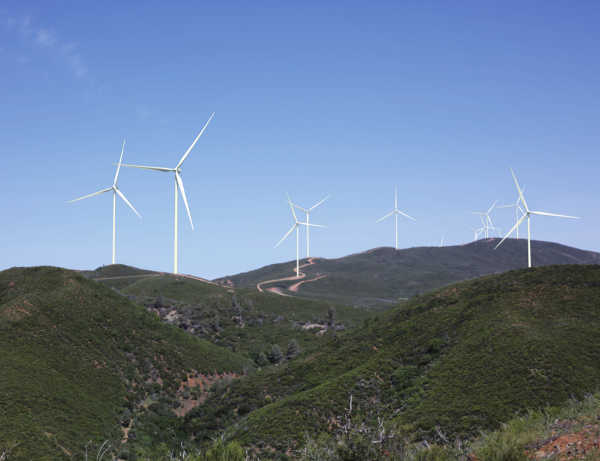
A graphic of how the turbines in a proposed wind project in the Walker Ridge area in Lake County, Calif., would look if built. Image courtesy of the Bureau of Land Management.
CLEARLAKE OAKS, Calif. – The Bureau of Land Management is in the beginning stages of a year-long process to analyze a Canadian-owned company’s proposal to build dozens of turbines in the Walker Ridge area, where another wind farm had been proposed a decade ago.
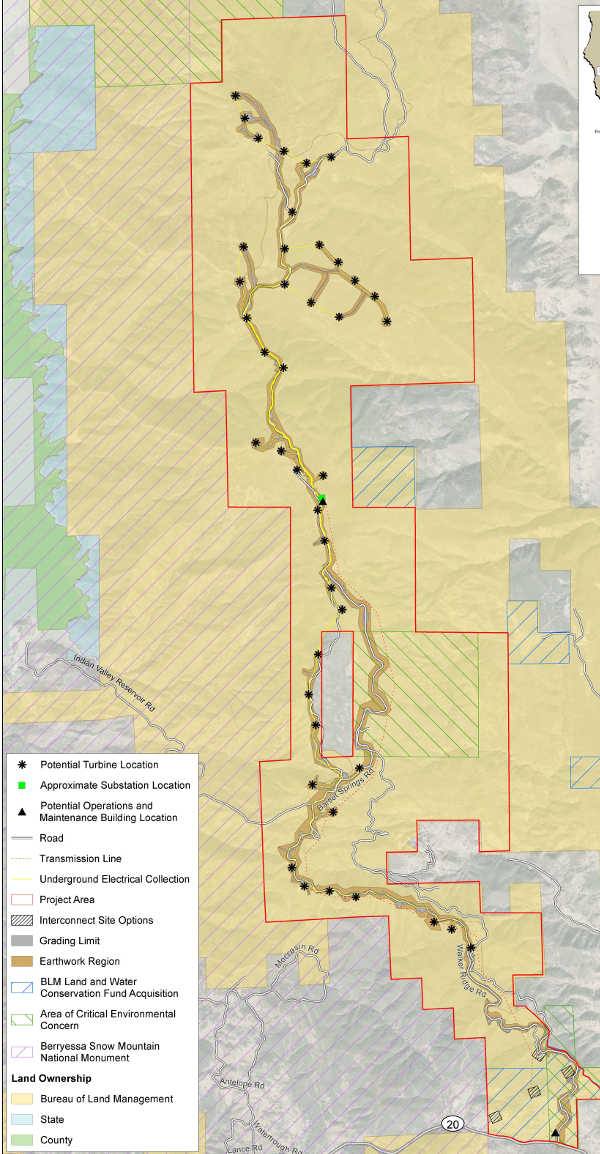
The project, proposed by Colusa Wind LLC, calls for the building of up to 42 wind turbines on approximately 2,270 acres of BLM-managed public land along Walker Ridge in Lake County, within the Indian Valley Management Area.
Other aspects of the proposed project include widening Walker Ridge Road, constructing a substation and overhead transmission line, and burying a collection line and tie-in to the existing Pacific Gas and Electric transmission line.
A full document library on the project can be found here.
The proposal’s notice of intent to prepare an environmental impact statement was published in the Federal Register on June 21, kicking off a 30-day public comment period, which ends July 24.
As part of the public input process, the BLM held an open house on the project on July 9 in Clearlake Oaks, as Lake County News has reported. Numerous county leaders, fire officials and residents, along with groups like the Sierra Club and Tuleyome, attended to get additional details about the plan.
At that event BLM officials were on hand to explain the process and the project details so far, and to take public input as it begins the environmental impact statement creation process, along with a potential amendment to the 2006 Ukiah Resource Management Plan for Colusa and Lake counties, which identified the Indian Valley Management Area as suitable for wind development.
Gaetan Mercier, a representative for the project proponents, was at the open house meeting. Mercier is director of project planning and permitting at the Canadian firm Liberty Power.
He said Colusa Wind is managed by Liberty Power, which in turn is owned by Canada-based Algonquin, which is on the New York and Toronto stock exchanges.
The proposed project will generate an estimated 144.4 megawatts, with the energy to be sold to PG&E and tied into an existing transmission line in the area, Mercier said.
He said the project, all of which will be located on the Lake County side of Walker Ridge, will be operated by five people on an ongoing basis. The turbine manufacturer will have three to four people operating it.
So far, Mercier said the project hasn’t settled on which turbine manufacturer it will use, as they will be evaluating the most viable options as they analyze their alternatives.
At the July 9 open house, information on how many people would be involved in construction and how long that might take wasn’t yet available.
Bob Schneider, a member of Tuleyome and a longtime conservationist, attended the open house, and questioned why scoping was starting on an incomplete project proposal. It was on that day that he was seeing some of the information for the first time.
BLM spokeswoman Serena Baker acknowledged there is still a lot of information to come, and the plan of development can be dynamic.
“We’ve just started,” she said of the project, noting that the proposal’s June 21 publication in the Federal Register was the first step.
While BLM’s process has only just started, it’s one that has been sped up significantly by an August 2017 order from the secretary of the Department of the Interior.
That order streamlines the review environmental review and permitting process for infrastructure projects under the National Environmental Policy Act, or NEPA.
As a result of the order, the BLM has one year from the notice of intention to make a decision about whether or not the project should move forward. That one-year process includes the often lengthy and complicated process of preparing and vetting an environmental impact statement, the federal version of an environmental impact report.
Baker said the BLM expects to have a record of decision by summer 2020.
“That’s a pretty tight timeline,” she said.
Colusa Wind LLC’s proposed project on Bureau of Land Management property in Lake County, Calif. Image courtesy of the Bureau of Land Management.
Current and past wind proposals focus on same area
In January 2010, AltaGas Income Trust, based in Calgary, Alberta, submitted a proposal to the BLM for a 60-to 70-megawatt clean energy wind generation project with 29 turbines to be located within a 8,157-acre area leased by the BLM to the company, as Lake County News reported. It was estimated that the project would generate enough energy to power 25,000 homes.
The process to review the project continued over several years and came to an apparent standstill by 2013.
A draft environmental impact was created for that proposed project but was pulled before publication, said Baker.
The Colusa Wind project is in the same general area as the AltaGas project, “but it’s slightly different,” and an apples to apples comparison can’t be made between the two projects, said Baker.
In Colusa Wind’s project, the available acreage is about a quarter of what had previously been proposed by AltaGas, and it proposes more turbines, up to 42 of them, Baker said.
The windmills will be up to 676 feet tall from the ground to the tip of the blade, according to details given at the meeting.
Mercier said the company proposing this new project is completely different than the one involved in the 2010 project proposal.
The turbines closest to the traveling public will be four miles from the scene area in Bear Valley, in the area of Highway 16 and Highway 20, BLM staff said.
Mockups of the windmills shown at the meeting and on the BLM Web site indicate that the structures will be able to be seen as far away as the Clear Lake Rivieras. Victoria Brandon, president of the Tuleyome Board of Directors and chair of the Sierra Club Lake Group, said she believes the structures will be visible from Lakeport.
Outlining concerns
Cal Fire Division Chief Greg Bertelli, Williams Fire Chief Jeff Gilbert and Northshore Fire Chief Mike Ciancio attended the July 9 meeting, as they were invited to bring any concerns they might have about the project.
They said at that time that medical response times are a concern, as are fire breaks for the project in an area that has repeatedly burned – most recently, 2008, 2012, 2015 and again in last year’s fires – and the presence of an emergency communications repeater tower.
Bertelli noted that the area also has been used for a helicopter landing zone and staging area for wildland firefighting.
Ciancio would report to his fire board later that week regarding the project, “It’s coming down to medical and rescue for us,” with Cal Fire seeking increased fire breaks around the windmills and along Walker Ridge Road.
With Northshore Fire having no tower rescue know-how, Ciancio said he’ll suggest that the fire board ask Colusa Wind to pay the $30,000 necessary to train his firefighters.
Brandon told Lake County News that she has a host of concerns, from the environmental to the economic, adding that both Tuleyome and the Sierra Club will submit comment letters on this project as they did on the previous.
“The dominant environmental impact is not birds and bats, it’s grading,” she said, pointing to the area’s serpentine soil, which contains asbestos and is unstable geologically. That soil also is home to rare plants.
Grading could potentially impact two already impaired watersheds, the north fork of Cache Creek and Bear Creek, she said.
Brandon also cited the area’s history of wildland fire, issues with lightning and its potential impact on Lake County’s noted dark skies – which are now the focus of a certification process – due to the need to light the turbines at night for airplanes.
Then there is the presence of up to 42 turbines in the middle of the Pacific Flyway, where millions of birds migrate annually, in addition to the gold and bald eagles that nest in the area, she said.
In the past, such projects have died due to economic volatility and the bottom line, Brandon said, adding that the current proposal likely will require heavy subsidies. She said the AltaGas project was to have been partially located on land purchased with conservation funds that prevent that land for being used for industry, which finally killed it.
Brandon said the Obama administration had pushed for renewables on public lands, but the Trump administration is not big on renewables, while California supports them.
There also is a question about just how much wind is in the Walker Ridge area. Brandon believes it’s an inconsistent source. She said previous studies have been proprietary so the information hasn’t been released publicly.
A wind map posted on the Department of Energy Web site suggests that area has an annual average wind speed ranging from between 4 and 5.5 miles per hour.
Baker said that the BLM has a duty to analyze to the best of its ability any project proposal it receives.
At the same time, as part of its analysis, she said BLM has to consider and balance a host of concerns – among them, critical environmental habitats such as serpentine soil and the accompanying flora and fauna, wildland fire, wildlife, the viewshed, off highway vehicle use and recreation, protection of cultural sites and any other existing uses – against the project’s benefits.
Two Lake County supervisors – Bruno Sabatier, representing District 2, and EJ Crandell, whose District 3 includes the Northshore and the project area – attended the July 9 open house to speak with federal officials.
Crandell said he’s concerned about maintenance of BLM land, pointing to areas he’s visited in the county that were impacted by last year’s Mendocino Complex and had no fire prevention maintenance. If something were to occur with a turbine, he questioned what would happen and how it could impact the land.
He also questioned if Lake County will benefit locally from the power generation.
Crandell cited the concern for bald eagles and other raptors that make the area their home. The questions he raised about raptors also have cultural and religious implications for his tribe, the Robinson Rancheria Band of Pomo Indians. They use hawks for regalia and eagle feathers only when they’re found.
Sabatier, like his colleague Crandell, wanted to know how Lake County will benefit from the project.
He said the Lake County Community Development Department said that Colusa Wind hasn’t submitted an application yet to the county.
Baker said that she doesn’t believe the applicant has to apply for county permits until a determination has been made whether or not to allow the proposed project.
Sabatier said he doesn’t want to see a project that harms the environment and scenery, which are two of Lake County’s greatest resources.
He said he wants to see a development agreement between the county and the applicant if the project moves forward, which will allow the county some impact on the operations.
“We need to have a say in what happens to our community,” said Sabatier.
The next steps in the process
Baker said that the community is invited to give public comment on this portion of the project through July 24.
She said the BLM needs substantive comments, with new data and specific concerns listed. The agency asks people to avoid broad opinion favoring or opposing the proposed project with no supporting data, no vague and open-ended questions, statements or concerns that do not give the BLM direction to act, and no identical form letters or petition signatures.
Rather, they’re seeking new or additional information or data sources pertaining to the proposed action. They ask for comments to clearly identify how their input is relevant, how it should be incorporated, to outline the issues and explain conclusions, and provide constructive solutions or reasonable alternatives with documentation or resources to support recommendations. If applicable, those submitting input are asked to include their experience as it relates to your observations and input.
“We want the public to be engaged,” said Baker.
Once the public comment period closes, BLM will move into the preparation of the draft environmental impact statement and the potential resource management plan amendment, according to a project timeline.
From there, Baker said the BLM anticipates publishing a notice of availability of the draft environmental impact statement and potential resource management plan amendment in the fall, which will lay out the range of alternatives.
That will initiate a 90-day public comment period, to be followed by the publication of the notice of availability of the final environmental impact statement and proposed resource management plan amendment, anticipated to occur in spring 2020.
Following the publication of the notice in the spring, a 30-day protest period will begin. Baker said that groups and community members must be involved in one of the public scoping or comment periods in order to have standing to weigh in during the protest period.
At the same time as the public protest period takes place, a 60-day governor’s consistency review will occur. The BLM will take input from those two steps and use them to resolve protests and inconsistencies.
The final step is the publication of the resource management plan amendment and record of decision next summer.
Baker said that the project is not guaranteed just because it was submitted, and that it must stand up to the analysis.
She said the BLM is willing to meet with community groups to further explain the process should they request it.
How to participate
The public is asked to submit written comments by the July 24 deadline.
Written comments may be submitted at https://go.usa.gov/xmtGu, via hand-delivery, or by mail to the Ukiah Field Office, Attn: Walker Ridge Wind Energy Project, 2550 N. State Street, Suite 2, Ukiah, CA 95482.
To be added to the electronic interested parties list, email bThis email address is being protected from spambots. You need JavaScript enabled to view it. .
Email Elizabeth Larson at This email address is being protected from spambots. You need JavaScript enabled to view it.. Follow her on Twitter, @ERLarson, or Lake County News, @LakeCoNews.
Panzanella. Photo by Esther Oertel. Italy’s geography is often described as a boot kicking the island of Sicily. If that’s true, then Tuscany is the area along the western coast just above Italy’s knee.
Famous for its artistic legacy, historical cities and breathtaking landscapes, it’s also known, though perhaps less so, for its simple cuisine with cooking traditions that date back thousands of years.
The city of Florence, once the center of the Italian Renaissance and home to Michelangelo and Leonardo di Vinci, now serves as Tuscany’s regional capital. Other cities in the region which have names that may be familiar to us are Siena, Pisa (of Leaning Tower fame), Livorno and Lucca.
Until the Kingdom of Italy was established in 1861 (of which Florence was also capital), what is now Italy was a collection of separate regions, each with its own traditions and cuisines. For that reason, Tuscany, like all Italian regions, has its own ingredients, recipes and hyper-local food traditions.
The name Tuscany derives from Etruscan, the moniker of the people (likely from Asia Minor), who settled the area in approximately 1,000 BCE.
The Etruscans cultivated legumes (chiefly chickpeas, lentils, and beans), grains such as millet, barley, and spelt, and a variety of fruits and vegetables. They also planted olive trees for oil and grapes for wine.
They raised sheep, goats, pigs, and cattle for milk and meat, and caught wild game, which they cooked over braziers.
The cuisine established by the Etruscans didn’t change much through the centuries, even when Roman colonization was taking place.
Later during the Renaissance when chefs prepared elaborate dishes for nobles, Tuscan cuisine remained simple. Simplicity still defines Tuscan cooking.
This straightforward, uncomplicated and frugal cuisine is based on peasant (or poor) cooking, known as “cucina povera” in Italian, where available ingredients are used to make large batches of inexpensive dishes.
Flavors are understated, and favorite aromatics such as thyme, rosemary and fennel are used sparingly.
Food is never squandered; in fact, many quintessential Tuscan dishes were created to avoid waste.
Fagioli bianchi (white beans, also known as cannellini beans) were introduced to Tuscany in the 1500s via Spain. They’ve become well-integrated in Tuscan cuisine, so much so that Tuscans are called mangiafagioli, or “bean eaters.”
Cannellini beans can be found in dishes such as zuppa di fagioli (bean soup) and fagioli all’uccelletto, a side dish of beans stewed with tomatoes, garlic and sage.
Tuscans are extremely fond of soups, and two favorites in the region are ribollita Toscana (Toscana means Tuscany in Italian) and pappa al pomodoro.
Ribollita Toscana is one of Tuscany’s most beloved soups, a winter medley featuring greens (often kale), beans, celery, carrots, onions, stale bread to thicken it, and plenty of olive oil.
The soup is meant to be reheated (ribollita means “cooked twice”) and the soup is cooked again the next day for a second meal.
Pappa al pomodoro is a soup made with tomatoes (pomodoro means tomato in Italian), garlic, olive oil, and, like ribollita, stale bread to thicken it. It has a creamy, comforting consistency, so it’s not surprising that it’s dubbed pappa, the Italian word for baby food.
Olive oil is ubiquitous in Tuscan recipes and is liberally used throughout the region, so I was surprised to learn that Tuscany produces only about four percent of Italy’s olive oil.
The lower olive yield from Tuscan trees means that oil from that region has a greater concentration of flavor and aroma, making its taste more pronounced.
If you’ve ever purchased an olive oil that’s a blend of Tuscan olives, you’ve likely noticed this.
Traditional Tuscan bread omits a key ingredient: salt. Saltless bread is unique to the region and, needless to say, its taste is unusual.
There is no definitive answer to why the tradition of bread without salt began in Tuscany, though some say it’s because of the steep taxation on this highly prized commodity during the Middle Ages.
Sheep’s milk cheese, known as pecorino, is plentiful in Tuscany. From soft and buttery to sharp, tangy, or firm, all are delicious with saltless bread.
Seafood is popular in coastal Tuscany, and in the port town of Livorno a tomato-laced everything-you-can-assemble seafood soup called caccuicco is the signature dish.
All manner of fish, as many types as possible, are thrown into a pot. Head, bones, and all are pureed for the broth. Scorpionfish, monkfish, mullet and other rockfish are some of the common varieties used, but the soup varies depending on the catches of the day.
It may have been in Sicily where squid ink was first infused into pasta, but it’s something that’s done in Tuscany, too, particularly along the coast.
Tuscans love rice, and a version of risotto made there also includes squid ink. Squab and chicken livers also find their way into Tuscan risotto dishes.
The Chianina, an Italian breed of cattle, is raised for meat in Tuscany. It’s one of the oldest and largest breeds in the world, and Tuscany’s famous bistecca alla fiorentina (beefsteak Florentine style) is produced from its meat.
Bistecca alla fiorentina is a T-bone steak grilled over a wood or charcoal fire and finished with a generous splash of olive oil. Thickly cut and large, it’s typically served to two or more people and is accompanied by Tuscan beans as a side dish.
The region is rich with game meats, including wild boar, hare, deer, and pheasant, which are used in pasta dishes and stews. Ham is also made from wild boar.
As in many Italian regions, a plethora of cured meats are made from pork. Tuscan specialties include prosciutto di bardotto, made from a hybrid pig born of a domesticated sow and a wild boar, and finocchiona, pork salami spiced with wild fennel, reputed to be delicious with saltless Tuscan bread.
Tortelli, a stuffed pasta, is a regional specialty similar to ravioli. The difference is that tortelli is made in a variety of shapes, while ravioli is typically square or round.
The name is believed to have originated from “torta,” a savory Medieval pie. Tortelli is one of the original stuffed pastas, traced back to the Middle Ages.
The fillings and shapes depend on the region, or even town, where the pasta is made.
Common Tuscan fillings include potatoes, ricotta cheese, spinach, or prosciutto. Sauces can be made with tomatoes, mushrooms, or broth, or simply butter with cheese or sage.
Tuscans make appetizers a priority. Meals start with crostini (toasted bread) lavished with liver pate, black olives, artichoke paste, dried tomatoes, or olive oil and garlic. Cold cuts of meat (such as salami or prosciutto) often serve as appetizers.
One of Italy’s best wines, Brunello di Monalcino, is produced in the Tuscan region. Chianti, a Sangiovese-based red wine, is probably the best-known Tuscan wine internationally.
Desserts can range from zuccotto, a beautifully molded frozen cake originating in Florence, to a simple flatbread studded with grapes baked since Etruscan days.
Castagnaccio, chestnut flour cake, hails from the mountains of Tuscany where chestnuts used to be the main resource. The sweetness comes from the flour itself and the added golden raisins and pine nuts. The cake is finished with an olive oil drizzle and a sprinkle of rosemary.
Vin santo, translating to holy wine, is a dessert wine unique to Tuscany. Cantucci, the Tuscan version of the twice-baked biscuit we know as biscotti, can be dipped in a small glass of vin santo to finish a meal.
And finally, we can’t speak of Tuscany without noting that truffles, among the most expensive foods in the world, are found there.
Both black and white truffles, or tartufo, grow in Tuscany.
Italian white truffles are rare and elusive, with a short season of just over a month. This makes them highly prized and far more expensive than black truffles, at times reaching a market price of more than $4,000 per kilo (roughly 2.20 pounds).
White truffles have a gentle, earthy flavor that’s so subtle that they should never be cooked, a shelf life of only ten days and, unlike black truffles, can’t be frozen.
Truffles can’t be cultivated, so hunters with trained dogs must locate them.
While pigs have sensitive noses for truffles, their rooting ruins the delicate mycelia, the spore-holding web necessary for the fungi’s reproduction.
Today’s recipes don’t include truffles, but I hope they’ll be valuable in your repertoire.
Panzanella, a Tuscan bread salad, was created as a way to utilize stale bread, and is the first recipe. While there are many versions of this dish, I’m sharing the one I created years ago for a class on no-cook summer side dishes.
The second recipe is for simple and rustic mini Tuscan cheese souffles, which I found to be a wonderful accompaniment to the bread salad.
Unlike a traditional French souffle, egg whites aren’t beaten and folded into the mixture. Hence, the souffles are more quichelike; in other words, denser and not as risen.
I got the recipe from Rustico Cooking, a culinary tour website, but it’s originally from the Ristorante Logge del Vignola in Montepulciano, a Renaissance mountain town in the Siena province of Tuscany.
I wasn’t able to find all the ingredients at my local market (there was no smoked mozzarella or young pecorino Toscano), so I used regular mozzarella (not fresh) and pecorino Romano. Pecorino Romano is a hard, aged cheese and likely saltier than the cheese in the recipe. I learned that salt was unnecessary with that substitution.
One more note: I didn’t have 12 ramekins, so I used a muffin tin.
Enjoy!
Tuscan Bread Salad with Summer Vegetables (Panzanella)
Ingredients
About 6 cups of bite-sized pieces of bread (choose a rustic loaf that will hold up well) 2 cups torn basil leaves 1 cup red onion, diced 1 cup cucumber, cut lengthwise into quarters and sliced (roughly one medium cucumber) 2 cups diced ripe tomatoes (garden, on-the-vine or heirloom are recommended) ¼ cup capers 1 cup bite-sized pieces of fresh mozzarella Pine nuts for garnish (optional)
Dressing
4 tbsp extra virgin olive oil (EVOO) 3 tbsp red wine vinegar 1 tbsp chopped fresh rosemary 3 cloves garlic, finely chopped Fresh ground pepper and coarse salt to taste
The trick to this salad is being sure all ingredients are bite sized. You can use day old bread if you have it, or the bread may be toasted in an oven or on an outdoor grill. Sliced bread is not recommended. Make the dressing first to allow the flavors to combine. Mix ingredients together first and then add dressing. If using pine nuts, sprinkle over top of plated salad just before serving. (If desired, toast pine nuts first.)
Tuscan cheese souffle. Photo by Esther Oertel. Tuscan Cheese Souffle
Nonstick spray for greasing the ramekins ¼ cup fresh breadcrumbs, plus extra for the ramekins 1 pound whole-milk Ricotta 1 cup freshly grated young Pecorino Toscano ¼ pound smoked Mozzarella, coarsely grated 4 large eggs ¼ teaspoon salt 1/8 teaspoon freshly ground black pepper 2 sage leaves, thinly sliced
Preheat the oven to 400 degrees.
Generously grease twelve 1-cup ramekins with nonstick spray and sprinkle with the breadcrumbs.
In a large bowl, beat together the Ricotta, Pecorino, smoked Mozzarella, eggs, salt, pepper, sage and the ¼ cup of breadcrumbs. Spoon into the prepared ramekins and place the ramekins on a large ovenproof tray. (The soufflés can be prepared up to this point 12 hours ahead and refrigerated.)
Bake in the preheated oven for 20 minutes, or until golden, puffed, and set. Serve the soufflés hot. Serves 12.
Esther Oertel is a writer and passionate home cook from a family of chefs. She grew up in a restaurant, where she began creating recipes from a young age. She’s taught culinary classes in a variety of venues in Lake County and previously wrote “The Veggie Girl” column for Lake County News. Most recently she’s taught culinary classes at Sur La Table in Santa Rosa, Calif. She lives in Middletown, Calif.
 How to resolve AdBlock issue?