The Ranch fire area in the Mendocino National Forest in Northern California. Photo courtesy of the Environmental Protection Information Center. NORTHERN CALIFORNIA – An environmental group has filed suit over timber sales on the Mendocino National Forest in the wake of the Ranch fire.
The Environmental Protection Information Center, or EPIC, is suing the U.S. Forest Service for approving a series of timber sales on the Mendocino National Forest that shortcut public participation and environmental review in violation of federal law.
In a complaint filed Wednesday, EPIC alleges that the Forest Service expedited seven timber sales, totaling up to 7,000 acres, by mislabeling the logging as a “road maintenance” project. At risk from the logging are clean water, northern spotted owls, and increased fuel conditions.
Mendocino National Forest spokesperson Sandra Moore said she had no comment on the pending litigation.
All Forest Service timber sales are subject to the National Environmental Policy Act, or NEPA. The core of NEPA is a requirement that agencies take a “hard look” at the environmental impacts of their proposed actions, typically done through an environmental impact statement or environmental analysis.
EPIC alleges that the timber sales were approved using what is called a “categorical exclusion.” Categorical exclusions do not require environmental impact review or public comment.
Here, the Forest Service argues that a commercial timber sale is “road maintenance” because the logging would remove dead and live trees affected by the 2018 Ranch fire along roads, reducing the odds that the trees may fall and block the road.
A separate categorical exclusion exists for post-fire logging, although that is limited to 250 acres, as anything larger in scale is assumed to be able to produce significant impacts to the environment.
All timber sales in this proposed project are larger than 250 acres and many of the roads proposed for logging are closed to motor vehicle use.
“The Mendocino National Forest is taking a page from Trump’s playbook,” said Tom Wheeler, executive director of EPIC. “Calling a timber sale ‘road maintenance’ is a stunning way to stifle public participation and ignore environmental impacts.”
Science has widely recognized that post-fire logging is especially impactful, as logging adds an additional disturbance on top of the effects of the fire.
EPIC said post-fire logging often results in degraded water quality, the spread of invasive plants, and loss of habitat for rare, threatened and endangered species. It can also increase the risk of high-severity fire since logging leaves behind a buildup of slash and finer “fuels.”
If allowed to use a categorical exclusion instead of an environmental impact statement, these impacts may never be adequately examined and mitigation measures to reduce harm through better project design would not be incorporated, EPIC said.
“This is a massive project covering thousands of acres,” said EPIC’s Public Land Advocate Kimberly Baker. “The Mendocino National Forest is breaking the law to meet timber targets and benefit timber corporations at a cost to fragile post-fire watersheds and threatened species. Public safety could be achieved in a more benign manner.”
EPIC is represented by René Voss of Natural Resources Law and Matt Kenna of Public Interest Environmental Law.
The case will be heard in the Northern District Court of California.
LAKE COUNTY, Calif. – Lake County Animal Care and Control has an eclectic group of dogs waiting to be adopted this week.
Dogs available for adoption this week include mixes of Australian Shepherd, boxer, Chihuahua, English Bulldog, husky, pit bull, Shih Tzu and terrier.
Dogs that are adopted from Lake County Animal Care and Control are either neutered or spayed, microchipped and, if old enough, given a rabies shot and county license before being released to their new owner. License fees do not apply to residents of the cities of Lakeport or Clearlake.
If you're looking for a new companion, visit the shelter. There are many great pets hoping you'll choose them.
The following dogs at the Lake County Animal Care and Control shelter have been cleared for adoption (additional dogs on the animal control Web site not listed are still “on hold”).
This female Australian Shepherd puppy is in kennel No. 14a, ID No. 13101. Photo courtesy of Lake County Animal Care and Control. Female Australian Shepherd puppy
This female Australian Shepherd puppy has a short tan and white coat and blue eyes.
She is in kennel No. 14a, ID No. 13101.
This male Australian Shepherd puppy is in kennel No. 14b, ID No. 13102. Photo courtesy of Lake County Animal Care and Control. Male Australian Shepherd puppy
This male Australian Shepherd puppy has a short tan and white coat and blue eyes.
He is in kennel No. 14b, ID No. 13102.
This male Australian Shepherd puppy is in kennel No. 14c, ID No. 13103. Photo courtesy of Lake County Animal Care and Control. Male Australian Shepherd puppy
This male Australian Shepherd puppy has a short tan and white coat and blue eyes.
He is in kennel No. 14c, ID No. 13103.
This female Australian Shepherd puppy is in kennel No. 14d, ID No. 13104. Photo courtesy of Lake County Animal Care and Control. Female Australian Shepherd puppy
This female Australian Shepherd puppy has a short tan and white coat and blue eyes.
She is in kennel No. 14d, ID No. 13104.
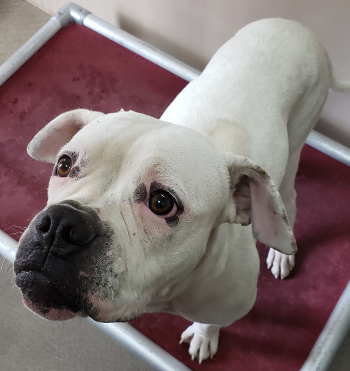
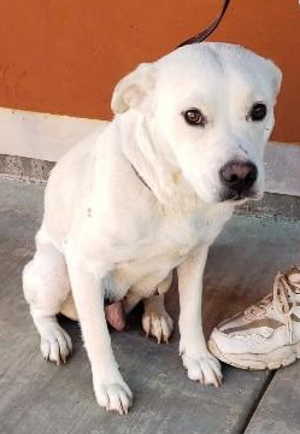
The female boxer is in kennel No. 17, ID No. 13093. Photo courtesy of Lake County Animal Care and Control. Female boxer
The female boxer has a short white coat and brown eyes.
She is in kennel No. 17, ID No. 13093.
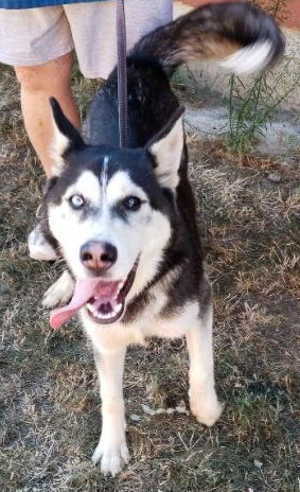
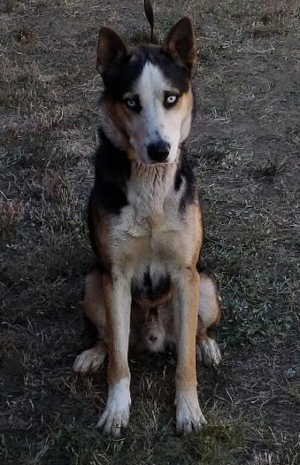
“Scrappy” is a male husky in kennel No. 20, ID No. 13076. Photo courtesy of Lake County Animal Care and Control. ‘Scrappy’
“Scrappy” is a male husky with a medium-length black and white coat and blue eyes.
He’s in kennel No. 20, ID No. 13076.
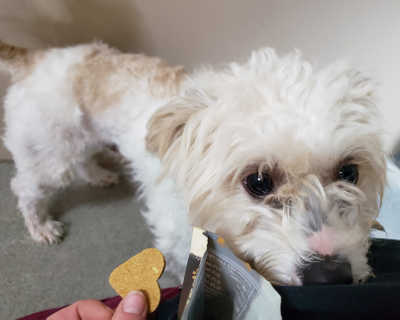
This male Shih Tzu is in kennel No. 24, ID No. 13094. Photo courtesy of Lake County Animal Care and Control. Male Shih Tzu
This male Shih Tzu has a curly tan and white coat.
He’s in kennel No. 24, ID No. 13094.
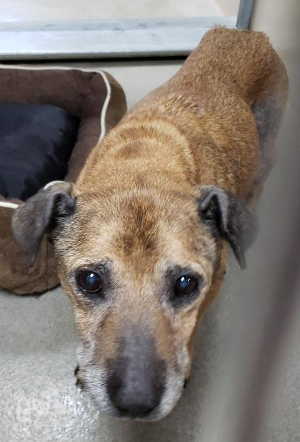
“Pudge” is a male terrier in kennel No. 25, ID No. 13068. Photo courtesy of Lake County Animal Care and Control. ‘Pudge’
“Pudge” is a male terrier with a short brown coat.
He has been neutered.
He’s in kennel No. 25, ID No. 13068.
“Woofy” is a male husky in kennel No. 26, ID No. 13077. Photo courtesy of Lake County Animal Care and Control. ‘Woofy’
“Woofy” is a male husky with a short tricolor coat and blue eyes.
He is in kennel No. 26, ID No. 13077.
“Mayhem” is a male English Bulldog in kennel No. 28, ID No. 13049. Photo courtesy of Lake County Animal Care and Control. ‘Mayhem’
“Mayhem” is a male English Bulldog with a short red and white coat.
He has been neutered.
He’s in kennel No. 28, ID No. 13049.
This female boxer is in kennel No. 29, ID No. 13048. Photo courtesy of Lake County Animal Care and Control. Female boxer
This female boxer has a short white coat.
She is in kennel No. 29, ID No. 13048.
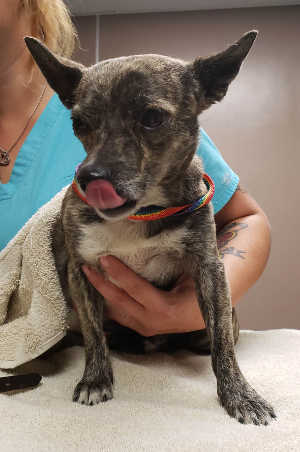
This male Chihuahua is in kennel No. 33, ID No. 13018. Photo courtesy of Lake County Animal Care and Control. Male Chihuahua
This male Chihuahua has a short brindle coat.
He is in kennel No. 33, ID No. 13018.
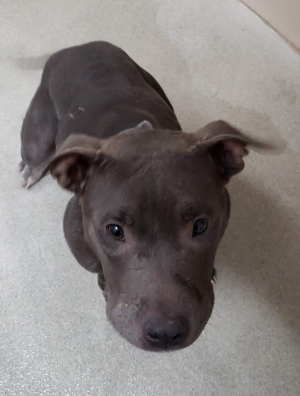
“Coco” is a female Labrador Retriever in kennel No. 34, ID No. 12764. Photo courtesy of Lake County Animal Care and Control. Female pit bull
This female pit bull has a short gray coat.
She is in kennel No. 34, ID No. 13092.
Lake County Animal Care and Control is located at 4949 Helbush in Lakeport, next to the Hill Road Correctional Facility.
Office hours are Monday through Friday, 11 a.m. to 5 p.m., and 11 a.m. to 3 p.m., Saturday. The shelter is open from 11 a.m. to 4 p.m., Monday through Friday and on Saturday from 11 a.m. to 3 p.m.
For more information call Lake County Animal Care and Control at 707-263-0278.
Email Elizabeth Larson at This email address is being protected from spambots. You need JavaScript enabled to view it.. Follow her on Twitter, @ERLarson, or Lake County News, @LakeCoNews.
The role that parents and guardians play as their child’s first teacher is crucial when it comes to driving.
During National Teen Driver Safety Week, Oct. 20 to 26, the California Highway Patrol joins the National Highway Traffic Safety Administration to help parents discuss driving safety with their young drivers.
Motor vehicle crashes are the leading cause of death for teens 15 to 18 years old in the United States, ahead of all other types of injury, disease, and violence.
Nationwide in 2017, there were 2,247 people killed in crashes involving a driver aged 15 to 18. In California, 77 people were killed in crashes involving drivers aged 15-18.
“Their lack of experience alone makes teen drivers a potential danger to themselves and others,” CHP Commissioner Warren Stanley said. “Talk to your teen drivers about safe driving habits and keep the conversation going.”
Discussions about safe driving include avoiding distractions such as cell phones, using seat belts, obeying speed limits, not driving impaired, and limiting the number of passengers. Parents and guardians must be aware that their own driving behavior, following the same rules, is as important as any conversation they could have with their teen.
“It will take all of us – educators, law enforcement, parents, and community leaders – to change the driving culture to one that is distraction-free,” Dr. Kelly Browning, executive director of Impact Teen Drivers said. “By combining quality education and enforcement in a multifaceted approach, we can stop the number one killer of teens in America – 100 percent preventable car crashes.”
In addition to its participation in the Impact Teen Drivers program, the CHP provides education to help keep teen drivers alive in its Start Smart course, offered at all CHP offices free of charge.
Participating in Start Smart will help parents and guardians learn how to effectively discuss the importance of driving safety with their young drivers.
Start Smart also teaches the responsibilities of newly licensed drivers, the Graduated Driver License program, and collision-avoidance techniques.
After seven years of operations, and upon finally running out of propellant, the second of the twin Van Allen Probes spacecraft were retired on Friday, Oct. 18.
Spacecraft A of the Van Allen Probes mission will be shut down by operators at the Johns Hopkins University Applied Physics Lab in Laurel, Maryland.
The command follows one three months previously that terminated operations for spacecraft B, the second spacecraft of the mission.
“This mission spent seven years in the radiation belts, and broke all the records for a spacecraft to tolerate and operate in that hazardous region, all with no interruptions,” said Nelofar Mosavi, Van Allen Probes project manager at Johns Hopkins APL. “This mission was about resiliency against the harshest space environment.”
Originally slated for a two-year mission, the spacecraft flew through the Van Allen belts — rings of charged particles trapped by Earth’s magnetic field — to understand how particles were gained and lost by the belts. The spacecraft made major discoveries that revolutionized how we understand our near-Earth environment.
“Van Allen Probe observations have been the subject of over 600 publications to date in refereed journals, and over 55 Ph.D. theses have used Van Allen Probe observations,” said David Sibeck, Van Allen Probes mission scientist at NASA’s Goddard Space Flight Center in Greenbelt, Maryland.
With instruments measuring electromagnetic fields and charged particles, the Van Allen Probes explored the invisible phenomena shepherding particles in and around the belts. It made discoveries about the architecture of the belts and the forces shaping them.
Just as ocean storms on Earth can create giant waves, space weather, caused by the Sun, can create plasma waves, where seas of particles are tossed by electromagnetic fields. The Van Allen Probes pioneered new explorations into the dynamics of these waves and their effects on our near-Earth environment.
“The Van Allen Probes rewrote the textbook on radiation belt physics,” said Sasha Ukhorskiy, Van Allen Probes project scientist at Johns Hopkins APL, which also designed and built the spacecraft. “The spacecraft used uniquely capable instruments to unveil radiation belt features that were all but invisible to previous sensors, and discovered many new physical mechanisms of radiation belt acceleration and loss.”
In celebration of the mission’s success, here are ten select discoveries, listed in chronological order, made by the Van Allen Probes.
– The Van Allen belts were first discovered in 1958 and for decades scientists thought there were only two concentric belts. But days after the Van Allen Probes launched, scientists discovered that during times of intense solar activity, a third belt can form.
– The belts, which are composed of charged particles and electromagnetic fields, can be energized by different types of plasma waves. One type, called electrostatic double layers, appear as short blips of enhanced electric field. During one observing period, Probe B saw 7,000 such blips repeatedly pass over the spacecraft in a single minute. These individually small events added up to one million volts over six minutes, capable of accelerating electrons up toward the relativistic energies commonly seen in radiation belt particles.
– During big space weather storms, which are ultimately caused by activity on the Sun, ions — electrically charged atoms or molecules — can be pushed deep into Earth’s magnetosphere in a series of impulsive events. These particles carry electromagnetic currents that circle around the planet and can dramatically distort Earth’s magnetic field.
– Across space, fluctuating electric and magnetic fields can create what are known as plasma waves. These waves intensify during space weather storms and can accelerate particles to relativistic speeds. The Van Allen Probes found that one type of plasma wave known as hiss can contribute greatly to the loss of electrons from the belts.
– The Van Allen belts are composed of electrons and ions with a range of energies. In 2015, research from the Van Allen Probes found that, unlike the outer belt, there were no electrons with energies greater than a million electron volts in the inner belt.
– Plasma waves known as whistler chorus waves are also common in our near-Earth environment. These waves can travel parallel or at an angle to the local magnetic field. The Van Allen Probes demonstrated the two types of waves cannot be present simultaneously, resulting in greater radiation belt particle scattering in certain areas.
– Very low frequency chorus waves, another variety of plasma waves, can pump up the energy of electrons to millions of electron volts. During storm conditions, the Van Allen Probes found these waves can hugely increase the energy of particles in the belts in just a few hours.
– Scientists often use computer simulation models to understand the physics behind certain phenomena. A model simulating particles in the Van Allen belts helped scientists understand how particles can be lost, replenished and trapped by the Earth’s magnetic field.
– The Van Allen Probes observed several cases of extremely energetic ions speeding toward Earth. Research found that these ions’ acceleration was connected to their electric charge and not to their mass.
– The Sun emits faster and slower gusts of charged particles called the solar wind. Since the Sun rotates, these gusts — the fast wind — reach Earth periodically. Changes in these gusts cause the extent of region of cold ionized gas around Earth — the plasmasphere — to shrink. Data from the Van Allen Probes showed that such changes in the plasmasphere fluctuated at the same rate as the solar rotation — every 27 days.
Mara Johnson-Groh works for NASA’s Goddard Space Flight Center in Greenbelt, Maryland.
California Gov. Gavin Newsom this week announced the debut of the nation’s first statewide earthquake early warning system that will deliver alerts to people’s cellphones through an app developed at the University of California, Berkeley.
The mobile phone app, MyShake, can provide seconds of warning before the ground starts to shake from a nearby quake — enough time to drop, cover and hold on to prevent injury.
“Nothing can replace families having a plan for earthquakes and other emergencies,” said Newsom. “And we know the ‘Big One’ might be around the corner. I encourage every Californian to download this app and ensure your family is earthquake ready."
Newsom announced the roll-out along with the Governor's Office of Emergency Services (Cal OES), UC Berkeley, United States Geological Survey (USGS) and several state and local political leaders.
Designed by UC Berkeley seismologists and engineers, MyShake is now available for download to cellphones or tablets through iTunes for iPhones and through Google Play stores for Android phones.
The announcement was timed for the 30th anniversary of the 1989 Loma Prieta earthquake, a magnitude 6.9 quake that damaged or collapsed buildings, overpasses and bridges from Santa Cruz to the Bay Area and led to 63 deaths and 3,757 injuries.
“Everyone asks me, ‘Are we safer now than in 1989?’ Well, now we have warnings a few seconds to tens of seconds before the shaking,” said Richard Allen, director of the Berkeley Seismological Laboratory and the Class of 1954 Professor in the Department of Earth and Planetary Science.
MyShake delivers alerts from the ShakeAlert Earthquake Early Warning System operated by the U.S. Geological Survey that utilizes data from seismic networks in California, Oregon and Washington. ShakeAlert calculates preliminary magnitudes and then estimates how strong the shaking will be at a user’s location. In California, ShakeAlert has been issuing alerts of imminent ground shaking from nearby quakes for more than three years to help cities, transit systems, utilities, police departments and fire stations prepare.
ShakeAlerts are now being offered to everyone in the state of California — residents and visitors alike — through the MyShake app, as long as they allow the app to access their locations. In the event of a quake, people’s phones will deliver the audio message, “Earthquake! Drop, cover and hold on. Shaking expected.”
Considered a prototype, MyShake will be continually improved with feedback from the public to create a reliable and indispensable life-saving tool for every resident. The statewide program is administered by the California Governor’s Office of Emergency Services (Cal OES) under the California Earthquake Early Warning (CEEW) Program.
“Delivering alerts remains technically challenging, both to rapidly detect earthquakes and to deliver the alerts in a timely way,” Allen said. “The reality is that warnings will arrive before, during or after shaking starts, but in all cases, they allow us to better respond and survive the earthquake.”
Earthquake-prone countries like Mexico and Japan have long had earthquake early warning (EEW) systems, with alerts typically delivered through cellphones or public address systems. For more than 10 years, seismologists from the U.S. Geological Survey, UC Berkeley, California Institute of Technology, University of Oregon and University of Washington have been developing ShakeAlert for the West Coast supported by public and private funds. Since 2016, the consortium has enlisted public agencies such as PG&E and BART to test the system.
BART, for example, now slows trains when it receives a ShakeAlert. Firehouses use precious seconds of early warning to raise their garage doors so that trucks are not trapped inside; local refineries have time to close valves to prevent spillage of dangerous chemicals and at hospitals, surgeons have time to pull their scalpels from inside patients.
Early warning, not prediction
The ShakeAlert system does not predict an earthquake, but rather provides an alert that an earthquake has been detected nearby and warns recipients that they are likely to feel shaking. It does this by detecting the first seismic waves, called P waves, from a quake, which travel faster than the much more damaging S waves. The farther you are from the epicenter, the greater the delay between P and S waves and the more advance warning you get.
While those near the quake’s epicenter are likely to experience shaking before the alert arrives, such alerts can be critical for those farther away, giving people a few seconds of warning that can save lives and property. After Southern California’s 7.1 magnitude Ridgecrest quake in July, ShakeAlert issued an alert in 7.4 seconds, which would have provided advance warning to residents more than 15 miles from the epicenter.
The ShakeAlertLA app that many Angelenos downloaded in expectation of early warning was not set to alert them to shaking from such a distant quake, and many were surprised when buildings started to sway. The threshold for local shaking has since been lowered.
As the official state EEW app, MyShake will provide the same information in Southern California as ShakeAlertLA does now in Los Angeles County. MyShake will, in addition, send back information to UC Berkeley about local shaking intensity, gathered by the cellphone’s built-in accelerometers, sensors that detect movement or vibrations. It also will give advice on how to prepare for a quake, and offer an easy way for people to provide feedback about their experiences during the quake.
Initially, MyShake will deliver alerts to people for quakes exceeding magnitude 4.5 that will produce a shaking intensity in their area greater than level 3 on the modified Mercalli scale: a threshold at which most people will feel shaking, if they are indoors, that is similar to feeling vibrations from a truck driving by on the street. Once the app has been tested, the developers plan to create a two-tier system, adding a more urgent message for those likely to experience a shaking intensity greater than 4, which is more like a truck hitting your building.
In addition to the MyShake app, the ShakeAlert system will also deliver alerts through the Wireless Emergency Alert, or WEA system — the same system that delivers severe weather warnings and AMBER Alerts. ShakeAlert computers confirm a quake and publish an alert in 3 to 10 seconds, while recent tests show that WEA has an average delivery time of about 13 seconds. MyShake has been demonstrated to deliver these alerts in as little as 3.7 seconds, meaning Californians could get an alert as soon as 7 seconds after a fault rupture begins.
“Our initial tests on the speed of MyShake alert delivery are very encouraging, but we do not know how these will change as the number of people using the app increases,” said Allen. “Rolling out the system is the only way to monitor the performance with a large number of users and further improve the system.”
Crowdsourcing information on shaking intensity
Allen leads the UC Berkeley team that developed MyShake, which has been funded since June by $1.5 million over two years from CalOES after five years of startup funding from the Moore Foundation. Allen’s team also wrote ShakeAlert’s core algorithm, which analyzes data from the state-wide network of earthquake sensors and makes the initial calculations of magnitude and estimates of shaking intensity.
MyShake was launched in 2016 as an app that crowdsources shaking data from the sensors in a cellphone and sends that information to UC Berkeley to be analyzed. The idea, Allen said, was to use the tens of millions of cellphones in circulation within the state as a dense sensor network, which, although not as good as the scientific-grade instruments of the California Integrated Seismic Network, would augment the existing ShakeAlert system and provide valuable additional data. MyShake employs machine learning to convert this crowdsourced data into early warning of ground shaking.
“The citizen science piece is very much part of the relationship with Cal OES,” he said. “Part of what Cal OES is funding is the research to explore how the MyShake phone triggers could be used to make ShakeAlert faster. By having many more people with this app on their phones, we are going to get more data, and that, over time, could make ShakeAlert better, as well.”
Allen has a global vision for MyShake, too: bringing EEW to regions of the world that don’t have seismic networks like those in Japan, Mexico and California, but do have millions of people with cellphones. While MyShake has been downloaded 300,000 times by people in 80 countries and has recorded more than 1,000 quakes in these countries, his team needs many more users to truly test the ability of the platform to serve as an early warning network, instead of just a data collection network.
While Allen hopes that the MyShake network of citizen scientists will make both ShakeAlert and MyShake much better, for now, MyShake alerts will be based on data supplied by the ShakeAlert seismic network alone.
“MyShake is a prototype system we are rolling out, but it has the potential to save lives, reduce injuries and minimize losses in the next California quake,” he said. “By delivering ShakeAlerts to smartphones across California, we can help fulfill the potential of the California Earthquake Early Warning System.”
Robert Sanders writes for the UC Berkeley News Center.
LAKE COUNTY, Calif. – The Board of Supervisors is asking community members to share their input on the public safety power shutoff Pacific Gas and Electric conducted across a large part of the state, including Lake County, last week.
Beginning in the early morning hours of Wednesday, Oct. 9, a “diablo” wind event prompted PG&E to initiate the shutoff, which resulted in loss of power for 738,000 customers, spanning 35 counties.
It is estimated that greater than two million Californians were without power for some portion of this four-day event.
With 44 helicopters deployed to check lines once winds subsided, PG&E reports power was restored for most customers within 48 hours of the all-clear that came on Thursday, Oct. 10.
Power began to come on in parts of Lake County on Thursday and Friday. PG&E said all power had been restored across the public safety power shutoff area by Saturday afternoon.
On Tuesday, Oct. 22, at 11 a.m., the Lake County Board of Supervisors will receive public comment on the effects of the public safety power shutoff.
For those who can’t make the meeting, they are asked to email comments by 5 p.m Monday, Oct. 21, to This email address is being protected from spambots. You need JavaScript enabled to view it..
“Every populated area of Lake County was affected by this highly unfortunate event. Many District 4 residents reached out to me, directly, to share their stories and concerns, and I am aware my fellow supervisors got many similar calls,” said Board Tina Scott.
“We all received general notice the power may periodically be shut off, to reduce the probability of wildfire, and the county shared many resources to help residents prepare. However, with many individuals and families and our county government facing severe economic hardship, it simply wasn’t possible for every household to have a generator. There were also complications for individuals and groups that could not have been fully anticipated,” Scott said.
Scott said that if public safety power shutoffs are to be a new normal in California, the state and PG&E need to well understand the consequences, and the unique challenges for individuals with medical needs in rural communities, where some may need to travel a considerable distance just to reach a PG&E Community Resource Center.
The shutoff also affected county operations and finances, at a time of fiscal crisis, according to County Administrative Officer Carol Huchingson.
“Lake County residents are all too familiar with natural disasters, and we have always worked hard to enable reimbursement of related costs, for residents and the government alike, as facilitated by the Stafford Act and other legislation,” said Huchingson. “Because a public safety power shutoff is a planned event, and not categorically a disaster, many hours of staff time and other expenses incurred by the county may never be reimbursed. This is not a norm that is acceptable.”
“We need to hear from you,” said Scott. “How were you affected by the public safety power shutoff? What did it mean for your family, your business? What were the costs? While options may be limited because this is not a qualifying disaster event, I can assure you our board and county staff will vigorously advocate for Lake County’s needs.”
 How to resolve AdBlock issue?