 How to resolve AdBlock issue?
News
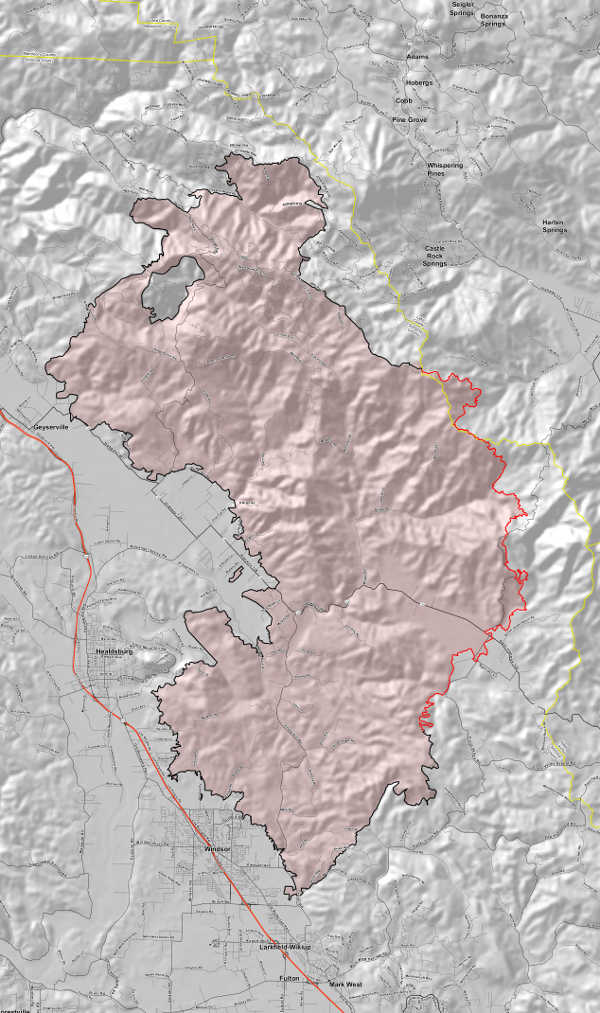
NORTH COAST, Calif. – With containment lines continuing to be strengthened around the Kincade fire, more Sonoma County residents who had been forced to evacuate were allowed to return home on Saturday.
The Kincade fire remained at 77,758 acres again on Saturday, with containment edging up to 74 percent by day’s end, Cal Fire reported.
As the fire’s containment rises, the number of threatened structures continues to drop. It was down to 400 by Saturday evening; during the height of the fire, more than 90,000 structures had been in danger.
The latest damage assessment number put the number of destroyed structures at 372, with another 59 structures damaged.
Thanks to the progress on containing the fire, more evacuation orders were reduced to warnings on Saturday in the Pine Flat Road area, and the area west of but not including Chalk Hill Road, South of W. Soda Rock Lane and north of the Windsor town limits.
Evacuation warnings also were lifted for areas to the south and east of Shiloh Meadow Road, and the area north of but not including Pine Flat Road, Dillingham Road and Socrates Mine Road.
Cal Fire said 4,032 firefighters, along with 363 engines, 64 water tenders, three helicopters, 102 hand crews and 29 dozers remain assigned.
The fire is expected to be fully contained on as of Thursday, Cal Fire said.
Email Elizabeth Larson at
NORTH COAST, Calif. – Residents of Lake County reported getting shaken by a Saturday morning quake in northern Sonoma County.
The 3.7-magnitude quake occurred at 7:05 a.m. Saturday northwest of The Geysers, according to the US Geological Survey.
The survey said the quake was centered in Sonoma County, 3.8 miles west northwest of Cobb and 13.5 miles southwest of Clearlake, right under the earth’s surface.
That location places the quake in the Kincade fire footprint.
The US Geological Survey reported receiving 48 shake reports from around California. The most reports came from Kelseyville, as well as many from the Bay Area, and others from as far away as Monterey and King City.
Email Elizabeth Larson atThis email address is being protected from spambots. You need JavaScript enabled to view it. . Follow her on Twitter, @ERLarson, or Lake County News, @LakeCoNews.
The 3.7-magnitude quake occurred at 7:05 a.m. Saturday northwest of The Geysers, according to the US Geological Survey.
The survey said the quake was centered in Sonoma County, 3.8 miles west northwest of Cobb and 13.5 miles southwest of Clearlake, right under the earth’s surface.
That location places the quake in the Kincade fire footprint.
The US Geological Survey reported receiving 48 shake reports from around California. The most reports came from Kelseyville, as well as many from the Bay Area, and others from as far away as Monterey and King City.
Email Elizabeth Larson at
In the early 1980s, heliophysicists needed answers.
They wanted to learn how to protect astronauts and assets around Earth from the potentially damaging space weather that results from our tumultuous Sun.
To do that, they needed to better understand the constantly changing, dynamic space system around our planet – including measurements of the properties of the solar wind, the constant billowing of charged particles coming off the Sun.
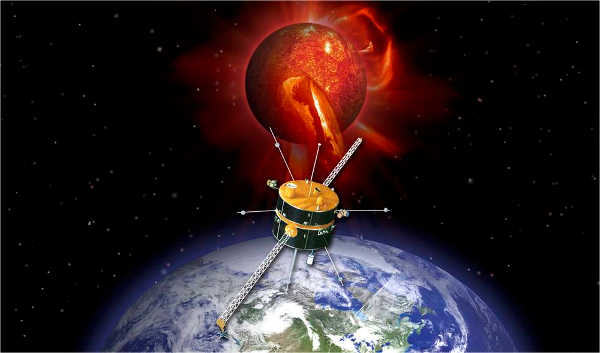
Answering this call was the aptly named “Wind Mission,” which launched 25 years ago, on Nov. 1, 1994.
Wind currently orbits at the first Lagrange point, L1, a spot of gravitational balance between the Sun and Earth, which allows the spacecraft to face the Sun at all times.
For the past 25 years, Wind has been studying the heated gas of charged particles – known as plasma – that fills the space between planets.
The observations have allowed scientists to gain an understanding of the solar wind and its interactions with the near-Earth environment.
Wind data has been instrumental in elucidating solar wind properties, intense space weather, and interstellar space, as well as assisting other spacecraft that have gone on to study the Sun up close.
So far, Wind’s data has been used in over 5,000 publications, and supported almost 100 graduate degrees. It has been steadily taking data for 25 years, and has enough fuel at its current orbit to last until 2074. Wind's scientific results are prodigious – here are some of the coolest results from the last 25 years:
1. Solar Radio
Early in its mission, Wind tuned in to the radio frequencies of the Sun. By listening in, Wind was able to detect a hum coming from our star; the Sun was singing.
By tracking the minute changes in this frequency, scientists can remotely observe the surface of the Sun and the space weather that comes towards Earth.
2. Interstellar Dust
In the early years of observations, scientists noticed something interesting happening with Wind’s electric field detectors aboard the mission. Every now and then, a large spike would appear in the data.
Eventually, scientists determined the spikes’ origin: hyper-fast dust particles impacting the spacecraft. When these dust particles hit Wind, they create tiny explosions of plasma on impact, which resulted in electric field spikes on the instruments.
Such particles can come from inside or outside the solar system, but most interstellar particles are kept out due to the influence of the solar wind. We do not have many tools in space to detect them.
So far Wind has measured well over 100,000 dust particle impacts. Scientists can use the information to determine where this dust comes from and better understand the properties of space outside our Sun’s influence.
3. Hit or Miss?
Wind has been a big part of helping scientists understand coronal mass ejections, or CMEs. Wind was designed to measure the magnetic fields of CMEs as they passed by.
Coronal mass ejections are gigantic clouds of solar material that burst off the Sun, pulling solar magnetic fields along for the ride. Since the 1980s, scientists have improved their ability to determine which CMEs would hit Earth, and which would miss Earth, based on what Wind observes as a CME passes.
This allowed space weather scientists today to make more accurate models that let them determine where a CME will hit, just by seeing what it looks like as it comes closer to Earth.
4. Made to Last
After 25 years, Wind isn’t done yet. Wind has enough fuel to keep orbiting and taking data until 2074 – another 55 years of science.
But how does it stay up there for so long?
For one, it’s in a spin-stabilized orbit. This means that it’s spinning around itself like a top, which keeps it steady in its orbit. This also means Wind doesn’t need to use much fuel to stay in place.
It’s also very well protected – highly conductive, so that the solar wind and other particles that interact with it are of no concern to the spacecraft.
5. High Certainty
On top of the spacecraft engineering, the instruments were designed for triple redundancy, which means there are three independent measurements of plasma density.
Having these redundant systems allows for highly accurate data analysis, and means Wind can be used to calibrate instruments on other spacecraft.
Wind records this data on two tape recorders – much like a VHS or cassette tape. The satellite sends the data back to Earth, and only once that data is received will Wind write over that data.
6. One Full Solar Cycle
Wind’s longevity has allowed it to observe a full 22-year solar cycle, the recurring cycle during which the entire solar magnetic field reverses polarity. That is, each magnetic pole switches from positive to negative or vice versa, then switches back again.
Wind’s long-term, high-accuracy observations have given scientists the only single-source, continuous observation of the solar wind over one full solar cycle.
7. Magnetic Reconnection
During a detour through Earth’s magnetic field, Wind serendipitously flew through a region undergoing a process called magnetic reconnection.
Magnetic reconnection happens when magnetic field lines twist and eventually snap. Near Earth, our planet's magnetic fields fly back towards the poles, bringing high-energy particle beams of plasma along for the ride and exciting particles in Earth’s upper atmosphere.
When Wind measured this process, scientists discovered something interesting: The process appeared to be collisionless. That is, instead of being pushed along – the way a drop of water pushes the next in a chain event that creates a current – the particles moved because they were guided by the magnetic field.
This was not what was expected. Particles tend to react to each other, but in the collisionless shock, they essentially ignored each other’s existence.
The discovery helped explain why the observed magnetic reconnection was so much faster than previously predicted by reconnection that depended on collisions.
8. Plasma Instability
Solar wind, despite the name, does not behave like wind on Earth. The farther the wind gets from its source, the Sun, the faster and hotter it gets – unlike any phenomenon we experience on Earth.
Recently, Wind’s data suggested that there is something happening in the solar wind that could account for this mysterious property – ion cyclotron waves. It’s a mouthful, but ion cyclotron waves are just electromagnetic waves where the fields rotate in wave-like rhythms while also propagating out in the solar wind.
Wind showed that these ion cyclotron waves appear in the solar wind near Earth. Missions like Parker Solar Probe have the capability to test whether such waves explain the solar coronal heating problem.
9. Helium and the Solar Wind
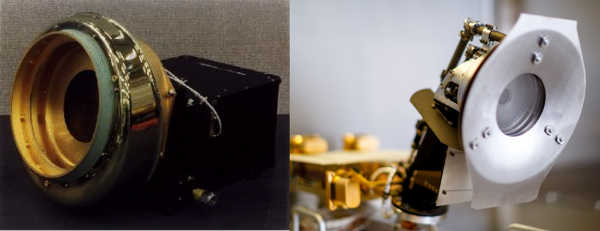
One of the instruments on Wind spotted an interesting quality of the solar wind. The solar wind experiment uses a Faraday cup – a charge-collecting plate – to measure the speed, density, and temperature of hydrogen and helium in the solar wind.
While studying the solar wind over 10 years with over 2.5 million measurements, scientists noticed the solar wind never traveled slower than 161 miles per second. Any slower, and the solar wind couldn’t escape the Sun’s surface.
They also saw that the faster the solar wind, the more helium was present in it – with barely any helium observed at the lowest speeds.
This tells scientists that helium is somehow helping set the speed of the solar wind, but they’re still searching for the exact process that causes this.
Other missions flying closer to the Sun – such as NASA's Parker Solar Probe and ESA's Solar Orbiter, scheduled to launch in February 2020 – may provide additional clues.
10. Flux Ropes
Wind’s high-resolution data offered new insight into the frequency of a solar phenomenon called flux ropes, thin strands of magnetic field bundles that come off the Sun and interact with Earth’s magnetosphere.
Unlike the larger CMEs that occur more often during solar maximum, these flux ropes appear more frequently during solar minimum. Scientists continue to study them to understand how they interact with our magnetosphere.
Over the last 25 years, Wind’s observations have offered new insights into multiple solar and plasma phenomena, including gamma ray and kinetic physics.
As it continues its observations of the Sun and near-Earth space, Wind will answer the call for plasma and solar wind observations, and possibly introduce even more mysteries to study into the future.
Susannah Darling works for NASA Headquarters in Washington, DC.
LAKE COUNTY, Calif. – After weeks of fires and blackouts, it’s time to “fall back.”
Daylight saving time ends at 2 a.m. Sunday, Nov. 3.
This year, it began on Sunday, March 10.
Daylight time goes into effect on the second Sunday in March and ends on the first Sunday in November, dates that went into effect in 2007 as established by Congress in the Energy Policy Act of 2005, according to the US Naval Observatory.
States that do not observe daylight saving time are Arizona and Hawaii; the US territories of American Samoa, Puerto Rico and the Virgin Islands also don’t hold to it.
Despite Californians voting last year in favor of a proposition to get rid of it, California’s Legislature has not yet taken action on getting rid of daylight saving time. Once it does, it must still have approval from Congress.
The National Weather Service said this is a good time to prepare your home and family for emergencies.
Preparations the agency suggests including doing fire drills at home and writing a family escape plan, and replacing batteries in important devices like weather radios, smoke alarms and carbon monoxide detectors.
Cal Fire also urges people to use daylight saving time as a reminder to check smoke alarms, which it said should be installed in all sleeping rooms, hallways that lead to sleeping areas, basements and each additional level of the home, because most fatal fires occur at night.
For more information about smoke alarms visit Cal Fire’s Web site at www.fire.ca.gov or contact your local fire department.
Daylight saving time ends at 2 a.m. Sunday, Nov. 3.
This year, it began on Sunday, March 10.
Daylight time goes into effect on the second Sunday in March and ends on the first Sunday in November, dates that went into effect in 2007 as established by Congress in the Energy Policy Act of 2005, according to the US Naval Observatory.
States that do not observe daylight saving time are Arizona and Hawaii; the US territories of American Samoa, Puerto Rico and the Virgin Islands also don’t hold to it.
Despite Californians voting last year in favor of a proposition to get rid of it, California’s Legislature has not yet taken action on getting rid of daylight saving time. Once it does, it must still have approval from Congress.
The National Weather Service said this is a good time to prepare your home and family for emergencies.
Preparations the agency suggests including doing fire drills at home and writing a family escape plan, and replacing batteries in important devices like weather radios, smoke alarms and carbon monoxide detectors.
Cal Fire also urges people to use daylight saving time as a reminder to check smoke alarms, which it said should be installed in all sleeping rooms, hallways that lead to sleeping areas, basements and each additional level of the home, because most fatal fires occur at night.
For more information about smoke alarms visit Cal Fire’s Web site at www.fire.ca.gov or contact your local fire department.
NORTHERN CALIFORNIA – As the weather starts to cool off and the rainy season begins, you’ll be seeing more and more fungi starting to make their appearance in the Berryessa Snow Mountain National Monument region.
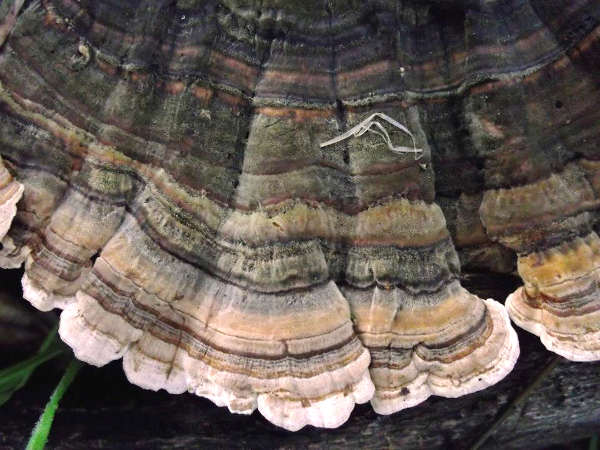
One of the most commonly found fungi in our region is turkey tail which looks something like the fanned-out tail of a wild turkey.
But along with the turkey tail there are other fungi that mimic it and grow in similar forms in the same places it does.
So, how do you tell them apart?
Turkey tail fungus and the mimics we’ll cover here usually grow on oak trees and other hardwoods.
The upper surface of each of them is made up of a concentric half-circle “zones” of varying colors; rings of browns, grays, tans and sometimes even muted orange. They all generate white spores.
The fungi are also all “saprobic,” which means they live by facilitating the decay of the dead or dying trees, and they all grow in shelf-like structures (brackets).
To tell the true turkey tail from its mimics, you need to look at the underside of these brackets.
True turkey tail, Trametes versicolor, is a “polypore” (many pored) fungus. On the underside of the fanned-out brackets, you’ll find a white or off-white surface full of tiny holes. Even when the sample dries out, you can still see the porous nature of its underside. These pores, like the gills on mushrooms, house the fungus’s spore-producing mechanisms.
T. versicolor has a slightly corky, leathery feel to it and some of the colored zones on top may be covered with tiny hairs. It’s probably the most common decomposer of hardwoods in North America. It is also considered to be “weakly parasitic”; that is, when it’s finished digesting dead organic material it may connect to living parts of the tree for a little extra sustenance.
The first mimic we’ll touch on is Stereum ostrea, commonly known as false turkey tail. This fungus itself is tough and leather and totally inedible. Although there is a good deal of anecdotal information about its medicinal properties, scientific studies done on the fungus suggest that while it may “contain potential antimicrobial compounds,” more study is required to see if any of those compounds are actually of benefit to humans.
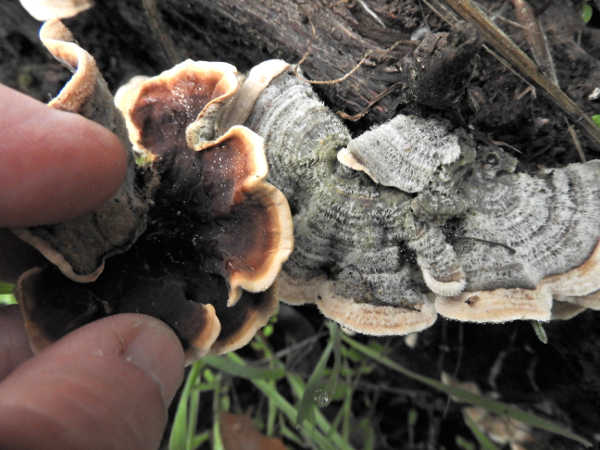
Like true turkey tail, false turkey tail grows in semi-circular brackets, but this is a crust fungus rather than a polypore.
Because fungi in general lack any chlorophyll and are incapable of photosynthesis, you won’t find green ones.
But sometimes alga grows on and into false turkey tail staining its upper surface green. It’s not believed that this is a communal or symbiotic relationship; rather, it seems that the alga is simply taking advantage of another substrate on which to rest while it goes through its photosynthetic processes.
The underside of this species is flat and smooth, sometimes shiny, and usually reddish tan or brown in color. It has no pores in which to produce its spores. Instead, the whole smooth surface of its underside is considered “fertile,” yet collecting spores prints from this fungus is especially difficult.
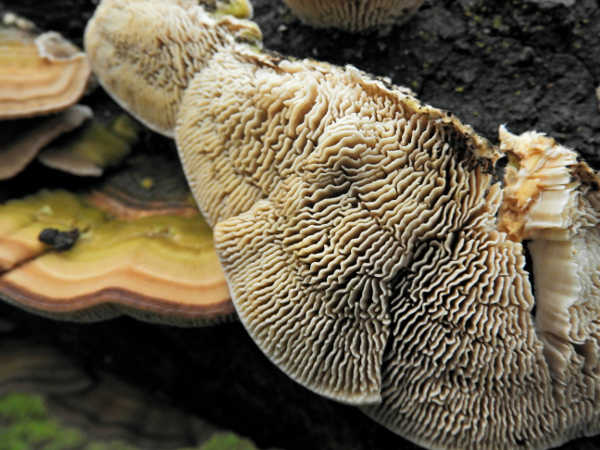
The undersurface of the second mimic is even more interesting. Like true turkey tail and false turkey tail, it too grows in those multi-colored zonal semi-circles, but underneath it’s very different.
It’s called oak mazegill, Daedalea quercina, and although it’s a polypore like true turkey tail, the porous surface on its underside alters significantly as it ages and matures.
In this one, some of the pore walls collapse resulting in a maze-like structure of partitions which are sometimes referred to as gills (although they’re not entirely like the gills of mushrooms).
So, oak mazegill is often described as a “gilled polypore” which can seem something of a contradiction in terms to most novice mushroom hunters since they’re often told at the outset that mushrooms either have gills OR pores but not both. Spore production is done in and along the walls of these partitions.
Mazegill’s scientific genus name “Daedalea” comes from the Greek myth of Daedalus (father of Icarus) the master craftsman who created the labyrinth which housed the Minotaur.
If you look carefully on your next walk out into the forest you may be able to see all three of these fungi in a single day: true turkey tail, false turkey tail and oak mazegill. And now you know how to tell one from another.
Mary K. Hanson is a Certified California Naturalist, author, nature photographer and blogger (https://chubbywomanwalkabout.com/). She also teaches naturalist classes through Tuleyome, a501(c)(3) nonprofit conservation organization based in Woodland, California. For more information, visit www.tuleyome.org.

NORTHERN CALIFORNIA – At his recent sixth annual Women of the Year event, Congressman John Garamendi (D-Fairfield, Yuba City, Davis) honored 50 women from California’s Third Congressional District who are leaders and visionaries in their communities.
The women have all made significant contributions to society through public service, business, education and local advocacy.
“One of the highlights of my year, every year, is hosting this event to recognize the achievements of these distinguished women,” said Garamendi. “These leaders come from a variety of backgrounds, but every one of them has made a real difference in their communities and the people around them. It’s a privilege to be able to honor them.”
Among the 50 recipients was one from Lake County, Tina Viramontes.
This year’s Women of the Year event included a posthumous tribute and recognition of Natalie Corona – the Davis police officer who was tragically killed during her service to the community earlier this year.
“Officer Corona was a bright member of the Davis Police Department. Even prior to completing her police training last December, Officer Corona was respected by her colleagues and friends for her commitment to serving her community and dedication to her fellow officers. She selflessly served and protected her community and will be remembered and honored for her dedication to making the city of Davis a safer environment for all,” Garamendi said.
A full list of the recipients Women of the Year recipients is below.
Colusa County
Rosemary Hicks
Roberta James
Jen Roberts
Kim Travis
Diane Vafis
Glenn County
Mary Rose Kennedy
Vangie Porras
Lake County
Tina Viramontes
Sacramento County
Diana Fuentes-Michel
Vajra Watson
Kristina Wiley
Solano County
Jill Cook
Jenalee Dawson
Patricia Dennis
Ana Dineen
Kathleen Heeran
Jaye Hurt
Erica Hurtado
Juantia Menefee
Pat Nicodemus
Margaret Renn
Beth Rowe
Heather Sanderson
Cherie Schroeder
Dee Tokiwa
Sarah Villec
Sutter County
Bobbi Abold
Navjot Bala-Singh
Neelam Dhinsa Canto-Lugo
Nancy Geweke Elrod
Kellie Geweke Sheeran
Julie Gill
Joyce Hammond
Navneet Randhawa
Jeanine Werner
Yolo County
Lisa Baker
Vinita Domier
Deborah Dunham
Catherine Farman
Kelly Heung
Jenn Rexroad
Lynn Rolston
Harmony Scopazzi
Cathy Speck
Tracy Tomasky
Denise Burbank
Yuba County
Abbie Cesena
Glenda Nelson
Natalie Corona