 How to resolve AdBlock issue?
News
- Details
- Written by: Lake County News reports
The joint project, called Reimagine Indians into Medicine, or RISE, stands to substantially increase the total number of Native medical and health science students nationwide, which in turn can decrease health disparities and improve public health.
“The UC Davis School of Medicine is firmly committed to reducing health disparities, and one of the most successful ways to achieve that is to matriculate more students from diverse backgrounds,” said Allison Brashear, dean of the UC Davis School of Medicine. “Studies show that students who belong to underrepresented minority groups are drawn to careers in medicine where they can care for underserved populations – which also happen to have the greatest health disparities.”
The Indian Health Service has found native populations suffer disproportionately from heart disease, diabetes, alcoholism, mental health conditions, asthma, chronic liver disease and intrahepatic bile duct cancer.
Among other factors, these health disparities can be attributed to a shortage of native physicians and other health care professionals.
Practitioners with knowledge of and sensitivity to the traditions of these communities can improve the health care that is delivered.
This makes efforts like the new partnership between the Northwest Portland Area Indian Health Board, Oregon Health & Science University, University of California Davis School of Medicine and Washington State University Health Sciences and its Elson S. Floyd College of Medicine critical.
The collaboration is supported by a nearly $1 million, five-year grant from IHS’s Indians Into Medicine Program, as well as more than $1 million in financial and in-kind contributions from project partners.
“This initiative will allow the UC Davis School of Medicine to help identify, prepare, enroll and train a greater number of Native American students, each of whom is likely to make a tangible difference in achieving health equity in their home communities where health disparities continue to persist,” Brashear said.
The project will build on the early success of the OHSU Wy’east Post-Baccalaureate Pathway, a 10-month program that offers citizens of federally recognized tribes a pathway to improve their academic skills and be successful in the medical school admissions process. UC Davis School of Medicine and WSU Elson S. Floyd College of Medicine will join Wy’east, with the three medical schools collectively admitting 18 students to the pathway. Upon successful completion of Wy’east, students will receive conditional acceptance from the medical schools.
Fewer than 1 percent of all working U.S. physicians are Native American. Just 44 of the 21,863 enrolled medical students nationwide this year identified as Native American alone, including two at UC Davis. If all 18 Wy'east students go on to study medicine, they could increase the total number of Natives enrolled in U.S. medical schools by about 40 percent.
Another key aspect of the joint project is creating summer academies, six-week enrichment programs in biomedical sciences and MCAT exam preparation for undergraduate or recently graduated native students wanting to attend medical school.
Project partners will also expand the pre-existing Pacific Northwest American Indian/Alaska Native Medical School Applicant Workshop, which helps the region’s Native students prepare to apply for medical school.
Finally, the four partners also will encourage native youth and adolescents to pursue medical careers through targeted digital and social media outreach, as well as hands-on health profession enrichment activities.
Native youth can text the keyword HEALER to 97779 to receive weekly text messages that include role-model videos, resources, tips and ideas to help them navigate the steps involved in becoming a healer.
- Details
- Written by: LAKE COUNTY NEWS REPORTS
The governor on Friday named Administrative Presiding Justice of the Sixth District Court of Appeal Mary J. Greenwood to serve on the Bay Area Judicial Selection Advisory Committee; Los Angeles County Public Defender’s Office head deputy-supervisor Irene G. Nunez and Greene, Broillet & Wheeler partner Christine D. Spagnoli to the Los Angeles Judicial Selection Advisory Committee; and former Presiding Judge of the San Diego County Superior Court Peter Deddeh to the San Diego Judicial Selection Advisory Committee.
In keeping with his commitment to increase transparency in government, the Governor last year announced the creation of eight Judicial Selection Advisory Committees – representing the Bay Area, Central Coast, Central Valley, Inland Empire, Los Angeles, Northern California, Orange and San Diego regions – comprised of attorneys and judges who live and work in the regions. For the first time in California history, the individuals who provide important feedback on judicial candidates for nomination and appointment are known to the public.
Committee members convene at the request of Judicial Appointments Secretary Justice Martin Jenkins (Ret.) to provide feedback on candidates’ legal acumen, work ethic, temperament and demonstrated commitment to public service.
They review all candidates before forwarding their names to the governor for review.
All feedback from the JSACs is advisory in nature only, and is considered by the Governor’s Office in combination with evaluations provided by the State Bar of California and county and affinity bar associations.
The JSACs are comprised of attorneys and judges, selected by the Judicial Appointments Secretary, who are in good standing with the State Bar of California and are diverse with respect to race, ethnicity, sexual orientation and gender, as well as substantive legal practice areas.
In identifying potential committee members, the judicial appointments secretary considers suggestions from members of California state and local bar organizations and California affinity bar organizations.
A complete list of committee members, by region, can be found here.
- Details
- Written by: Dennis Fordham
The Setting Every Community Up for Retirement Enhancement Act of 2019, or the SECURE Act of 2019, is, from a taxpayer’s perspective, both “good news” and “bad news.”
The “good news” includes helping small employers establish 401(k) retirement plans and allowing more employees to save for retirement.
The “bad news” is that the new tax law eliminates the much-loved income tax deferral – called, “stretch out” – enjoyed by non-spousal death beneficiaries who inherit individual retirement accounts, or IRAs, and 401(k) retirement plans on or after Jan. 1, 2020.
That is, the new SECURE act of 2019 applies to IRAs and 401(k)s where the owner dies on or after Jan. 1, 2020.
Thus, the longstanding “stretch out” tax deferral rules continue for IRA’s and 401(k)’s inherited before 2020.
Under the new law, most nonspousal death beneficiaries are required to receive full distribution of the inherited IRA within 10 years of the owner’s death.
Thus, non-spousal beneficiaries generally cannot “stretch out” the “required minimum distributions,” or RMDs, to themselves from the inherited IRA over their own lifetimes.
Stretch-out of the inherited IRA allows younger beneficiaries with long actuarial life expectancies to receive much smaller annual RMDs; both reducing annual income taxes owed on RMDs and allowing the continued accumulation of tax-free growth inside the inherited IRA.
The new 10-year rule allows certain flexibility and tax planning: The distributions could occur as ten annual payments or as one lump sum payment in the 10th year.
Certain designated death beneficiaries, however, are excepted from the 10-year rule: The IRA owner’s surviving spouse, a beneficiary who is not more than 10 years younger than the owner, and the deceased owner’s minor, disabled or ill child.
Surviving spouses who are death beneficiaries continue to be able to “roll over” their deceased spouse’s IRA or 401(k) into their own IRA, as if she had funded the “roll over” account with her own earnings.
Accordingly, the surviving spouse does not have to commence annual RMDs until he or she reaches the required beginning date, or RBD. The RBD is now increased to age 72. A modest improvement from 70 ½ years old.
However, the new 10-year rule may motivate some married couples with multiple retirement accounts to leave some retirement accounts to their children and not the surviving spouse. That way their children commence the ten year period on some accounts at the first spouse’s death and not on all accounts at the death of the surviving spouse.
Losing “stretch out” deferral of RMDs is particularly troublesome if the designated death beneficiary is a so-called “conduit trust.”
Conduit trusts require all annual RMDs to be paid each year either to or for the benefit of the trust beneficiary and are drafted in contemplation of the annual RMDs received by the trust being “stretched out” over the beneficiary’s lifetime; a period usually greater than 10 years. Thus allowing the inherited IRA to last longer and be spent more appropriately by the trustee.
With full payout occurring within 10 years of the owner’s death, some conduit trusts, where possible, can be modified into so-called accumulation trusts. Accumulation trusts – as the name suggests – allow the trustee to accumulate (rather than distribute) the annual RMDs received by the trustee from the inherited IRA.
Like all trusts, however, accumulation trusts suffer from the big disadvantages: Trusts are taxed at the highest marginal tax rate once their undistributed net taxable income reaches $12,750 (2019); one reason why conduit trusts were used.
A possible solution is to convert traditional IRAs into Roth IRAs – whose distributions are nontaxable income to the beneficiary.
The IRS needs to issue regulations to implement the SECURE Act of 2019. These IRS regulations will provide important details and thus allow further planning opportunities.
Anyone concerned about the foregoing issues should discuss them with a qualified financial advisor and/or tax professional.
Attorney Dennis A. Fordham is a State Bar-Certified Specialist in estate planning, probate and trust law. His office is at 870 S. Main St., Lakeport, Calif. He can be reached at
- Details
- Written by: Ravi Kumar Kopparapu, NASA
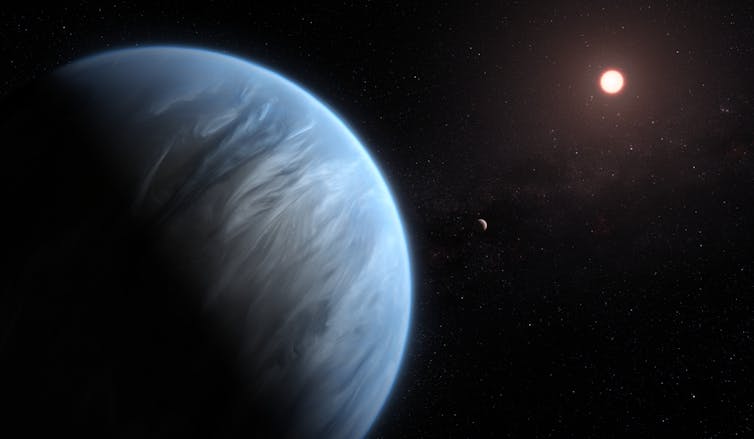
A few months ago a group of NASA exoplanet astronomers, who are in the business of discovering planets around other stars, called me into a secret meeting to tell me about a planet that had captured their interest. Because my expertise lies in modeling the climate of exoplanets, they asked me to figure out whether this new planet was habitable – a place where liquid water might exist.
These NASA colleagues, Josh Schlieder and his students Emily Gilbert, Tom Barclay and Elisa Quintana, had been studying data from TESS (Transiting Exoplanet Survey Satellite) when they discovered what may be TESS’ first known Earth-sized planet in a zone where liquid water could exist on the surface of a terrestrial planet. This is very exciting news because this new planet is relatively close to Earth, and it may be possible to observe its atmosphere with either the James Webb Space Telescope or ground-based large telescopes.
Habitable zone planets
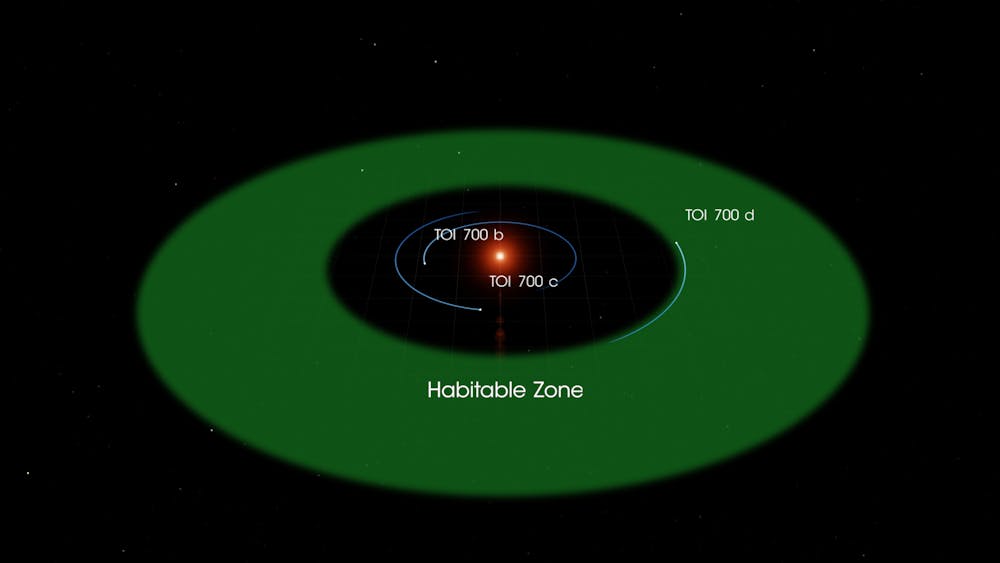
The host star of the planet that Gilbert’s team discovered is called TESS of Interest number 700, or TOI-700. Compared to the Sun, it is a small, dim star. It is 40% the size, only about 1/50 of the Sun’s brightness and is located about 100 light-years from Earth in the constellation Dorado, which is visible from our Southern Hemisphere. For comparison, the nearest star to us, Proxima Centauri, is 4.2 light-years away from Earth. To get a sense of these distances, if you were to travel on the fastest spacecraft (Parker Solar Probe) to reach Proxima Centauri, it would take nearly 20,000 years.
There are three planets around TOI-700: b, c and d. Planet d is Earth-size, within the star’s habitable zone and orbits TOI-700 every 37 days. My colleagues wanted me to create a climate model for Planet d using the known properties of the star and planet. Planets b and c are Earth-size and mini-Neptune-size, respectively. However, they orbit much closer to their host star, receiving 5 times and 2.6 times the starlight that our own Earth receives from the Sun. For comparison, Venus, a dry and hellishly hot world with surface temperature of approximately 860 degrees Fahrenheit, receives twice the sunlight of Earth.
Until about a decade ago, only two habitable zone planets of any size were known to astronomers: Earth and Mars. Within the last decade, however, thanks to discoveries made through both ground-based telescopes and the Kepler mission (which also looked for exoplanets from 2009 to 2019, but is now retired), astronomers have discovered about a dozen terrestrial-sized exoplanets. These are between half and two times larger than the Earth within the habitable zones of their host stars.
Despite the relatively large number of small exoplanet discoveries to date, the majority of stars are between 600 to 3,000 light-years away from Earth – too far and dim for detailed follow-up observation.
Why is liquid water important for habitability?
Unlike Kepler, TESS’ mission is to search for planets around the Sun’s nearest neighbors: those bright enough for follow-up observations.
Between April 2018 and now, TESS discovered more than 1,500 planet candidates. Most are more than twice the size of Earth with orbits of less than 10 days. Earth, of course, takes 365 days to orbit around our Sun. As a result, the planets receive significantly more heat than Earth receives from the Sun and are too hot for liquid water to exist on the surface.
Liquid water is essential for habitability. It provides a medium for chemicals to interact with each other. While it is possible for exotic life to exist at higher pressures, or hotter temperatures – like the extremophiles found near hydro-thermal vents or the microbes found half a mile beneath the West Antarctic ice sheet – those discoveries were possible because humans were able to directly probe those extreme environments. They would not have been detectable from space.
When it comes to finding life, or even habitable conditions, beyond our solar system, humans depend entirely upon remote observations. Surface liquid water may create habitable conditions that can potentially promote life. These life forms can then interact with the atmosphere above, creating remotely detectable bio-signatures that Earth-based telescopes can detect. These bio-signatures could be current Earth-like gas compositions (oxygen, ozone, methane, carbon dioxide and water vapor), or the composition of ancient Earth 2.7 billion years ago (mostly methane and carbon dioxide, and no oxygen).
We know one such planet where this has already happened: Earth. Therefore, astronomers’ goal is to find those planets that are about Earth-size, orbiting at those distances from the star where water could exist in liquid form on the surface. These planets will be our primary targets to hunt for habitable worlds and signatures of life outside our solar system.
Possible climates for planet TOI-700 d
To prove that TOI-700 d is real, Gilbert’s team needed to confirm using data from a different type of telescope. TESS detects planets when they cross in front of the star, causing a dip in the starlight. However, such dips could also be created by other sources, such as spurious instrumental noise or binary stars in the background eclipsing each other, creating false positive signals. Independent observations came from Joey Rodriguez at Center for Astrophysics at Harvard University. Rodriguez and his team confirmed the TESS detection of TOI-700 d with the Spitzer telescope, and removed any remaining doubt that it is a genuine planet.
My student Gabrielle Engelmann-Suissa and I used our modeling software to figure out what type of climate might exist on planet TOI-700 d. Because we do not yet know what kind of gases this planet may actually have in its atmosphere, we use our climate models to explore possible gas combinations that would support liquid oceans on its surface. Engelmann-Suissa, with the help of my longtime collaborator Eric Wolf, tested various scenarios including the current Earth atmosphere (77% nitrogen, 21% oxygen, remaining methane and carbon dioxide), the composition of Earth’s atmosphere 2.7 billion years ago (mostly methane and carbon dioxide) and even a Martian atmosphere (a lot of carbon dioxide) as it possibly existed 3.5 billion years ago.
Based on our models, we found that if the atmosphere of planet TOI-700 d contains a combination of methane or carbon dioxide or water vapor, the planet could be habitable. Now our team needs to confirm these hypotheses with the James Webb Space Telescope.
Strange new worlds and their climates
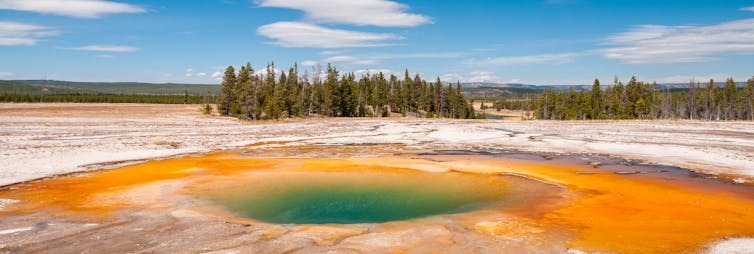
The climate simulations our NASA team has completed suggest that an Earth-like atmosphere and gas pressure isn’t adequate to support liquid water on its surface. If we put the same quantity of greenhouse gases as we have on Earth on TOI-700 d, the surface temperature on this planet would still be below freezing.
Our own atmosphere supports a liquid ocean on Earth now because our star is quite big and brighter than TOI-700. One thing is for sure: All of our teams’ modeling indicates that the climates of planets around small and dim stars like TOI-700 are very unlike what we see on our Earth.
The field of exoplanets is now in a transitional era from discovering them to characterizing their atmospheres. In the history of astronomy, new techniques enable new observations of the universe including surprises like the discovery of hot-Jupiters and mini-Neptunes, which have no equivalent in our solar system. The stage is now set to observe the atmospheres of these planets to see which ones have conditions that support life.
[ You’re smart and curious about the world. So are The Conversation’s authors and editors. You can get our highlights each weekend. ]
Ravi Kumar Kopparapu, Research Scientist of Planetary Studies, NASA
This article is republished from The Conversation under a Creative Commons license. Read the original article.