 How to resolve AdBlock issue?
News
- Details
- Written by: Ryan Matthew Brewer, Indiana University
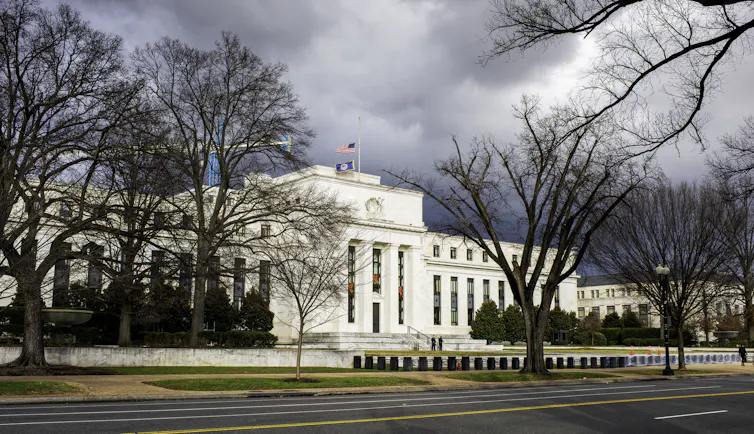
The United States Federal Reserve has committed to do everything it can to save the financial system and the American economy from collapse.
Most recently, it began an unprecedented effort to ensure banks, companies and now households have all the money they need by offering to buy unlimited amounts of securities, including bundled student loans and credit card debt. Even at the peak of the financial crisis in 2008, the Fed’s actions were much more limited in scope – as well as speed.
My colleagues and I at the Indiana Business Research Center have been studying the Fed, its actions and the economic impact for over a quarter-century. Here’s a quick primer on the U.S. central bank, how it works and what it’s doing to keep the economy from sinking into depression.
No guarantee of safety
Before Congress created the Federal Reserve System, the safety and soundness of U.S. banks was hardly a sure thing.
Bank runs – when a large number of customers withdraw their deposits simultaneously over concerns of a bank’s solvency – were common, such as during the Gilded Age from 1863 to 1907, when financial crises occurred frequently.
Yet many Americans were uncomfortable with the idea of a powerful central financial authority. Alexander Hamilton’s short-lived First Bank of the United States, which was “dominated by big banking and money interests,” did little to help to allay those concerns.
Without a central bank, it fell to private financiers like John Pierpont Morgan to avert financial crises by infusing their own capital into the economy. Recurring crises like these eventually led more people to believe that monetary policy and banking should be centralized, culminating in the 1913 Federal Reserve Act.
The act said the Fed would handle monetary policy and stimulus, keep banks safe and sound, and make sure the amount of money circulating was appropriate.
While initially successful at limiting bank runs, the Fed failed to prevent the speculative bubble that preceded the Great Depression – and the bankruptcy of nearly 10,000 banks. This led to the Glass-Steagall Act in 1933, which separated commercial and investment banking and created federal deposit insurance to prevent bank runs.
Congress more clearly delineated the Fed’s purpose in 1977, when it passed the Federal Reserve Reform Act and established what became known as the “dual mandate” of maximum employment and stable prices.
It continues to perform other functions in line with its founding purpose, such as identifying and neutralizing risks to the economy, protecting consumers and promoting the soundness of the financial system and individual institutions.
The Fed’s two key tools
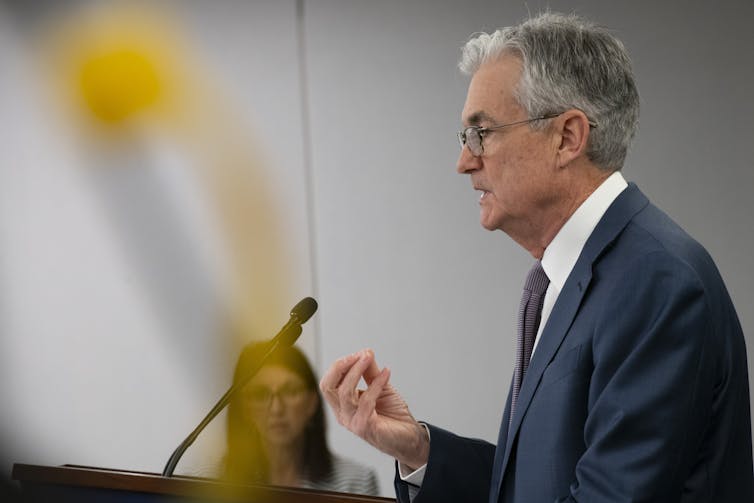
The Fed consists of a group of seven economists – collectively known as the Board of Governors – who have two key tools to affect monetary policy. The Board of Governors uses 12 regional banks of the Federal Reserve System to perform banking services.
The most well-known tool is the Fed’s ability to set short-term interest rates. When it lowers rates, the Fed aims to reduce borrowing costs for companies and consumers to encourage more lending and investment, thus stimulating the economy. It raises rates primarily when the economy is strong, when it wants to keep a lid on inflation.
The other key tool is its ability to buy and sell debt securities in open-market operations.
The Fed used this tool for the first time in 1923 ostensibly to stem a recession. By buying Treasury securities from private sellers, it was able to pump more money into the banking system, ensuring there was enough cheap credit for borrowers.
The Fed reimagined this powerful tool during the 2008 financial crisis, when it began a program of “quantitative easing” to buy longer-term, riskier debt. At the program’s peak in 2015, the Fed had accrued over US$4.5 trillion in both safe and riskier debt on its balance sheet.
The Fed’s plan to save the US
Financial markets have been in a panic since late February, when they began to reflect anxiety about the economic impact of the new coronavirus.
Since then, the Fed has engaged in a variety of actions to keep financial markets working and calm investors, including backstopping the commercial paper market and supporting money market funds.
It has also been using its two tools in more traditional ways.
The Fed used its first tool in dramatic fashion recently when it cut rates twice, first by half a percentage point and then by a full point, bringing its target rate to basically zero. Barring negative rates, there’s very little it can do to further stimulate the economy this way.
So it turned to its second tool and committed to essentially buy as many securities as necessary to stave off mass layoffs, debt defaults, bankruptcies and depression. This includes buying bundles of investment-grade corporate bonds, student loans and credit card debt for the first time.
As a result, the Fed’s balance sheet, which had fallen below $4 trillion last year, has now swelled to a new record of $4.7 trillion – and could double in size before it’s done, based on the new lending authority it’s being granted by the federal bailout.
Time will tell if this – alongside the $2 trillion in fiscal stimulus Congress is injecting – will be enough.
[Our newsletter explains what’s going on with the coronavirus pandemic. Subscribe now.]
Ryan Matthew Brewer, Associate Professor of Finance, Indiana University
This article is republished from The Conversation under a Creative Commons license. Read the original article.
- Details
- Written by: LAKE COUNTY NEWS REPORTS
During an inmate count at around 9:45 p.m. on March 27, staff discovered inmate Derek Barnett, 29 and Noah Wilson, 28 were not in their assigned bunks. A search of the camp buildings and grounds was immediately conducted, officials said.
CDCR said the men were last seen at approximately 8:30 p.m. Friday Both were wearing grey sweatshirts, grey sweat pants and white tennis shoes.
CDCR’s Office of Correctional Safety, Cal Fire, the California Highway Patrol and local law enforcement agencies have been notified and are assisting in the search.
Barnett was assigned as a porter and Wilson was assigned as a cook at the camp, which houses approximately 120 minimum-custody inmates.
CDCR told Lake County News that they are continuing to search for the two inmates, and asking people around the region to be on the lookout.
Barnett is a white male, 5 feet 10 inches tall, weighing 272 pounds with brown eyes, black hair, a mustache and goatee. He was received on Feb. 7, 2019, from Placer County, sentenced to four and eight months for possession of a firearm and vehicle theft. He was scheduled to parole in December.
Wilson is a white male, 5 feet 11 inches tall, weighing 200 pounds with hazel eyes, brown hair, a mustache and goatee, with a tattoo “Damaged” above his right eye. He was received from San Bernardino County on July 9, 2019, sentenced to four years for possession of a controlled substance for sale. He was scheduled to parole in April 2021.
Anyone who sees Barnett or Wilson should contact 911 or law enforcement authorities immediately.
Anyone having information about or knowledge of the location of Barnett or Wilson should contact the CCC watch commander at 530-257-2181, Extension 4173.
- Details
- Written by: Kathleen Scavone

LAKE COUNTY, Calif. – What can anyone do right now during the latest in a series of major disruptions in our lives that affect so very many, but act responsibly and curb all activities away from our homes if at all possible.
Somehow, knowing that “this too, shall pass” like all crises doesn't help most of us much when you add up the ripple-effect of the coronavirus: the cost in lives, the damages to businesses and the economy, as well as the losses of the rich threads of community that weave our lives together in 'normal' times.
Without sounding Pollyannaish, what we do have now though is our hope: hope that the mortality rate will soon drop and nature will balance out in the end, keeping our cherished families and friends safe.
We also have an innate ability to feed our inner strength, rather than nourish the triple beasts of dread, panic and fear.
Also, we have one another, and in the land of 21st-century technology many of us possess the ability to stay connected. And that connection is truly a gift.
Previous to the pandemic I was out on Highway 20 heading toward the Bureau of Land Management’s Cache Creek Wilderness Area.
Just before the Redbud Trailhead sign I was treated to a sighting of Lake County's herd of tule elk.
The big beasts were grazing on grasses along with the aquatic plants in the nearby pond.
Elk have been observed munching on manzanita berries, blue oak branches, oak leaves and scrub oak.
Elk avoid humans and will abandon their favorite grazing grounds if people approach too closely.
The elk herds appear to associate with horses, however, as they have been spotted together on different occasions grazing and even galloping along together, along with tossing their heads in concert with horses.
Deer and elk tend to avoid one another and keep to their own kind. I snapped a few photos of the tule elk and noted their scruffy coats, so I contacted Joshua Bush at the California Department of Fish and Wildlife and asked him about it.
“Overall their coats look pretty good; they can be much scruffier looking,” Bush said. “You are correct that they are not likely molting into their summer coats because it is too early. The disrupted patches of fur you are seeing are likely from rubbing to remove tick or other bugs and rubbing on vegetation in general."
Our tule elk are a native subspecies to California, which should be called super-elk, since they are the only type which can withstand desert conditions.
Smaller and lighter than their cousins the Roosevelt elk and Rocky Mountain elk, the tule elk's population was around half a million before European contact.
Then, they ranged from the Sierra Nevada hillsides to the Pacific Coast, and north to Shasta along with their southern population extending to Kern County.
After the California gold rush tule elk suffered habitat loss with the introduction of non-native plants.
Elk herds had to compete for food with the range cattle and other livestock that were introduced then.
Along with those devastating elk herd disruptions came unregulated hunting that further wiped out tule elk numbers, bringing them to near-extinction.
Thankfully, tule elk hunting was banned in 1873 by the State Legislature.
In 1874 a game warden, A. C Tibbett happened upon a breeding pair of tule elk on cattle rancher Henry Miller's land in the San Joquin Valley, thereby producing evidence that the elk had not been completely decimated as was the fear.
In the 1970s conservation measures for the tule elk were put into place to protect these stately animals.
Now, elk numbers are estimated at about 5,000 with 22 separate populations.
The growing elk population is a true gift, ours to enjoy.
Kathleen Scavone, M.A., is a retired educator, potter, freelance writer and author of “Anderson Marsh State Historic Park: A Walking History, Prehistory, Flora, and Fauna Tour of a California State Park” and “Native Americans of Lake County.”

- Details
- Written by: Lake County News reports
In 2006 the program expanded its service area to include older adults in all of Mendocino and Lake counties.
Each year it has responded to the questions of an average of 384 individuals, and approximately 293 of those annual inquirers have been first-time callers.
Now in its 14th year of speaking with older adults and their loved ones from Point Arena to Clearlake Oaks, Senior Information & Assistance is pleased to report that it has served over 4,000 unique individuals.
Funded through the Area Agency on Aging of Lake & Mendocino Counties, and with the longtime support of the T.R. Eriksen Foundation, Senior Information & Assistance not only offers referrals to callers about available programs and services for older adults, it also checks back with them to see if they were able to make a connection to those supports.
This followup component is one of the things that brings callers back to Community Care months and years later as new needs and questions arise.
To learn more about area resources for adults ages 60 and older, contact Senior Information & Assistance Monday through Friday, 8 a.m. to 5 p.m. by calling 707-468-5132 or 1-800-510-2020, or visit www.SeniorResourceDirectory.org .