 How to resolve AdBlock issue?
News
- Details
- Written by: Elizabeth Larson
The board will meet virtually beginning at 9 a.m. Tuesday, April 14, in the board chambers on the first floor of the Lake County Courthouse, 255 N. Forbes St., Lakeport.
The meeting can be watched live on Channel 8 and online on the county’s Facebook page or at https://countyoflake.legistar.com/Calendar.aspx. Accompanying board documents, the agenda and archived board meeting videos also are available at that link.
Because the meeting will be held virtually, members of the public are asked to submit comments on items to
At 9:06 a.m., the board will present proclamations designating the month of April 2020 as Sexual Assault Awareness Month in Lake County and the week of April 12 to 18, 2020 as National Public Safety Dispatcher Week.
At 9:10 a.m., Public Health Dr. Gary Pace will give the board his weekly update on the COVID-19 pandemic.
In an untimed item, Supervisor Rob Brown is asking the board to consider sending a letter to the US Small Business Administration in support of local tribal casinos being able to apply for assistance through the Paycheck Protection Program.
Currently, tribal government-owned gaming businesses and their employees are prevented from seeking economic support under the newly-established Paycheck Protection Program.
The board’s proposed letter said that rule “directly conflicts with both the text and overarching goals of the CARES Act,” also known as the Coronavirus Aid, Relief, and Economic Security Act.
Two board members, Chair Moke Simon and Supervisor EJ Crandell, are in the tribal leadership of Middletown Rancheria and Robinson Rancheria, respectively, which own casinos that are closed in response to state and local shelter in place orders.
In another untimed item, the board also will consider an urgency ordinance establishing a temporary exception to certain nuisance abatement notice requirements of Chapter 13 of the Lake County Code relating to the nuisance abatement process.
The urgency ordinance states: “For the period of April 15, 2020 through July 15, 2020, when the County Fire Official serves a Notice of Nuisance and Order to Abate pursuant to Section 13-62.1.2 of the Lake County Code as a result of a public nuisance caused by hazardous vegetation, the thirty (30) day period for the property owner to self abate described in that section shall be modified to provide that said notice shall order that hazardous vegetation must be abated within fifteen (15) days.”
The full agenda follows.
CONSENT AGENDA
5.1: Approve letter of support for Hope Rising’s Center for Transformation and authorize Supervisor Scott to sign on behalf of the board.
5.2: Approve minutes of the Board of Supervisors meetings from Jan. 7, Jan. 28, Feb. 4, Feb. 25 and March 17, 2020.
5.3: Approve budget transfer for capital asset improvements in the amount of $85,000 to pay Garland Co. for roofing materials and authorize the chair to sign.
5.4: Approve late travel claim for Mental Health Services Act Team Leader Carrie Manning in the amount of $216.81 and authorize the auditor-controller to process payment.
5.5: Adopt proclamation designating the month of April 2020 as Sexual Assault Awareness Month in Lake County.
5.6: Approve public nuisance abatement contracts for the following service vendors, (a) JDM Earthworks for an amount not to exceed $150,000, (b) Cook Construction Engineering Partnership for an amount not to exceed $150,000 and (c) Leonard’s Hauling Services for an amount not to exceed $200,000 and for a term from March 17, 2020, to June 30, 2022 and authorize chair to sign.
5.7: Adopt resolution accepting official canvass of the presidential primary election held on March 3, 2020, and declaring county supervisors duly elected.
5.8: Authorize the closure of the Eastlake Sanitary Landfill until the county of Lake Health officer rescinds the COVID-19 shelter-in-place order.
5.9: Approve agreement for Federal Apportionment Exchange Program and State Match Program for California Department of Transportation - Non MPO County, and authorize the chair to sign.
5.10: Adopt proclamation designating the week of April 12-18, 2020, as National Public Safety Dispatcher Week.
5.11: Approve first amendment to the contract between county of Lake and Lake Family Resource Center for Cal-Learn Teen Parenting Services in the amount of $50,000 for the term of July 1, 2019, to June 30, 2020, and authorize the chair to sign.
5.12: Adopt resolution approving the Standard Agreement #19-5042 between the county of Lake and California Department of Social Services for Resource Family Approval Program services and authorizing the director of Social Services to sign the standard agreement.
TIMED ITEMS
6.2, 9:06 a.m.: (a) Presentation of proclamation designating the month of April 2020 as Sexual Assault Awareness Month in Lake County; and (b) presentation of proclamation designating the week of April 12 to 18, 2020 as National Public Safety Dispatcher Week.
6.3, 9:10 a.m.: Consideration of update on COVID-19.
6.4, 9:30 a.m.: Public hearing: Continued from March 24, this item will be continued to May 19, appeal to Board of Supervisors, AB 19-03 for Minor Use Permit MUP 18-10 (Sandtner/Frey).
UNTIMED ITEMS
7.2: Consideration of letter to SBA in support of the needs of local tribes due to the COVID-19 crisis.
7.3: Consideration of proposed findings of fact and decision in the appeal of Lake County Local (AB -19-07).
7.4: Consideration of an urgency ordinance establishing a temporary exception to certain nuisance abatement notice requirements of Chapter 13 of the Lake County Code.
CLOSED SESSION
8.1: Conference with labor negotiator: (a) chief negotiator: M. Long; county negotiators: C. Huchingson and P. Samac; and (b) employee organizations: LCDDAA, LCDSA, LCCOA, LCEA, LCSEA and LCSMA.
8.2: Public employee evaluation: Public Health officer.
Email Elizabeth Larson at
- Details
- Written by: Raymond Scheppach, University of Virginia
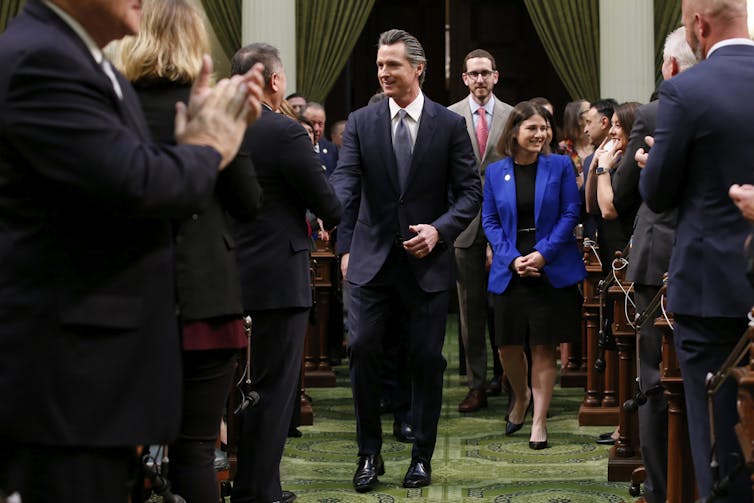
“Governors Have the Best Political Jobs in America” is the name of one of my lectures in a leadership course I occasionally teach at the University of Virginia.
In that class, I describe how governors have huge appointment powers for their personal staff, agency directors and even boards and commissions.
Governors dominate state legislatures, which are often part-time with few staff. They have substantial say over state budgets, which in 2019 ran from US$6.1 billion for a small state like New Hampshire to $311.3 billion for California.
When former governors Ronald Reagan, Bill Clinton and George W. Bush later became president and had to work with the U.S Congress, they wished they still had the line-item veto powers they had as governors, which allowed them to cut individual items in the budget passed by the legislature.
Today, as governors continue to provide leadership on the coronavirus crisis they are about to confront a second crisis, as their state’s fiscal positions will rapidly deteriorate. In my view, it will be as bad as the Great Recession of 2008 to 2009 and its aftermath.
I might call that lecture now “Governor, why did you want that job anyway?”
The magnitude of the fiscal crisis that governors and their states will have to face is just starting to emerge. And that crisis will affect states’ abilities to do everything from paying teachers to paving roads to providing social services.
Money in, money out
Total state spending in 2019 was about $2.1 trillion. In national summary figures, the largest state program is Medicaid, which is about 28.9% of total spending, substantially above the 19.5% for elementary and secondary education and the 10.1% for higher education. The other major spending is for transportation, which is about 8.1%.
The remaining 33.4% is for a catch-all category of smaller programs like the environment and economic development.
On the revenue side of the equation, which is also about $2.1 trillion, the three major taxes on sales, personal income and corporate income make up 40.8% of the total. Special fees and other taxes represent 28.5%. The federal government, through grants and contracts, contributes 30.7%.
There are five key components in understanding the seriousness of the challenge to states and their governors. They reflect the complex interplay between the federal and state levels of government, commercial activity and a state’s need for money to operate and provide services:
1. Rainy day funds will quickly evaporate
Before the pandemic hit, states collectively had built-up rainy day and other surpluses of $113.2 billion – an all-time high – amounting to 13% of their general fund spending in 2019. Governors thought they were prepared for the next economic downturn.
Unfortunately, these pots of money will likely be empty by the end of June 2020. This is because sales tax revenues began crashing as early as March.
That crash is continuing through the second quarter of the year, as people stop purchasing goods because restaurants, stores and bars are closed and as individuals practice social distancing. Once the revenue from sales taxes dives, states will be forced to turn to – and ultimately deplete – their rainy day funds.
2. Revenues will collapse
The Congressional Budget Office recently released its forecast that included the impact of the coronavirus pandemic. It indicated that economic activity will drop at least 7% in the second quarter and unemployment will exceed 10%.
Others are far more pessimistic. James Bullard, the President of the Federal Reserve Bank of St. Louis, said unemployment could reach 30% in the second quarter.
Masses of people no longer getting paychecks means a big drop in income tax revenue to states.
The three main state taxes on sales, personal and corporate income totaled $718.9 billion in revenues in 2019. During the Great Recession, the Pew Charitable Trusts estimates that states were denied about $283 billion in tax revenue they would normally receive between 2008 and 2013.
How much states will fail to collect in projected tax revenues this time will depend on the depth and length of the downturn. But it clearly will be deeper than the previous downturn.

3. Medicaid spending will explode
As mentioned earlier, Medicaid, a health-care program for low income individuals paid for by both federal and state governments, represents about 28.9% of total state spending.
Thirty-six states have already expanded eligibility of this program up to 140% of poverty (annual income of $17,486 for one person; $36,050 for a family of four) under the Affordable Care Act.
Now, as unemployment skyrockets, many people will have lost their employer-paid health insurance and will qualify for Medicaid if they are under the income threshold. That is an echo of what happened during the Great Recession, when an additional 6 million people – a 14% increase – came on to the Medicaid rolls.
In 2019 states spent $234 billion of their own revenues on medicaid so another 14% increase in the case load could cost over $30 billion per year extra. Far more people will come on the rolls this time, because the unemployment rate will be higher than the peak of 10.5% in the last downturn and the states have substantially expanded eligibility.
4. Governors will cut spending and increase taxes
State governments can’t spend more money than they bring in: 49 of the 50 states have some type of balanced budget requirement in law or in the state’s constitution. Sometimes that simply means that the governor has to submit a balanced budget. Other state mandates require balance to be maintained during the year.
You can already see governors taking action to meet this requirement. Gov. Steve Sisolak of Nevada just asked his state agencies to prepare for up to $687 million in budget cuts to his $14.7 billion budget. Gov. Jay Inslee of Washington is in the process of cutting his state’s $48.5 billion budget by $445 million.
States have not yet begun to raise taxes or fees but, in my view, that will come later.
5. Federal action will be required
The budget cuts and tax and fee increases that governors will be forced to make will weaken aggregate demand and the economy and make the economic downturn deeper and longer.
In the recently enacted Coronavirus Aid, Relief and Economic Security Act the federal government made $150 billion available for state and local governments.
But only the $30 billion in the Education Stabilization Fund created by the act will be to replenish state coffers by offsetting state revenue losses. The rest goes to local governments and to states for additional non-Medicaid health care and hospital costs incurred in the fight against the coronavirus.
States are looking to the federal government to include in its fourth relief package both a major increase in the federal contribution for Medicaid as well as a stabilization fund of $250 billion to assist states in filling the budget gap and buoy the economy.
Because the economy is so much larger now, that would be a contribution similar to the 2009 American Recovery and Reinvestment Act, which provided states with $147 billion in Medicaid and education funds.
The people’s judgment
The economic and public health crises facing states and their governors will have an impact in another realm: politics. In November, 2020 there will be 11 gubernatorial elections, with nine incumbents likely to be running for re-election.
The real test of leadership during the these twin crises will be reflected in the results of those elections.

Raymond Scheppach, Professor of Public Policy, University of Virginia
This article is republished from The Conversation under a Creative Commons license. Read the original article.
- Details
- Written by: LAKE COUNTY NEWS REPORTS
March also was rather soggy, continuing the nation’s wet streak for 2020, according to the National Oceanic and Atmospheric Administration's National Centers for Environmental Information.
Tragically, the nation has endured two billion-dollar weather and climate disasters this year, so far – in January and March.
Here are more highlights from NOAA’s latest monthly U.S. climate report.
Climate by the numbers March 2020
The average monthly temperature across the contiguous U.S. was 46.1 degrees Fahrenheit – 4.6 degrees above the 20th-century average – making it the 10th-hottest March on record.
Florida saw its warmest March on record, and 17 other states from Texas to New England tallied a top-10 warmest March.
The average precipitation last month across the contiguous U.S. was 2.83 inches – 0.32 of an inch above average – ranking in the wettest third of the 126-year climate record.
Above-average precipitation fell from the Southwest northeastward into the Great Lakes. Both Oklahoma and Texas had a top-10 wettest March.
Year to date and billion-dollar disasters
The average U.S. temperature for the year to date (January through March) was 39.3 degrees F (4.1 degrees above the 20th-century average), which ranked 8th-warmest on record.
The contiguous U.S. kicked off the year on a soggy note as well, with a year-to-date average rainfall of 8.02 inches — 1.06 inches above average.
Moreover, the U.S. saw two billion-dollar disasters since the beginning of the new year:
– From Jan. 10 to 12, widespread storms and flooding swept from the South to the Midwest, including tornadoes, severe flooding and coastal damage along the Great Lakes.
– During March 2 and 3, overnight tornadoes in and around Nashville, Tenn., killed dozens of people and left a long swath of collapsed buildings and destroyed properties.
More notable climate events in March
– The Bering Sea saw a record ice melt: The Bering Sea’s ice cover started the month above average, but southerly winds pushed warmer water and warmer temperatures into the region causing the largest drop in March ice extent on record.
– A snowy month for parts of Alaska: The Headquarters for Denali National Park and Preserve experienced its snowiest four-day period on record for March, with 32.6 inches of snow falling between March 23 and 26.
– U.S. drought conditions intensified: By the end of March, 14.5 percent of the contiguous U.S. was in drought, up from 11.5 percent at the beginning of the month.
- Details
- Written by: Kathleen Scavone

LAKE COUNTY, Calif. – Not your typical bunny, the rabbit that inhabits Lake County is the black-tailed jackrabbit.
But here's the confusing part – jackrabbits are really hares, according to National Geographic.
A hare, which is not a rabbit, is a relative within the mammalian order Lagomorpha.
One of the key differences between a hare and a rabbit is that a hare will freeze in place when threatened, while a rabbit will make a bee-line to its burrow to escape a predator.
The manikin-like pose that the hare assumes lasts until its attacker gets too close for comfort. Then, the hare will make use of its gangly-looking lengthy legs, which are truly lithe and nimble, and will swerve and outmaneuver – if it's lucky – its predator.
Originally jackrabbits were referred to as “jackass rabbits.” In fact, Mark Twain wrote of the subject in his book, “Roughing It.”
After a time, the moniker in the popular lexicon was changed to jackrabbit.
Another term in our lexicon is “harebrained,” meaning silly, juvenile or foolish, which originates from the critters being nervous and agitated when caged.
The saying, “mad as a March hare” came about because of hares' zany antics during their January to August mating season when they jump up, frolic and otherwise become “mad as a March hare.”
A female hare, called a jill, requires that the male, called a jack, chase her for miles to “prove” he is good paternal material. A jill will throw a punch at any male approaching her if she is not yet ready to mate.
Female jackrabbits can birth several litters a year, with between one and six kits, or baby rabbits.
Jackrabbits grow to reach a length of approximately two feet, and weigh in at three to six pounds.
Black-tailed jackrabbits are not the largest of the North American hares, since the antelope jackrabbit, along with the white-tailed jackrabbit hold the distinction of being larger animals.
Our jackrabbits have beige fur, speckled with black along with long, black-edged ears. The elongated ears can track sounds by pivoting like satellite dishes. This fine sense of hearing allows it to tune in more readily on its many predators, like coyote, bobcat and fox.
Jackrabbits work hard to defend themselves against predators by “screaming,” biting and kicking with their powerful hind feet.
They signal danger to other rabbits by thumping their feet, along with flashing the bright, white underside of their tails like a warning light.
Jackrabbits become more active in late afternoon and remain hidden in vegetation during the daylight hours.
Their diet consists mainly of grasses and shrubs. It is in the consumption of all of this plant matter that the jackrabbit obtains enough water to survive, requiring an equivalent water-to-body weight ratio to thrive.
Along with our black-tailed jackrabbits, there are five other species of jackrabbits that thrive in western and central North America.
Be sure to watch for these wild creatures and their Bugs Bunny antics this season.
Kathleen Scavone, M.A., is a retired educator, potter, freelance writer and author of “Anderson Marsh State Historic Park: A Walking History, Prehistory, Flora, and Fauna Tour of a California State Park” and “Native Americans of Lake County.”