 How to resolve AdBlock issue?
News
- Details
- Written by: Lake County News reports

CLEARLAKE, Calif. – A Clearlake man who posted bail after being arrested for a shooting earlier this week has been arrested again, with his bail raised at the request of prosecutors.
David Glenn Ford Jr., 25, was taken into custody again on Thursday, according to a report from Sgt. Ryan Peterson of the Clearlake Police Department.
Peterson said that at approximately midnight on Tuesday, officers responded to the 3200 block of Park Street for a report of a gunshot victim.
Based on the investigation it is believed that Ford, along with another person got into an argument with subjects near the 3300 block of 10th Street in Clearlake late on Monday night. Peterson said Ford and the other person then followed the subjects he was in an argument with to a residence in the 3200 block of Park Street, where the argument continued.
The resident of the home, a 54-year-old male, exited the house and confronted Ford. During this confrontation, Peterson said it is believed that Ford shot the resident and fled the scene with the other person whom he was with back to his residence on 10th Street.
Peterson said the shooting victim was transported to an out-of-county medical facility for treatment. As of this time, he is reported to be in stable condition.
Detectives from the Clearlake Police Department Investigations Bureau responded to the scene, Peterson said.
Peterson said detectives obtained a search warrant and during the execution of the search warrant, they ultimately arrested Ford on probable cause for attempted murder and assault on a person with a firearm.
He was booked into the Lake County Jail with his bail set at $250,000. Ford bailed from the Lake County Jail prior to any court proceedings, Peterson said.
After further review of the investigation, Peterson said the Lake County District Attorney’s Office requested a warrant for Ford’s arrest through the Lake County Superior Court with an increased bail set at $1,500,000.
On Thursday afternoon, Peterson said Clearlake Police officers located Ford in the area of Sixth Street in Clearlake, placed him under arrest for the warrant and booked him into the Lake County Jail.
As of Saturday, Ford remained in custody pending further court proceedings, which his booking sheet indicated will take place on Tuesday.
The investigation is ongoing and anyone with information is asked to contact Det. Leo Flores at 707-994-8251.
- Details
- Written by: LAKE COUNTY NEWS REPORTS
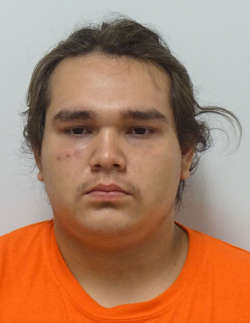
LAKE COUNTY, Calif. – Sheriff’s deputies have arrested a young Clearlake man who is charged with shooting another man following an argument.
Isreel Otter Sloan, 18, of Clearlake was arrested several hours after the incident occurred on the morning of Saturday, Aug. 8, according to Lt. Rich Ward of the Lake County Sheriff’s Office.
Ward said that at 12:44 a.m. Aug. 8, the Lake County Sheriff’s Office responded to the 17000 block of Holly Way in Spring Valley, east of Clearlake Oaks, for a report of several subjects having a party where suspected gunfire was heard.
While en route, Central Dispatch advised deputies a gunshot victim was being transported in a white Honda to Adventist Health in Clearlake, Ward said.
Deputies located the white Honda and gunshot victim near the intersection of Highway 20 and Spring Valley Road. Ward said medics were on scene treating a male adult for a suspected gunshot wound to their leg.
The victim was transported by medics to Adventist Health and later transported via air ambulance to an out-of-county trauma center, he said.
Ward said deputies obtained statements from the driver of the Honda and victim. Deputies learned the shooting took place at a residence in the 2600 block of River View Road in Clearlake Oaks.
The son of the Honda driver and several of his friends arrived at the residence in a dark-colored Jeep. Ward said the victim was involved in an argument with the subjects in an attempt to get them to leave.
While walking back into the residence, the victim heard a single gunshot and was struck in the leg. Ward said the subjects in the Jeep fled the scene, damaging a wooden fence post near the front of the residence.
Deputies responded to the residence on River View Road and processed the scene. They obtained additional statements from residents and neighbors as well as potential identifying information regarding the subjects who fled in the dark-colored Jeep, Ward said.
He said the deputies obtained an address for one of the suspects in the 14000 block of Uhl Avenue in Clearlake.
Deputies responded to the Uhl Avenue address and located a blue-colored Jeep Cherokee associated with the residence. Ward said the deputies noticed damage to the Jeep and white paint transfer, which caused them to suspect the Jeep was involved in damaging the Clearlake Oaks address fence post where the victim was shot.
The residents advised deputies the individuals they were looking for were inside the basement of the home. Deputies located and spoke with several subjects who admitted being at the River View Road residence where the shooting occurred. They also admitted to leaving in the Jeep Cherokee, Ward said.
The deputies also located two firearms, one of which had the serial numbers removed, according to Ward’s report.
After speaking with several of the subjects and parties associated with the Jeep, deputies developed probable cause to arrest Sloan, Ward said.
Ward said Sloan was transported to the Hill Road Correctional Facility where he was booked for discharge of a firearm from a vehicle, willful discharge of a firearm in a negligent manner, assault with a firearm on a person, battery on a person causing serious bodily injury, changing, altering or removing serial numbers from a firearm and obstructing, and resisting or delaying a peace officer in the performance of their duties.
Sloan’s bail was set at $50,000 and he later was released, according to jail records.
This investigation is ongoing and the Lake County Sheriff’s encourages anyone with information pertaining to this case to contact Det. Sgt. John Gregore at Central Dispatch nonemergency line, 707-263-2690, or email
- Details
- Written by: Lake County News reports
Also included in the list is a $9.5 million allocation for safety improvements on Highway 20 near Witter Springs Road in Lake County.
“Our maintenance and construction crews remain hard at work improving California’s transportation infrastructure,” said Caltrans Director Toks Omishakin. “The $1.6 billion allocated will allow the department to continue with critical repairs and upgrades to roads and highways, and will support thousands of jobs that are essential for our economy.”
In addition to the Lake County project, other District 1 funding allocations include:
– Approximately $24 million for roadway rehabilitation on U.S. Highway 101 from south of the Fields Landing Overhead Bridge to north of the Herrick Avenue Overcrossing near Eureka in Humboldt County.
– Approximately $15.5 million for safety improvements on Highway 299 from east of Cedar Creek Road to a mile west of the Highway 96 junction in Humboldt County.
– Approximately $13.8 million for wastewater improvements along U.S Highway 101 at the Moss Cove Safety Roadside Rest Area near Laytonville in Mendocino County.
The California Transportation Commission also approved more than $118 million in funds for rail and mass transit projects, including freight, intercity rail and bus services. This allocation expands access to public transportation and helps reduce greenhouse gas emissions and traffic congestion.
This investment includes $77 million for the Trade Corridor Enhancement Program, which is dedicated to projects that enhance the movement of goods along corridors with high freight volume by making improvements to state highways, local roads, freight rail systems, port facilities and truck corridors.
In addition, the California Transportation Commission approved nearly $14 million for 17 projects that will improve bicycle and pedestrian overcrossings, repair sidewalks and bike lanes, and provide safer routes to school for children.
Project funding is derived from federal and state gas taxes, including $1.2 billion from Senate Bill (SB) 1, the Road Repair and Accountability Act of 2017. The state’s portion of SB 1 funds are used for the ongoing maintenance and rehabilitation of the State Highway System.
By 2027, these funds will enable Caltrans to fix more than 17,000 lane miles of pavement, 500 bridges, 55,000 culverts, and 7,700 traffic operating systems that help reduce highway congestion, such as ramp meters, traffic cameras and electric highway message signs.
For details on SB 1, visit Rebuilding California - Senate Bill 1.
- Details
- Written by: Mara Johnson-Groh
A special type of aurora, draped east-west across the night sky like a glowing pearl necklace, is helping scientists better understand the science of auroras and their powerful drivers out in space.
Known as auroral beads, these lights often show up just before large auroral displays, which are caused by electrical storms in space called substorms.
Previously, scientists weren’t sure if auroral beads are somehow connected to other auroral displays as a phenomenon in space that precedes substorms, or if they are caused by disturbances closer to Earth’s atmosphere.
But powerful new computer models combined with observations from NASA’s Time History of Events and Macroscale Interactions during Substorms – THEMIS – mission have provided the first strong evidence of the events in space that lead to the appearance of these beads, and demonstrated the important role they play in our near space environment.
“Now we know for certain that the formation of these beads is part of a process that precedes the triggering of a substorm in space,” said Vassilis Angelopoulos, principal investigator of THEMIS at the University of California, Los Angeles. “This is an important new piece of the puzzle.”
By providing a broader picture than can be seen with the three THEMIS spacecraft or ground observations alone, the new models have shown that auroral beads are caused by turbulence in the plasma – a fourth state of matter, made up of gaseous and highly conductive charged particles – surrounding Earth.
The results, recently published in the journals Geophysical Research Letters and Journal of Geophysical Research: Space Physics, will ultimately help scientists better understand the full range of swirling structures seen in the auroras.
“THEMIS observations have now revealed turbulences in space that cause flows seen lighting up the sky as of single pearls in the glowing auroral necklace," said Evgeny Panov, lead author on one of the new papers and THEMIS scientist at the Space Research Institute of the Austrian Academy of Sciences. “These turbulences in space are initially caused by lighter and more agile electrons, moving with the weight of particles 2000 times heavier, and which theoretically may develop to full-scale auroral substorms.”
Mysteries of auroral beads formation
Auroras are created when charged particles from the Sun are trapped in Earth’s magnetic environment – the magnetosphere – and are funneled into Earth’s upper atmosphere, where collisions cause hydrogen, oxygen, and nitrogen atoms and molecules to glow.
By modelling the near-Earth environment on scales from tens of miles to 1.2 million miles, the THEMIS scientists were able to show the details of how auroral beads form.
As streaming clouds of plasma belched by the Sun pass Earth, their interaction with the Earth’s magnetic field creates buoyant bubbles of plasma behind Earth.
Like a lava lamp, imbalances in the buoyancy between the bubbles and heavier plasma in the magnetosphere creates fingers of plasma 2,500 miles wide that stretch down towards Earth. Signatures of these fingers create the distinct bead-shaped structure in the aurora.
“There's been a realization that, all summed up, these relatively little transient events that happen around the magnetosphere are somehow important,” said David Sibeck, THEMIS project scientist at NASA’s Goddard Space Flight Center in Greenbelt, Maryland. “We have only recently gotten to the point where computing power is good enough to capture the basic physics in these systems.”
Now that scientists understand the auroral beads precede substorms, they want to figure out how, why and when the beads might trigger full-blown substorm.
At least in theory, the fingers may tangle magnetic field lines and cause an explosive event known as magnetic reconnection, which is well known to create full-scale substorms and auroras that fill the nightside sky.
New models open new doors
Since its launch in 2007, THEMIS has been taking detailed measurements as it passes through the magnetosphere in order to understand the causes of the substorms that lead to auroras. In its prime mission, THEMIS was able to show that magnetic reconnection is a primary driver of substorms.
The new results highlight the importance of structures and phenomenon on smaller scales – those hundreds and thousands of miles across as compared to ones spanning millions of miles.
“In order to understand these features in the aurora, you really need to resolve both global and smaller, local scales. That's why it was so challenging up to now,” said Slava Merkin, co-author on one of the new papers and scientist at NASA’s Center for Geospace Storms headquartered at Johns Hopkins University Applied Physics Laboratory in Laurel, Maryland. “It requires very sophisticated algorithms and very big supercomputers.”
The new computer simulations almost perfectly match THEMIS and ground observations. After the initial success of the new computer models, THEMIS scientists are eager to apply them to other unexplained auroral phenomena. Particularly in explaining small-scale structures, computer models are essential as they can help interpret what happens in between the spaces where the three THEMIS spacecraft pass.
“There’s lots of very dynamic, very small-scale structures that people see in the auroras which are hard to connect to the larger picture in space since they happen very quickly and on very small scales,” said Kareem Sorathia, lead author on one of the new papers and scientist at NASA’s Center for Geospace Storms headquartered at Johns Hopkins Applied Physics Laboratory. “Now that we can use global models to characterize and investigate them, that opens up a lot of new doors.”
Mara Johnson-Groh works for NASA's Goddard Space Flight Center in Greenbelt, Maryland.