How to resolve AdBlock issue?
News
- Details
- Written by: Elizabeth Larson
The hearings are scheduled for 9 a.m. Wednesday, Sept. 16, and will continue on Thursday, Sept. 17, if necessary.
The supervisors will meet in the board chambers on the first floor of the Lake County Courthouse, 255 N. Forbes St., Lakeport, for a hybrid meeting format which also will include the opportunity for community members to continue to participate virtually.
The meeting can be watched live on Channel 8, online at https://countyoflake.legistar.com/Calendar.aspx and on the county’s Facebook page. Accompanying board documents, the agenda and archived board meeting videos also are available at that link.
To participate in real-time, join the Zoom meeting Sept. 16 by clicking this link at 9 a.m. The meeting ID is 932 2053 1970, password 301945.
For the Sept. 17 meeting, join by clicking this link. The meeting ID is 921 6335 9913, password 258258.
To submit a written comment on any agenda item please visit https://countyoflake.legistar.com/Calendar.aspx and click on the eComment feature linked to the meeting date. If a comment is submitted after the meeting begins, it may not be read during
the meeting but will become a part of the record.
In her memo to the board, County Administrative Officer Carol Huchingson reported that the final recommended budget for the new fiscal year totals approximately $292,261,503, which represents an increase of $34,012,659 when compared to the Fiscal year 2019-20 Adopted Budget amount of $258,248,844.
“In light of the COVID-19 pandemic, this recent cycle of budget preparation has been quite unusual,” Huchingson wrote.
Huchingson said that in late March the board approved staff’s recommendation to make changes to the scheduled budget hearings for this fiscal year cycle and to flip the extended budget hearing process – during which the board receives detailed presentations from county department heads – from the recommended budget to the final recommended budget.
While staff previously had informed the board of potential impacts from the COVID-19 crisis, Huchingson said the county has begun to receive federal CARES Act funding and state realignment backfill, which is helping alleviate some of the financial pressure.
Huchingson said that at the time of the recommended budget discussions in June, the board contemplated 10-percent cuts to county departments in anticipation of negative financial impacts resulting from the pandemic.
“Absent CARES Act and Realignment Backfill, the County would be facing dire financial circumstances with likely reductions to staffing and services the public relies upon,” said Huchingson.
Out of an abundance of caution, Huchingson said general fund departments have been held to the same net county cost in Fiscal Year 2020-21 as they received in FY 2019-20.
Email Elizabeth Larson at
- Details
- Written by: BETSY LADYZHETS
For the first time since America’s COVID-19 outbreak started, a federal public health agency released county-level testing data.
On Sept. 3, the Centers for Medicare & Medicaid Services, or CMS, published a dataset showing COVID-19 test positivity rates broken out by U.S. county.
While this dataset has not been highly publicized, it provides key information about the state of COVID-19 testing and outbreak control across the country, as originally reported by Stacker Media.
A test positivity rate describes the percentage of tests conducted in a particular area that return a positive result. For example, if 1,000 people in a New York county are tested for COVID-19 in a particular week and 10 of those people test positive, the county would have a positivity rate of 1%. Meanwhile, if 25 people in an Oklahoma county are tested and 5 test positive, the test positivity rate for that county is 20%.
These positivity rates are typically reported for a short period of time, either one day or one week, and are used to reflect a region’s testing capacity over time. If a region has a higher positivity rate, that likely means either many people there have COVID-19, the region does not have enough testing available to accurately measure its outbreak, or both. If a region has a lower positivity rate, on the other hand, that likely means a large share of the population has access to testing, and the region is diagnosing a more accurate share of its infected residents.
Test positivity rates are often used as a key indicator of how well a particular region is controlling its COVID-19 outbreak. The World Health Organization recommends a test positivity rate of 5% or lower. This figure, and a more lenient benchmark of 10%, have been adopted by school districts looking to reopen and states looking to restrict out-of-state visitors as a key threshold that must be met.
Stacker has visualized the positivity rates reported by the CMS. These figures reflect average weekly test positivity for the week of Aug. 27 to Sept. 2. CMS has categorized counties according to their positivity rates:
Green: test positivity under 5% in the past week (or with fewer than 10 tests in the past week).
Yellow: test positivity between 5% and 10% in the past week.
Red: test positivity greater than 10% in the past week.
The new data showed that Lake County, California, was in the yellow category of between 5 and 10 percent for that week, which aligns with positivity rates reported by Lake County Public Health for that week.
The visualizations also include state-level positivity rates for the same time period, sourced from the COVID Tracking Project at The Atlantic, and county-level case and death counts from the most recent week of data available (Sept. 3 to Sept. 9), sourced from the New York Times COVID-19 data repository.
Stacker
- Details
- Written by: Lake County News reports
The virtual town hall will take place from 7 to 8 p.m. Thursday, Sept. 17.
Thompson will be joined by special guest Rep. Kathy Castor (FL-14), chair of the House Select Committee on the Climate Crisis, for a climate change discussion.
This is the 14th in a series of virtual town halls. All constituents of California’s Fifth Congressional District and members of the press are invited to join.
This event will be held over Zoom and interested participants must email
Interested participants should include their name, their email and their city of residence. They will be notified via email with instructions on how to join.
The event will also be streamed on Facebook Live via Thompson’s page.
Thompson represents California’s Fifth Congressional District, which includes all or part of Contra Costa, Lake, Napa, Solano and Sonoma counties.
- Details
- Written by: Lake County News reports
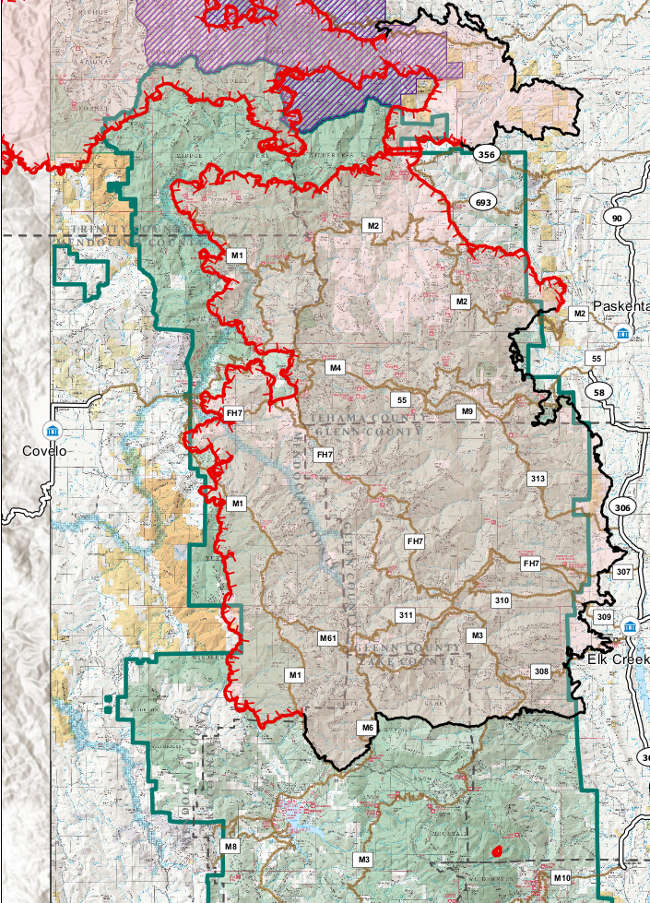
As of Monday, the August Complex was at 755,603 acres with 30-percent containment, the US Forest Service reported.
It is the largest wildland fire in recorded California history, surpassing the second-largest – the 2018 Mendocino Complex – by nearly 300,000 acres.
Officials said Monday that the acreage of the August Complex has decreased by about 22,000 acres due to more accurate mapping and establishing management zones.
The US Forest Service and Cal Fire are engaged in a coordinated response to manage and suppress the August Complex, which complex consists of multiple fires that have burned together over the past month on the Mendocino, Shasta-Trinity and Six Rivers National Forests.
The complex has been divided into the North, South and West Zones for management purposes.
Officials said Monday that firefighters are continuing to mop up all along the fire’s perimeter utilizing both ground and aerial resources. Some of this work is being conducted by the 14th Brigade Engineer Battalion from Joint Base Lewis-McChord in Washington.
A dozer line is being completed around the Salt Creek Conservation Camp and may be followed by a burnout if necessary to help protect the area, officials said.
A structure protection group has been established in the Pillsbury Lake Basin to help protect infrastructure. This includes installing hose lays, supplying water dip tanks for helicopters and putting in dozer lines where appropriate. Crews will continue to patrol and monitor containment lines throughout the fire area, officials reported.
The fire crossed containment lines in the Yuki Wilderness Sunday and made a run to the west.
Firefighters worked on suppression efforts in that area Monday to contain the fire. Officials said crews are working closely with resource advisors in the wilderness to reduce suppression impacts.
Because of winds, high temperatures and dry fuels, officials said fire activity is expected to remain high.
New evacuations were issued Sunday night in Mendocino County. Additional evacuation orders are in effect for Mendocino, Lake, Humboldt and Trinity counties. More information on evacuations is available here.