How to resolve AdBlock issue?
News
- Details
- Written by: NATIONAL AERONAUTICS AND SPACE ADMINISTRATION
The Sun is stirring from its latest slumber. As sunspots and flares, signs of a new solar cycle, bubble from the Sun’s surface, scientists wonder what this next cycle will look like.
The short answer is, probably a lot like the last — that is, the past 11 years of the Sun’s life, since that’s the average length of any given cycle.
But the longer story involves a panel of experts that meets once a decade, a fleet of Sun-studying satellites, and dozens of complicated models — all revolving around efforts to understand the mystifying behavior of the star we live with.
NASA scientists study and model the Sun to better understand what it does and why. The Sun has its ups and downs and cycles between them regularly. Roughly every 11 years, at the height of this cycle, the Sun’s magnetic poles flip — on Earth, that’d be like if the North and South Poles swapped places every decade — and the Sun transitions from sluggish to active and stormy. At its quietest, the Sun is at solar minimum; during solar maximum, the Sun blazes with bright flares and solar eruptions.
Solar cycle predictions give a rough idea of what we can expect in terms of space weather, the conditions in space that change much like weather on Earth. Outbursts from the Sun can lead to a range of effects, from ethereal aurora to satellite orbital decay, and disruptions to radio communications or the power grid.
NOAA’s Space Weather Prediction Center is the U.S. government’s official source for space weather forecasts, watches, warnings, and alerts: With accurate predictions, we can prepare.
The work that researchers at NASA and around the world do to advance our solar activity models helps improve those forecasts. In turn, solar cycle forecasts give us a sense of how stormy the Sun will be over the next 11 years and how much radiation spacecraft and astronauts may face during heavy bouts of solar activity.
Modeling the Sun is a tricky business because scientists don’t fully understand the internal churning that causes this magnetic flip-flop. Computer models use equations to represent the Sun, but the star manages to elude them. If the Sun were a machine, it would have countless knobs and dials whose functions and sensitivities remain unknown.
“Over the last 40 years, we’ve come to observe the Sun in much greater detail,” said Lika Guhathakurta, program scientist of the Heliophysics Division at NASA Headquarters. “It’s produced a wealth of information, but quantifying and modeling the solar cycle remains challenging. We’re working against how variable the Sun is, and the complexity of what happens inside the Sun.”
Without fully understanding how the magnetic field, which drives solar activity, moves inside the Sun, scientists have to make some assumptions. The plight of solar modelers could be likened to that of weather forecasters — if they tried to forecast the weather by looking at just the upper atmosphere, and not the critical layers below.
There are many approaches to modeling the Sun in order to develop solar cycle predictions. Some models use ground-based observations spanning hundreds of years; others may use satellite data, which has only been available for the past four decades or so.
In recent years, some researchers have incorporated machine-learning tactics. Models may focus on different precursors scientists have identified are linked to solar activity: Earth’s magnetic field, which responds to the Sun’s, and the strength of the magnetic field at the Sun’s poles are most common.
“Part of the scientific process is whittling these questions down, and working in parallel on the same problem in different ways,” said Maria Weber, an astrophysicist at Delta State University in Cleveland, Mississippi. Each model is one tool among many. “We might find there are different tools that can get us the same outcome, and then you could pick the type that best suits you.”
It’s the job of the Solar Cycle Prediction Panel — co-sponsored by NASA and NOAA, the National Oceanic and Atmospheric Administration — to evaluate all of these models and release an official prediction representing the scientific community’s best efforts.
Meeting every decade since 1989, the panel brings together experts from around the world, including Weber, who served on the panel for Solar Cycle 25. The discussions are known to occasionally get heated, a sign of the complex task at hand and the fervor each scientist has for their favorite models.
In the end, the scientists wrote their predictions on a little piece of paper, Weber said, and the debating began. “Ultimately, we all had to agree, whittling down and adjusting our estimates, so that people felt it best reflected everything we knew up to that point,” she said.
In March 2019, only the fourth time such a panel had convened, the 12 experts considered some 60 different models. In recent years, one seems to be especially successful: the polar magnetic field model. This uses measurements of the magnetic field at the Sun’s north and south poles. The idea is that the magnetic field at the Sun’s poles acts like a seed for the next cycle. If it’s strong during solar minimum, the next solar cycle will be strong; if it’s diminished, the next cycle should be too.
Together, they predicted dates for Cycle 25’s start and peak, and the peak sunspot number, an indicator of how strong the cycle will be. The more sunspots, the higher the sunspot number, and the more solar eruptions a cycle is expected to unleash.
Currently, the Sun’s poles are about as strong as they were at the same point in the last solar cycle, which scientists interpret as signs that Solar Cycle 25 will play out in similar fashion to Cycle 24. Solar Cycle 24 was a feeble cycle, peaking at 114 sunspots (the average is 179). Solar Cycle 25 is now underway and expected to peak with 115 sunspots in July 2025.
Lisa Upton, co-chair of the Solar Cycle 25 Prediction Panel and solar physicist at Space Systems Research Corporation in Westminster, Colorado, compared their task to hurricane forecasting. Meteorologists often consult several models, each spitting out its own possible path a hurricane could take.
“One of the lessons there is you don’t put too much faith in one model, but see what all of the models together can tell you and teach you,” Upton said. As a whole, a group of predictions is more likely to land on the right path.
Some have taken novel approaches to making these predictions. Scientists recently published a new way to survey the solar cycle: Instead of the traditional linear view of time, they used a mathematical technique to map the last 18 solar cycles onto a circle. What emerged was a more orderly pattern of behavior than expected from the Sun.
Their so-called solar clock is like a typical clock, where each roughly 11-year cycle can be described over 12 hours. Instead of the time of day, certain “times” correspond to high solar activity. Right now, the scientists say, it’s about 3 o’clock, near the first uptick in activity that comes at the beginning of each solar cycle. The scientists reported their findings in Geophysical Research Letters.
“The most active Sun — in terms of solar eruptions — happens between 5:30 and about 10:00, when there’s a sharp drop-off in activity as the Sun moves toward minimum,” said Robert Leamon, a solar scientist on the study, based at NASA’s Goddard Space Flight Center in Greenbelt, Maryland. “Once we know where we are on the solar clock and can calculate the speed of the cycle we’re in, we can make much more precise predictions about when the next cycle of solar activity will start and stop.”
According to their clock, the Sun’s next quiet period will begin around the first half of 2027.
If Solar Cycle 25 meets the panel’s predictions, it should be weaker than average. Cycle 25 is also expected to end a longer trend over the past four decades, in which the magnetic field at the Sun’s poles were gradually weakening.
As a result, the solar cycles have been steadily weaker too. If Solar Cycle 25 sees an end to this waning, it would quell speculations that the Sun might enter a grand solar minimum, a decades-to-centuries long stretch of little solar activity.
The last such minimum — known as the Maunder minimum — occurred in the middle of what’s known as the Little Ice Age from the 13th to 19th centuries, causing erroneous beliefs that another grand minimum could lead to global cooling.
“There is no indication that we are currently approaching a Maunder-type minimum in solar activity,” Upton said. But even if the Sun dropped into a grand minimum, there’s no reason to think Earth would undergo another Ice Age; not only do scientists theorize that the Little Ice Age occurred for other reasons, but in our contemporary world, greenhouse gases far surpass the Sun’s effects when it comes to changes in Earth’s climate.
Eventually, scientists would like to issue weekly forecasts for the Sun, just like meteorologists do for Earth. But solar cycle and space weather forecasting have far to go. There are still questions about the Sun’s interior to answer and important data to collect.
“One of the things that’s exciting about being a solar physicist is that we’re at the forefront of this — there’s still all these questions that have yet to be answered,” Upton said. “There are still a lot of rocks to unturn.”
Solar Cycle 25 will continue to unfold, and scientists will keep tinkering with their models and watching to see how close their predictions come. It will be another five to six years before they can say who was right — or wrong — all along.
Lake County Fair Board cancels Lakeport Speedway contract with NCRA; work underway to resolve issues
- Details
- Written by: Elizabeth Larson

LAKE COUNTY, Calif. – The Lake County Fair Board has canceled its contract with the Northern California Racing Association for the Lakeport Speedway, a move that the fair’s CEO said is meant to allow the fair to pursue a new contract for the track’s operation.
Fair CEO Sheli Wright said the Fair Board of Directors took the action at its Sept. 8 meeting after reviewing the current contract with NCRA for operating the Lakeport Speedway.
Wright said that the fair board, taking into consideration NCRA’s ongoing complaints about the speedway contract, voted unanimously to cancel the contract “in the hopes of meeting changing times and current needs.”
Dan Camacho, NCRA’s president-elect who takes office on Jan. 1, said the fair gave NCRA a 30-day notice on Tuesday.
He said the contract between NCRA and the fair has had some issues that need to be resolved and that the fair is trying to figure out a way to work with the association.
The news of the contract’s cancellation has upset local racers and racing enthusiasts, including Mike Sullivan, the speedway’s 2020 modified champion, who on Facebook criticized the decision, noting the work he and others have put into the facility.
Sullivan said he, his employees and “a very dedicated group of NCRA members as well have all busted their butts to make everything so much better after it was left and such state disarray,” referring to change in track management that took place in 2019.
On the NCRA Facebook page on Friday, the association posted an update in response to community concerns, explaining that it had requested the fair extend the contract. However, “due to the way the contract was written and errors that were beyond our control unfortunately the best option for the fairgrounds was to null the contract and given [sic] us our 30 notice. At this time the fairgrounds is working with us to get the situation resolved. We appreciate everyone’s support right now! We will keep everyone posted as the situation changes.”
Wright emphasized that the Lakeport Speedway is not closing, noting that the fair board waited until after NCRA completed its race series before voting to give notice.
“The directors believe this is the first step in the process of acquiring a new contract that could be beneficial to both the fair and appealing to the local racers,” Wright said.
She said canceling the contract does not preclude NCRA getting another contract, it’s just a cancellation of this particular contract which was scheduled to end in December of this year.
Race season is usually through October. This year, however, NCRA gave notice that their last race of the season would be Sept. 12, Wright said.
The speedway’s season didn’t get underway until late May, when Lake County Public Health Officer Dr. Gary Pace let them go forward with “test and tune” practice sessions, as Lake County News has reported.
Camacho said that the speedway wasn’t allowed to have anyone in the stands this year, but instead live-streamed the races on Facebook.
Over the summer months of racing, Camacho said viewership grew until, by the last race, they had 3,600 viewers.
“It was actually a lot of fun,” Camacho said of the live-streamed races.
The challenges NCRA faced this year due to COVID-19 followed major changes in 2019, when the speedway underwent a change in promoters.
As for next steps, Wright told Lake County News that the fair board isn’t yet sure of what process it will follow.
Camacho also said he didn’t know when talks might open with the fair for a new speedway contract.
However, there appears to be plenty of time to work out a new contract between the fair and NCRA, whose season in 2021 is expected to start in April or May, Camacho said.
“I think we have a good relationship with the fairgrounds,” and there are just a few things that need to be worked out, Camacho said.
At this point, Camacho said NCRA isn’t getting indications from Public Health about whether they could once again have live audiences when the racing season opens in the spring.
Email Elizabeth Larson at
- Details
- Written by: Jonathan Entin, Case Western Reserve University
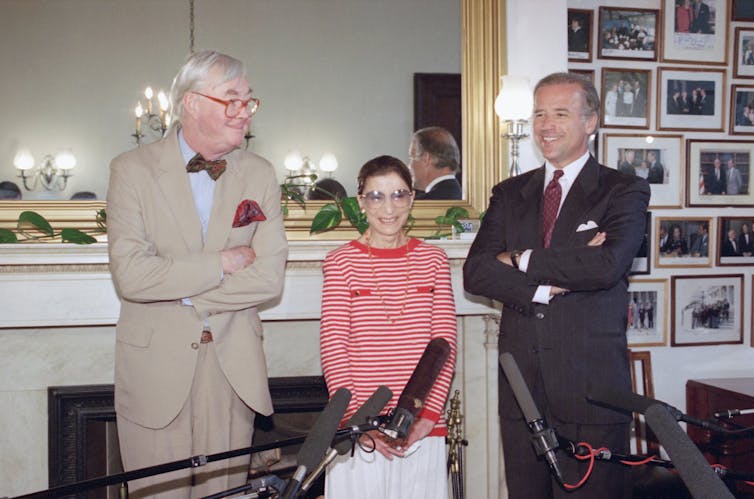 Judge Ruth Bader Ginsburg paying a courtesy call on Sen. Daniel Patrick Moynihan, D-N.Y., left, and Sen. Joseph Biden, D-Del., in June 1993, before her confirmation hearing for the Supreme Court. AP/Marcy Nighswander
Justice Ruth Bader Ginsburg died on Friday, the Supreme Court announced.
Chief Justice John Roberts said in a statement that “Our nation has lost a jurist of historic stature.”
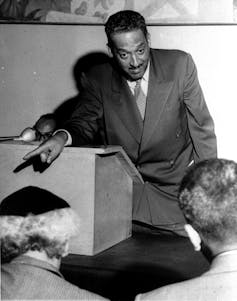
Even before her appointment, she had reshaped American law. When he nominated Ginsburg to the Supreme Court, President Bill Clinton compared her legal work on behalf of women to the epochal work of Thurgood Marshall on behalf of African-Americans.
The comparison was entirely appropriate: As Marshall oversaw the legal strategy that culminated in Brown v. Board of Education, the 1954 case that outlawed segregated schools, Ginsburg coordinated a similar effort against sex discrimination.
Decades before she joined the court, Ginsburg’s work as an attorney in the 1970s fundamentally changed the Supreme Court’s approach to women’s rights, and the modern skepticism about sex-based policies stems in no small way from her lawyering. Ginsburg’s work helped to change the way we all think about women – and men, for that matter.
I’m a legal scholar who studies social reform movements and I served as a law clerk to Ginsburg when she was an appeals court judge. In my opinion – as remarkable as Marshall’s work on behalf of African-Americans was – in some ways Ginsburg faced more daunting prospects when she started.
Starting at zero
When Marshall began challenging segregation in the 1930s, the Supreme Court had rejected some forms of racial discrimination even though it had upheld segregation.
When Ginsburg started her work in the 1960s, the Supreme Court had never invalidated any type of sex-based rule. Worse, it had rejected every challenge to laws that treated women worse than men.
For instance, in 1873, the court allowed Illinois authorities to ban Myra Bradwell from becoming a lawyer because she was a woman. Justice Joseph P. Bradley, widely viewed as a progressive, wrote that women were too fragile to be lawyers: “The paramount destiny and mission of woman are to fulfil the noble and benign offices of wife and mother. This is the law of the Creator.”
And in 1908, the court upheld an Oregon law that limited the number of hours that women – but not men – could work. The opinion relied heavily on a famous brief submitted by Louis Brandeis to support the notion that women needed protection to avoid harming their reproductive function.
As late as 1961, the court upheld a Florida law that for all practical purposes kept women from serving on juries because they were “the center of the home and family life” and therefore need not incur the burden of jury service.
Challenging paternalistic notions
Ginsburg followed Marshall’s approach to promote women’s rights – despite some important differences between segregation and gender discrimination.
Segregation rested on the racist notion that Black people were less than fully human and deserved to be treated like animals. Gender discrimination reflected paternalistic notions of female frailty. Those notions placed women on a pedestal – but also denied them opportunities.
Either way, though, Black Americans and women got the short end of the stick.
Ginsburg started with a seemingly inconsequential case. Reed v. Reed challenged an Idaho law requiring probate courts to appoint men to administer estates, even if there were a qualified woman who could perform that task.
Sally and Cecil Reed, the long-divorced parents of a teenage son who committed suicide while in his father’s custody, both applied to administer the boy’s tiny estate.
The probate judge appointed the father as required by state law. Sally Reed appealed the case all the way to the Supreme Court.
Ginsburg did not argue the case, but wrote the brief that persuaded a unanimous court in 1971 to invalidate the state’s preference for males. As the court’s decision stated, that preference was “the very kind of arbitrary legislative choice forbidden by the Equal Protection Clause of the 14th Amendment.”
Two years later, Ginsburg won in her first appearance before the Supreme Court. She appeared on behalf of Air Force Lt. Sharron Frontiero. Frontiero was required by federal law to prove that her husband, Joseph, was dependent on her for at least half his economic support in order to qualify for housing, medical and dental benefits.
If Joseph Frontiero had been the soldier, the couple would have automatically qualified for those benefits. Ginsburg argued that sex-based classifications such as the one Sharron Frontiero challenged should be treated the same as the now-discredited race-based policies.
By an 8–1 vote, the court in Frontiero v. Richardson agreed that this sex-based rule was unconstitutional. But the justices could not agree on the legal test to use for evaluating the constitutionality of sex-based policies.
Strategy: Represent men
In 1974, Ginsburg suffered her only loss in the Supreme Court, in a case that she entered at the last minute.
Mel Kahn, a Florida widower, asked for the property tax exemption that state law allowed only to widows. The Florida courts ruled against him.
Ginsburg, working with the national ACLU, stepped in after the local affiliate brought the case to the Supreme Court. But a closely divided court upheld the exemption as compensation for women who had suffered economic discrimination over the years.
Despite the unfavorable result, the Kahn case showed an important aspect of Ginsburg’s approach: her willingness to work on behalf of men challenging gender discrimination. She reasoned that rigid attitudes about sex roles could harm everyone and that the all-male Supreme Court might more easily get the point in cases involving male plaintiffs.
She turned out to be correct, just not in the Kahn case.
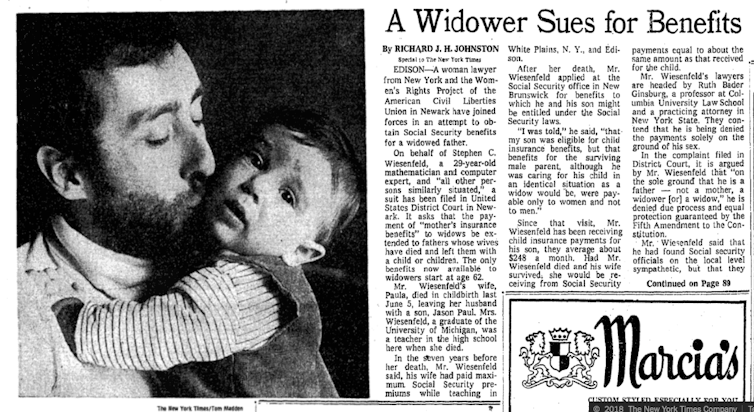
Ginsburg represented widower Stephen Wiesenfeld in challenging a Social Security Act provision that provided parental benefits only to widows with minor children.
Wiesenfeld’s wife had died in childbirth, so he was denied benefits even though he faced all of the challenges of single parenthood that a mother would have faced. The Supreme Court gave Wiesenfeld and Ginsburg a win in 1975, unanimously ruling that sex-based distinction unconstitutional.
And two years later, Ginsburg successfully represented Leon Goldfarb in his challenge to another sex-based provision of the Social Security Act: Widows automatically received survivor’s benefits on the death of their husbands. But widowers could receive such benefits only if the men could prove that they were financially dependent on their wives’ earnings.
Ginsburg also wrote an influential brief in Craig v. Boren, the 1976 case that established the current standard for evaluating the constitutionality of sex-based laws.
Like Wiesenfeld and Goldfarb, the challengers in the Craig case were men. Their claim seemed trivial: They objected to an Oklahoma law that allowed women to buy low-alcohol beer at age 18 but required men to be 21 to buy the same product.
But this deceptively simple case illustrated the vices of sex stereotypes: Aggressive men (and boys) drink and drive, women (and girls) are demure passengers. And those stereotypes affected everyone’s behavior, including the enforcement decisions of police officers.
Under the standard delineated by the justices in the Boren case, such a law can be justified only if it is substantially related to an important governmental interest.
Among the few laws that satisfied this test was a California law that punished sex with an underage female but not with an underage male as a way to reduce the risk of teen pregnancy.
These are only some of the Supreme Court cases in which Ginsburg played a prominent part as a lawyer. She handled many lower-court cases as well. She had plenty of help along the way, but everyone recognized her as the key strategist.
In the century before Ginsburg won the Reed case, the Supreme Court never met a gender classification that it didn’t like. Since then, sex-based policies usually have been struck down.
I believe President Clinton was absolutely right in comparing Ruth Bader Ginsburg’s efforts to those of Thurgood Marshall, and in appointing her to the Supreme Court.
Jonathan Entin, Professor Emeritus of Law and Adjunct Professor of Political Science, Case Western Reserve University
This article is republished from The Conversation under a Creative Commons license. Read the original article.
- Details
- Written by: Lake County News reports
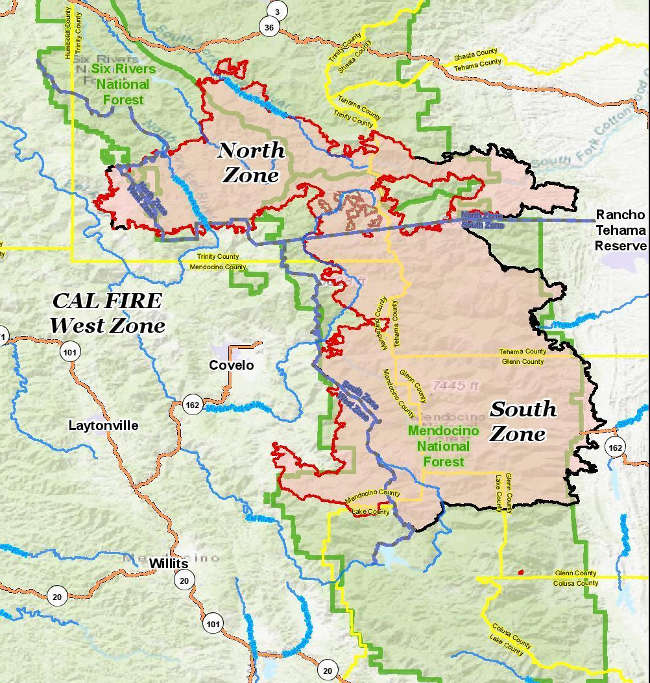
The Forest Service reported on Friday that the August Complex was up to 824,118 acres on all of its zones, a rollback of about 15,000 acres from the Thursday estimate, due to mapping. Containment remained at 30 percent.
The complex, burning in the Mendocino, Shasta-Trinity and Six Rivers National Forests, has destroyed 35 structures and is threatening approximately 1,395 more, officials said.
To date, it has resulted in one fatality of a firefighter – which was the result of a vehicle crash on Aug. 31 – and 11 injuries.
Officials said a cold front moving onshore is expected to bring higher humidity, more cloud cover and isolated showers to the area, although warmer conditions are forecast to return next week.
The Forest Service said structure defense remains a priority; indirect line construction, away from the fire’s edge; direct line construction and tactical firing operations, applying fire on
the ground to remove vegetation and widen containment lines.
Officials said Friday that the fire has crossed north of Rattlesnake Ridge and firefighters are conducting structure protection efforts in the Forest Glen area. Crews were assessing the Trinity Pines/Post Mountain area for structure defense.
Structure defense continues in Ruth Valley and Hettenshaw Valley with structure preparation ongoing in Kettenpom Valley, officials said.
Tactical firing operations also continued on Horse Ridge, west toward Ruth Valley to check northerly progression of the fire. Direct and indirect control lines have been constructed from Zenia Road east of the East Fork of the Eel River to Mad River Ridge, the Forest Service said.
On the northeast perimeter in the Shasta-Trinity National Forest, officials said good progress has been made and crews continue to reinforce the containment line along the 35 Road. Established containment lines in this area are being actively monitored.
In the Yolla Bolly-Middle Eel Wilderness along Wrights Ridge, the August Complex North and South Zones continue to merge, therefore it is not safe to put firefighters in the area, officials reported.
Better weather conditions – with higher humidity and cloud cover – are aiding firefighters good air quality is expected to the west of the complex with improving conditions expected south of the fire.