 How to resolve AdBlock issue?
News
- Details
- Written by: Elizabeth Larson
Cal Fire said Tuesday night that the Glass fire, burning since early Sunday, had reached 46,600 acres, with containment at 2 percent.
Tens of thousands of North Coast residents remain under evacuation on Tuesday as 22,310 structures are threatened, but officials said some evacuations were downgraded in the city of Santa Rosa due to improving conditions.
As of Tuesday night, Cal Fire had confirmed 43 structures had been destroyed in Sonoma County, 28 of them residences and 15 minor structures. In Napa County, the fire has destroyed 72 structures, including 52 residences, two commercial buildings, 17 minor structures and one classified as “other.”
Cal Fire said firefighters continued to focus on structure defense on Tuesday while also building and reinforcing containment lines.
Firefighters have been using fire lines from the 2017 North Bay fires to help control the movement of the Glass fire, officials said Tuesday.
Changing winds led to some areas of increased fire activity. Aircraft operations also were inhibited by smoky conditions and poor visibility, although Cal Fire officials said on Tuesday morning that aircraft were working around the community of Angwin.
The fire has been burning in Trione-Annadel State Park, and Cal Fire said a fire operation was conducted there on Monday night. Officials said the fire also has become established in Sugarloaf Ridge State Park, which is an area of concern.
Cal Fire said firefighters will continue to aggressively fight the fire overnight.
Hot dry weather is anticipated over the next several days, with the National Weather Service issuing a heat advisory for Thursday for parts of the fire area, where temperatures are forecast to pass the century mark.
Email Elizabeth Larson at
- Details
- Written by: Elizabeth Larson
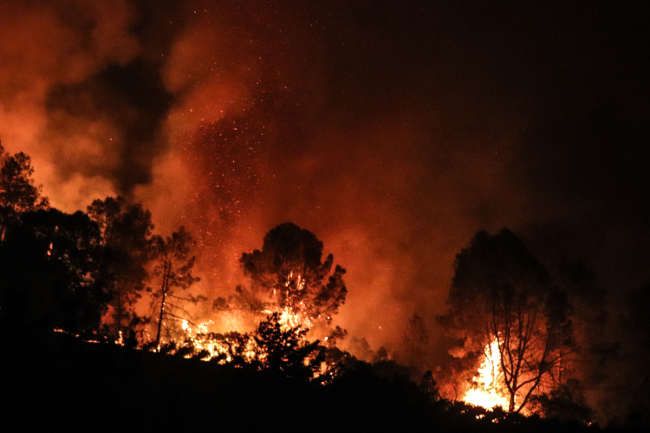
NORTHERN CALIFORNIA – As the Glass and Zogg fires continued to tear through parts of Northern California on Monday, Gov. Gavin Newsom declared a state of emergency for three counties.
The Glass fire, which began early Sunday morning, more than tripled in size on Monday, with Cal Fire reporting by nightfall that it had burned 36,236 acres across neighboring Napa and Sonoma counties, with zero containment.
The fire, which has prompted tens of thousands of North Coast residents to leave their homes under mandatory evacuation orders, is threatening 8,543 structures. Cal Fire said Monday night that it has destroyed 113 buildings and damaged two others.
Farther to the north, the Zogg fire in Shasta County, which began Sunday afternoon, was up to 31,237 acres and no containment on Monday night, Cal Fire said. It has killed three civilians, is threatening 1,538 structures and has so far destroyed 146 buildings.
Pacific Gas and Electric Co., which concluded on Monday a public safety power shutoff to 65,000 customers across 15 counties due to the red flag warning in effect through the weekend, said it’s continuing to closely monitor the Glass and Zogg fires and is working closely with first responders and Cal Fire.
On Monday night, the company said approximately 24,000 of its customers in Napa, Sonoma, Shasta and Tehama counties impacted by wildfires are without power. In some instances, power was turned off in partnership with Cal Fire and for the safety of firefighters in active fire areas or due to damage caused from wildfire-related impacts to equipment.
Also on Monday night, Gov. Newsom issued his state of emergency declaration for Napa and Sonoma counties due to the Glass fire and for Shasta County due to the Zogg fire.

The governor on Monday also sent a letter to President Donald Trump requesting a presidential major disaster declaration to assist state and local wildfire response and recovery efforts in the counties of Fresno, Los Angeles, Madera, Mendocino, San Bernardino, San Diego and Siskiyou.
California previously secured a presidential major disaster declaration to bolster the state’s emergency response to the Northern California wildfires as well as Fire Management Assistance Grants from the Federal Emergency Management Agency to support the state’s ongoing response to fires burning across the state.
In addition, Gov. Newsom has declared a statewide emergency due to the widespread fires and extreme weather conditions, activated the State Operations Center to its highest level and signed an executive order to streamline recovery efforts in communities impacted by the devastating fires.
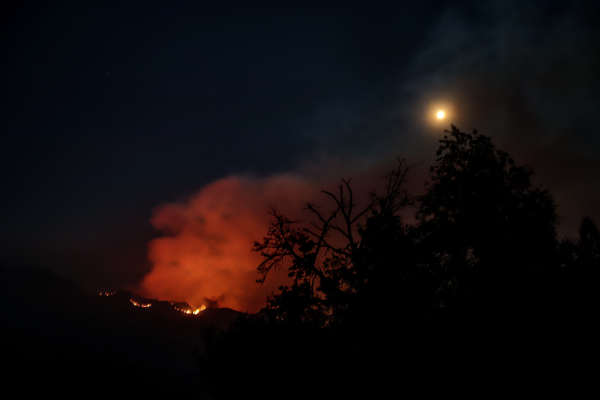
Through the night on Monday and into early Tuesday, scanner traffic indicated the struggle firefighters are facing with the Glass fire, as it makes runs over ridges, spot fires develop and some residents who refused to evacuate called in for help as the fire approached their homes.
Calistoga, which was placed under evacuation on Monday evening, appeared abandoned later in the night, according to Lake County News correspondent Gemini Garcia.
Garcia said the fire was burning along Silverado Trail at Highway 29. She said dozers were headed up Palisades Road near Calistoga. “It’s the only sound you can hear from any viewpoint.”
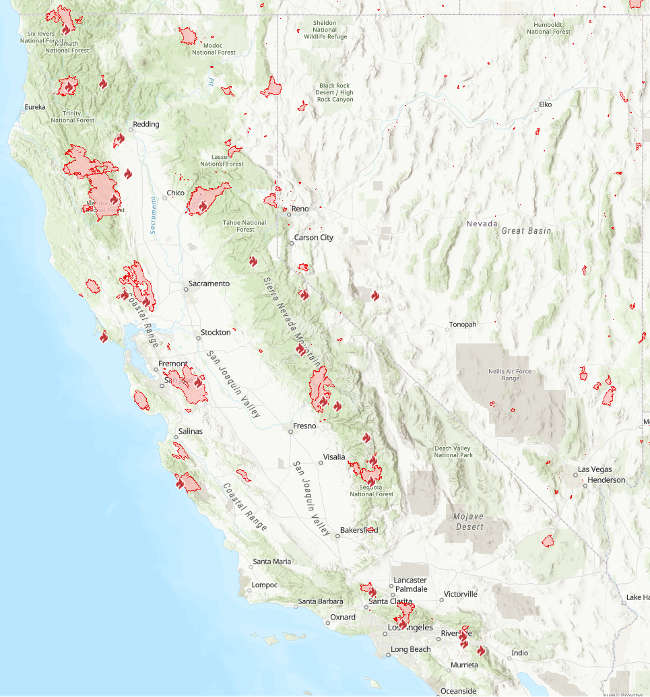
Fires burning now among state’s largest
In a briefing on Monday morning, Gov. Gavin Newsom said 27 major wildland incidents were burning across the state.
Separately, Cal Fire reported that there have been more than 8,100 wildfires that have burned more than 3.7 million acres in California since the start of the year.
Since Aug. 15, when California’s fire activity elevated, there have been 26 fatalities and over 7,000 structures destroyed, Cal Fire said.
Five of the six largest wildland fires in recorded California history are now burning.
They include the August Complex in the Mendocino, Shasta-Trinity and Six Rivers National Forests, an area that includes northern Lake County, the largest fire in state history at more than 902,463 acres; the SCU Lightning Complex, the third-largest in history, which has burned 396,624 acres in Alameda, Contra Costa, Merced, San Joaquin, Santa Clara and Stanislaus counties; the LNU Lightning Complex, No. 4, at 363,220 acres, burning in Colusa, Lake, Napa, Sonoma, Solano and Yolo counties; the North Complex, No. 5, which has burned 306,135 acres in Butte and Plumas counties; and the Creek fire, at 304,640 acres, burning in Fresno and Madera counties, is No. 6.
The 2018 Mendocino Complex, which burned 459,123 acres in Colusa, Glenn, Lake and Mendocino counties, is the second-largest fire in state history.
Email Elizabeth Larson at
- Details
- Written by: Elizabeth Larson
Dr. Gary Pace said last week that, based on information from the state, Lake County was set to be moved fully into the purple tier, the highest when assessing COVID-19 transmission risk, as early as Tuesday, as Lake County News has reported.
For the weeks of Sept. 6 to 12 and Sept. 13 to 19 Lake County’s case and positivity rates put it in line for greater restrictions.
However, Pace said many of those cases were associated with a single outbreak, referring to the situation at a skilled nursing facility, Lakeport Post Acute.
The California Department of Public Health reported the outbreak has resulted in 37 residents and 22 staffers testing positive, with Lake County Public Health confirming seven residents have died.
Pace said Monday that the state agreed to grant Lake County another week – Sept. 20 to 26 – to observe whether the case rate in the general population stays high.
“Data for Sept. 20 to 26 is still coming in, but it is probable we will move to the purple tier Tuesday, Oct. 6, with businesses having three additional days to comply. Business owners are encouraged to plan for this,” Pace said.
If the county is moved into that higher tier, Pace said businesses and enterprises considered high-risk must move all services outdoors. That includes restaurants, movie theaters, worship services and gyms/fitness centers, etc.
Select a purple tier county (such as Butte) to see all restrictions on the state website.
Pace said schools that have opened for on-site learning prior to the county joining the purple tier can stay open.
Schools offering remote learning only will have to wait until the county returns to the red tier – which has to be sustained over two consecutive seven-day reporting periods – to offer on-site instruction, Pace said.
“We are all tired and frustrated by how long the COVID-19 pandemic has endured, but rising cases mean we all must observe recommended and mandated precautions. COVID-19 can be serious, even fatal. If it continues to spread, we will be forced to further limit activities. The state will get increasingly involved in local affairs,” Pace said.
“We all want to be free to live our lives. Right now, we promote that when we wear a mask, keep a safe distance and avoid gatherings, particularly indoors, with people outside of our households,” as well as by taking special care if working with vulnerable people, Pace said.
“Our actions make a difference,” he said.
Email Elizabeth Larson at
- Details
- Written by: Elizabeth Larson
The company said it reduced the scope of its public safety power shutoff from 89,000 customers in 16 counties to 65,000 customers in 15 counties: Alpine, Amador, Butte, Calaveras, El Dorado, Lake, Napa, Nevada, Placer, Plumas, Shasta, Sierra, Tehama and Yuba counties.
As of Monday night, 1,300 customers were awaiting restoration, PG&E said.
In Lake County, PG&E said 55 customers, two of them in the medical baseline program, were impacted, along with two customers within Sonoma County. A few customers in Kern County had initially been included, but due to improved weather conditions, were removed from the scope.
The shutoffs began early Sunday morning and continued into the evening, when Lake County’s customers – in an area near the Lake and Napa County line south of Middletown – were reported to have had their power shut off.
On Monday morning, PG&E said meteorologists in its Emergency Operations Center issued a weather all-clear for most – but not all – areas impacted by the shutoff.
PG&E crews – consisting of nearly 1,700 ground personnel and 50 helicopters – then began inspecting nearly 3,915 miles of transmission and distribution lines for damage or hazards.
They began to restore powers to customers in areas where no damage or hazards to the company’s electrical equipment was found.
However, PG&E said preliminary data from the inspections revealed 13 instances of weather-related damage and hazards in the PSPS-affected areas. Examples include downed lines and vegetation on power lines.
The company said that, had it not deenergized power lines, those types of damage could have caused potential wildfire ignitions.
During the wind event, PG&E said top wind speeds throughout the power shutoff area included 61 miles per hour sustained and 73-mile-per-hour gusts on the Mt. St. Helena West weather station in Sonoma County; 44-mile-per-hour sustained winds and gusts of 72 miles per hour at Jarbo Gap in Butte County; and at Mt. Diablo in Contra Costa County, sustained winds were recorded at 52 miles per hour, with gusts of 66 miles per hour.
Email Elizabeth Larson at