 How to resolve AdBlock issue?
News
- Details
- Written by: Lake County News reports

NORTHERN CALIFORNIA – In addition to destroying and threatening thousands of homes and businesses, the devastating Glass Fire in Napa and Sonoma counties jeopardized the California Department of Fish and Wildlife’s Inland Chinook Salmon Program – until the Feather River Fish Hatchery in Oroville came to the rescue.
The Feather River Fish Hatchery is owned and maintained by the California Department of Water Resources, and operated by the California Department of Fish and Wildlife, or CDFW.
Each year, CDFW raises approximately 800,000 Chinook salmon smolts and fingerlings for planting and recreational fishing in large foothill and valley reservoirs from Fresno County to Trinity County.
These landlocked salmon often grow quite large and fill an ecological and recreational angling niche in these deep-water impoundments not typically occupied by other fish species.
The state record inland Chinook salmon came from Trinity Lake in 2013 weighing 20 pounds, 15 ounces. Anglers regularly catch inland Chinook salmon weighing 7 to 8 pounds at Lake Oroville and 5 to 6 pounds at Folsom Lake.
The inland Chinook salmon originate with eggs collected and spawned at the Feather River Fish Hatchery each fall from salmon returning to the Feather River. The eggs and fish are excess to the hatchery’s annual production goals.
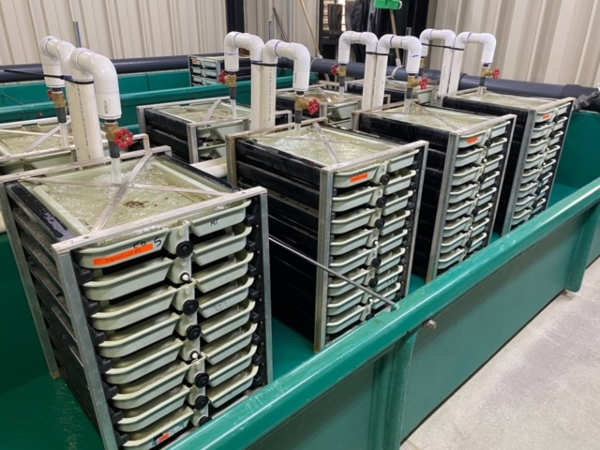
About 1.4 million Chinook salmon eggs were collected from the Feather River Fish Hatchery in early October and designated for the Inland Chinook Salmon Program.
Ordinarily, most of these eggs are taken to CDFW’s Silverado Fisheries Base in Napa County for incubation, where they remain until the baby salmon are big enough for stocking.
The Silverado Fisheries Base suffered power outages and came under evacuation orders as a result of the Glass Fire.
In response to the emergency and with assistance from CDFW’s Inland Chinook Salmon Program staff, temporary adjustments were made at the Feather River Fish Hatchery to keep the eggs, incubate them and grow out the salmon until the Silverado Fisheries Base is once again able to accommodate the fish, likely in November.
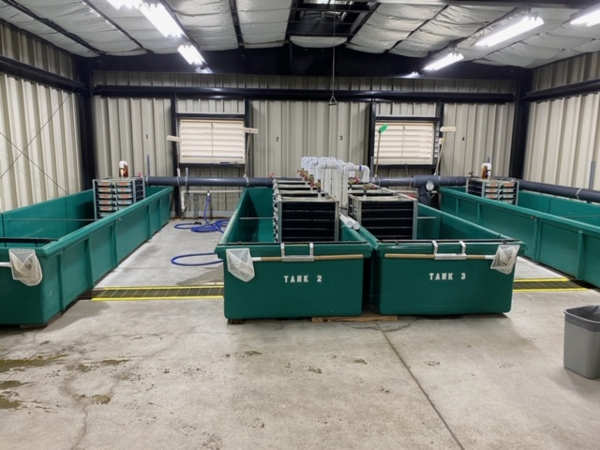
CDFW staff set up additional fish-rearing incubators in their Inland Chinook Salmon Building. That building typically only has space to hold 300,000 eggs and baby salmon destined for Lake Oroville. Thanks to the extra effort, the Feather River Hatchery is now holding 1.4 million eggs that represent the entire annual production of the state’s Inland Chinook Salmon Program.
“Understanding the inherent risk of losing an entire year’s production, CDFW staff will play a crucial role in ensuring future inland Chinook fisheries in Folsom, Oroville and eight other lakes and reservoirs,” said Kyle Murphy, a senior environmental scientist with CDFW’s Fisheries Branch. “This interagency teamwork will have long-reaching effects for thousands of anglers in central and northern California.”
Adding to the stress, the Feather River Fish Hatchery itself was ordered to evacuate for a day Oct. 15 due to a nearby fire in Oroville. Both the Oroville fire and the Glass Fire have been contained and no longer pose threats to either facility.
- Details
- Written by: Elizabeth Larson
The following dogs are ready for adoption or foster.

‘Banjo’
“Banjo” is a male American Staffordshire Terrier mix with a short tan and white coat.
He is dog No. 4267.

‘Bella’
“Bella” is a female American Bully mix.
She has a short beige and tan coat.
She is dog No. 3537.

‘Charlie’
“Charlie” is a male adult Chihuahua with a short tan coat.
He has been neutered.
Charlie is recovering from surgery to fix a broken leg.
He is dog No. 4277.

‘Chester’
“Chester” is a male Chihuahua mix with a short tan coat.
He is dog No. 360.

‘Chuckie’
“Chuckie’ is a small male adult German Shepherd mix.
He has a short tan and black coat.
He is dog No. 4297.

‘Jack’
“Jack” is a male Labrador Retriever mix with a short yellow coat.
He is dog No. 4155.

‘Lady’
“Lady” is a female German Shepherd mix.
She has been spayed.
She is dog No. 3683.
The shelter is open by appointment only due to COVID-19.
Call the Clearlake Animal Control shelter at 707-273-9440, or email
Visit Clearlake Animal Control on Facebook or on the city’s website.
Email Elizabeth Larson at
- Details
- Written by: Elizabeth Landau
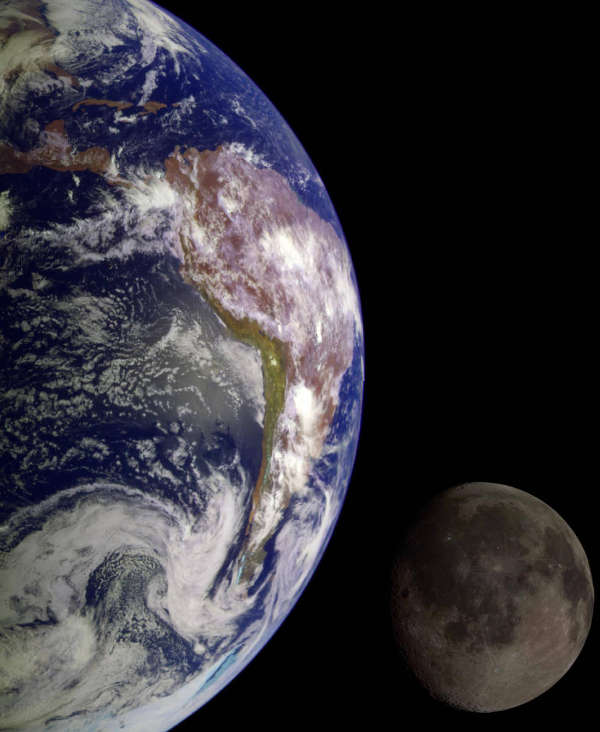
Four-and-a-half billion years ago, Earth’s surface was a menacing, hot mess. Long before the emergence of life, temperatures were scorching, and the air was toxic.
Plus, as a mere toddler, the Sun bombarded our planet with violent outbursts of radiation called flares and coronal mass ejections. Streams of charged particles called the solar wind threatened our atmosphere. Our planet was, in short, uninhabitable.
But a neighboring shield may have helped our planet retain its atmosphere and eventually go on to develop life and habitable conditions. That shield was the moon, says a NASA-led study in the journal Science Advances.
“The moon seems to have presented a substantial protective barrier against the solar wind for the Earth, which was critical to Earth’s ability to maintain its atmosphere during this time,” said Jim Green, NASA’s chief scientist and lead author of the new study. “We look forward to following up on these findings when NASA sends astronauts to the moon through the Artemis program, which will return critical samples of the lunar South Pole.”
A brief history of the moon
The moon formed 4.5 billion years ago when a Mars-sized object called Theia slammed into the proto-Earth when our planet was less than 100 million years old, according to leading theories.
Debris from the collision coalesced into the moon, while other remnants reincorporated themselves into the Earth. Because of gravity, the presence of the moon stabilized the Earth’s spin axis. At that time, our planet was spinning much faster, with one day lasting only 5 hours.
And in the early days, the moon was a lot closer, too. As the moon’s gravity pulls on our oceans, the water is slightly heated, and that energy gets dissipated. This results in the moon moving away from Earth at a rate of 1.5 inches per year, or about the width of two adjacent dimes. Over time, that really adds up.
By 4 billion years ago, the moon was three times closer to Earth than it is today – about 80,000 miles away, compared to the current 238,000 miles. At some point, the moon also became “tidally locked,” meaning Earth sees only one side of it.
Scientists once thought that the moon never had a long-lasting global magnetic field because it has such a small core. A magnetic field causes electrical charges to move along invisible lines, which bow down toward the moon at the poles.
Scientists have long known about Earth’s magnetic field, which creates the beautifully colored aurorae in the Arctic and Antarctic regions. The movement of liquid iron and nickel deep inside the Earth, still flowing because of the heat left over from Earth’s formation, generates the magnetic fields that make up a protective bubble surrounding Earth, the magnetosphere.
But thanks to studies of samples of the lunar surface from the Apollo missions, scientists figured out that the moon once had a magnetosphere, too. Evidence continues to mount from samples that were sealed for decades and recently analyzed with modern technology.
Like Earth, the heat from the moon’s formation would have kept iron flowing deep inside, although not for nearly as long because of its size.
“It’s like baking a cake: You take it out of the oven, and it’s still cooling off,” Green said. “The bigger the mass, the longer it takes to cool off.”

A magnetic shield
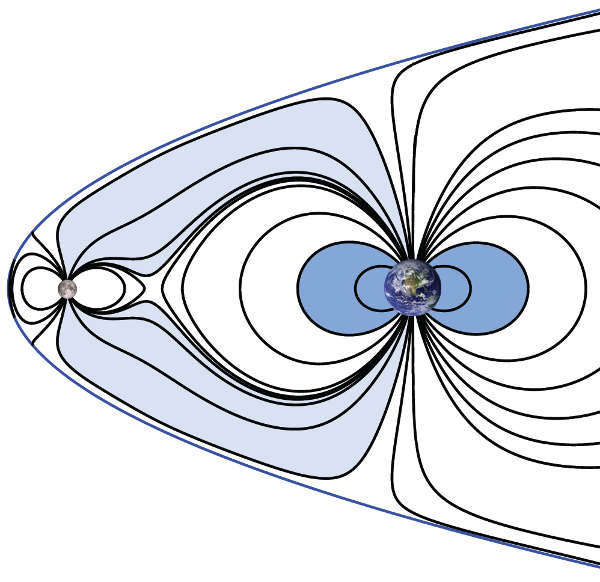
The new study simulates how the magnetic fields of the Earth and moon behaved about 4 billion years ago. Scientists created a computer model to look at the behavior of the magnetic fields at two positions in their respective orbits.
At certain times, the moon’s magnetosphere would have served as a barrier to the harsh solar radiation raining down on the Earth-moon system, scientists write.
That’s because, according to the model, the magnetospheres of the moon and Earth would have been magnetically connected in the polar regions of each object. Importantly for the evolution of Earth, the high-energy solar wind particles could not completely penetrate the coupled magnetic field and strip away the atmosphere.
But there was some atmospheric exchange, too. The extreme ultraviolet light from the Sun would have stripped electrons from neutral particles in Earth’s uppermost atmosphere, making those particles charged and enabling them to travel to the moon along the lunar magnetic field lines.
This may have contributed to the moon maintaining a thin atmosphere at that time, too. The discovery of nitrogen in lunar rock samples support the idea that Earth’s atmosphere, which is dominated by nitrogen, contributed to the moon’s ancient atmosphere and its crust.
Scientists calculate that this shared magnetic field situation, with Earth and moon’s magnetospheres joined, could have persisted from 4.1 to 3.5 billion years ago.
“Understanding the history of the moon's magnetic field helps us understand not only possible early atmospheres, but how the lunar interior evolved,” said David Draper, NASA’s deputy chief scientist and study co-author. “It tells us about what the moon's core could have been like – probably a combination of both liquid and solid metal at some point in its history – and that is a very important piece of the puzzle for how the moon works on the inside.”
Over time, as the moon’s interior cooled, our nearest neighbor lost its magnetosphere, and eventually its atmosphere. The field must have diminished significantly 3.2 billion years ago, and vanished by about 1.5 billion years ago.
Without a magnetic field, the solar wind stripped the atmosphere away. This is also why Mars lost its atmosphere: Solar radiation stripped it away.
If our moon played a role in shielding our planet from harmful radiation during a critical early time, then in a similar way, there may be other moons around terrestrial exoplanets in the galaxy that help preserve atmospheres for their host planets, and even contribute to habitable conditions, scientists say.
This would be of interest to the field of astrobiology – the study of the origins of life and the search for life beyond Earth.
This modeling study presents ideas for how the ancient histories of Earth and moon contributed to the preservation of Earth’s early atmosphere. The mysterious and complex processes are difficult to figure out, but new samples from the lunar surface will provide clues to the mysteries.
As NASA plans to establish a sustainable human presence on the moon through the Artemis program, there may be multiple opportunities to test out these ideas.
When astronauts return the first samples from the lunar South Pole, where the magnetic fields of the Earth and moon connected most strongly, scientists can look for chemical signatures of Earth’s ancient atmosphere, as well as the volatile substances like water that were delivered by impacting meteors and asteroids.
Scientists are especially interested in areas of the lunar South Pole that have not seen any sunlight at all in billions of years – the “permanently shadowed regions” – because the harsh solar particles would not have stripped away volatiles.
Nitrogen and oxygen, for example, may have traveled from Earth to moon along the magnetic field lines and gotten trapped in those rocks.
“Significant samples from these permanently shadowed regions will be critical for us to be able to untangle this early evolution of the Earth’s volatiles, testing our model assumptions,” Green said.
The other co-authors on the paper are Scott Boardsen from the University of Maryland, Baltimore County; and Chuanfei Dong from Princeton University in New Jersey.
Elizabeth Landau works for NASA Headquarters.

When the moon had a magnetic field, it would have been shielded from incoming solar wind, as shown in this illustration. Credits: NASA.
- Details
- Written by: Lake County News reports

LAKE COUNTY, Calif. – In 2020, Red Ribbon Week, the nation's largest and longest-running drug-use prevention campaign which runs from Oct. 23 to 31,, turns 35.
Red Ribbon Week has informed millions of children and parents about the danger of drugs and alcohol, influencing positive choices and behaviors.
However, one drug that hasn’t received as much attention lately is nicotine, which is highly addictive.
The Centers for Disease Control and Prevention recently released its 2019 Youth Risk Behavior Survey, which measures a variety of risky behaviors, including tobacco use.
The survey found that in California, more than 42 percent of high school students reported having tried e-cigarettes and more than 18 percent reported using currently. More than seven percent reported currently using smokeless tobacco.
The common thread among these products is flavored nicotine which the tobacco industry uses to spark curiosity and mask the harsh taste of tobacco. If sweet fruity flavors seem harmless, the high dose of nicotine teens get when they use, isn’t.
Rural communities have long been targeted by the tobacco industry. For decades, the tobacco industry has taken advantage of often weaker tobacco retail laws in rural areas and push misleading advertising, marketing and promotions that tie tobacco use to values such as strength, independence and resilience, while using images of cowboys, hunters and racecars to make smoking seem like it’s a part of life.
In recent years, they have added new products like e-cigarettes, but the intent is the same.
For example, Lakeport Unified School District was part of the California Healthy Kids Survey that also measures risk-related behaviors.
The 2018-19 survey found that 27 percent of 11th graders reported using e-cigarettes in the past 30 days (and 26 percent for ninth graders), but just 5 percent report using traditional cigarettes.
The 2019 High School Youth Risk Behavior Survey also found that California high school students overall are using smokeless tobacco more than students nationally.
Part of the problem may also be the perception of nicotine.
“Make no mistake, nicotine is the tobacco industry’s tool to hook our kids to deadly products – that hasn’t changed,” said Shelly Brantley, project director of Rural Initiatives Strengthening Equity, or RISE, a program dedicated to combatting tobacco’s harms in California’s rural communities, such as Lake County.
“What’s changed is how they’re packaging this drug. The tobacco industry continues to target our communities and portray tobacco products, such as e-cigarettes or smokeless tobacco, as being less harmful, but that’s far from the truth, especially for youth,” she said.
“Aside from the health problems these products present, they often contain high amounts of nicotine, which is a harmful drug that is basically brain poison for youth, and the tobacco industry now has it wrapped up in sweet, fruity flavors in a variety of forms to entice kids to try them, and far too often, get addicted,” said Brantley. “Not only is nicotine a highly addictive drug for youth, but nicotine exposure can actually change the chemistry in teens’ brains and can impact learning, memory and attention.”
Brantley added, “The tobacco industry views our kids as their next generation of customers, and nicotine is their tool to hook them. We need to talk with our kids about what nicotine really is – it’s a harmful, addictive drug.”
To find out information about how RISE combats tobacco harm in rural communities, including Lake County, and to take action, visit https://www.ca-rise.org/.