 How to resolve AdBlock issue?
News
- Details
- Written by: James Mortimer, The Open University and Mahesh Anand, The Open University

The Moon was for a long time considered to be bone dry, with analyses of returned lunar samples from the Apollo missions showing only trace amounts of water. These traces were in fact believed to be due to contamination on Earth. But over the past two decades, re-analyses of lunar samples, observations by spacecraft missions, and theoretical modelling have proved this initial assessment to be wrong.
“Water” has since been detected inside the minerals in lunar rocks. Water ice has also been discovered to be mixed in with lunar dust grains in cold, permanently shadowed regions near the lunar poles.
But scientists haven’t been sure how much of this water is present as “molecular water” – made up of two parts hydrogen and one part oxygen (H2O). Now two new studies published in Nature Astronomy provide an answer, while also giving an idea of how and where to extract it.
Water and more water
The term water isn’t just used for molecular water, but also also for detections of hydrogen (H) and hydroxyl (OH). Although H and OH could be combined by astronauts to form molecular water at the lunar surface, it is important to know in what form these compounds are present initially. That’s because this will have an impact on their stability and location under lunar surface conditions, and the effort required to extract them. Molecular water, if present as water ice, would be easier to extract than hydroxyl locked in rocks.
The presence of water on the Moon is scientifically interesting; its distribution and form can help address some profound questions. For example, how did water and other volatile substances arrive at the inner Solar System in the first place? Was it produced there or brought there by asteroids or meteorites? Knowing more about the specific compound could help us find out.
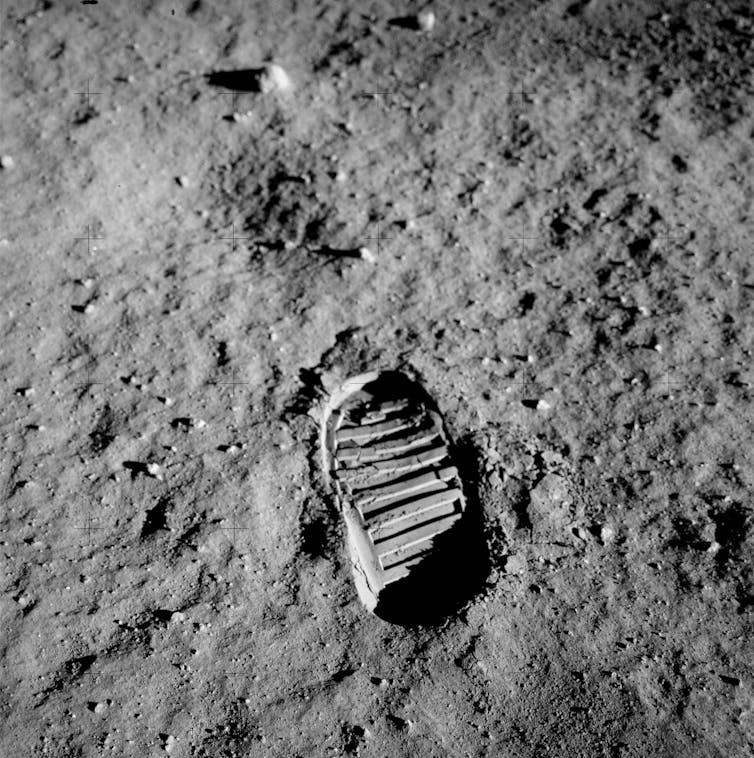
Understanding how much water is present, and its location, is also incredibly useful for planning human missions to the Moon and beyond. Water represents a key resource that can be used for life-support purposes – but it can also be split apart into its constituent elements and put to other uses. Oxygen could replenish air supplies, or be used in simple chemical reactions at the lunar surface to extract other useful resources from the regolith (soil composed of small grains). Water could also be used as rocket fuel in the form of liquid hydrogen and liquid oxygen.
This means that the Moon has great potential to become a refuelling base for space missions further into the Solar System or beyond. Its lower gravity and lack of atmosphere means it would require less fuel to launch from there than from Earth. So when space agencies talk of in-situ resource utilisation at the Moon, water is front and centre of their plans, making the new papers extremely exciting.
New research
Instruments on board various spacecraft have previously measured “reflectance spectra” (light broken down by wavelength) from the Moon. These detect light coming from a surface to measure how much energy it reflects at a specific wavelength. This will differ based on what the surface consists of. Because it has water, the Moon’s surface absorbs light at 3𝜇m wavelengths (0.000003 metres). However, absorptions at this wavelength cannot distinguish between molecular water and hydroxyl compounds.
Using the NASA/DLR Stratospheric Observatory for Infrared Astronomy (SOFIA) telescope, flown at 43,000 feet, the team behind one of the new papers observed sunlit sections of the Moon’s surface in wavelengths of 5-8𝜇m. H2O results in a characteristic peak in the spectrum at 6𝜇m, and by comparing a near-equatorial area as a baseline (thought to have almost no water) with an area near the south pole, this study reports the first unequivocal observations of molecular water under ambient conditions at the lunar surface at an abundance of 100-400 parts per million.
This is several orders of magnitude too large for most of the water to be adsorbed onto regolith grain surfaces. Instead, the authors suggest that the water they have observed must be locked up inside glass formed by tiny meteorites impacting and melting already hydrated regolith grains. Alternatively, it could be present in voids between grain boundaries, which would make it easier to extract. Where exactly this water is sited would be of extreme interest for future explorers as it would dictate the processes and energy required to extract it.
Luckily, the other paper used new theoretical models, based on temperature data and higher resolution images from the Lunar Reconnaissance Orbiter, to refine predictions of where conditions are right for molecular water to be trapped as ice.
Previous research has shown already that there are such kilometres-wide “cold traps” in permanently shadowed areas near the poles, where water ice may be present. Evidence from orbiting spacecraft, however, was inconclusive about this being molecular water or hydroxyl. The new study finds that there are also abundant small cold traps where conditions permit water ice to accumulate – on the scale of centimetres or decimetres. In fact, such traps should be hundreds to thousands of times more numerous than larger cold traps.
The team calculates that 0.1% of the total lunar surface is cold enough to trap water as ice, and that the majority of these icy cold traps are at high latitudes (> 80°). This is particularly near to the lunar south pole, narrowing down the choice of future landing sites with the highest chance of finding trapped water ice. However, it is important to realise that the two studies investigated areas at different latitudes (55°-75°S vs >80°S) and therefore cannot be compared directly.
Nevertheless, these latest discoveries further enhance our understanding of the history of water on our nearest neighbour. They will undoubtedly strengthen plans for a return to the Moon. Instruments such as the European Space Agency’s (PROSPECT payload on Luna 27) will be able to make measurements on the Moon to “ground-truth” these tantalising glimpses of the wealth of information yet to be discovered.
James Mortimer, Postdoctoral researcher in Planetary Science and Exploration, The Open University and Mahesh Anand, Professor of Planetary Science and Exploration, The Open University
This article is republished from The Conversation under a Creative Commons license. Read the original article.
CHP welcomes new officers equipped with real-life experience; Hidden Valley Lake man among graduates
- Details
- Written by: Lake County News reports
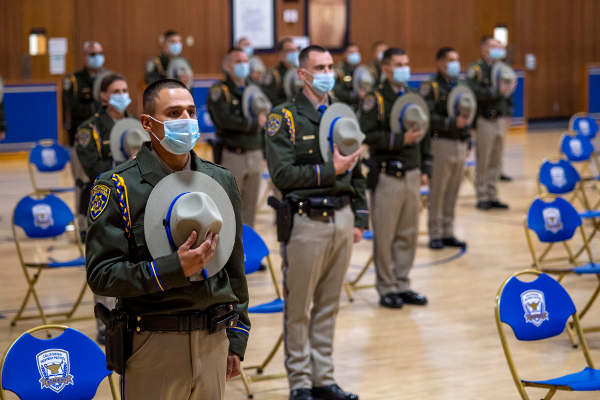
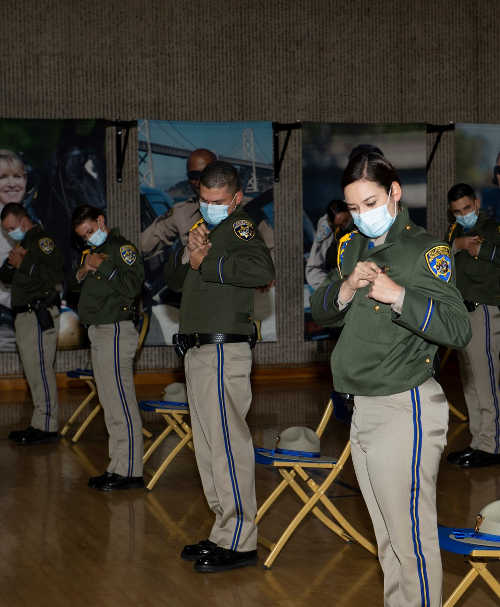
NORTHERN CALIFORNIA – On Friday 77 new California Highway Patrol officers – including a Hidden Valley Lake man – were sworn in during an unprecedented socially distant graduation ceremony at the CHP Academy.
The graduating class begins their new career with more hands-on experience than any class in academy history, the CHP reported.
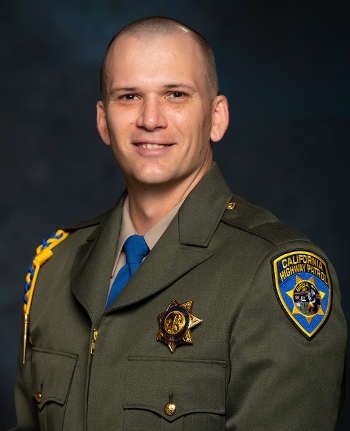
Among this year’s graduates is Kyle Nelson of Hidden Valley Lake.
Officer Nelson graduated from Windsor High School in 2004. Prior to attending the CHP Academy, he worked as a senior technician for Viavi Solutions in Santa Rosa.
As concerns of the COVID-19 pandemic intensified, the CHP closed its live-in academy in West Sacramento on March 20.
All cadets were sent home and assigned to work in CHP Area offices located as close to their residences as practicable.
Prior to leaving, the seven women and 70 men of Cadet Training Class, or CTC, III-19, who started Oct. 21, 2019, had completed 23 weeks of their 29-week training at the academy.
During the six months spent working in CHP Area offices throughout the state, cadets had an unprecedented opportunity to observe a wide variety of activities and tasks, enhancing their classroom work.
On ride-alongs with officers, they experienced a CHP officer’s shift in the field and learned first-hand how to complete crash reports and assist the public.
They also learned the administrative side of the job – filing reports, answering the phone, and performing general tasks that may be unfamiliar to many officers.
The CHP said Nelson spent six months working in the Clear Lake Area office in Kelseyville.
On Sept. 14, all members of CTC III-19 who left in March returned to the academy for their final weeks of training with enhanced health and safety protocols.
“We are all so proud of this class,” CHP Commissioner Warren Stanley said. “These cadets faced the uncertainty of the pandemic with resolve and returned to the Academy energized about their new careers, benefiting from a wealth of real-life experience that no other cadets have had.”
At the CHP Academy, cadet training starts with nobility in policing, leadership, professionalism and ethics, and cultural diversity. Training also includes mental illness response and crisis intervention techniques.
Cadet instruction covers patrol operations, crash investigation, first aid, and the arrest of suspected violators, including those who drive under the influence of alcohol or drugs.
The cadets also receive training in traffic control, report writing, recovery of stolen vehicles, assisting the motoring public, issuing citations, emergency scene management, and knowledge of various codes including the Vehicle Code, Penal Code, and Health and Safety Code.
Upon graduation, the cadets are assigned to CHP Area offices throughout the state.
The CHP said Nelson has been assigned to the Napa Area office.
- Details
- Written by: Elizabeth Larson
Dr. Gary Pace said Friday that the latest deaths were the county’s 16th and 17th.
The 16th death, reported early this week, was in a person over age 65 who lived in a senior residential facility and had chronic medical issues, he said.
On Thursday, Public Health was informed of the 17th COVID-19-related death. Pace said the individual was over 60, had chronic medical issues and was living at the same senior residential facility as the person who died earlier in the week.
Both deaths reported this week were connected to Lake County’s second outbreak at a residential facility, Pace said.
Pace noted that the outbreak has now “started to stabilize.”
He did not name the facility. However, the first local outbreak was at Lakeport Post Acute, the second was at Rocky Point Care Center, also in Lakeport, according to the California Department of Public Health’s COVID-19 dashboard.
Lakeport Post Acute has had 37 residents and 22 health care workers test positive for COVID-19, while Rocky Point has had 49 confirmed cases in residents and 17 in its health care staff, the state reported.
The state’s dashboard did not give the specific numbers of deaths at each facility, only saying each had less than 11.
The California Department of Public Health said that there have been 27,411 residents who have tested positive for COVID-19 in the 1,223 skilled nursing facilities across the state, with 21,006 health care workers also contracting the virus. Altogether, 4,705 residents and 153 health care workers associated with those facilities have died, the state said.
“Each time we receive a report of a COVID-connected death in Lake County, it is a stark and painful reminder of just how destructive this virus can be, not only to the individuals that pass away but to all of those connected to them,” said Pace.
Overall, Lake County has had well over 700 confirmed cases, although the case numbers posted by the county on Friday were not current due to technical issues.
Statewide, as of Friday night, there had been more than 928,800 confirmed cases and 17,632 deaths, according to reports posted online by the Public Health departments of California’s 58 counties.
“COVID-19 is prevalent in our communities,” said Pace. “Think about the people you know. If you are closely associated with someone working in a job that requires a lot of public contact, or direct interaction with vulnerable individuals, for example, please be vigilant in taking precautions at all times. Simple precautions can be life-saving.”
Dr. Pace is scheduled to give the Board of Supervisors an update on the local situation with the virus at 9:35 a.m. Tuesday.
Email Elizabeth Larson at
- Details
- Written by: Lake County News reports
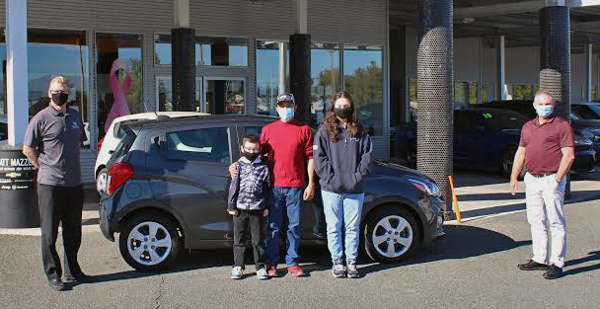
LAKE COUNTY, Calif. – The Lake County Office of Education announced that David Carter is the 2019-20 Drive for Perfect Attendance Main Event and recipient of the 2020 Chevy Spark offered through the event.
Carter is currently a fourth grader at Terrace Middle School but was gifted the car based on his attendance at Lakeport Elementary School in the Lakeport Unified School District.
The main event took place virtually due to the pandemic at 4 p.m. Thursday, Oct. 15.
Lake County Superintendent of Schools Brock Falkenberg conducted the event and did the drawings of all the recipients.
“The idea behind this event is to promote school attendance for all Lake County students and to help publicize the importance of regular school attendance,” Falkenberg said.
Along with the vehicle, Carter was also gifted funding to cover auto insurance for up to one year for $2,000 and 12 $100 gas cards to help pay for fuel for a year.
The other 11 finalists also received scholarships for postsecondary education that were started by the Lake County Office of Education and matched by the Redwood Credit Union. Each scholarship varied from $100 to $600.
Each month that a student has perfect attendance, their name goes into a drawing. Each district holds a drawing to select their student representative. How many representatives are chosen in a district is dependent on the student population.
“Whether you are attending school virtually or attending school physically, attendance has been shown to be the number one factor in student success,” Falkenberg said.
The Drive 4 Perfect Attendance is sponsored by the Habematolel Pomo of Upper Lake, in partnership with Mazzei Chevrolet and the Redwood Credit Union. It was also administered by the Lake County Office of Education to help promote school attendance for students in Lake County public schools.
The contest began on Aug. 10, 2019. It was scheduled to end on June 15, 2020, at 3 p.m. However, due to COVID-19, it ran through the month of February.
To view a list of all recipients, please visit www.lakecoe.org/Drive.