 How to resolve AdBlock issue?
News
- Details
- Written by: LAKE COUNTY NEWS REPORTS
LAKEPORT, Calif. — The Lake County Resource Conservation District and USDA Natural Resources Conservation Service invite farmers, ranchers, agriculture professionals, range owners, forest landowners and other stakeholders to participate in the first meeting of the local work group of Lake County.
The meeting will be held in two sessions on Thursday, Aug. 7, in the Mendocino College Lake Center Round Room at 2565 Parallel Drive in Lakeport.
Local work groups, or LWG, are held by Natural Resources Conservation Service, or NRCS, field offices in partnership with resource conservation districts to seek input on conservation programming at the local level.
The LWG creates a pathway for landowners and farmers to identify, prioritize and provide feedback on natural resource issues and related concerns within the county.
Input gathered at the local work group meeting will be submitted to the State Technical Committee to guide NRCS programs in California.
The LWG will bring together a diverse group of partners within Lake County to discuss, prioritize, and develop recommendations around local agricultural and forest health concerns.
Participation is open to nonprofit organizations, state and federal agencies, local governments, and members of the public with a vested interest in the natural resources of Lake County.
These meetings are required to be held annually, are advisory in nature, and have no enforcement or implementation authority.
This meeting of Lake County’s LWG will consist of two separate sessions.
Attendees will have the option of joining this meeting in-person or virtually via Zoom. The morning session, from 9:30 to 11:30 a.m., will focus on agriculture and rangeland, and the afternoon session, from 1:30 to 3:30 p.m., will focus on forest health and wildfire resilience.
Due to space constraints, please limit attendance to a maximum of three representatives per organization.
Please reach out to Wren Ward, LCRCD Forestry Technician, at
- Details
- Written by: Elizabeth Larson
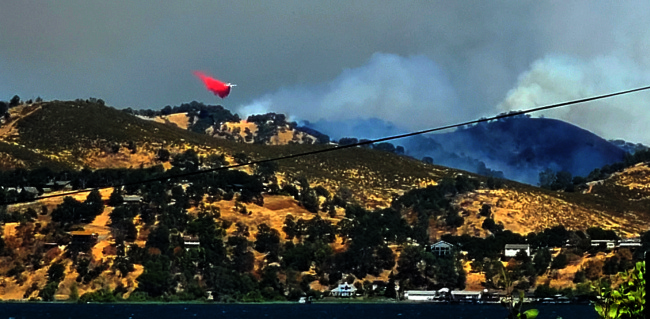
LAKE COUNTY, Calif. — Firefighters from multiple agencies and counties are in Clearlake this afternoon fighting a wildland fire that has prompted evacuations in some parts of the city.
The Lake fire was first reported at 2:20 p.m. Sunday at Nacimiento Lake Drive and Oak Street, south of Borax Lake in Clearlake.
As of 4:30 p.m., Cal Fire reported over the air that the blaze had burned 340 acres, making it the largest fire of the summer season in Lake County so far. As of 5:15 p.m., it was 5% contained.
Radio traffic indicated at least one structure may have been burned.
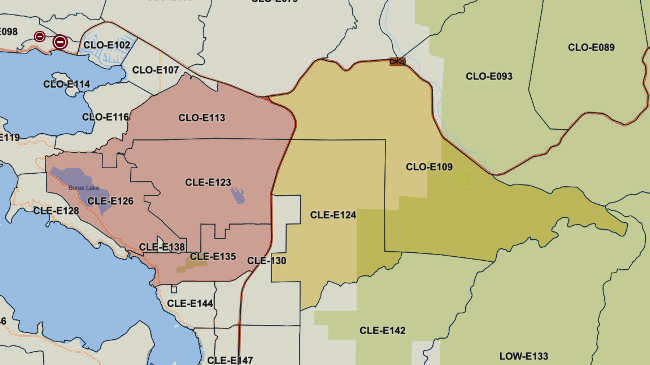
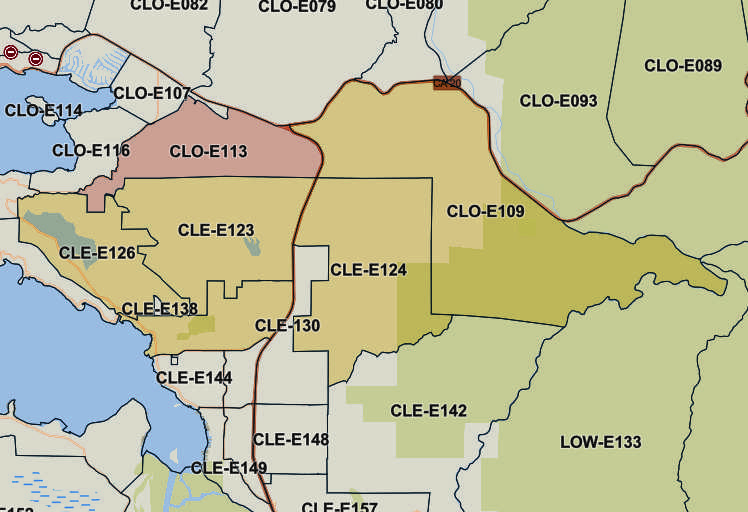
Mandatory evacuation zones as of 4:30 p.m. were CLO-E113, CLE-E123, CLE-E126 and CLE-E13. Advisory evacuation zones by that time were CLO-E109 and CLE-E124.
Just after 5 p.m., all but one of the mandatory evacuations were reduced to advisory, according to a radio report from Lake County Fire Chief Willie Sapeta.
The one remaining mandatory zone at that point was CLO-E113, and it was reduced to advisory a short time later.
Zones can be seen here.
Shortly before 2:30 p.m., the Clearlake Police Department issued a Nixle alert asking people to avoid the area of East Lake Drive and Second Street due to the fire.
About 10 minutes later, the agency issued its first evacuation advisory for everything east of zones CL-E126, which includes Borax Lake, and CL-E123, which is to the east of that zone.
As of 3:30 p.m., mandatory evacuations were ordered for the area of Acacia Street to Highway 53 and north of Eastlake Drive, with advisory evacuations for Highway 53 east from Ogulin Canyon and north of Ogulin Canyon Road.
Fifteen minutes later, Clearlake Police reported the mandatory evacuations were expanded from Acacia Street west to 16th Street and Eastlake Drive north, Acacia Street east to Highway 53 and Old Highway 53 north of Burns Valley Road east to Highway 53. At about the same time, cell phones lit up with the warning.
Incident command has pulled in firefighters from Colusa and Mendocino counties, with air resources coming from Ukiah. Lake County Fire Protection District and other Lake County resources are part of the multi-agency firefighting effort.
A report of a fire on Mark West Springs Road near Santa Rosa just after 4:15 p.m. resulted in a brief redirect of two tankers from the fire, but after air resources for that new fire.
Scanner traffic shortly before 4:45 p.m. indicated good progress is being made on the Lake fire, with retardant and dozer lines being strengthened ahead of bringing in ground crews.
Reports from the scene stated that firefighters are working to protect structures, with retardant drops a key part of that work.
Cal Fire said the cause remains under investigation.
At 5:20 p.m., dispatch reported receiving a report about a spot fire near Pomo Elementary, with firefighters responding.
The remaining tankers were released about 5:30 p.m., at which point the retardant work was done, according to radio reports.
Three helicopters continued to work the scene at that time, along with dozers on the ground.
Forward progress was reported to have been stopped at 6:13 p.m., according to radio traffic.
Incident command said the fire was holding at 340 acres, with containment up to 25%.
By that point, incident command was arranging to have the helicopters prepare to begin departing the fire in order to be back at base by dark.
All evacuation warnings and advisories were lifted as of 6:56 p.m., according to radio traffic.
Cal Fire said the cause remains under investigation.
Email Elizabeth Larson at
- Details
- Written by: Bryan Pride
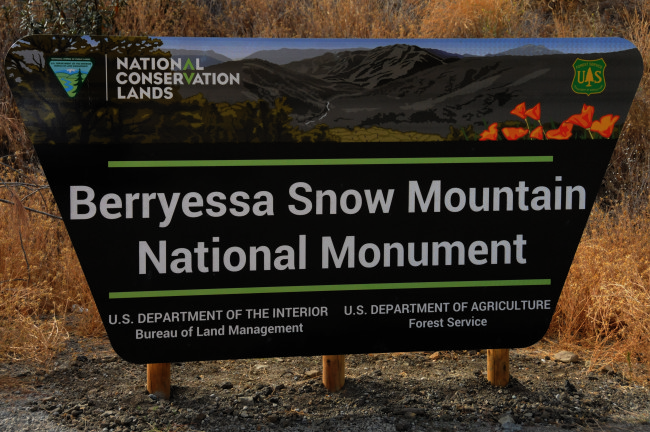
NORTHERN CALIFORNIA — On July 10, the Berryessa Snow Mountain National Monument celebrated its 10th anniversary, a milestone that showcases what becomes possible when communities unite to protect irreplaceable landscapes.
The monument's designation in 2015, followed by its expansion to include Molok Luyuk in 2024, stands as a testament to grassroots conservation success in the heart of Northern California's inner coastal range.
Spanning 344,476 acres, the Berryessa Snow Mountain National Monument holds exceptional biodiversity and ecological integrity that ranks among the top 5% of all United States Forest and Bureau of Land Management properties in the contiguous United States.
The ancient serpentine soil of the monument is the foundation of the vast landscape, creating one of California’s most unique ecosystems.
These distinctive soils nurture rare plant species found nowhere else on Earth, including the delicate adobe lily (Fritillaria pluriflora) and the scythleaf onion (Allium falcifolium).
Such botanical treasures represent thousands of years of evolutionary adaptation, harboring genetic diversity that, if lost, can never be recovered.
The specialized ecosystems that serpentine soils support have evolved in isolation, creating rare biological communities.
But the monument's significance extends far beyond its botanical rarities and unique soils. It holds a deep history of indigenous culture and heritage. This landscape has witnessed 20,000 years of documented cultural change and development.
The monument served as a key connector and trade route used by indigenous communities. Historic trail networks once connected Patwin, Pomo, Lake Miwok, and Wappo peoples, positioning this area at the center of extensive trade networks that linked the Clear Lake Basin with the Sacramento Valley.
Beyond the ecological and cultural significance, the same serpentine geology that creates the monuments unique biodiversity, also shaped early California history.
From the 1860s through the 1970s, the Sulphur Creek mining district extracted mercury that was used for gold mining throughout the Sierra Nevada and regional mines.
Miners and their families established the Sulphur Creek village during the mid-to-late 1800s, creating communities and infrastructure that led to the broader economic development of California during the Gold Rush era.
The geological foundation weaves together the monument's environmental treasures, Indigenous heritage, and Gold Rush history into a singular narrative of place demonstrating how landscape, ecology, and human story interconnect across millennia.
Today, the monument represents a new chapter in conservation leadership. Co-stewardship agreements between the Bureau of Land Management and indigenous communities create a powerful model for partnerships in land management, directly supporting federal and state mandates to integrate traditional ecological knowledge into land management practices.
The monument's protection also contributes significantly to California's ambitious 30x30 initiative aiming to protect 30% of lands and waters by 2030. These efforts address the biodiversity crisis and climate change by safeguarding critical habitat corridors and carbon storage capacity.
Perhaps most importantly, the Berryessa Snow Mountain National Monument proves that conservation enhances public access rather than restricts it.
The monument provides improved trail management and diverse recreational opportunities including OHV use, mountain biking, and hiking, welcoming visitors to experience these protected landscapes responsibly.
As we celebrate this 10th anniversary, the monument stands as proof that grassroots organizing and local advocacy can achieve federal conservation action.
Community voices influenced national policy and secured permanent protection for the Berryessa Snow Mountain landscape.
Demonstrating how our public lands are cherished by recreationists, Indigenous communities, scientists, and nature lovers alike.
The Berryessa Snow Mountain National Monument showcases that when communities come together around shared values of protection and stewardship, remarkable conservation victories become possible.
Its first decade marks not an ending, but the beginning of a conservation model ready for replication across California and beyond.
Bryan Pride is policy director for Tuleyome, a 501 (c)(3) nonprofit conservation organization based in Woodland, California. For more information go to www.tuleyome.org.
- Details
- Written by: LAKE COUNTY NEWS REPORTS
California is expanding its historic commitment to local journalism with a $15 million budget allocation for fellowships to early-career reporters and editors and training to strengthen the economic viability of news outlets.
This commitment will fund another infusion of California Local News Fellows — the nation’s largest publicly funded journalism initiative based at UC Berkeley Journalism — and will expand the program to include editing fellows.
Lingzi Chen, staff reporter for Lake County News, is a California Local News Fellow and part of the program’s second cohort. She joined the publication in September 2024.
Leadership and sustainability training and support for California newsrooms will be provided by the Maynard Institute’s Propel Initiative, in collaboration with California Black Media, the Latino Media Collaborative and American Community Media.
“California is stepping up once again to support local journalism at a time when our democracy and the cohesion of our communities depend on fact-based reporting,” said Elena Conis, interim dean of UC Berkeley Journalism. “The state’s historic commitment signals that journalism is a precious public resource that contributes to the health and well-being of our state.”
“This funding strengthens the people and organizations anchoring local journalism in communities across California,” said Martin G. Reynolds, co-executive director of the Robert C. Maynard Institute for Journalism Education. “It recognizes that the work these outlets and journalists do every day is essential to a democratic and informed society. By investing in those closest to the story, California is building a future where local news is not only sustainable, but truly reflective of the people it serves. The Institute is proud to work alongside Berkeley Journalism and our Propel partners in this historic, community-led coalition — a model for how states can support journalism that serves all of their residents.”
The FY26 budget will support California Local News Fellowships — in reporting and editing — to begin in 2026 and continue through 2028. The Maynard Institute’s Propel Initiative will equip journalists and publishers with practical tools for leadership and business sustainability, helping local outlets build long-term strength and resilience.
“Even in tight financial times, independent journalism, which underpins a citizen-informed democracy, is deserving of priority support,” said former State Senator Steve Glazer — who spearheaded a $25 million allocation in 2023 to launch the California Local News Fellowship Program. “I appreciate the legislative leadership by Senator Catherine Blakespear (D-Encinitas) and Assemblymember Marc Berman (D-Menlo Park) for championing this program’s renewal and expansion. They were supported by budget leaders Senators Scott Wiener (D-San Francisco) and John Laird (D-Santa Cruz) and Assemblymembers Jesse Gabriel (D-Encino) and David Alvarez (D-San Diego).” Glazer championed this latest effort as a volunteer.
The California Local News Fellowship program currently supports more than 70 full-time reporters (with full-time pay and benefits), who report approximately 100 stories per week.
Fellows such as Chen cover critical stories on immigration, climate change, and federal policies that affect Californians, especially in largely underserved communities.
They are based in newsrooms across the state, in counties that account for approximately 92 percent of California’s population.
A third cohort of full-time reporting fellows, supported by the state’s initial investment, will start working in newsrooms this fall.
The Propel Initiative is a statewide training and leadership program that supports the people who power California’s local newsrooms. The initiative prioritizes support for ethnic media and community-based outlets, while also serving journalists and publishers across the journalism sector.
Through coaching, business sustainability training, editorial leadership development, and peer learning, Propel equips participants with the tools and support needed to build a more resilient and representative local news ecosystem.
“This approved fund is significant in terms of the state recognizing and supporting the crucial role of local news media in helping promote and preserve democracy in these trying times,” said Sandy Close, executive director of American Community Media.
“How we got here is historic,” said Julian Do, American Community Media’s co-director, “as all media sectors and groups — from mainstream and multicultural news outlets to journalism schools, unions, and media groups — have come together with one goal: to serve the public.”