 How to resolve AdBlock issue?
News
- Details
- Written by: Elizabeth Larson
Public Health Officer Dr. Gary Pace said Lake County is now in the purple tier of the state’s Blueprint for a Safer Economy after weeks of being in the red, or second most restrictive, tier.
Lake is now among 51 of 58 counties in the purple tier, representing 39.7 million people or 99.1 percent of California's population.
Pace did not give an update on the total number of cases in Lake County. The last time Public Health updated the numbers on its website was Wednesday, and on Saturday those numbers remained unchanged, with 886 cases and 19 deaths reported.
Across California, the caseload continues to climb. The Public Health departments of the state’s 58 counties reported a total of approximately 1,195,649 cases and 19,122 deaths as of Saturday night.
Impacting Lake County’s caseload is an outbreak that is continuing in the Lake County Jail, Pace said.
In addition, Pace said a large case cluster has emerged in the Native American community, “a variety of businesses are experiencing new cases, and we see continued spread in households and social settings. Many people had smaller gatherings in observance of Thanksgiving, and we expect a significant post-holiday elevation in numbers.”
Over the course of the week, Lake County’s hospitalizations have nearly doubled. Pace said 11 people were hospitalized due to COVID-19-related issues on Friday, which is about twice the number of hospitalizations the county has had in the last month.
Pace said eight of those patients have since been transferred to other counties.
“Our hospitals are maintaining now, and plans are in place if there are significant surges,” he said.
Epidemiologist Sarah Marikos is tracking COVID-19 case trends in Lake County, and has found that the positivity rate has tripled over the last three weeks, from 1.9 percent to 6.3 percent, Pace said. During the same period, the county’s daily case rate increased about 2.5 times, from 5 to 13 per 100,000.
In addition, since mid-October, there has been a steady increase in the weekly number of cases, from a low of 21 per week to 57 in mid-November. For the week of Nov. 22 to 28, there already are 39 known cases, Pace reported.
Regarding how people are becoming infected, Pace said Marikos has found that from Nov. 1 to 20, nearly 2 in 5 cases – or 39 percent – are believed to have resulted from community contact, and about 1 in 3 via household contact.
“Limiting community transmission is key to decreasing the overall number of cases, and it will reduce the number of people who become infected through household contact,” said Pace.
Marikos’ research has found that in November, about 80 percent of the known cases lived in the following places: Kelseyville (26 percent of cases), Clearlake (21 percent), Lakeport (20 percent), Clearlake Oaks (8 percent) and Hidden Valley Lake (5 percent).
Cases in November have increased among white, non-Hispanic individuals and Native Americans, and there has been a decrease in Latino cases, Pace reported.
Lake County now under increased restrictions; sheriff won’t enforce orders
Along with being moved into the most restrictive COVID-19 tier comes enhanced restrictions on businesses and social movement in Lake County that Pace said will go into effect on Sunday in an effort to slow the spread of this virus.
Among the restrictions, schools that were already open can remain open, while schools that have not yet opened need to remain closed until the county returns to the red tier. Pace said elementary schools can apply for a waiver that may allow reopening.
As for businesses, Pace said hair salons, personal care services and barbershops can remain open with modifications, and retail establishments can open indoors with modifications and a maximum capacity of 25 percent.
Restaurants cannot have indoor dining and must go to outdoor-only with modifications. Also required to move to outdoors-only activities are museums, places of worship, and gyms and fitness centers, Pace said.
Only outdoor private gatherings are permitted, with modifications, with a maximum of three households for a two-hour duration.
Pace said Lake County also will now be under the limited stay at home order issued by the state Public Health officer on Nov. 19.
That order requires that all gatherings with members of other households and all activities conducted outside the residence, lodging or temporary accommodation with members of other households cease between 10 p.m. and 5 a.m. “except for those activities associated with the operation, maintenance, or usage of critical infrastructure or required by law.” It doesn’t apply to the homeless.
The full order can be found here.
In response to the state’s action on Saturday, Sheriff Brian Martin – whose department for weeks has been working to control the jail outbreak – issued a statement on his Facebook page in which he said that Government Code Section 8627 authorizes the governor, during a state of emergency, to “promulgate, issue, and enforce such orders and regulations as are deemed necessary.”
Government Code Section 8567 states such orders “shall have the force and effect of law” and Section 8665 makes violation of such an order a misdemeanor, Martin said.
“However, section 26602 gives the sheriff the authority, but not the obligation to enforce such orders,” Martin noted.
“In accordance with the authority granted under section 26602, the Lake County Sheriff’s Office will not be determining compliance with, or enforcing compliance of any health or emergency orders related to curfews, staying at home, or other social gathering inside or outside the home, maximum occupancy, or mask mandates,” Martin said.
“Further, we will not dispatch deputies for these purposes; callers will be transferred or advised to contact the County Public Health Department, in accordance with Health and Safety Code section 101030. Of course, if there is potential criminal behavior or the potential for impacts to public or personal safety, we will continue to respond appropriately,” he said.
Martin concluded, “Please understand this applies only to the Lake County Sheriff’s Office. Other State, County, and City agencies may be actively enforcing these orders.”
Meanwhile, Pace is asking the community to take the coronavirus seriously. “It is spreading freely throughout the community now,” he said.
Pace added, “Stay home, wear masks, and be super careful. The next few months will be tough, but we will make it through this period a lot better off if we consider each other’s needs and vulnerabilities when we are thinking about going out and doing things with other people.”
Email Elizabeth Larson at
- Details
- Written by: Yasmin Anwar
Even average residents of wealthy countries belonging to the Organization for Economic Cooperation and Development, or OECD, such as Japan, were on par with or outliving affluent Americans in 2018, said UC Berkeley demographer Magali Barbieri, associate director of the Human Mortality Database and author of the report funded by the Society of Actuaries and published Nov. 17.
“Life expectancy for the most affluent American men was one year less than for the average Japanese man,” Barbieri said. “Meanwhile, the gap between average Japanese women and the most affluent American women reached nearly 3.5 years.”
Using U.S. Census and other national vital statistics data, Barbieri tracked mortality rates for residents in dozens of U.S. counties based on education, income, employment, occupation, housing costs and quality, and other socioeconomic characteristics. She calculated the average lifespans of men and women, separately, in all these counties for every year from 1999 to 2018.
Notably, Barbieri discovered that, in 2018, men in the most affluent U.S. category could expect to live at least seven years longer than those in the most disadvantaged U.S. group (80.5 vs. 73.2 years). For women, that gap was six years (84.9 vs. 79.9 years). The socioeconomic gap was particularly high for children and for adults between the ages of 40 and 60.
By comparison, the socioeconomic gap in life expectancy in 1999 amounted to 5.5 years for men and 3.4 years for women.
Although she did not factor in data for 2019 and 2020, which is still being collected, mortality rates in the U.S. and worldwide are projected to rise sharply due to the COVID-19 pandemic.
Over the last century, life expectancy in the United States and other OECD nations has risen at a rate of three to four months per year.
But Barbieri found that, after 2010, life expectancy in the U.S. leveled off and then decreased from 2014 to 2017, going up slightly in 2018. The higher death toll, she said, is partly due to the opioid epidemic and unsuccessful efforts to control cardiovascular disease, the leading cause of death in the U.S.
While the most disadvantaged U.S. counties saw a rise in mortality between 2010 and 2014, the life expectancy of affluent Americans increased only slightly over that same period.
As for how the lifespan of Americans compares to that of other industrialized countries, Barbieri finds the U.S. is losing ground.
“Overall, Americans are lagging further and further behind in life expectancy, compared to similarly wealthy democratic countries where mortality has continued to decline at a relatively fast pace over the first two decades of the 21st century,” Barbieri said.
“Only the 10 percent of Americans in the most affluent U.S. counties can now expect to live as long as their peers in similarly wealthy nations,” she added. “And, when compared with Japan where the length of life is particularly long, and where progress has continued unabated, all socioeconomic categories of Americans are falling further and further behind.”
Yasmin Anwar writes for the UC Berkeley News Center.
- Details
- Written by: Elizabeth Larson
Dogs available for adoption this week include mixes of husky, Labrador Retriever, pit bull, heeler and Shar Pei.
Dogs that are adopted from Lake County Animal Care and Control are either neutered or spayed, microchipped and, if old enough, given a rabies shot and county license before being released to their new owner. License fees do not apply to residents of the cities of Lakeport or Clearlake.
The following dogs at the Lake County Animal Care and Control shelter have been cleared for adoption (additional dogs on the animal control Web site not listed are still “on hold”).
Call Lake County Animal Care and Control at 707-263-0278 or visit the shelter online at http://www.co.lake.ca.us/Government/Directory/Animal_Care_And_Control.htm for information on visiting or adopting.

Male husky
This male husky has a medium-length black and white coat and blue eyes.
He’s in kennel No. 22, ID No. 14194.

Female pit bull terrier
This young female pit bull terrier has a short brown coat.
She is in kennel No. 25, ID No. 14181.

Male pit bull terrier
This male pit bull terrier has a short gray and brindle coat.
He is in kennel No. 26, ID No. 14138.
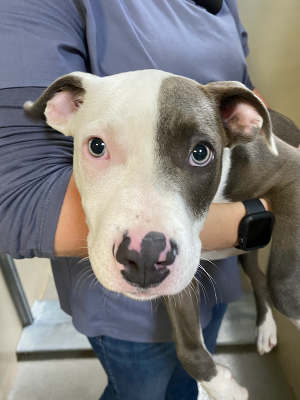
Male pit bull terrier
This young male pit bull terrier has a short blue and white coat.
He is in kennel No. 28, ID No. 14198.
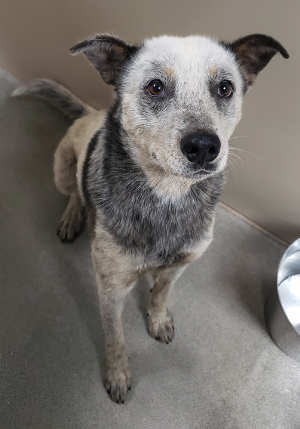
Male heeler-Labrador Retriever
This male heeler-Labrador Retriever mix has a short black and white coat.
He is in kennel No. 29, ID No. 14178.

Male pit bull-Shar Pei
This male pit bull-Shar Pei has a short brown coat.
He is in kennel No. 30, ID No. 14177.
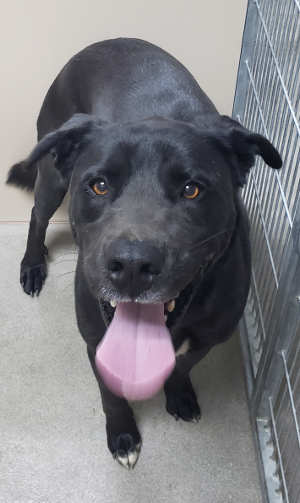
‘Hugo’
“Hugo” is a male pit bull terrier with a medium-length black and white coat.
He has been neutered.
He’s in kennel No. 34, ID No. 14174.
Email Elizabeth Larson at
- Details
- Written by: NATIONAL AERONAUTICS AND SPACE ADMINISTRATION

The hungriest of black holes are thought to gobble up so much surrounding material they put an end to the life of their host galaxy.
This feasting process is so intense that it creates a highly energetic object called a quasar – one of the brightest objects in the universe – as the spinning matter is sucked into the black hole’s belly.
Now, researchers have found a galaxy that is surviving the black hole’s ravenous forces by continuing to birth new stars – about 100 Sun-sized stars a year.
The discovery from NASA’s telescope on an airplane, the Stratospheric Observatory for Infrared Astronomy, can help explain how massive galaxies came to be, even though the universe today is dominated by galaxies that no longer form stars. The results are published in the Astrophysical Journal.
“This shows us that the growth of active black holes doesn’t stop star birth instantaneously, which goes against all the current scientific predictions,” said Allison Kirkpatrick, assistant professor at the University of Kansas in Lawrence Kansas and co-author on the study. “It’s causing us to re-think our theories on how galaxies evolve.”
SOFIA, a joint project of NASA and the German Aerospace Center, DLR, studied an extremely distant galaxy, located more than 5.25 billion light years away called CQ4479. At its core is a special type of quasar that was recently discovered by Kirkpatrick called a “cold quasar.”
In this kind of quasar, the active black hole is still feasting on material from its host galaxy, but the quasar’s intense energy has not ravaged all of the cold gas, so stars can keep forming and the galaxy lives on.
This is the first time researchers have a detailed look at a cold quasar, directly measuring the black hole’s growth, star birth rate, and how much cold gas remains to fuel the galaxy.
“We were surprised to see another oddball galaxy that defies current theories,” said Kevin Cooke, postdoctoral researcher at the University of Kansas in Lawrence, Kansas, and lead author of this study. “If this tandem growth continues both the black hole and the stars surrounding it would triple in mass before the galaxy reaches the end of its life.”
As one of the brightest and most distant objects in the universe, quasars, or “quasi-stellar radio sources,” are notoriously difficult to observe because they often outshine everything around them. They form when an especially active black hole consumes huge amounts of material from its surrounding galaxy, creating strong gravitational forces.
As more and more material spins faster and faster toward the center of the black hole, the material heats up and glows brightly. A quasar produces so much energy that it often outshines everything around it, blinding attempts to observe its host galaxy.
Current theories predict that this energy heats up or expels the cold gas needed to create stars, stopping star birth and driving a lethal blow to a galaxy’s growth. But SOFIA reveals there is a relatively short period when the galaxy’s star birth can continue while the black hole’s feast goes on powering the quasar’s powerful forces.
Rather than directly observing the newborn stars, SOFIA used its 9-foot telescope to detect the infrared light radiating from the dust heated by the process of star formation.
Using data collected by SOFIA's High-resolution Airborne Wideband Camera-Plus, or HAWC+ instrument, scientists were able to estimate the amount of star formation over the past 100 million years.
“SOFIA lets us see into this brief window of time where the two processes can co-exist,” said Cooke. “It’s the only telescope capable of studying star birth in this galaxy without being overwhelmed by the intensely luminous quasar.”
The short window of joint black hole and star growth represents an early phase in the death of a galaxy, wherein the galaxy has not yet succumbed to the devastating effects of the quasar.
Continued research with SOFIA is needed to learn if many other galaxies go through a similar stage with joint black hole and star growth before ultimately reaching the end of life.
Future observations with the James Webb Space Telescope, which is scheduled to launch in 2021, could uncover how quasars affect the overall shape of their host galaxies.
SOFIA is a joint project of NASA and the German Aerospace Center. NASA’s Ames Research Center in California’s Silicon Valley manages the SOFIA program, science, and mission operations in cooperation with the Universities Space Research Association, headquartered in Columbia, Maryland, and the German SOFIA Institute at the University of Stuttgart.
The aircraft is maintained and operated by NASA’s Armstrong Flight Research Center Building 703, in Palmdale, California. The HAWC+ instrument was developed and delivered to NASA by a multi-institution team led by NASA’s Jet Propulsion Laboratory.