How to resolve AdBlock issue?
News
- Details
- Written by: Elizabeth Larson
The commission will meet via webinar beginning at 5:30 p.m. Wednesday, Jan. 13.
The agenda is available here.
To speak on an agenda item, access the meeting remotely here; the meeting ID is 986 6166 5155.
Comments can be submitted by email to
Please indicate in the email subject line "for public comment" and list the item number of the agenda item that is the topic of the comment. Comments that read to the council will be subject to the three minute time limitation (approximately 350 words). Written comments that are only to be provided to the council and not read at the meeting will be distributed to the council prior to the meeting.
The meeting will begin with the swearing-in of new commissioners Scott Barnett, Kurt Combs and Nathan Maxman.
The newly seated commission will then elect its officers for 2021.
Other agenda items include a Brown Act workshop and an overview of the roles and responsibilities of the Lakeport Planning Commission.
The commission also has been asked to consider Lake County’s recently adopted ordinance permitting microenterprise home kitchens in accordance with AB 626 and to direct city staff accordingly.
The commission also will review the Community Development Department’s pending projects list.
Email Elizabeth Larson at
- Details
- Written by: Lake County News reports
California is expanding access to Medi-Cal for older adults and people with disabilities.
The legal advocacy agency Justice in Aging recently issued an alert that reminds us that, effective Dec. 1, 2020, two important changes took place.
First, California increased its Medi-Cal income eligibility limit to 138 percent of the federal poverty level for its Aged, Blind and Disabled Federal Poverty Level Program.
This means that the income eligibility limit is now $1,468 for one person and $1,983 for a couple, and will increase each year in April.
People who are currently receiving Medi-Cal with a share of cost may now be eligible for free Medi-Cal.
The California Department of Health Care Services sent a letter to people who may be eligible, but if you did not get the memo, or have in the past thought you made too much to apply for Medi-Cal, this is a good time to contact your local Medi-Cal office to see if this change benefits you.
The cost of medical insurance premiums can offset one’s countable income, so even those with higher incomes may be found eligible if paying supplemental, prescription, vision, dental or other medical insurance plans brings their incomes to below the eligibility thresholds. Medi-Cal’s asset limits remain the same.
Additionally, California will stop flipping Medi-Cal recipients between free and share of cost Medi-Cal based on who is paying the Medicare Part B premium.
This problem has existed for some time and can cause significant disruptions, including disenrollment from managed care and unaffordable health care costs during the months when a recipient is on share of cost Medi-Cal.
The new rule allows the county welfare departments to deduct the same amount as the Part B premium regardless of whether the recipient is currently paying it or the state is paying it as a benefit of free Medi-Cal.
Individuals who are applying for the first time must still pay the premium themselves for the state to subtract the payment as an income disregard. However, once a person is eligible for Medi-Cal, the person will continue to be eligible for free Medi-Cal.
To learn more about this or other resources for older adults in Lake and Mendocino counties, contact the Senior Information & Assistance Program at Community Care at 707-468-5132, or visit www.SeniorResourceDirectory.org.
- Details
- Written by: Brett B. Palm, University of Washington
The year 2020 will be remembered for many reasons, including its record-breaking wildfires that turned San Francisco’s skies an apocalyptic shade of red and blanketed large parts of the West in smoke for weeks on end.
California experienced five of its six largest fires on record in 2020, including the first modern “gigafire,” a wildfire that burned over 1 million acres. Colorado saw its three largest fires on record.
While the smoke can make for beautiful sunsets, it can also have dire consequences for human health.
I am an atmospheric chemist, and the atmosphere is my laboratory. When I look at the sky, I see a mixture of many thousands of different chemical compounds interacting with each other and with sunlight.
The reactions and transformations in the atmosphere cause wildfire smoke to change dramatically as it travels downwind, and studies have shown that it can grow more toxic as it ages. In order to accurately forecast the effects of wildfire emissions on downwind populations and issue more-targeted air quality warnings as wildfire seasons worsen, we have to understand which chemicals are being emitted and how smoke changes with time.
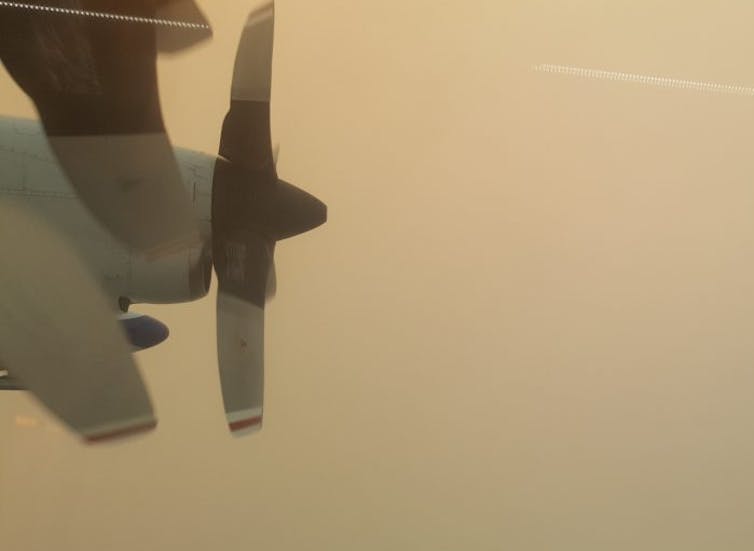
To figure that out, my colleagues and I flew airplanes into the smoke plumes of some of the West’s large wildfires.
How we study wildfires
Large wildfires and the way wind carries their smoke cannot be easily replicated in a laboratory. This makes them difficult to study. One of the best ways to learn about real wildfire smoke chemistry is to sample it directly in the atmosphere.
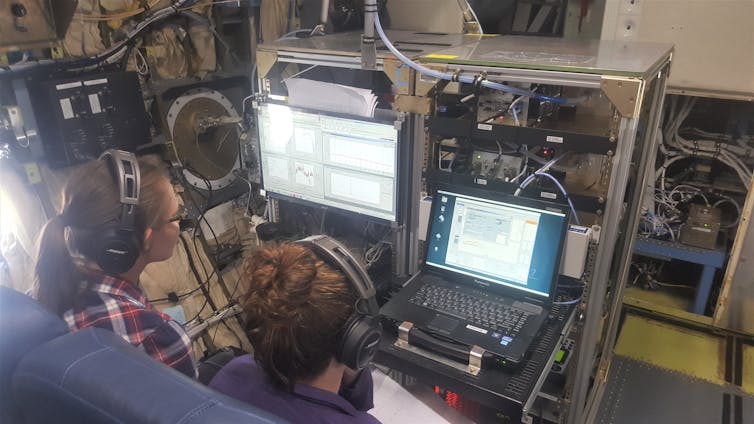
In 2018 and 2019, my colleagues and I crisscrossed the sky over active wildfires in specialized airplanes loaded with scientific instruments. Each instrument is designed to sample a different part of the smoke, often by literally sticking a tube out the window.
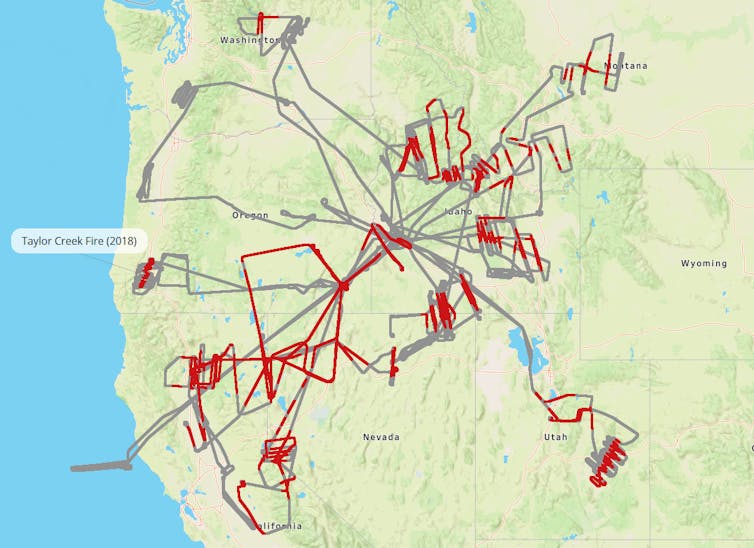
Wildfire smoke is far more complex and dynamic than meets the eye. It contains thousands of different compounds, most of which are molecules containing various amounts of carbon, hydrogen, nitrogen and oxygen atoms. There are gases (individual molecules) as well as particles (millions of molecules coagulated together).
No single instrument can measure all of these molecules at once. In fact, some specific compounds are a challenge to measure at all. Many scientists, including myself, dedicate their careers to designing and building new instruments to improve our measurements and continue to advance our understanding of the atmosphere and how it affects us.
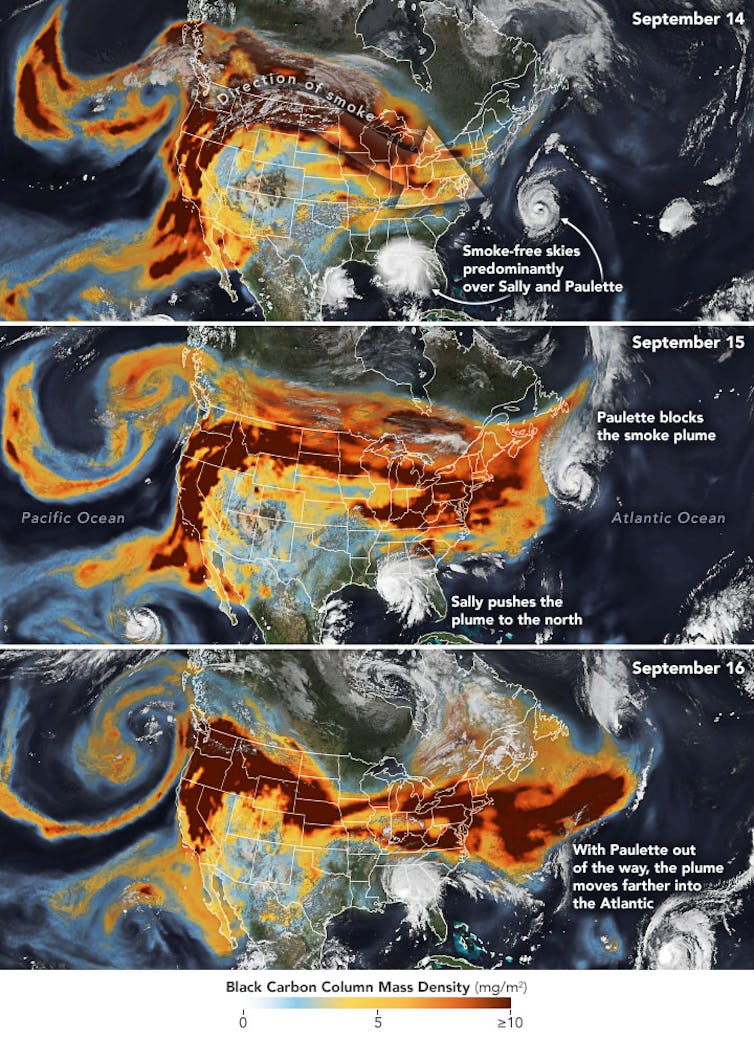
In newly published research from the 2018 wildfires, my colleagues and I showed how the smoke particles changed rapidly as they were carried downwind.
Some of the particles were evaporating into gases, similar to a rain puddle evaporating into water vapor when the Sun comes out. At the same time, some of the gases in smoke were going through reactions to form new particles, similar to water vapor condensing to form a cloud or dew droplets. Meanwhile, chemical reactions were occurring, changing the molecules themselves.
As these molecules reacted with sunlight and other gases in the atmosphere, the smoke was fundamentally transformed. This is what we mean when scientists talk about smoke “aging” or getting “stale” over time. Other recent research has started to show how wildfire smoke can become more toxic as it ages.
What do all these changes mean for health?
The health damage from smoke is largely a result of how much PM2.5 it contains. These are tiny particles, a fraction of the width of a human hair, that can be breathed deep into the lungs where they can irritate the respiratory tract. Even short-term exposure can aggravate heart and lung problems.
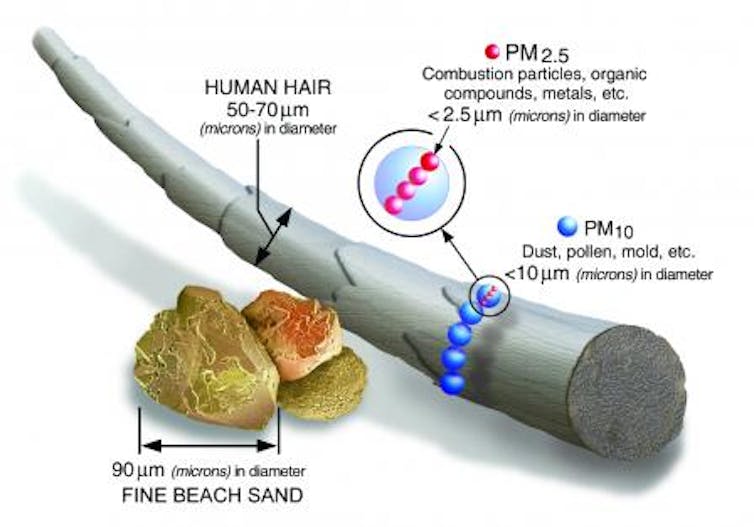
Chemical reactions control how much PM2.5 is in wildfire smoke as it is transported away from the fires and into population centers. Using our aircraft measurements to understand these processes, we chemists can better predict how much PM2.5 will be present in aged smoke.
Combined with meteorology forecasting that predicts where the smoke will go, this could lead to improved air quality models that can tell people downwind whether they will be exposed to unhealthy air.
Better air quality forecasting
With wildfires increasingly in the news, more people have become aware of their own air quality. Resources such as AirNow from the U.S. Environmental Protection Agency provide current and forecasted air quality data, along with explanations of the health hazards. Local information is often available from state or regional agencies as well.
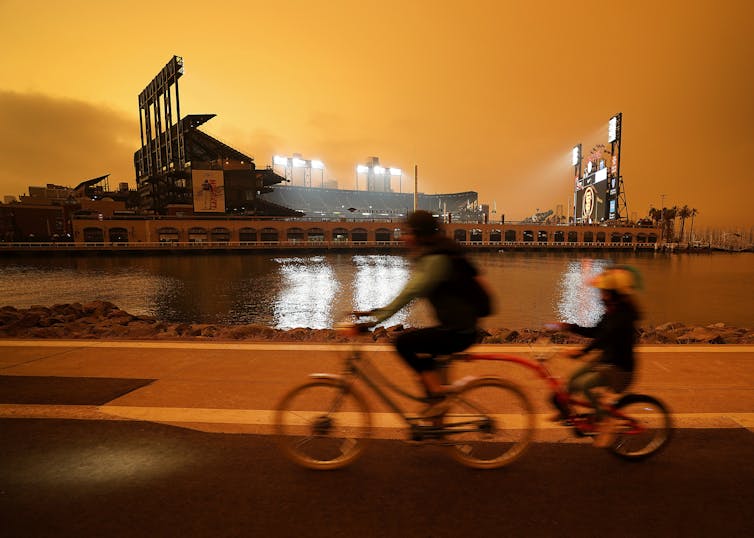
Air quality measurements and forecasts can help people avoid unhealthy situations, especially sensitive groups such as people with asthma. During predicted periods of unhealthy air quality, local or state governments can use forecasts to reduce other pollution sources, such as discouraging residential wood burning or high-emitting industrial activities.
Looking to the future, wildfire smoke is likely to be widespread across the West each year for several reasons. Rising temperatures are leaving the landscape drier and more flammable. At the same time, more people are building homes in the wildland-urban interface, creating more opportunities for fires to start.
A large community of scientists including me are working to better understand wildfire emissions and how they change as they blow into downwind communities. That knowledge will improve forecasts for air quality and health impacts of wildfire smoke, so people can learn to adapt and avoid the worst health consequences.
Brett B. Palm, Postdoctoral Researcher in Atmospheric Chemistry, University of Washington
This article is republished from The Conversation under a Creative Commons license. Read the original article.
- Details
- Written by: Nate Lillge
NORTHERN CALIFORNIA – Like all our neighbors throughout California and the Berryessa Snow Mountain National Monument region, Tuleyome has been impacted by the numerous, large fires that have swept through the state in the last couple of years.
Our properties throughout Lake, Yolo and Solano Counties have all burned in the past three years.
While Tuleyome did not lose any buildings, our hearts go out to those who have lost buildings, or worse.
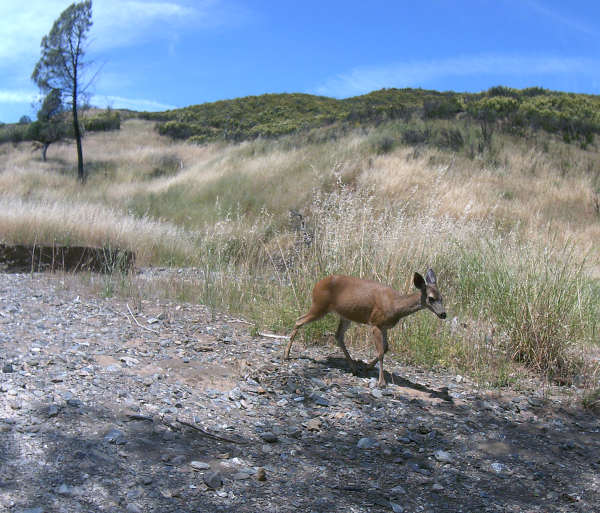
Tuleyome’s properties are mostly remote and difficult to access, so the fires have presented the opportunity for us and citizen scientists to study how wildlife has been impacted by and responded to the fires.
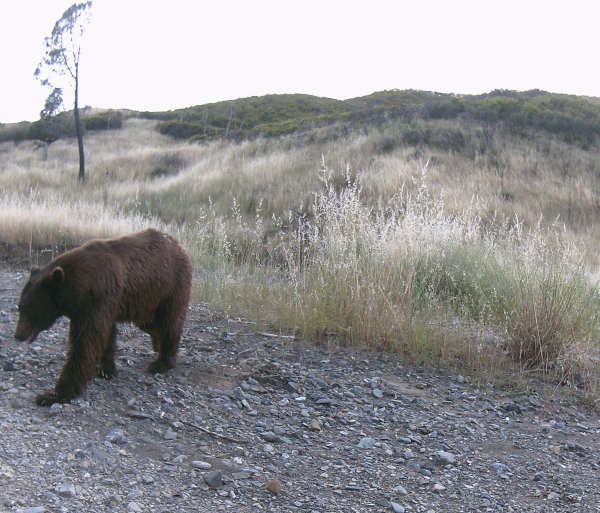
In fall 2018, cameras were placed at our Silver Spur Ranch property in Lake County which burned in the summer of 2018. We have been excited by what the cameras have seen: bears, bobcats, mountain lions, and more.
Feral pigs, wild boars, are not native to our region – they are descendants of the European wild boar and domestic swine – and can have a big impact on the environment.
While rooting around for roots, fungus, and other food, they can make it look like a rototiller was used on an entire hillside. These large animals can be nearly five times as heavy as mountain lions!
Black bears are relatively common in the Northern Inner Coast Range and multiple cameras have captured individuals at our property. These animals have claws on front and hind which help them dig to find food and to climb trees to escape predators. These large animals, weighing between 300 and 500 pounds, can reach speeds up to 35 miles per hour.
Bobcats are named for their bobbed tail which is one of the best ways to identify them. Their smaller size, pointed ears, spots, and round face also help distinguish them from mountain lions. They prey on a wide variety of small animals, rabbits, rodents, raccoons, but are able to take down prey that is much larger than they are. Bobcats are the most abundant wildcat in the United States, being native to every state and seen in Canada and south of Mexico City.
Mountain lions are the apex predator of the Berryessa Snow Mountain National Monument region. These secretive animals are very rarely seen but evidence of their presence is commonly found on trails.
Scat, prints, and even scraps can be found. Male lions have territories up to 100 square mile while females have smaller (60 square miles) territories. Generally, wherever there is prey, mountain lions can be found.
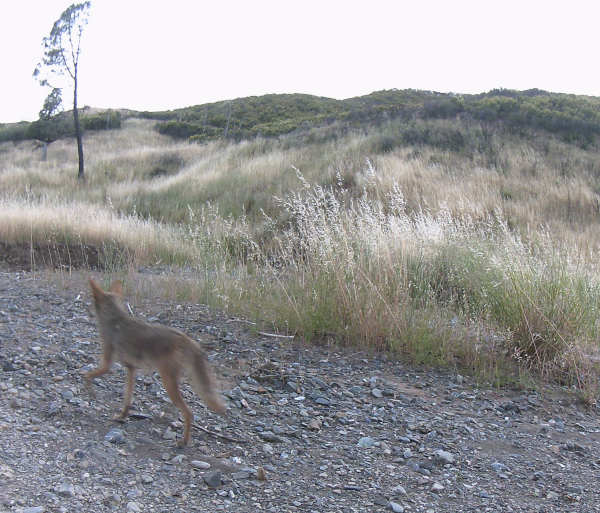
Arguably the most commonly seen mammalian predator is the coyote. Although they can be found in and around cities – including Sacramento and San Francisco! – they are at home in the wild.
They have an important role in the ecosystem by keeping rodent populations under control. Although they usually feed on rodents, our cameras have captured these animals carrying a deer head and even a grey fox!
Deer. They are not just in our neighborhoods. They are common throughout California and returned shortly after the fire swept through our property. Through our study, we have seen that there are a couple small groups that have made the property home. We have seen at least one fawn every spring.
The Berryessa Snow Mountain National Monument Region has evolved with fire as part of the natural process for thousands of years. The plants and animals that make the region their home have devised strategies to survive.
Recent fires have been more intense and burned large areas. Will plants and animals need to adapt their survival strategies to withstand these fires? The game camera survey at Tuleyome’s Silver Spur Ranch can help provide answers.
For more information about the project, visit Tuleyome’s website at www.tuleyome.org or contact Nate Lillge at
Nate Lillge is Tuleyome’s adventures and engagement director, a Certified California Naturalist and lead instructor for Tuleyome’s Certified California Naturalist class. Tuleyome is a 501(c)(3) nonprofit conservation organization based in Woodland, California. For more information visit www.tuleyome.org.