 How to resolve AdBlock issue?
News
- Details
- Written by: Elizabeth Larson
The California Highway Patrol’s Clear Lake Area office said Juan Torres, 28, was arrested for driving under the influence during the Saturday afternoon crash that killed 19-year-old Athena Karan, also of Santa Rosa.
The CHP said that at 4:33 p.m. Torres was driving his 2019 Honda Talon off-highway vehicle, or OHV, in the Indian Valley Reservoir area.
Riding with him was I. Rubio Velasquez, 22, of Santa Rosa, who was in the right seat, with Karan seated on her lap, the CHP said.
Torres was traveling in an easterly direction within the reservoir when he went over a large dip in the roadway, causing him to lose control of the vehicle, according to the report.
The CHP said the OHV subsequently rolled over, ejecting Karan, who sustained major injuries when she hit the ground and subsequently succumbed to her injuries at the scene.
Officer Greg Buchholz arrived on scene and determined that Torres, who suffered minor injuries, was operating the OHV while under the influence of an alcoholic beverage, the CHP said. Torres subsequently was placed under arrest and booked into the Lake County Jail.
The CHP said Velasquez sustained minor injuries and was transported by ambulance to Sutter Lakeside Hospital.
Email Elizabeth Larson at
- Details
- Written by: Lake County News reports
The Scotts Valley Energy Co., or SVEC, is bringing the first bioenergy/biochar production facility to its tribal lands in Lake County, said Tribal Chairman Shawn Davis.
Davis said the facility will utilize waste woody biomass mitigated from high fire threat areas or previously burned areas to create sustainable, clean electricity as well as produce biochar – a soil amendment used in agricultural production to improve soil moisture and nutrient retention lessening the amounts of water and fertilizer used which in turn will help better protect the environment.
“Additionally, this new technology – which produces no smoke or particulates, can help lessen the amount of open-pile burning that currently occurs on agricultural and forested lands releasing carbon and smoke,” said Davis.
The grant award in the amount of $248,000 will allow SVEC to create a feasibility toolkit that will allow tribes and other large businesses to determine energy usage, resource availability, micro-grid options, biomass fuel requirements and more.
“California recognizes the leadership of tribes in advancing strong clean air standards as well as
ambitious climate and energy goals,” said Christina Snider, tribal advisor to Gov. Gavin Newsom. “These grants provide opportunities to focus on new Tribal climate and energy planning activities.”
Funded by the California Energy Commission, or CEC, and administered in partnership with the California Strategic Growth Council, or SGC, the program focuses on the unique needs of tribal governments and the valuable ongoing role tribes serve in helping the state achieve its climate goals.
“The CEC is proud to provide funding to support Tribal climate leadership through this unique initiative,” said CEC Commissioner Karen Douglas. “These tribally-driven projects will bring important research and technological gains while helping ensure all communities benefit from access to the state’s clean energy investments.”
The grants range from $215,000 to $250,000 and support planning for a variety of climate change and clean energy projects, including energy storage, renewables, biomass, and community and energy resilience to climate impacts.
“The California Strategic Growth Council Team looks forward to building relationships and collaborating with the Tribal Government Challenge grantees to ensure projects advance Tribes’ goals and priorities around climate change, energy, and resilience,” said Louise Bedsworth, SGC’s executive director. “We commend all of the applicants for submitting thoughtful proposals and are eager to support the awardees as they begin their planning processes.”
“With over 100 federally recognized Tribes in Northern California, all of which live under the threat of catastrophic wildfire and the need for reliable, clean, and sustainable energy, we see SVEC’s small-scale bioenergy/biochar production facilities as a possible key to solve many issues facing Indian Country today, said Thomas Jordan, CEO of SVEC. “We look forward to the opportunity to create a feasibility toolkit for other tribes to make informed energy decisions.”
In addition to the Scotts Valley Energy Co., another enterprise of the Scotts Valley Band of
Pomo Indians is The Clean Carbon Co., or T3, which will take in the biochar created by the SVEC facilities and process it into activated charcoal, thanks to a grant from the Centers for Disease Control and Prevention.
This activated charcoal will be used in the production of much-needed N-95 respirators, and also can be used in drinking water filtration systems.
The Scotts Valley Band of Pomo Indians said it takes the threat of hazardous fuels reduction to mitigate the threat of wildfires very seriously as the tribe – and all residents of the county – have seen more than 60 percent of Lake County landmass burn in catastrophic wildfires over the past six years.
Another way they are helping to address this issue is by co-creating the not for profit Tribal EcoRestoration Alliance, which is a cross-cultural, multi-organizational collaborative that works to revitalize ecology, economy, and culture through indigenous-led stewardship including restoration work that mitigates the impacts of climate change and reduces the risk of uncharacteristic wildfires and incorporates traditional ecological knowledge.
The Tribal Government Challenge Program is also supporting a Statewide Gap Analysis to provide an assessment of tribes’ clean energy and climate change adaptation and resilience priorities. The analysis is led by Glendora-based firm Prosper Sustainability along with a consulting team including tribal professionals, and women- and Native American-owned businesses, all with extensive experience working with California Native American Tribes.
Tribal Government Challenge Planning Grant awardees include:
• The Big Valley Band of Pomo Indians (Lake County)
• The Karuk Tribe (Siskiyou County)
• The Kashia Band of Pomo Indians (Sonoma County)
• The Middletown Rancheria of Pomo Indians of California (Lake County)
• The Pit River Tribe (Shasta, Siskiyou, Modoc, and Lassen Counties)
• The Pala Band of Mission Indians, the Rincon Band of Luiseño Indians, and the San Pasqual Band
of Mission Indians (San Diego County)
• The Scotts Valley Band of Pomo Indians (Lake County)
• The Tule River Tribe (Tulare County)
- Details
- Written by: Elizabeth Larson
The foundation will host the Wrangler Round-Up drive-thru dinner on Saturday, Feb. 6.
It will take place from 5 to 7:30 p.m. at the fairgrounds, located at 401 Martin St. in Lakeport.
The fundraiser also will include an online auction at www.stockshowauctions.com.
The foundation was created in 2015 to support the fair.
It’s hard at work on the new fundraiser which is particularly important considering that the 2020 fair was canceled and the future of the Lake County Fairs – and fairs statewide – currently is unclear due to the far-ranging economic impacts of the pandemic.
The dinner will include barbecue tri-tip and chicken, vegetables, macaroni and cheese and a dinner roll for a ticket cost of $40 per person or $75 for two.
Tickets will be available online at www.lakecountyfairfoundation.com. The deadline to purchase tickets is Feb. 2.
Donations for the online auction are being requested. To donate call Katy at 707-272-9163.
For more information contact Jeff at 925-381-0359 or email
Donations to support the fair also can be mailed to the foundation at P.O. Box 967, Lakeport, CA 95453.
Email Elizabeth Larson at
- Details
- Written by: NATIONAL AERONAUTICS AND SPACE ADMINISTRATION
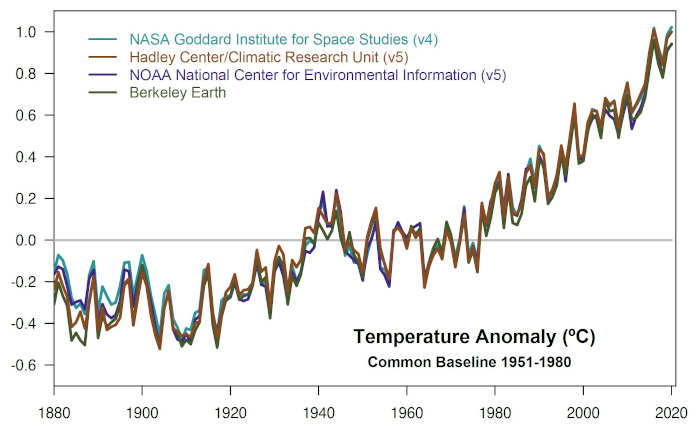
Earth’s global average surface temperature in 2020 tied with 2016 as the warmest year on record, according to an analysis by NASA.
Continuing the planet’s long-term warming trend, the year’s globally averaged temperature was 1.84 degrees Fahrenheit (1.02 degrees Celsius) warmer than the baseline 1951-1980 mean, according to scientists at NASA’s Goddard Institute for Space Studies, or GISS, in New York.
The year 2020 edged out 2016 by a very small amount, within the margin of error of the analysis, making the years effectively tied for the warmest year on record.
“The last seven years have been the warmest seven years on record, typifying the ongoing and dramatic warming trend,” said GISS Director Gavin Schmidt. “Whether one year is a record or not is not really that important – the important things are long-term trends. With these trends, and as the human impact on the climate increases, we have to expect that records will continue to be broken.”
A warming, changing world
Tracking global temperature trends provides a critical indicator of the impact of human activities – specifically, greenhouse gas emissions – on our planet. Earth's average temperature has risen more than 2 degrees Fahrenheit (1.2 degrees Celsius) since the late 19th century.
Rising temperatures are causing phenomena such as loss of sea ice and ice sheet mass, sea level rise, longer and more intense heat waves, and shifts in plant and animal habitats.
Understanding such long-term climate trends is essential for the safety and quality of human life, allowing humans to adapt to the changing environment in ways such as planting different crops, managing our water resources and preparing for extreme weather events.
Ranking the records
A separate, independent analysis by the National Oceanic and Atmospheric Administration, or NOAA, concluded that 2020 was the second-warmest year in their record, behind 2016.
NOAA scientists use much of the same raw temperature data in their analysis, but have a different baseline period (1901-2000) and methodology.
Unlike NASA, NOAA also does not infer temperatures in polar regions lacking observations, which accounts for much of the difference between NASA and NOAA records.
Like all scientific data, these temperature findings contain a small amount of uncertainty – in this case, mainly due to changes in weather station locations and temperature measurement methods over time.
The GISS temperature analysis, or GISTEMP, is accurate to within 0.1 degrees Fahrenheit with a 95 percent confidence level for the most recent period.
Beyond a global, annual average
While the long-term trend of warming continues, a variety of events and factors contribute to any particular year’s average temperature. Two separate events changed the amount of sunlight reaching the Earth’s surface.
The Australian bush fires during the first half of the year burned 46 million acres of land, releasing smoke and other particles more than 18 miles high in the atmosphere, blocking sunlight and likely cooling the atmosphere slightly.
In contrast, global shutdowns related to the ongoing COVID-19 pandemic reduced particulate air pollution in many areas, allowing more sunlight to reach the surface and producing a small but potentially significant warming effect.
These shutdowns also appear to have reduced the amount of carbon dioxide emissions last year, but overall CO2 concentrations continued to increase, and since warming is related to cumulative emissions, the overall amount of avoided warming will be minimal.
The largest source of year-to-year variability in global temperatures typically comes from the El Nino-Southern Oscillation, or ENSO, a naturally occurring cycle of heat exchange between the ocean and atmosphere.
While the year has ended in a negative (cool) phase of ENSO, it started in a slightly positive (warm) phase, which marginally increased the average overall temperature. The cooling influence from the negative phase is expected to have a larger influence on 2021 than 2020.
“The previous record warm year, 2016, received a significant boost from a strong El Nino. The lack of a similar assist from El Nino this year is evidence that the background climate continues to warm due to greenhouse gases,” Schmidt said.
The 2020 GISS values represent surface temperatures averaged over both the whole globe and the entire year. Local weather plays a role in regional temperature variations, so not every region on Earth experiences similar amounts of warming even in a record year.
According to NOAA, parts of the continental United States experienced record high temperatures in 2020, while others did not.
In the long term, parts of the globe are also warming faster than others. Earth’s warming trends are most pronounced in the Arctic, which the GISTEMP analysis shows is warming more than three times as fast as the rest of the globe over the past 30 years, according to Schmidt.
The loss of Arctic sea ice – whose annual minimum area is declining by about 13 percent per decade – makes the region less reflective, meaning more sunlight is absorbed by the oceans and temperatures rise further still. This phenomenon, known as Arctic amplification, is driving further sea ice loss, ice sheet melt and sea level rise, more intense Arctic fire seasons, and permafrost melt.
Land, sea, air and space
NASA’s analysis incorporates surface temperature measurements from more than 26,000 weather stations and thousands of ship- and buoy-based observations of sea surface temperatures.
These raw measurements are analyzed using an algorithm that considers the varied spacing of temperature stations around the globe and urban heating effects that could skew the conclusions if not taken into account.
The result of these calculations is an estimate of the global average temperature difference from a baseline period of 1951 to 1980.
NASA measures Earth's vital signs from land, air, and space with a fleet of satellites, as well as airborne and ground-based observation campaigns. The satellite surface temperature record from the Atmospheric Infrared Sounder instrument aboard NASA’s Aura satellite confirms the GISTEMP results of the past seven years being the warmest on record.
Satellite measurements of air temperature, sea surface temperature, and sea levels, as well as other space-based observations, also reflect a warming, changing world. The agency develops new ways to observe and study Earth's interconnected natural systems with long-term data records and computer analysis tools to better see how our planet is changing.
NASA shares this unique knowledge with the global community and works with institutions in the United States and around the world that contribute to understanding and protecting our home planet.
NASA’s full surface temperature data set – and the complete methodology used to make the temperature calculation – are available at https://data.giss.nasa.gov/gistemp.
GISS is a NASA laboratory managed by the Earth Sciences Division of the agency’s Goddard Space Flight Center in Greenbelt, Maryland. The laboratory is affiliated with Columbia University’s Earth Institute and School of Engineering and Applied Science in New York.
For more information about NASA’s Earth science missions, visit https://www.nasa.gov/earth.
- As the nation commemorates Martin Luther King Jr. Day, here are ways to learn more about him
- COVID-19 variant first found in other countries and states detected in several California counties, including Lake
- Board of Supervisors to hold special Jan. 19 meeting; reduction of in-person county services on the agenda