How to resolve AdBlock issue?
Refresh this page
How to resolve AdBlock issue?
Refresh this page
Lake County News,California
  • Home
    • Registration Form
  • News
    • Education
    • Veterans
    • Community
      • Obituaries
      • Letters
      • Commentary
    • Police Logs
    • Business
    • Recreation
    • Health
    • Religion
    • Legals
    • Arts & Life
    • Regional
  • Calendar
  • Contact us
    • FAQs
    • Phones, E-Mail
    • Subscribe
  • Advertise Here
  • Login
How to resolve AdBlock issue?
Refresh this page

News

CDFW introduces new digital tools to track wildlife connectivity, barriers

Details
Written by: LAKE COUNTY NEWS REPORTS
Published: 10 August 2025

The California Department of Fish and Wildlife, or CDFW, has announced the launch of a new suite of online tools to help identify and address wildlife connectivity barriers across the state. 

These resources will make it easier for the public, planners and partners to explore known barriers to wildlife movement and understand where action is needed to support animal migration and road safety.

“I am thrilled we can share these new online tools that will advance collaboration with our partners and ultimately improve wildlife connectivity and movement across the state,” said CDFW Director Charlton H. Bonham. “California is making tremendous progress on identifying and resolving wildlife connectivity barriers as exemplified by the Annenberg Wildlife Crossing in Southern California, the largest wildlife crossing of its kind in the nation now in the final stages of construction.”

Habitat connectivity is essential to the health and resilience of wildlife populations — especially in the face of increasing development and climate change. 

Transportation and other linear infrastructure can block wildlife movement, isolate populations, reduce genetic exchange and lead to increased wildlife-vehicle collisions. 

Addressing these barriers is critical to protect California’s diverse wildlife populations and provide increased road safety.

CDFW’s new Wildlife Connectivity Barriers web page features an interactive map and additional resources that allow users to identify, explore and understand the locations of known wildlife movement and barriers.

Key features of the Wildlife Connectivity Barriers web page include:

• An interactive map showcasing over 200 high-priority barrier segments across 3,000 miles of roadways and infrastructure.
• A searchable database with detailed information on each barrier, including species affected (e.g., deer, mountain lions, amphibians, reptiles) and prioritization data.
• Online tools to export data, zoom in on relevant areas of interest, and print focal areas of concern.
• Resources for planners and partners to inform conservation, restoration, and infrastructure planning.

In recent years, CDFW has taken major steps toward a more strategic and science-based approach to identifying and remediating wildlife connectivity barriers. 

The new digital tools build on CDFW’s first statewide assessment of priority barriers in 2020 (updated in 2022). 

This transition to an online format continues to build on years of interagency and partner collaboration and is designed to make barrier data more accessible, dynamic, and user-friendly.

This effort also leverages the 2024 California State Action Plan developed under U.S. Department of Interior Secretarial Order No. 3362, which supports the conservation of big-game migration corridors across the western United States. 

Of the barriers identified in California, 21 intersect with lands prioritized under this plan, highlighting routes essential to ungulate species.

Space News: Meet ‘lite intermediate black holes,’ the supermassive black hole’s smaller, much more mysterious cousin

Details
Written by: Bill Smith, Vanderbilt University; Karan Jani, Vanderbilt University, and Krystal Ruiz-Rocha, Vanderbilt University
Published: 10 August 2025

Merging black holes generate gravitational waves, which astronomers can track. SXS, CC BY-ND

Black holes are massive, strange and incredibly powerful astronomical objects. Scientists know that supermassive black holes reside in the centers of most galaxies.

And they understand how certain stars form the comparatively smaller stellar mass black holes once they reach the end of their life. Understanding how the smaller stellar mass black holes could form the supermassive black holes helps astronomers learn about how the universe grows and evolves.

But there’s an open question in black hole research: What about black holes with masses in between? These are much harder to find than their stellar and supermassive peers, in size range of a few hundred to a few hundred thousand times the mass of the Sun.

We’re a team of astronomers who are searching for these in-between black holes, called intermediate black holes. In a new paper, two of us (Krystal and Karan) teamed up with a group of researchers, including postdoctoral researcher Anjali Yelikar, to look at ripples in space-time to spot a few of these elusive black holes merging.

Take me out to the (gravitational wave) ball game

To gain an intuitive idea of how scientists detect stellar mass black holes, imagine you are at a baseball game where you’re sitting directly behind a big concrete column and can’t see the diamond. Even worse, the crowd is deafeningly loud, so it is also nearly impossible to see or hear the game.

But you’re a scientist, so you take out a high-quality microphone and your computer and write a computer algorithm that can take audio data and separate the crowd’s noise from the “thunk” of a bat hitting a ball.

You start recording, and, with enough practice and updates to your hardware and software, you can begin following the game, getting a sense of when a ball is hit, what direction it goes, when it hits a glove, where runners’ feet pound into the dirt and more.

Admittedly, this is a challenging way to watch a baseball game. But unlike baseball, when observing the universe, sometimes the challenging way is all we have.

This principle of recording sound and using computer algorithms to isolate certain sound waves to determine what they are and where they are coming from is similar to how astronomers like us study gravitational waves. Gravitational waves are ripples in space-time that allow us to observe objects such as black holes.

Now imagine implementing a different sound algorithm, testing it over several innings of the game and finding a particular hit that no legal combination of bats and balls could have produced. Imagine the data was suggesting that the ball was bigger and heavier than a legal baseball could be. If our paper was about a baseball game instead of gravitational waves, that’s what we would have found.

Listening for gravitational waves

While the baseball recording setup is designed specifically to hear the sounds of a baseball game, scientists use a specialized observatory called the Laser Interferometer Gravitational-Wave Observatory, or LIGO, to observe the “sound” of two black holes merging out in the universe.
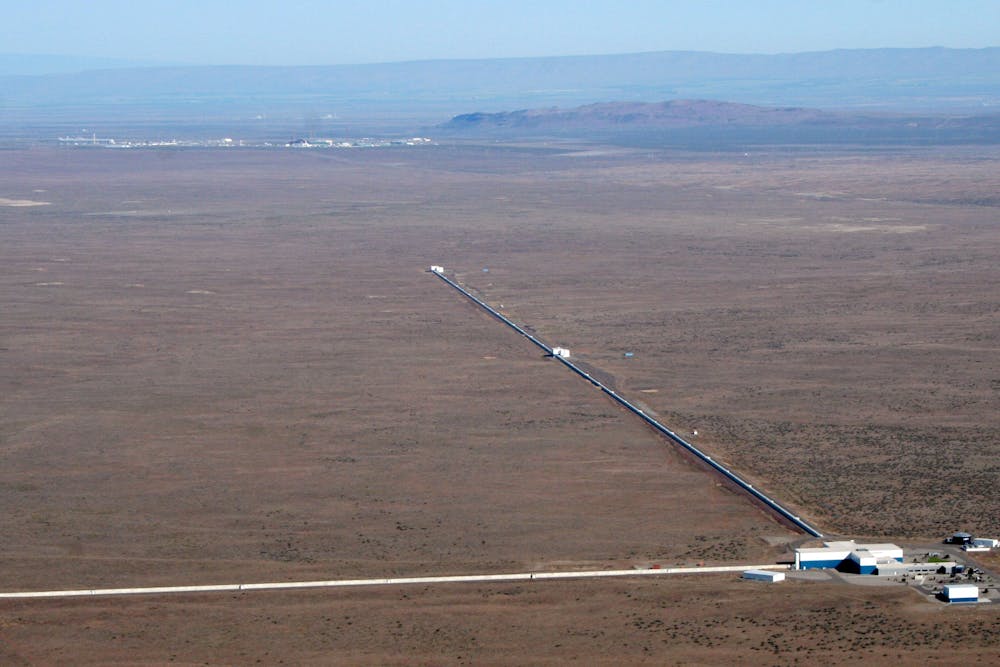
An L-shaped facility with two long arms extending out from a central building.
The LIGO detector in Hanford, Wash., uses lasers to measure the minuscule stretching of space caused by a gravitational wave. LIGO Laboratory

Scientists look for the gravitational waves that we can measure using LIGO, which has one of the most mind-bogglingly advanced laser and optics systems ever created.

In each event, two “parent” black holes merge into a single, more massive black hole. Using LIGO data, scientists can figure out where and how far away the merger happened, how massive the parents and resultant black holes are, which direction in the sky the merger happened and other key details.

Most of the parent black holes in merger events originally form from stars that have reached the end of their lives – these are stellar mass black holes.

An illustration of a black hole with gas swirling around it, coming from a large cloud around a star on the right.
This artist’s impression shows a binary system containing a stellar mass black hole called IGR J17091-3624. The strong gravity of the black hole, on the left, is pulling gas away from a companion star on the right. NASA/CXC/M.Weiss, CC BY-NC

The black hole mass gap

Not every dying star can create a stellar mass black hole. The ones that do are usually between about 20 to 100 times the mass of the Sun. But due to complicated nuclear physics, really massive stars explode differently and don’t leave behind any remnant, black hole or otherwise.

These physics create what we refer to as the “mass gap” in black holes. A smaller black hole likely formed from a dying star. But we know that a black hole more massive than about 60 times the size of the Sun, while not a supermassive black hole, is still too big to have formed directly from a dying star.

The exact cutoff for the mass gap is still somewhat uncertain, and many astrophysicists are working on more precise measurements. However, we are confident that the mass gaps exist and that we are in the ballpark of the boundary.

We call black holes in this gap lite intermediate mass black holes or lite IMBHs, because they are the least massive black holes that we expect to exist from sources other than stars. They are no longer considered stellar mass black holes.

Calling them “intermediate” also doesn’t quite capture why they are special. They are special because they are much harder to find, astronomers still aren’t sure what astronomical events might create them, and they fill a gap in astronomers’ knowledge of how the universe grows and evolves.

Evidence for IMBHs

In our research, we analyzed 11 black hole merger candidates from LIGO’s third observing run. These candidates were possibly gravitational wave signals that looked promising but still needed more analysis to conclusively confirm.

The data suggested that for those 11 we analyzed, their final post-merger black hole may have been in the lite IMBH range. We found five post-merger black holes that our analysis was 90% confident were lite IMBHs.

Even more critically, we found that one of the events had a parent black hole that was in the mass gap range, and two had parent black holes above the mass gap range. Since we know these black holes can’t come from stars directly, this finding suggests that the universe has some other way of creating black holes this massive.

A parent black hole this massive may already be the product of two other black holes that merged in the past, so observing more IMBHs can help us understand how often black holes are able to “find” each other and merge out in the universe.

LIGO is in the end stages of its fourth observing run. Since this work used data from the third observing run, we are excited to apply our analysis to this new dataset. We expect to continue to search for lite IMBHs, and with this new data we will improve our understanding of how to more confidently “hear” these signals from more massive black holes above all the noise.

We hope this work not only strengthens the case for lite IMBHs in general but helps shed more light on how they are formed.The Conversation

Bill Smith, Ph.D. Candidate in Physics & Astronomy, Vanderbilt University; Karan Jani, Assistant Professor of Physics & Astronomy, Vanderbilt University, and Krystal Ruiz-Rocha, Ph.D. Candidate in Physics & Astronomy, Vanderbilt University

This article is republished from The Conversation under a Creative Commons license. Read the original article.
Roadside vegetation fire prompts evacuations in Lucerne

Details
Written by: Elizabeth Larson
Published: 09 August 2025
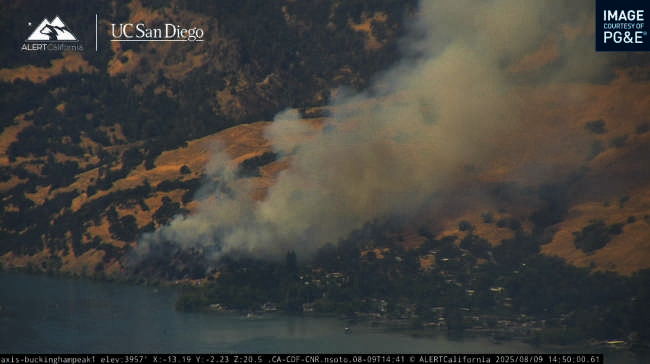
A view of the Arden fire in Lucerne, California, on Saturday, Aug. 9, 2025. Image courtesy of AlertCalifornia.


LUCERNE, Calif. — A fast-moving wildland fire along Highway 20 is threatening structures and prompting evacuations in Lucerne.

The Arden fire was first dispatched at around 2:10 p.m. Saturday on Highway 20 and Foothill Drive, on the west end of town.

The first units on scene said the fire was between one and two acres, with a moderate rate of spread and moving uphill with multiple structures threatened.

Cal Fire dispatched air attack and tankers, with units coming from Northshore Fire and Lakeport Fire, and units on call from the Mendocino National Forest.

Evacuations were called for in the fire’s immediate area around Roland Road and Arden Drive.

The California Highway Patrol has been requested to respond and close Highway 20 at the fire’s location. 

Air resources arrived just before 2:30 p.m. Air attack reported that at that time the fire was five acres in grass, with a moderate rate of spread and spotting, with the potential for 50 acres.

At about the same time, it was reported that there were some structures involved.

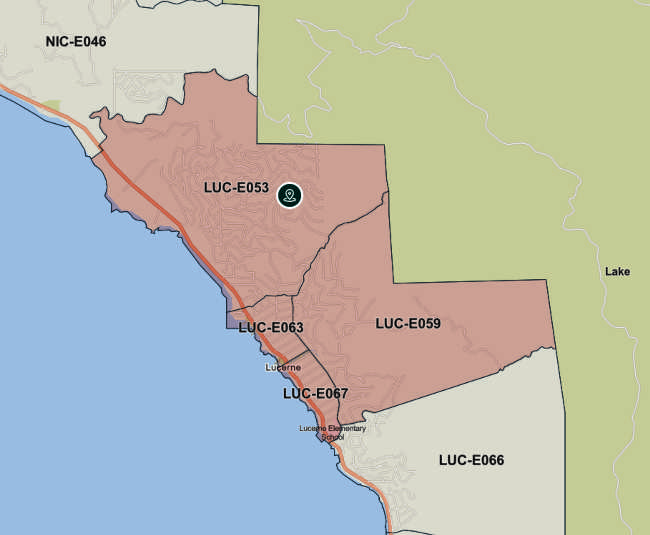
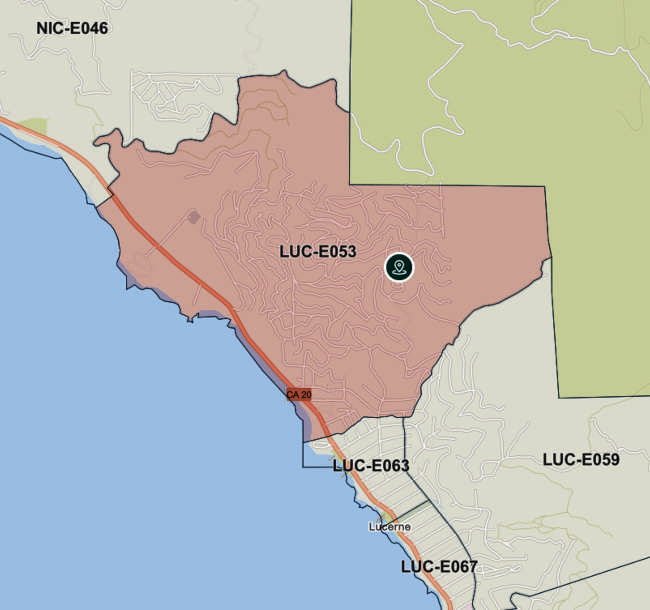
At 2:35 p.m., an evacuation order was sent via phone for the evacuation zone LUC-E053, at the west end of the town. A phone call from the Lake County Sheriff’s Office followed.

A unit was requested to the incident command post at 2:45 p.m. for a medical aid. A short time later, Lakeport’s fire chief transported one person off the incident.

At 2:48 p.m. they said it was 10 to 15 acres, running uphill with multiple structures threatened, but no spotting on the hill.

At around 3 p.m., the evacuation zone was expanded to LUC-E059, LUC-E063 and LUC-E067, taking up much of the town.

The sheriff’s office said a temporary evacuation point is being established in the parking lot of East Lake Elementary School, 13050 High Valley Road in Clearlake Oaks.

Just after 3:30 p.m., the power went off across Lucerne. Initial estimates from PG&E are that power will not be restored until 10:45 p.m. Saturday.

By 4 p.m., zones LUC-E059 and LUC-E067 had been reduced to evacuation warnings. About 10 minutes later, it was reported over the air that the rest of the zones also were reduced to evacuation warnings.

Shortly before 5 p.m., the Lucerne Alpine Senior Center opened as a cooling center due to the power remaining out. The center is located at 3985 Country Club Drive. No pets are accepted. Service animals are OK. Hours will vary based on community needs. Any questions can be directed to the Senior Center at 707-274-8779. 

At 6:16 p.m., there was a report of a new fire start at the head of the fire, outside of the fire lines. Incident command requested air attack respond.

That new fire start is reported to be underneath high tension power lines.

This report is being updated on an ongoing basis.

Email Elizabeth Larson at This email address is being protected from spambots. You need JavaScript enabled to view it.. Follow her on Twitter, @ERLarson, and on Bluesky, @erlarson.bsky.social. Find Lake County News on the following platforms: Facebook, @LakeCoNews; X, @LakeCoNews; Threads, @lakeconews, and on Bluesky, @lakeconews.bsky.social. 

The evacuation zone as of 2:55 p.m. Image courtesy of Protect Genasys.


The evacuation zone as of 3:10 p.m. Image courtesy of Protect Genasys.


Lake County celebrates first summer youth CNA graduation

Details
Written by: LAKE COUNTY NEWS REPORTS
Published: 09 August 2025
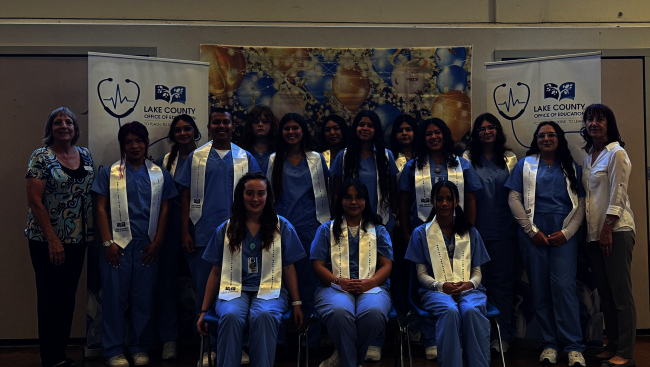
The Lake County Office of Education Certified Nursing Assistant, or CNA, Summer Youth graduating Class of 2025 with CNA Instructors Rhonda Daugherty L.V.N and KayLynn Erdman R.N. at graduation on Friday, August 1, 2025, at the Kelseyville High School Student Service Center. Photo courtesy of the Lake County Office of Education.

LAKEPORT, Calif. — The Lake County Office of Education celebrates the completion of its first Youth Certified Nursing Assistant, or CNA, Program, with 14 students prepared to take their certification exam and launch their careers in health care.

The graduation ceremony took place on Friday, Aug. 1, at the Kelseyville High School Student Service Center.

The CNA graduates, who are all current high school students or recent graduates, completed an intensive seven-week summer program that prepared them to take the state CNA exam.

During the seven weeks, participants received hands-on clinical training, classroom instruction, and mentorship from experienced health care professionals. 

Now that each is certified, students are eligible to work in a variety of health care settings including skilled nursing facilities, assisted living centers, and hospitals.

“This program gave students a fantastic opportunity to explore a career in the medical field and develop real-world skills before they graduate,” said Brock Falkenberg, Lake County Superintendent of Schools. “By preparing them for the workforce while they’re still in high school, we’re helping students take confident steps toward their future, and supporting the needs of our community.”

The Youth CNA Program reflects LCOE’s commitment to helping students succeed by connecting their education to real career opportunities.

“This program gives students a head start on their careers,” said Matt Russell, Director of Adult Education & Career and College Readiness. “It helps them build confidence, earn credentials, and take real steps toward their future.”

To learn more about the CNA Youth Program and other Medical Training Programs offered by the Lake County Office of Education, visit lakecoe.org/mtp.

  1. New Mountain Vista Middle School principal brings fresh perspective
  2. Gov. Newsom and California leaders host Texas officials, discuss response to gerrymandering attempts
  3. Authorities locate missing man
  • 198
  • 199
  • 200
  • 201
  • 202
  • 203
  • 204
  • 205
  • 206
  • 207
How to resolve AdBlock issue?
Refresh this page