 How to resolve AdBlock issue?
News
- Details
- Written by: JANE CALLEN
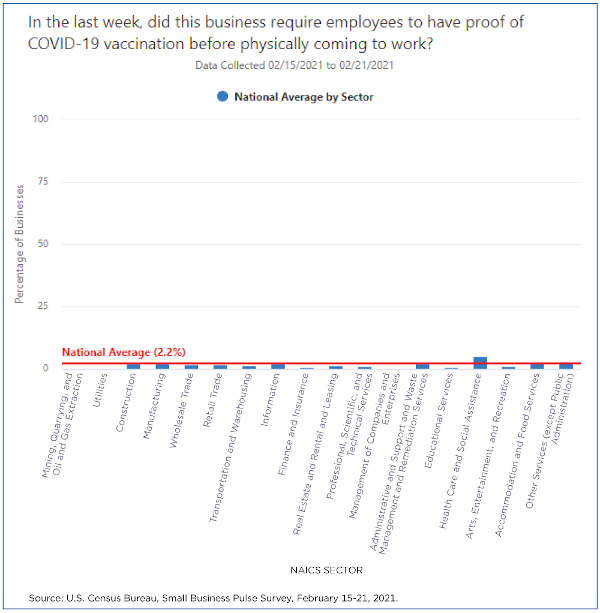
Most of the nation’s small businesses do not require employees to get COVID-19 vaccines or tests to return to work, according to the first results of Phase 4 of the U.S. Census Bureau’s Small Business Pulse Survey, or SBPS, released last week.
SBPS was launched Feb. 15, to measure the effect of changing business conditions during the coronavirus pandemic on our nation's small businesses.
Many prior survey questions have evolved and additional questions such as those related to coronavirus vaccinations and tests have been added.
The recent data make it increasingly clear that SBPS is sufficiently resilient and current to measure the economic impact of the coronavirus pandemic as well as other natural disasters such as the recent storms that hit the southern United States.
The value of this experimental data product is far-reaching, providing decision makers and the public with near real-time insight into the impact of events, from the pandemic to natural disasters, on the small-business economy.
Following are the survey’s new questions about the vaccine and initial data results:
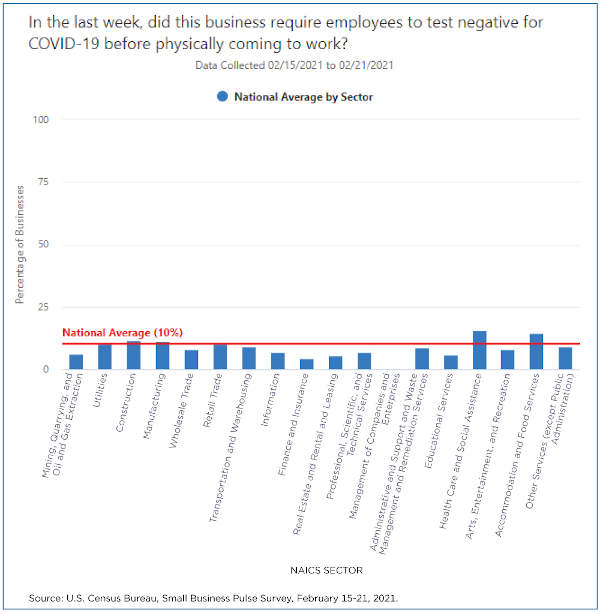
Question: In the last week, did this business require employees to test negative for COVID-19 before physically coming to work? Respondents may select only one of the following check boxes: “yes,” “no” or “not applicable, this business did not have employees physically coming to work in the last week.”
Responses: 10.0% said yes; 70.1% said no; and 19.9% said not applicable or n/a. Responses in two specific sectors outpaced the national average: 15.5% of health care and 14.3% of accommodation/food service businesses for requiring a negative test.
Question: In the last week, did this business require employees to have proof of COVID-19 vaccination before physically coming to work? Respondents may select only one: “yes,” “no” or “not applicable, this business did not have employees physically coming to work in the last week.”
Responses: 2.2% said yes; 78.4% said no; and 19.4% said not applicable. Health care was by far the largest sector requiring a vaccine with 62% of its respondents checking that box.
A finger on the pulse of small business
SBPS complements existing Census Bureau data collections by providing high-frequency, detailed information on the challenges that small businesses (those with 1-499 employees) are facing during the pandemic.
The survey also includes information on small business operations, requests and receipt of assistance, capital expenditures and expectations for recovery. SBPS has been conducted in 9-week phases: Phase 1 started in late April 2020; Phase 2 began in August; and Phase 3 started in November.
In the first week of Phase 4, the survey was sent to approximately 100,000 businesses and about 25,000 responded.
Data are available by sector, state and for the 50 most populous Metropolitan Statistical Areas or MSAs, in addition to Puerto Rico, as well as sub-sector, state by sector and by employee size class.
Survey results provide local, state and federal officials essential up-to-date data to help them make informed policy decisions. The information also aids businesses in making economic decisions and assists researchers studying the economic effects of the pandemic.
Other content changes in Phase 4 include the addition of new questions on leased space, planned capital expenditures and business travel:
Question: The White House declared a national emergency because of the coronavirus pandemic on March 13, 2020. Since March 13, 2020, did this business change the amount of square footage leased/rented for operations? Respondents may select only one of the following responses: “yes, increased,” “yes, decreased,” “no change” or “not applicable, this business does not lease/rent space.”
Responses: 2.6% said yes, increased; 6.1% said yes, decreased; 76.3% said no change; and 15.1% said not applicable. The decrease in leased space outpaced the increase, but both are dwarfed by no change.
Question: Since March 13, 2020, what changes did this business make to its planned capital expenditures for 2020? Respondents may select all of the following answers that apply: “canceled planned capital expenditures,” “postponed planned capital expenditures,” “decreased planned capital expenditures,” “increased planned capital expenditures,” “introduced new unplanned capital expenditures,” “this business had no changes to planned capital expenditures for 2020” and “this business had no planned capital expenditures for 2020.”
Responses: 12.8% canceled planned capital expenditures; 22% postponed planned capital expenditures; 15.6% decreased planned capital expenditures; 2.9% increased planned capital expenditures; 7.5% introduced new unplanned capital expenditures; 21.3% said this business had no changes to planned capital expenditures for 2020 and 33% said this business had no planned capital expenditures for 2020.
Question: In the next 6 months, do you think this business will have business travel expenditures for air, rail, car rental, or lodging? Respondents may select only one of the following: “yes,” “no” and “not applicable, this business does not usually have business travel expenditures.”
Responses: 26.5% said yes, 42.7% said no and 30.8% said not applicable. Far fewer small businesses anticipated travel expenses in the next six months.
Phase 4 excluded earlier questions about rehiring employees, working from home, cash flow, loan defaults, other payment defaults and online platforms. (Question on product service offerings and mode of product delivery have not been included since Phase 1.) Phase 4 also includes updates to answer options for questions on financial assistance, factors that affect capacity and future needs.
Jane Callen is senior writer/editor in the Census Bureau's Communications Directorate.
- Details
- Written by: Elizabeth Larson
The following dogs are ready for adoption or foster.
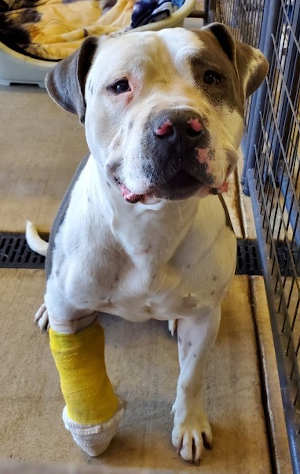
‘Dorito’
“Dorito” is a male American Staffordshire Terrier mix with a short white and gray coat.
He has been neutered.
He is dog No. 4576.
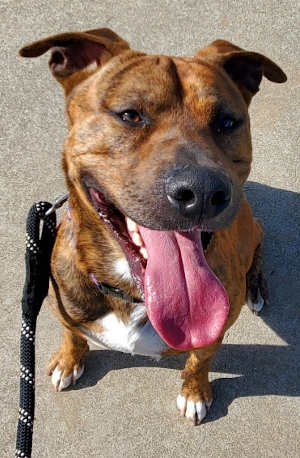
‘Hector’
“Hector” is a male American Pit Bull Terrier mix with a short brindle coat.
He is dog No. 4697.

‘Inky’
“Inky” is a male German Shepherd mix with a long black coat.
He has been neutered.
He is dog No. 4324.
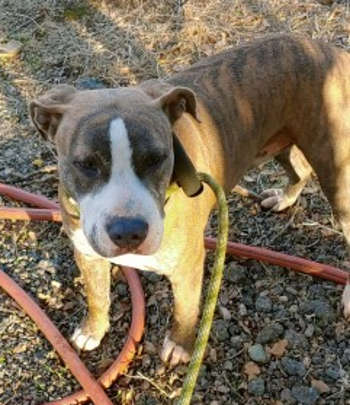
Jerry
“Jerry” is a male pit bull terrier mix with a short brindle coat.
He has been neutered.
He is dog No. 4455.
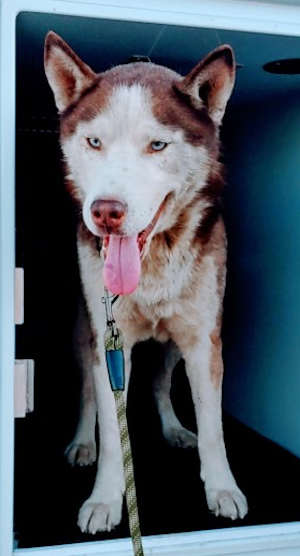
‘Ranger’
“Ranger” is a male husky mix with a long red and white coat.
He has been neutered.
Ranger is dog No. 4443.

‘Sarah’
“Sarah” is a female terrier mix with a short tan coat.
She is dog No. 4712.
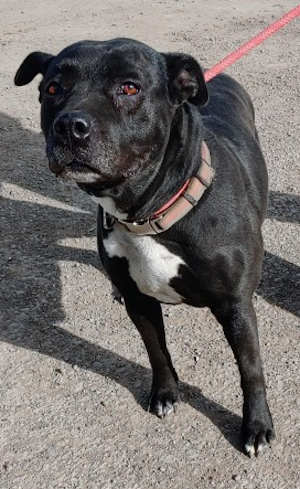
‘Tia’
“Tia” is a female American Bully with a short black with white markings.
She is dog No. 4602.
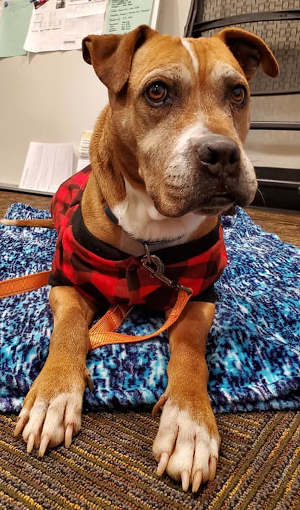
‘Toby’
“Toby” is a friendly senior male boxer mix.
He has a short tan and white coat.
He is dog No. 4389.
Call the Clearlake Animal Control shelter at 707-273-9440, or email
Visit Clearlake Animal Control on Facebook or on the city’s website.
Email Elizabeth Larson at
- Details
- Written by: Lake County News reports
The bipartisan group of representatives consisted of House Transportation and Infrastructure Committee Chairman Peter DeFazio (D-OR) and Reps. Eleanor Holmes Norton (D-DC), John Garamendi (D-CA), Sharice Davids (D-KS), Garret Graves (R-LA), Rodney Davis (R-IL), John Katko (R-NY) and Brian Fitzpatrick (R-PA).
Garamendi, a senior member of the Transportation and Infrastructure Committee who represents a portion of Lake County in the House, led a discussion at the meeting on the need to advance “Buy American” policies in any forthcoming infrastructure bill.
He has championed Buy American legislation through his “Make it in America” agenda in Congress over the past 10 years.
Garamendi emphasized the importance of modernizing our nation’s outdated infrastructure and advancing the Biden Administration’s “Build Back Better” plan with American products made by American workers.
“It was an honor to join President Biden, Vice President Harris, Secretary Buttigieg, and this bipartisan group of Congressional leaders to discuss the ways we can pass much-needed infrastructure legislation to create American jobs and help our economy build back better,” Garamendi said.
“I am looking forward to working with the White House in the months ahead to rebuild our crumbling infrastructure with American workers and materials. As American businesses close due to the compounding COVID-19 crisis, the federal government must take every action it can to support American manufacturing and workers.” Garamendi continued.
“President Biden has a bold plan to modernize our nation’s outdated infrastructure that will create hundreds of thousands of good-paying jobs in the process. I look forward to working tirelessly in Congress to ensure that his plan is realized,” Garamendi said, offering his thanks to the president and vice president, the secretary and his colleagues in Congress.
- Details
- Written by: Elizabeth Larson
LAKE COUNTY, Calif. – State officials said Wednesday night that they are taking a new approach to vaccinating the state’s residents against COVID-19, placing focus on low income areas that could include Lake County.
Officials with Gov. Gavin Newsom’s administration said they are unveiling a vaccination plan focusing on equity, specifically, addressing the state’s lowest-income communities.
The state now intends to focus 40 percent of the vaccine supply in lower income and lower quartile communities, which include 400 zip codes where an estimated eight million Californians live.
That’s because state health officials have found that more than 40 percent of California’s disease burden – cases and deaths – have been shouldered by those living in the lowest quartiles in the California Healthy Places Index.
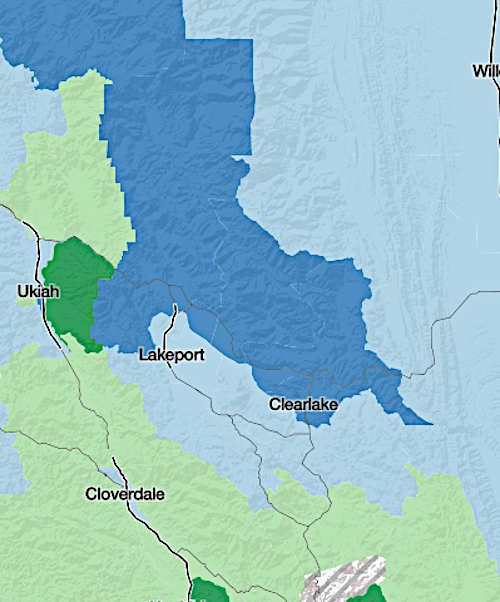
The index considers 25 community characteristics – among them, housing, education, economics and social factors – and creates a single score to help assess the health and well-being of each neighborhood in California, with the lowest scores in dark blue and the highest in dark green.
This new change in vaccination focus could prove particularly important to Lake County, a large portion of which the California Healthy Places Index shows is in the bottom quartile and among the lowest-ranked areas of the state.
The areas of Lake County ranked in the lowest quartile and marked out in dark blue stretch from the top of the county, north of Upper Lake, to west of Lakeport and east along the Northshore, including the communities of Nice, Lucerne and Clearlake Oaks, and down to the Clearlake area.
Lake County Public Health’s demographics breakdown shows that District 2, which includes most of the city of Clearlake and areas east, has consistently had the most cases, but it’s also a major population center in the county.
It’s followed by areas that rank higher in the Healthy Places Index: District 4, which includes Lakeport, and District 5, which includes the greater Kelseyville and Cobb areas.
District 3, which includes the Northshore communities that also have a low index ranking, is ranked fourth for case numbers and District 1, which includes portions of Clear Lake, Lower Lake, Anderson Springs, Hidden Valley Lake and Middletown, has the county’s lowest case numbers and the county’s best index ranking.
As of Wednesday, the California Department of Public Health said that 13,845 COVID-19 vaccine doses have been administered in Lake County, which has more than 64,000 residents and to date has had more than 3,100 cases and 41 deaths.
Focused vaccinations to be followed by tier adjustments
Over the next few weeks, the state will be focused on distributing the vaccines to two million residents in the 400 zip codes identified as being the state’s lowest-income communities. As of Wednesday night, those specific zip codes had not yet been released to the public.
Once they hit that threshold, the state will adjust the case rate threshold upward for the red tier on the Blueprint for a Safer Economy from seven to 10 cases per 100,000 people, which is expected to allow areas to drop out of the purple tier, which is the most restrictive on the blueprint.
Lake County remained in the purple tier this week, with its daily case rate at 11 per 100,000, down from 15 per 100,000 last week, according to the county’s epidemiologist, Sarah Marikos.
When the state hits the four million dose threshold, the numbers for the orange and yellow tiers also will be adjusted, officials said.
Additional information on the plan is expected over the next few days.
Administration officials also emphasized that they are in no way planning to abandon safety measures implemented in California during the pandemic, and are in fact doubling down and continuing with them.
On Thursday clearer guidance will be released on the critical role masks play in curbing COVID-19 transmission. Testing capacity also will remain a focus.
Even with proposed changes coming for the state’s tiers, officials said California will still maintain some of the strongest public health protections in the nation through its Blueprint for a Safer Economy.
Email Elizabeth Larson at