 How to resolve AdBlock issue?
News
- Details
- Written by: Elizabeth Larson
The council will meet in closed session at 5:30 p.m. to hold a performance evaluation of the city manager and discuss existing litigation against the county and the treasurer-tax collector over tax-defaulted property sales before the public portion of the meeting begins at 6 p.m. Thursday, March 18.
Because of the county’s shelter in place order, Clearlake City Hall remains closed to the public, however, the virtual meeting will be broadcast live on the city's YouTube channel or the Lake County PEGTV YouTube Channel. Community members also can participate via Zoom.
The agenda can be found here.
Comments and questions can be submitted in writing for City Council consideration by sending them to Administrative Services Director/City Clerk Melissa Swanson at
To give the council adequate time to review your questions and comments, please submit your written comments prior to 4 p.m. on Thursday, March 18.
Each public comment emailed to the city clerk will be read aloud by the mayor or a member of staff for up to three minutes or will be displayed on a screen. Public comment emails and town hall public comment submissions that are received after the beginning of the meeting will not be included in the record.
The council on Thursday will get a presentation on March’s adoptable dogs and hear an update on the Hope Center, which serves the community’s homeless population.
A public hearing will take place at the meeting to consider amending Chapter 18-18, Section 18-18.040 (Use Regulations), Table 6 of the Clearlake Municipal Code to allow “self-storage” facilities in the “RR” Rural Residential and “MUX” Mixed Use Zoning Designations upon securing a conditional use permit. The second reading and adoption is set for April 1.
Under council business, council members will continue the second extension of Emergency Ordinance No. 241-2020 establishing a moratorium on industrial hemp cultivation in the city.
The council also will consider employment services agreements with City Manager Alan Flora and Police Chief Andrew White.
Flora has served as city manager since March 14, 2019, having previously served as assistant city manager and finance director under then-City Manager Greg Folsom.
“Under Mr. Flora’s leadership and following the policy direction of the City Council, the City has seen many improvements in the community over the past two years,” said City Attorney Ryan Jones in his report to the council.
Jones said the council will consider rescinding Flora’s current city manager contract and approving the new employment services agreement.
The new agreement is for five years, with Flora to receive a 7.5-percent increase upon the council’s approval. Jones said that will bring his monthly salary to $13,785.63. That totals $165,427.56 annually.
“Contingent upon a favorable evaluation from the City Council and the Local Economic Benchmark exceeding audited revenues from fiscal year 19-20, Mr. Flora would receive a 3% raise on July 1 of each year thereafter,” Jones wrote.
Similarly, Flora is asking the council to approve a new agreement with White, who has been chief since July 2018.
“Under Chief White’s leadership and following the policy direction of the City Council, the City has seen many improvements to technology, professionalism, impacts to crime rates and overall community support of the department,” Flora wrote.
He said White’s current contract is set to expire in July and accordingly, and Flora has negotiated a new longer-term contract in order to retain the chief.
The new agreement will be for a five-year term, and upon council approval Flora said White will receive a 7.5-percent increase, bringing his monthly salary to $12,647.37. That totals $151,768.44 annually.
“Contingent upon a favorable evaluation from the City Manager and the Local Economic Benchmark exceeding audited revenues from fiscal year 19-20, Chief White would receive a 3% raise on July 1 of each year thereafter,” Flora wrote.
Staff on Thursday also will ask the council to update salary range positions for the positions of police trainee and finance director, and consider authorizing an agreement with Lexipol LLC for local government administration policy manual and daily training bulletins.
On the meeting's consent agenda – items that are not considered controversial and are usually adopted on a single vote – are warrants; adoption of the 10th amendment to the FY 2020-21 Budget (Resolution 2020-27) Appropriating Cannabis Equity Grant Funding; minutes of the Feb. 4, Feb. 18 and March 4 meetings; minutes of the Feb. 10 Lake County Vector Control District Board Meeting; award of contract for the Traffic Signal Relocation Project to DC Electric Group Inc.; and adoption of the 11th amendment to the FY 2020-21 Budget (Resolution 2020-27) appropriating funding for Traffic Signal Work and the Airport Road Project; Resolution No. 2021-17.
Email Elizabeth Larson at
- Details
- Written by: DERICK MOORE, GERSON VASQUEZ AND RYAN DOLAN
Irish heritage is strong in America: More than 31.5 million residents claim Irish ancestry, second only to German (43.0 million).
And when it comes to U.S. presidents, including current President Joe Biden, exactly half (23) trace some of their roots to Ireland.
Not surprisingly, the most Irish states are in New England and are geographically connected.
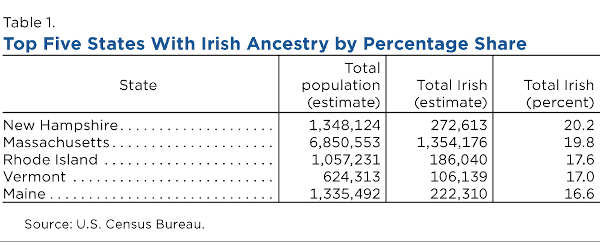
However, the five states with the most smiling Irish eyes are the nation’s most populous: California, New York, Pennsylvania, Florida and Texas. But none of these states have the highest percentage of people with Irish ancestry.
The interactive U.S. map of Irish ancestry will make Irish eyes smile wider when they zoom in to the county level. The map shows counties that are 20% or more Irish (dark green) and ranges down to less than 5% (light green).
Hover your mouse over any county to see its name, the state it’s in and the share of its population that is Irish. In the top left corner, select a state to zoom in to for a better view of counties in that state.
The map shows that Lake County, California, has 6,265 residents – or 9.8 percent – with Irish ancestry.
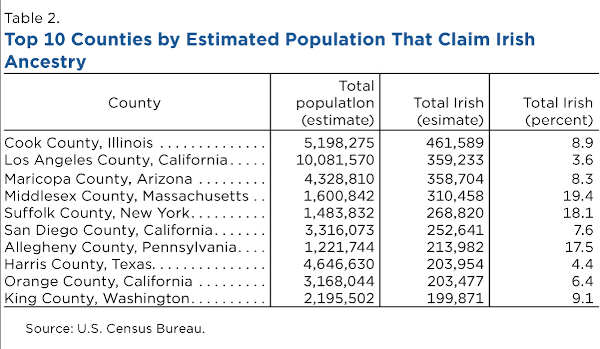
Of the 10 counties with the largest population of Irish ancestry in the United States, Los Angeles County — the nation’s largest — has the smallest (3.6%).
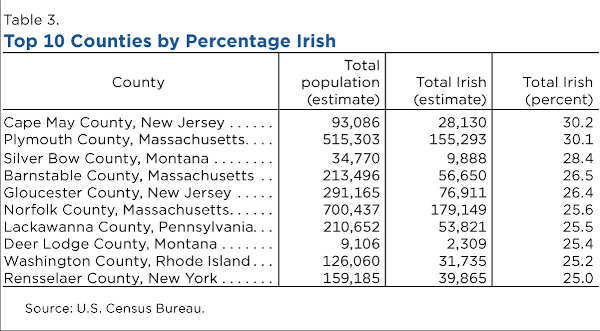
Two counties in Montana are small but very Irish: Silver Bow County at 28.4% and Deer Lodge County at 25.4%.
Derick Moore is a senior communications specialist at the Census Bureau. Gerson Vasquez and Ryan Dolan are data visualization leads at the Census Bureau.
- Details
- Written by: Lake County News reports
“The CHP is committed to making California’s roadways safe for all who use them.” said CHP Commissioner Amanda Ray. “Remember to buckle up, slow down, don’t drive distracted, and never drive impaired. If you chose to celebrate, please do so responsibly by designating a sober driver or making other arrangements to get home safe.”
The CHP wants everyone to remember safe driving rules have not changed and that officers will be on the lookout for impaired driving.
The CHP also cautions drivers that alcohol is not the only substance that can lead to an arrest for driving under the influence. Cannabis, prescription medications and illegal drugs can all lead to impaired driving.
Throughout the country, the National Highway Transportation Safety Administration, or NHTSA, reports that in 2020, 327 fatal alcohol-related crashes occurred on St. Patrick's Day.
Drunk driving accounts for nearly one-third of vehicle-related fatalities in the United States, NHTSA data shows.
In California, the CHP made 67 arrests for driving under the influence of drugs or alcohol on St. Patrick’s Day last year.
Data from the CHP’s Statewide Integrated Traffic Records System shows alcohol- or drug-related crashes resulted in injuries to 31 people.
“Think of your safety and that of others before deciding whether it is safe for you to drive,” Office of Traffic Safety Director Barbara Rooney said. “We urge all drivers to make getting home safely part of your celebratory plans.”
The public can help keep California roadways safe by calling 9-1-1 if they suspect an impaired driver.
Callers should be prepared to give the vehicle’s description, location, license plate number, and direction of travel.
- Details
- Written by: Elizabeth Larson
On Tuesday afternoon, the California Department of Public Health, or CDPH, confirmed Lake County has been moved from the purple or “widespread” tier, the most restrictive, to the red tier, which signifies “substantial” virus in the community.
The changes in tier rankings go into effect on Wednesday, officials said.
CDPH said Lake was among 11 counties to be moved from the purple tier.
The other counties seeing their status changed to red on Tuesday are Monterey, Riverside, Sacramento, San Diego, Santa Barbara, Sutter, Tehama, Tulare and Ventura.
San Mateo moved from the red tier to the orange, or “moderate,” tier, the state said.
The state said no counties moved to a more restrictive tier.
With Tuesday’s tier adjustments, 11 counties are in the purple tier, 42 in red, four in orange and one in the yellow, or “minimal,” tier.
The state said the counties now in the purple tier represent 4.1 million, or 10.3 percent of California’s population, while the red tier accounts for 35.1 million or 87.7 percent, orange covers 817,908 or 2 percent and yellow covers 1,117 people, and doesn’t show up as a percentage of population on the state’s metrics.
Additional tier changes won’t be immediate
The state moved Lake County into the purple tier at the end of November, as Lake County News has reported. Since then, activities like indoor dining have been prohibited.
Last week, state and local officials had announced that they anticipated Lake County would drop into the red tier this week.
As of Tuesday, Lake County Public Health reported that the county had 3,224 confirmed cases – of which 3,148 have recovered – and 43 deaths.
CDPH said Tuesday that Lake County’s new case rate was 5.1 per 100,000, and a seven-day positivity rate of 3 percent.
While Lake’s COVID-19 case rate is down to the lowest rates it has seen since the first half of October, what hastened the tier rating changes was CDPH’s adjustment of tier thresholds due to the state meeting a goal of vaccinating two million people in the communities across the state hardest hit by COVID-19.
Based on the current version of the state’s framework, county officials said Lake County won’t be eligible to move down to the orange tier until at least Tuesday, April 6.
That’s because counties can move only one tier at a time, and Lake County must be in the red tier for three weeks prior to advancing to orange.
To stay in the red tier, the county must have no more than 45 cases per week, and would need to have less than 18 per week to go into orange and four per week to go into the yellow tier, according to Sarah Marikos, Lake County’s epidemiologist.
In related news, the county’s movement into the red tier triggered the Board of Supervisors’ return to “hybrid” board meetings which allow for both Zoom and in-person participation. The board had closed meetings to in-person participation by the public in January after a surge in COVID-19 cases.
County officials said the hybrid board meetings will resume on Tuesday, March 23.
The capacity of the board chambers, as modified to accommodate social distancing, is 23 people. To encourage broad and safe participation, electronic options – phone, Zoom, Facebook, YouTube, written Granicus eComment and Lake County PEG TV – will continue for the foreseeable future, the county reported.
Information on the tier assignments and the changes in restrictions can be found here.
A rundown of Tuesday’s updates is here.
Email Elizabeth Larson at