How to resolve AdBlock issue?
News
- Details
- Written by: Robert Sanders
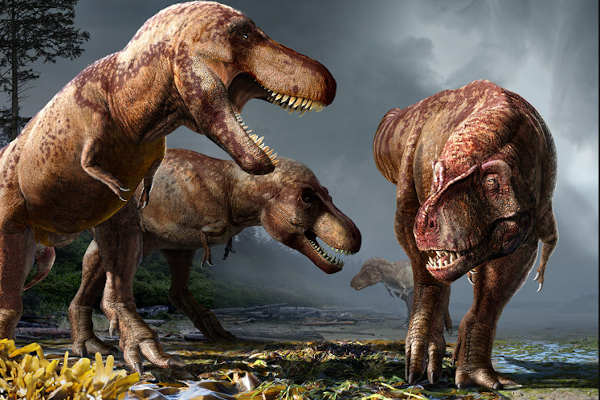
How many Tyrannosaurus rexes roamed North America during the Cretaceous period?
That's a question Charles Marshall pestered his paleontologist colleagues with for years until he finally teamed up with his students to find an answer.
What the team found, published this month in the journal Science, is that about 20,000 adult T. rexes probably lived at any one time, give or take a factor of 10, which is in the ballpark of what most of his colleagues guessed.
What few paleontologists had fully grasped, he said, including himself, is that this means that some 2.5 billion lived and died over the approximately 2 1/2 million years the dinosaur walked the earth.
Until now, no one has been able to compute population numbers for long-extinct animals, and George Gaylord Simpson, one of the most influential paleontologists of the last century, felt that it couldn't be done.
Marshall, director of the University of California Museum of Paleontology, the Philip Sandford Boone Chair in Paleontology and a UC Berkeley professor of integrative biology and of earth and planetary science, was also surprised that such a calculation was possible.
"The project just started off as a lark, in a way," he said. "When I hold a fossil in my hand, I can’t help wondering at the improbability that this very beast was alive millions of years ago, and here I am holding part of its skeleton — it seems so improbable. The question just kept popping into my head, 'Just how improbable is it? Is it one in a thousand, one in a million, one in a billion?' And then I began to realize that maybe we can actually estimate how many were alive, and thus, that I could answer that question."
Marshall is quick to point out that the uncertainties in the estimates are large. While the population of T. rexes was most likely 20,000 adults at any given time, the 95% confidence range — the population range within which there's a 95% chance that the real number lies — is from 1,300 to 328,000 individuals. Thus, the total number of individuals that existed over the lifetime of the species could have been anywhere from 140 million to 42 billion.
"As Simpson observed, it is very hard to make quantitative estimates with the fossil record," he said. "In our study, we focused in developing robust constraints on the variables we needed to make our calculations, rather than on focusing on making best estimates, per se."
He and his team then used Monte Carlo computer simulation to determine how the uncertainties in the data translated into uncertainties in the results.
The greatest uncertainty in these numbers, Marshall said, centers around questions about the exact nature of the dinosaur's ecology, including how warm-blooded T. rex was.
The study relies on data published by John Damuth of UC Santa Barbara that relates body mass to population density for living animals, a relationship known as Damuth’s Law.
While the relationship is strong, he said, ecological differences result in large variations in population densities for animals with the same physiology and ecological niche.
For example, jaguars and hyenas are about the same size, but hyenas are found in their habitat at a density 50 times greater than the density of jaguars in their habitat.
"Our calculations depend on this relationship for living animals between their body mass and their population density, but the uncertainty in the relationship spans about two orders of magnitude," Marshall said. "Surprisingly, then, the uncertainty in our estimates is dominated by this ecological variability and not from the uncertainty in the paleontological data we used."
As part of the calculations, Marshall chose to treat T. rex as a predator with energy requirements halfway between those of a lion and a Komodo dragon, the largest lizard on Earth.
The issue of T. rex's place in the ecosystem led Marshall and his team to ignore juvenile T. rexes, which are underrepresented in the fossil record and may, in fact, have lived apart from adults and pursued different prey.
As T. rex crossed into maturity, its jaws became stronger by an order of magnitude, enabling it to crush bone. This suggests that juveniles and adults ate different prey and were almost like different predator species.
This possibility is supported by a recent study, led by evolutionary biologist Felicia Smith of the University of New Mexico, which hypothesized that the absence of medium-size predators alongside the massive predatory T. rex during the late Cretaceous was because juvenile T. rex filled that ecological niche.
What the fossils tell us
The UC Berkeley scientists mined the scientific literature and the expertise of colleagues for data they used to estimate that the likely age at sexual maturity of a T. rex was 15.5 years; its maximum lifespan was probably into its late 20s; and its average body mass as an adult — its so-called ecological body mass, — was about 5,200 kilograms, or 5.2 tons.
They also used data on how quickly T. rexes grew over their life span: They had a growth spurt around sexual maturity and could grow to weigh about 7,000 kilograms, or 7 tons.
From these estimates, they also calculated that each generation lasted about 19 years, and that the average population density was about one dinosaur for every 100 square kilometers.
Then, estimating that the total geographic range of T. rex was about 2.3 million square kilometers, and that the species survived for roughly 2 1/2 million years, they calculated a standing population size of 20,000. Over a total of about 127,000 generations that the species lived, that translates to about 2.5 billion individuals overall.
With such a large number of post-juvenile dinosaurs over the history of the species, not to mention the juveniles that were presumably more numerous, where did all those bones go? What proportion of these individuals have been discovered by paleontologists? To date, fewer than 100 T. rex individuals have been found, many represented by a single fossilized bone.
"There are about 32 relatively well-preserved, post-juvenile T. rexes in public museums today," he said. "Of all the post-juvenile adults that ever lived, this means we have about one in 80 million of them."
“If we restrict our analysis of the fossil recovery rate to where T. rex fossils are most common, a portion of the famous Hell Creek Formation in Montana, we estimate we have recovered about one in 16,000 of the T. rexes that lived in that region over that time interval that the rocks were deposited," he added. "We were surprised by this number; this fossil record has a much higher representation of the living than I first guessed. It could be as good as one in a 1,000, if hardly any lived there, or it could be as low as one in a quarter million, given the uncertainties in the estimated population densities of the beast.”
Marshall expects his colleagues will quibble with many, if not most, of the numbers, but he believes that his calculational framework for estimating extinct populations will stand and be useful for estimating populations of other fossilized creatures.
"In some ways, this has been a paleontological exercise in how much we can know, and how we go about knowing it," he said. "It's surprising how much we actually know about these dinosaurs and, from that, how much more we can compute. Our knowledge of T. rex has expanded so greatly in the past few decades thanks to more fossils, more ways of analyzing them and better ways of integrating information over the multiple fossils known."
The framework, which the researchers have made available as computer code, also lays the foundation for estimating how many species paleontologists might have missed when excavating for fossils, he said.
"With these numbers, we can start to estimate how many short-lived, geographically specialized species we might be missing in the fossil record," he said. "This may be a way of beginning to quantify what we don’t know."
Marshall's co-authors are UC Berkeley undergraduate Connor Wilson and graduate students Daniel Latorre, Tanner Frank, Katherine Magoulick, Joshua Zimmt and Ashley Poust, who is now a postdoctoral fellow at the San Diego Natural History Museum.
Robert Sanders writes for the UC Berkeley News Center.
- Details
- Written by: Elizabeth Larson
Dogs available for adoption this week include mixes of boxer, Maltese and pit bull.
Dogs that are adopted from Lake County Animal Care and Control are either neutered or spayed, microchipped and, if old enough, given a rabies shot and county license before being released to their new owner. License fees do not apply to residents of the cities of Lakeport or Clearlake.
The following dogs at the Lake County Animal Care and Control shelter have been cleared for adoption (additional dogs on the animal control Web site not listed are still “on hold”).
Call Lake County Animal Care and Control at 707-263-0278 or visit the shelter online at http://www.co.lake.ca.us/Government/Directory/Animal_Care_And_Control.htm for information on visiting or adopting.
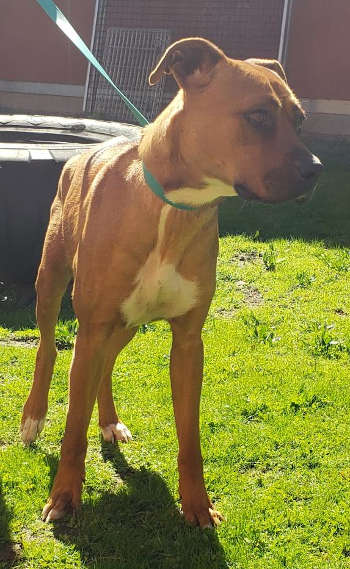
‘Sophie’
“Sophie” is a female boxer-pit bull mix with a short red coat.
She is in kennel No. 18, ID No. 14356.
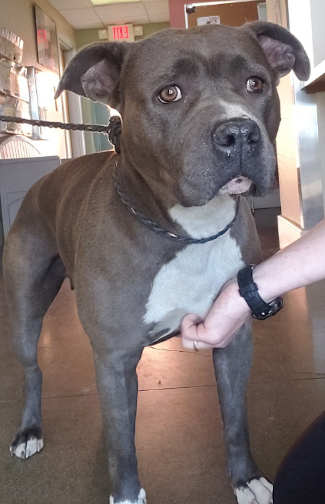
Female pit bull terrier
This female pit bull terrier has a short blue and white coat.
She is in kennel No. 22, ID No. 14486.

Male Maltese
This senior male Maltese has a long white coat.
He is in kennel No. 24, ID No. 14489.
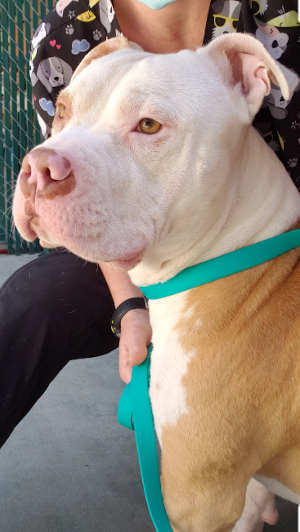
‘Cowboy’
“Cowboy” is a young male pit bull terrier with a short white and tan coat.
He is in kennel No. 27, ID No. 14499.
Email Elizabeth Larson at
- Details
- Written by: National Aeronautics and Space Administration
In celebration of the 31st anniversary of the launching of NASA's Hubble Space Telescope, astronomers aimed the renowned observatory at a brilliant "celebrity star," one of the brightest stars seen in our galaxy, surrounded by a glowing halo of gas and dust.
The price for the monster star's opulence is "living on the edge." The star, called AG Carinae, is waging a tug-of-war between gravity and radiation to avoid self-destruction.
The expanding shell of gas and dust that surrounds the star is about five light-years wide, which equals the distance from here to the nearest star beyond the Sun, Proxima Centauri.
The huge structure was created from one or more giant eruptions about 10,000 years ago. The star's outer layers were blown into space – like a boiling teapot popping off its lid. The expelled material amounts to roughly 10 times our Sun's mass.
These outbursts are the typical life of a rare breed of star called a luminous blue variable, a brief convulsive phase in the short life of an ultra-bright, glamorous star that lives fast and dies young. These stars are among the most massive and brightest stars known. They live for only a few million years, compared to the roughly 10-billion-year lifetime of our Sun. AG Carinae is a few million years old and resides 20,000 light-years away inside our Milky Way galaxy.
Luminous blue variables exhibit a dual personality: They appear to spend years in quiescent bliss and then they erupt in a petulant outburst. These behemoths are stars in the extreme, far different from normal stars like our Sun. In fact, AG Carinae is estimated to be up to 70 times more massive than our Sun and shines with the blinding brilliance of one million suns.
"I like studying these kinds of stars because I am fascinated by their instability. They are doing something weird," said Kerstin Weis, a luminous blue variable expert at Ruhr University in Bochum, Germany.
Major outbursts such as the one that produced the nebula occur once or twice during a luminous blue variable's lifetime. A luminous blue variable star only casts off material when it is in danger of self-destruction as a supernova. Because of their massive forms and super-hot temperatures, luminous blue variable stars like AG Carinae are in a constant battle to maintain stability.
It's an arm-wrestling contest between radiation pressure from within the star pushing outward and gravity pressing inward. This cosmic match results in the star expanding and contracting.
The outward pressure occasionally wins the battle, and the star expands to such an immense size that it blows off its outer layers, like a volcano erupting. But this outburst only happens when the star is on the verge of coming apart. After the star ejects the material, it contracts to its normal size, settles back down, and becomes quiescent for a while.
Like many other luminous blue variables, AG Carinae remains unstable. It has experienced lesser outbursts that have not been as powerful as the one that created the present nebula.
Although AG Carinae is quiescent now, as a super-hot star it continues pouring out searing radiation and powerful stellar wind (streams of charged particles). This outflow continues shaping the ancient nebula, sculpting intricate structures as outflowing gas slams into the slower-moving outer nebula.
The wind is traveling at up to 670,000 miles per hour, about 10 times faster than the expanding nebula. Over time, the hot wind catches up with the cooler expelled material, plows into it, and pushes it farther away from the star. This "snowplow" effect has cleared a cavity around the star.
The red material is glowing hydrogen gas laced with nitrogen gas. The diffuse red material at upper left pinpoints where the wind has broken through a tenuous region of material and swept it into space.
The most prominent features, highlighted in blue, are filamentary structures shaped like tadpoles and lopsided bubbles. These structures are dust clumps illuminated by the star's reflected light.
The tadpole-shaped features, most prominent at left and bottom, are denser dust clumps that have been sculpted by the stellar wind. Hubble's sharp vision reveals these delicate-looking structures in great detail.
The image was taken in visible and ultraviolet light. Ultraviolet light offers a slightly clearer view of the filamentary dust structures that extend all the way down toward the star. Hubble is ideally suited for ultraviolet-light observations because this wavelength range can only be viewed from space.
Massive stars, like AG Carinae, are important to astronomers because of their far-reaching effects on their environment. The largest program in Hubble's history – the Ultraviolet Legacy Library of Young Stars as Essential Standards – is studying the ultraviolet light of young stars and the way they shape their surroundings.
Luminous blue variable stars are rare: Less than 50 are known among the galaxies in our local group of neighboring galaxies. These stars spend tens of thousands of years in this phase, a blink of an eye in cosmic time. Many are expected to end their lives in titanic supernova blasts, which enrich the universe with heavier elements beyond iron.
Hubble trivia
– Launched on April 24, 1990, NASA's Hubble Space Telescope has made more than 1.5 million observations of about 48,000 celestial objects.
– In its 31-year lifetime, the telescope has racked up more than 181,000 orbits around our planet, totaling over 4.5 billion miles.
– Hubble observations have produced more than 169 terabytes of data, which are available for present and future generations of researchers.
– Astronomers using Hubble data have published more than 18,000 scientific papers, with more than 900 of those papers published in 2020.
The Hubble Space Telescope is a project of international cooperation between NASA and the European Space Agency. NASA's Goddard Space Flight Center in Greenbelt, Maryland, manages the telescope. The Space Telescope Science Institute (STScI) in Baltimore, Maryland, conducts Hubble science operations. STScI is operated for NASA by the Association of Universities for Research in Astronomy in Washington, D.C.
- Details
- Written by: Lake County News reports

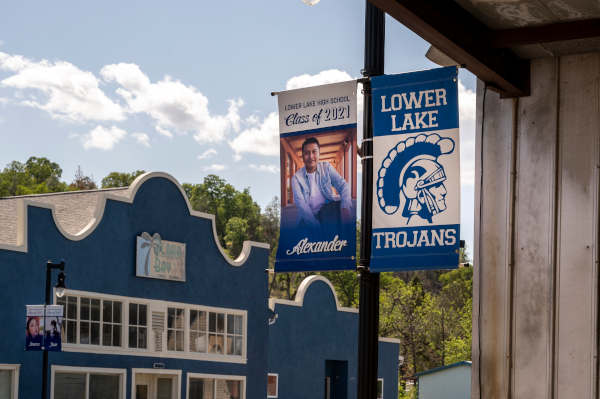
LAKE COUNTY, Calif. – Community members honored the high school seniors of Konocti Unified School District with streetlight banners again this year, thanks in large part to the efforts of parent Rachelle Sapeta.
Last spring, Sapeta wondered how she could make her daughter’s high school graduation special during a global pandemic, when traditional graduation ceremonies were not permitted.
Her idea? To hang banners featuring portraits of high school seniors from the lamp posts along the roads most commonly traveled near Konocti Unified’s four high schools: Lower Lake, Konocti Education Center, Lewis School and Carle.
With community and parent support, the project was fully funded in less than two weeks.
This year, Sapeta’s son is graduating from Lower Lake High School, and given the popularity of last year’s project, Sapeta decided to organize the banners again.
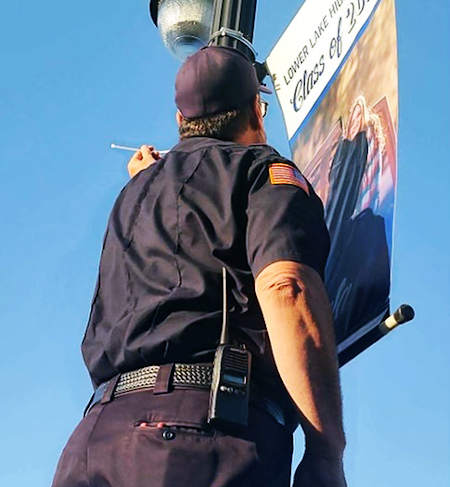
This week, the banners returned to Main Street in Lower Lake, and to Lakeshore Drive and Olympic Drive in Clearlake to highlight this year’s seniors.
“It’s been so fun to hear from community members who share that they take the long way home just to see the banners, or to witness students posing under their photos in their caps and gowns,” she said.
Sapeta thought last year would be the only year she would do something like this, but the pandemic lasted longer than anyone expected.
Although students just returned to in-person school part-time, COVID-19 will likely prevent traditional graduation ceremonies once again. This project felt like a way to celebrate these hard-working students.
Sapeta credits Konocti Unified Superintendent Dr. Becky Salato for letting her run with the idea, Lower Lake High School secretary Sherry Hoeckendorf for her help coordinating the project, the Lake County Fire Protection District for rallying together and putting up the banners in just two nights, and the parents and organizations that made it possible through funding and other support.
Salato said, “Our goal is to help our students build both academic skills and the coping skills that enable them to thrive, and we believe the best way to do so is through personal connection. This has been a hard year for many, and we are so grateful to the community members who united around our students to remind them that they are loved and their accomplishments did not go unnoticed.”
The banners will be up until the week after graduation when students will be invited to take their banners home with them.
Last year, the banner project cost $10,000. This year, because much of the hardware could be reused, the total cost was slightly less, but still a significant investment.
Project funders include Sober Grad, Action Sanitary, First American Title, Chernoh Excavating, Clearlake Police Association, Clearlake Oaks Glenhaven Business Association, Rotary Club of Clearlake and Case Excavating, as well as community members and families.