 How to resolve AdBlock issue?
News
- Details
- Written by: NATIONAL AERONAUTICS AND SPACE ADMINISTRATION

The first of the gas-giant orbiter’s back-to-back flybys will provide a close encounter with the massive moon after over 20 years.
On Monday, June 7, at 10:35 a.m. Pacific Time, NASA’s Juno spacecraft will come within 645 miles of the surface of Jupiter’s largest moon, Ganymede.
The flyby will be the closest a spacecraft has come to the solar system’s largest natural satellite since NASA’s Galileo spacecraft made its penultimate close approach back on May 20, 2000.
Along with striking imagery, the solar-powered spacecraft’s flyby will yield insights into the moon’s composition, ionosphere, magnetosphere, and ice shell. Juno’s measurements of the radiation environment near the moon will also benefit future missions to the Jovian system.
Ganymede is bigger than the planet Mercury and is the only moon in the solar system with its own magnetosphere — a bubble-shaped region of charged particles surrounding the celestial body.
“Juno carries a suite of sensitive instruments capable of seeing Ganymede in ways never before possible,” said Juno Principal Investigator Scott Bolton of the Southwest Research Institute in San Antonio. “By flying so close, we will bring the exploration of Ganymede into the 21st century, both complementing future missions with our unique sensors and helping prepare for the next generation of missions to the Jovian system — NASA’s Europa Clipper and ESA’s [European Space Agency’s] JUpiter ICy moons Explorer [JUICE] mission.”
Juno’s science instruments will begin collecting data about three hours before the spacecraft’s closest approach. Along with the Ultraviolet Spectrograph and Jovian Infrared Auroral Mapper instruments, Juno’s Microwave Radiometer’s, or MWR, will peer into Ganymede’s water-ice crust, obtaining data on its composition and temperature.
“Ganymede’s ice shell has some light and dark regions, suggesting that some areas may be pure ice while other areas contain dirty ice,” said Bolton. “MWR will provide the first in-depth investigation of how the composition and structure of the ice varies with depth, leading to a better understanding of how the ice shell forms and the ongoing processes that resurface the ice over time.”
The results will complement those from ESA’s forthcoming JUICE mission, which will look at the ice using radar at different wavelengths when it becomes the first spacecraft to orbit a moon other than Earth’s Moon in 2032.
Signals from Juno’s X-band and Ka-band radio wavelengths will be used to perform a radio occultation experiment to probe the moon’s tenuous ionosphere (the outer layer of an atmosphere where gases are excited by solar radiation to form ions, which have an electrical charge).
“As Juno passes behind Ganymede, radio signals will pass through Ganymede’s ionosphere, causing small changes in the frequency that should be picked up by two antennas at the Deep Space Network’s Canberra complex in Australia,” said Dustin Buccino, a signal analysis engineer for the Juno mission at JPL. “If we can measure this change, we might be able to understand the connection between Ganymede’s ionosphere, its intrinsic magnetic field, and Jupiter’s magnetosphere.”
Three cameras, two jobs
Normally, Juno’s Stellar Reference Unit, or SRU, navigation camera is tasked with helping keep the Jupiter orbiter on course, but during the flyby it will do double duty.
Along with its navigation duties, the camera — which is well shielded against radiation that could otherwise adversely affect it — will gather information on the high-energy radiation environment in the region near Ganymede by collecting a special set of images.
“The signatures from penetrating high-energy particles in Jupiter’s extreme radiation environment appear as dots, squiggles, and streaks in the images — like static on a television screen. We extract these radiation-induced noise signatures from SRU images to obtain diagnostic snapshots of the radiation levels encountered by Juno,” said Heidi Becker, Juno’s radiation monitoring lead at JPL.
Meanwhile, the Advanced Stellar Compass camera, built at the Technical University of Denmark, will count very energetic electrons that penetrate its shielding with a measurement every quarter of a second.
Also being enlisted is the JunoCam imager. Conceived to bring the excitement and beauty of Jupiter exploration to the public, the camera has provided an abundance of useful science as well during the mission’s almost five-year tenure at Jupiter.
For the Ganymede flyby, JunoCam will collect images at a resolution equivalent to the best from Voyager and Galileo. The Juno science team will scour the images, comparing them to those from previous missions, looking for changes in surface features that might have occurred over four-plus decades.
Any changes to crater distribution on the surface could help astronomers better understand the current population of objects that impact moons in the outer solar system.
Due to the speed of the flyby, the icy moon will – from JunoCam’s viewpoint – go from being a point of light to a viewable disk then back to a point of light in about 25 minutes. So that’s just enough time for five images.
“Things usually happen pretty quick in the world of flybys, and we have two back-to-back next week. So literally every second counts,” said Juno Mission Manager Matt Johnson of JPL. “On Monday, we are going to race past Ganymede at almost 12 miles per second (19 kilometers per second). Less than 24 hours later we’re performing our 33rd science pass of Jupiter – screaming low over the cloud tops, at about 36 miles per second (58 kilometers per second). It is going to be a wild ride.”
More information about Juno is available at https://www.nasa.gov/juno and https://www.missionjuno.swri.edu.
Follow the mission on Facebook and Twitter.
- Details
- Written by: Elizabeth Larson
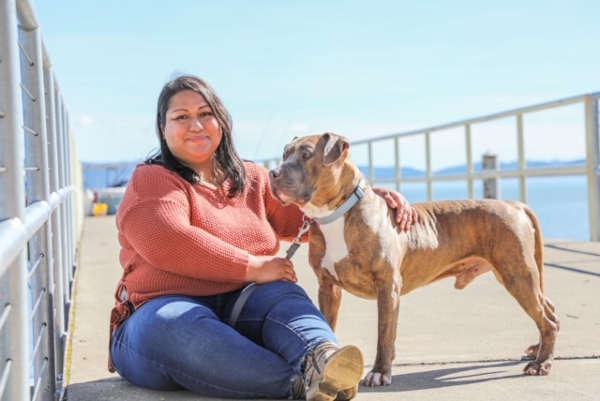
LAKE COUNTY, Calif. — Lake County’s poet laureate is among 23 nationwide who have been chosen by the Academy of American Poets as 2021 Poets Laureate Fellows.
The academy announced Thursday that Lake County Poet Laureate Georgina Marie Guardado of Lakeport has been selected as a member of this year’s fellows class.
“These 23 Poets Laureate Fellows will lead an extraordinary range of public poetry programs,” said Elizabeth Alexander, poet and president of the Mellon Foundation. “We are delighted to support them as they create their own poems, collaborate with other artists, and center poetry in their engagement with communities across our vast country — from urban to rural counties — while we collectively begin to process and reflect on the exceptional crises of the past year.”
The news came on the same day that the group of past Lake County poets emeriti announced that Guardado has been offered, and has accepted, a second term.
“I am honored and so moved by both the offer to extend my poet laureate role by two more years and by being awarded a Poets Laureate Fellowship by the Academy of American Poets,” Guardado told Lake County News. “The AAP fellowship is the largest financial supporter of poets in the nation and I have been following the academy for years, reading their poems on poets.org and on social media. I feel incredibly pleased to have my efforts and hard work recognized by such a prestigious organization and on a national scale. This will undoubtedly further my literary career as a poet and open so many doors for me. Not to mention, this is an amazing opportunity for poetry and the poetry community of Lake County.”
The academy is awarding a combined total of $1.1 million to the poets selected as fellows this year.
More than $100,000 also will be provided to 14 nonprofit organizations that have agreed to support the fellows’ proposed projects.
Guardado was selected as Lake County poet laureate in April of 2020, at the onset of the pandemic and shelter-in-place order.
She will receive $50,000 from the Academy of American Poets to install poetry boxes, poetry display cases, tiny poetry libraries and poetry murals in all 18 communities in Lake County.
She also plans to expand the project — with the permission and input of local tribal officials and peoples — the six Native American reservations in Lake County.
To complete the project, Guardado said she will engage government leaders, local poets, artists and youth.
“During the pandemic, I have strived to keep the literary momentum going in Lake County and both of these opportunities will allow me to continue doing so with time and financial support,” Guardado said. “For poets in our county of all ages and backgrounds, I hope this offers hope and inspiration that you can do anything you dream of even from a small, rural county as our own.”
Guardado will be able to carry out the project while she serves a second consecutive two-year term as Lake County poet laureate.
“Georgina has done a tremendous job promoting online poetry workshops and events during the pandemic,” said Lake County Poet Laureate Emeritus Carolyn Wing Greenlee. “The poets laureate feel that she deserves the experience of live events, including poet laureate events in California, as communities begin to reunite in the near future.”
The role of a poet laureate is to promote poetry, writing and literacy in the community they represent.
In Lake County, the poet laureate role began in 1998 with the installation of the first Lake County poet laureate, Jim Lyle, by the Board of Supervisors.
The Lake County poet laureate role is a volunteer one, with the selection process taking place every two years and conducted by the poets who previously held the post.
The next Lake County poet laureate search will take place in April of 2024.
In addition to Guardado, the 2021 Poets Laureate Fellows and the communities they serve are Marcus Amaker (Charleston, South Carolina), Semaj Brown (Flint, Michigan), Roscoe Burnems (Richmond, Virginia), Aileen Cassinetto (San Mateo County, California), Leslie Contreras Schwartz (Houston, Texas), Magdalena Gómez (Springfield, Massachusetts), Chasity Gunn (Elgin, Illinois), Kari Gunter-Seymour (Ohio), Luisa A. Igloria (Virginia), Angela Jackson (Illinois), Dasha Kelly Hamilton (Milwaukee, Wisconsin and Wisconsin state), Melissa Kwasny and M.L. Smoker (Montana), Bobby LeFebre (Colorado), Debra Marquart (Iowa), Trapeta B. Mayson (Philadelphia, Pennsylvania), Anis Mojgani (Oregon), Chelsea Rathburn (Georgia), Andrea “Vocab” Sanderson (San Antonio, Texas), Lloyd Schwartz (Somerville, Massachusetts), M. Bartley Seigel (Upper Peninsula, Michigan) and Brian Sonia-Wallace (West Hollywood, California).
Email Elizabeth Larson at
- Details
- Written by: Lake County News reports
In late 2019, those three utilities deenergized power to customers during high wildfire danger weather to reduce the risk of their infrastructure igniting catastrophic wildfires.
In November 2019, the CPUC opened an investigation of those 2019 events to assess whether the utilities prioritized safety and complied with CPUC regulations and requirements when planning and implementing the shut-off, or PSPS, events.
The Thursday decision orders utilities to take a number of actions to improve their power shut-off planning and implementation, including:
— Forgo collection of revenues from customers that are associated with electricity not sold during future PSPS events until it can be demonstrated that utilities have made improvements in identifying, evaluating, weighing, and reporting public harm when determining whether to initiate a shut-off event.
— Take corrective actions to improve future compliance with the CPUC’s existing PSPS guidelines.
— Improve, among other things, communications with customers dependent on electricity for medical reasons, especially life support, before, during, and after a PSPS event.
— Share best practices and lessons learned for initiating, communicating, reporting, and improving all aspects of PSPS events by regularly holding utility working group meetings.
— Provide standard emergency management system training for all personnel and contractors involved in PSPS planning.
— File annual reports describing progress and status on improving compliance with PSPS guidelines.
— Support the CPUC’s Safety and Enforcement Division’s development of a standardized 10-day post-event reporting template. Post-event reporting facilitates learning and improvement across utilities, state, and local public safety agencies and local jurisdictions.
In implementing the late 2019 PSPS events, PG&E, Southern California Edison and San Diego Gas & Electric had, to different degrees, ineffective coordination with public safety partners, inadequate consideration of the access and functional needs communities, and lack of reasonable consideration of the public safety risks caused by PSPS events, the CPUC said.
In the case of PG&E, the utility experienced communication network outages and lack of coordination of appropriate backup power; inadequate notification efforts; inadequate outreach and education to identify additional resources available to the public; lack of outreach regarding community resource centers, or CRCs, and inadequate services provided at CRCs; delays in coordinating with local jurisdictions to identify critical facilities and infrastructure; and difficulty providing GIS shapefiles depicting PSPS information.
Since the 2019 PSPS events, the CPUC has taken a series of ongoing actions to further ensure utilities continue to reduce the scope and duration of PSPS events and prioritize customer safety.
Among those actions:
— In 2019 and throughout 2020 required PG&E implement a series of actions to correct deficiencies in 2019 PSPS events;
— In May 2020, adopted refinements and improvements to existing PSPS guidelines and requirements in advance of 2020 wildfire season;
— In early 2021, held public meetings for the utilities to report on lessons learned and to hear from impacted communities and access and functional needs communities and required SCE to implement a series of actions to correct deficiencies in 2020 PSPS events;
— In May 2021, issued for public comment a proposal that would enhance and update existing guidelines and rules for utility PSPS events in advance of the 2021 wildfire season. Utilities
would be required to take a results-based approach to improving notification and mitigating the impacts of PSPS events; and,
— In May 2021, issued an administrative law judge decision penalizing PG&E $106 million for violating guidelines during Fall 2019 PSPS events. The decision offsets the penalty by $86 million based on bill credits that were already provided to customers by PG&E shareholders at the governor’s direction, making the net penalty assessed on PG&E $20 million. The $20 million penalty will be paid by shareholders in the form of customer bill credits and a contribution to a backup portable battery program.
The proposal voted on is available here.
Documents related to this proceeding here.
More information on the CPUC’s actions regarding PSPS events is available at www.cpuc.ca.gov/psps.
- Details
- Written by: Lake County News reports
AB 14 aims to revolutionize the state’s broadband deployment program under the California Advanced Services Program, and provides new and increased funding to bring California into the technological 21st Century.
The ongoing COVID-19 pandemic has laid bare the massive gaps in internet connectivity at sufficient speeds for too many Californians, Aguiar-Curry’s office reported.
As more Californians have struggled to conduct distance learning, virtual work, access telehealth services and safeguard small business participation in the virtual marketplace, the need to connect the state at sufficient speeds with adaptable technology has reached crisis proportions, she said.
“Even before the pandemic, which shone a glaring light on Californians’ lack of reliable, affordable internet services, we knew access to the internet is an essential requirement for participating in the promise of today’s online world,” said Aguiar-Curry (D-Winters).
With the passage of AB 14 and SB 4 from the Assembly and Senate on Wednesday, the effort to offer all Californians the access they need to internet-based services like telehealth, the digital economy, and education and job-training is closer to becoming a reality, Aguiar-Curry said.
“The California of today cannot lead our people into the future with the technology of the past. In partnership with Sen. Gonzalez and our many colleagues in the Legislature, we can provide that future for every home and business in our state,” she said.
Sen. Lena Gonzalez (D-Long Beach), a principal coauthor of AB 14, said she looks forward to continuing to work with Aguiar-Curry, the Newsom administration and stakeholders to help fund broadband infrastructure and provide fast internet connectivity to more families across our state.
“The COVID-19 pandemic has shown us how critical it is that families have access to fast internet connectivity to meet the needs of daily life,” said Gonzalez. “The digital divide impacts low income, rural, and urban communities of color the most. That is a huge injustice and that is why we must address the digital divide with urgency, to make sure all Californians have the internet connectivity they need to learn, work and socialize online, especially as we continue to work through the challenges of this global pandemic.”
The Internet for All Act of 2021 prioritizes the deployment of broadband infrastructure in California’s most vulnerable and unserved rural and urban communities by extending the ongoing collection of funds deposited into the California Advanced Services Fund, or CASF, to provide communities with grants necessary to bridge the digital divide.
AB 14 offers a vital pathway to connect California’s workforce to gainful employment, harness the lifesaving technology of telemedicine, democratize distance learning, enable precision agriculture, and sustain economic transactions in the 21st Century E-Marketplace.
The act extends eligibility for grants administered by the California Public Utilities Commission to local and tribal governments, who are willing and able to quickly and efficiently connect households, community anchor institutions (including educational institutions, fairgrounds for emergency response, and health care facilities), small businesses and employers.
Aguiar-Curry’s office said AB 14 is “a measured and meaningful approach” to building a statewide fiber middle-mile network that will provide higher speeds and access to connectivity to all those who are unserved along the path of deployment.
The bill now heads to the state Senate, Aguiar-Curry’s office reported.
Aguiar-Curry represents the Fourth Assembly District, which includes all of Lake and Napa Counties, parts of Colusa, Solano and Sonoma counties, and all of Yolo County except West Sacramento.