 How to resolve AdBlock issue?
News
- Details
- Written by: Brian Whitacre, Oklahoma State University and Christina Biedny, Oklahoma State University
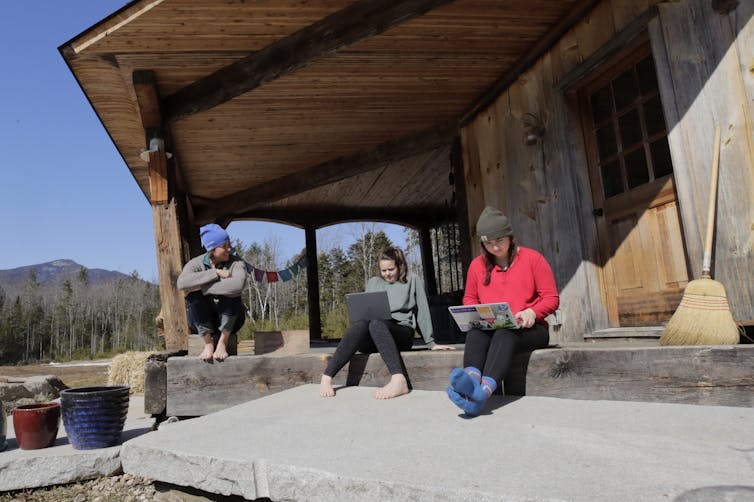
The federal government is pouring billions of dollars into expanding broadband internet access. But it’s at the state level where the financial rubber meets the fiber-optic road. History suggests some states are ahead of the game while others will have to play catch-up.
The recently signed Infrastructure Investment and Jobs Act includes significant funding to expand broadband access, to help households pay for their monthly broadband connections and to help people learn how to productively use those connections. This legislation represents Congress’ first formal recognition of the essential nature of high-speed internet.
Historically, broadband funding has been distributed from federal entities like the Federal Communications Commission or U.S. Department of Agriculture directly to internet providers. The Government Accountability Office, which monitors and audits government operations, has been critical of these efforts.
This time, however, states are at the center of the funding that is coming down the pipeline. The US$42.5 billion Broadband Equity, Access, and Deployment program, known as BEAD, requires each state to generate a five-year action plan laying out how it will use the funds, including a process for prioritizing locations that are classified as “unserved” or “underserved.”
Similarly, the $2.7 billion Digital Equity Act requires each state to establish an organization responsible for developing a digital equity plan, which will help to disburse subgrants. Digital equity means ensuring that every community has adequate access to the technologies and skills needed to fully participate in society.
From newbies to wily veterans
Not all states are equally positioned to handle the funds that will flow down from the federal government. Some states have operated formal broadband offices for years, and many have extensive experience running their own broadband grant programs. In others there are multiple agencies with jurisdiction over broadband, so even deciding who will develop the action plan may be challenging.
Some states have built detailed broadband maps that move beyond the highly criticized FCC versions, and clearly depict areas without access. Others were early adopters of “digital inclusion” efforts and have an established base of nonprofits and public entities that have already been successful at this type of work.
In short, states have varying track records when it comes to broadband projects. Rolling out billions of dollars of funding will be a challenge for states without a history of evaluating applications – or those that are brand-new to the quickly growing field of digital equity.
Why each state gets $100 million
The largest portion of the forthcoming broadband funding is the BEAD program focused on the provision of new broadband infrastructure. Each state will be awarded an initial amount of $100 million, with the remainder of the $42.5 billion allocated based on the percentage of unserved locations across states. The states are then responsible for disbursing these funds as subgrants. Unserved locations can include agricultural and business sites, not just households.
So, while it might seem unfair that Vermont, with fewer than 50,000 people classified as unserved, receives the same initial allocation as Texas, with over 1.2 million people unserved, this investment is less than 15% of the total BEAD funding. The $100 million should also provide an incentive for states to establish their five-year action plans and to set up offices capable of awarding grants within their borders.
The task of setting up a process to handle grant applications and assess which ones should be funded is not trivial. Recent research has defined a competitive grant program as a key component of state broadband policy, including the establishment of evaluation criteria.
States with existing broadband offices and grant programs will be well positioned to hit the ground running. States that to date don’t have broadband offices are Alabama, Alaska, Arizona, Delaware, Hawaii, Idaho, Iowa, Michigan, Mississippi, Montana, Nebraska, Nevada, New Hampshire, New Jersey, North Dakota, Oklahoma, Pennsylvania, South Carolina, South Dakota, Tennessee, Texas, Vermont and Wyoming. The District of Columbia also does not have a broadband office. These governments will need to put considerable time and effort into establishing ground rules and recruiting and educating employees to handle the grant evaluation process.
The law also adds several points related to grant awards that will be new for most states, regardless of how long their broadband office has been in place. One prevents states from excluding cooperatives, local governments, nonprofits and public utilities when considering who is eligible for the broadband funds.
The second requires grant awardees to establish a low-cost service option, leaving the definition of “low-cost” up to the state. Similar state-level efforts have not fared well in the past, and there is likely to be opposition from awardees about price and eligibility.
Digital equity
While federal programs to address broadband infrastructure have been around for a while, the focus on digital equity is new. Here, again, some states are at an advantage.
California has had a program emphasizing digital literacy, accessibility and broadband adoption, with grant programs in each, for over 10 years. Maine and North Carolina were also early to set up digital inclusion efforts, and Washington dedicated $7.5 million in state funding before the passage of the infrastructure act.
Most other states are newcomers to the topic, although there are resources to help them get started.
State policies – and experience – matter
A growing body of evidence suggests that state-level broadband policies matter. Case studies of successful state programs show a range of promising practices, including stakeholder engagement and program evaluation.
[Get the best of The Conversation, every weekend. Sign up for our weekly newsletter.]
The pending broadband funds will build on many of these practices – for states that had the foresight to have them up and running. Other states will be at a disadvantage from the outset. We believe that these differences are likely to play an important role in the success of the overall program.
Brian Whitacre, Professor and Neustadt Chair, Department of Agricultural Economics, Oklahoma State University and Christina Biedny, Ph.D. student in Agricultural Economics, Oklahoma State University
This article is republished from The Conversation under a Creative Commons license. Read the original article.
- Details
- Written by: Elizabeth Larson
Call Lake County Animal Care and Control at 707-263-0278 or visit the shelter online for information on visiting or adopting.
The following cats at the shelter have been cleared for adoption.

Domestic shorthair kitten
This female domestic shorthair kitten has a gray tabby coat.
She is in cat room kennel No. 6a, ID No. LCAC-A-2133.

Domestic shorthair kitten
This female domestic shorthair kitten has a gray tabby coat.
She is in cat room kennel No. 6b, ID No. LCAC-A-2134.

Male domestic shorthair kitten
This male domestic shorthair kitten has an orange tabby coat.
He is in cat room kennel No. 96a, ID No. LCAC-A-1871.

Male domestic shorthair kitten
This male domestic shorthair kitten has an orange tabby coat.
He is in cat room kennel No. 96c, ID No. LCAC-A-1873.

Female domestic shorthair kitten
This female domestic shorthair kitten has an orange tabby coat.
She is in cat room kennel No. 96d, ID No. LCAC-A-1874.

Female domestic shorthair kitten
This female domestic shorthair kitten has a gray tabby coat.
She is in cat room kennel No. 101a, ID No. LCAC-A-1945.
Email Elizabeth Larson at
- Details
- Written by: Elizabeth Larson
The council unanimously approved the Clearlake College Promise Program, which is an agreement between the city and Woodland Community College, which has a campus in Clearlake.
The program will commit $55,000 in city funds for the 2022-23 and 2023-24 academic years “for the purpose of implementing a last dollar scholarship program.”
It will pay the fees for qualified Clearlake residents who graduate from any high school within the city of Clearlake and attend any one of the three Woodland Community College campuses.
As the agreement explains, “The services will benefit the City of Clearlake and its residents by encouraging Clearlake residents graduating from high school to pursue a college education and to provide educational opportunities for students who may not otherwise be able to afford to continue their education.”
The program has two components: the fee-free Clearlake College Promise and a scholarship component called the Clearlake Stars Scholarship.
The Clearlake College Promise will cover up to two years of community college fees for eligible Clearlake students. The agreement explains that students graduating from high school within a 12-month period before enrollment will be eligible for the promise component.
The points-based Clearlake Stars Scholarship offers up to $1,000 per year for additional discretionary college expenses. That scholarship is scheduled to begin in fall 2023.
“The program may provide for eligible students to receive scholarship money that can be used toward the payment of college expenses including textbooks and other required supplemental materials for enrolled classes,” the agreement states.
The program developed after Mayor Dirk Slooten began talking to the college about a promise program concept.
He told Lake County News in an interview earlier this year that the program is modeled on one that the city of Woodland has in place with Woodland Community College.
The city’s financial commitment is not a huge amount, Slooten said, but it is expected to have an impact for students.
It’s also expected to help increase enrollment, which is a challenge Yuba Community College District — of which Woodland Community College is a part — is struggling with across its eight-county service area.
As a result of Slooten’s discussions with the college, in May Dr. Cirilo Cortez, dean of the Lake County Campus of Woodland College, and college president Dr. Art Pimentel gave a presentation to the council on the promise program idea, which then was proposed to offer a total of $40,000.
As a result of the presentation, the council gave staff direction to work with the college on a plan.
At Thursday’s meeting, City Manager Alan Flora gave credit to Slooten for his energy and ability to work with the college to establish the agreement.
Cortez was on hand at the meeting to answer questions while Pimentel attended by Zoom.
Pimentel said he appreciated the city developing the model. He added that high school students who participate in such programs succeed.
He thanked Slooten and the council, noting they had asked what they could do to help support education and youth in this community and develop the workforce.
Pimentel said he was happy to know the city is committed to the community and youth and providing as many opportunities as they can.
Slooten then read a letter from Konocti Unified Superintendent Dr. Becky Salato, who thanked the council for its consideration and approval, noting the importance of education.
With the city’s support, the future will continue to be bright for students, with Salato adding that it takes a village to raise a child.
During the discussion, Flora noted that a student taking 15 units at the community college pays $742, a figure cited in the agreement.
Councilman Russ Cremer praised Slooten for his work. “I think it’s a great program,” said Cremer. “This is the type of thing we need to support.”
Cremer then moved to approve the program, with Overton offering the second and the council voting 5-0.
“Now we really have to start promoting this,” said Slooten.
He added that he had been at the college’s culinary arts program at the Lake County Campus that day. That program now has a waiting list.
Email Elizabeth Larson at
- Details
- Written by: Elizabeth Larson
The National Weather Service’s forecast notes that periods of rain will become increasingly likely during this week, particularly from Wednesday through next weekend.
Chances of rain are in the forecast beginning on Monday, with a break on Tuesday, before more rain is forecast Wednesday and Thursday.
Conditions are forecast to clear again on Friday, with slight chances of rain anticipated on Saturday, the National Weather Service said.
Daytime temperatures through much of the week will range from the high 50s to high 60s, before dropping into the high 40s on Friday, the forecast said.
Nighttime temperatures will be in the 40s until next weekend, when they are forecast to move into the 30s.
“A more impactful winter storm system may emerge late next weekend,” the National Weather Service reported.
Forecasters said a wet and stormy scenario is anticipated from Dec. 12 to 14, complete with “widespread beneficial rain, periods of gusty winds, and mountain snow” if the stormy pattern materializes.
Email Elizabeth Larson at