 How to resolve AdBlock issue?
News
- Details
- Written by: NATIONAL AERONAUTICS AND SPACE ADMINISTRATION
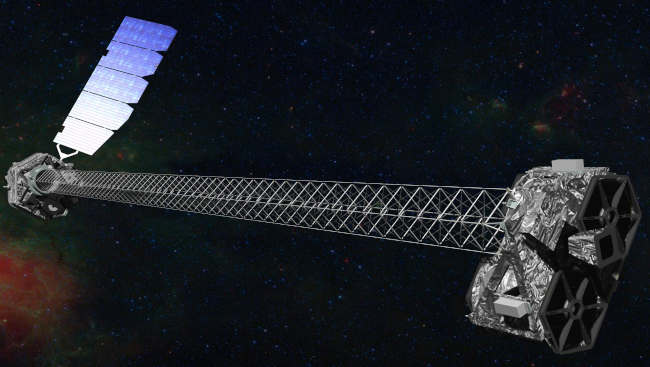
After a decade of observing some of the hottest, densest, and most energetic regions in our universe, this small but powerful space telescope still has more to see.
NASA’s Nuclear Spectroscopic Telescope Array, or NuSTAR, is turning 10. Launched on June 13, 2012, this space telescope detects high-energy X-ray light and studies some of the most energetic objects and processes in the universe, from black holes devouring hot gas to the radioactive remains of exploded stars. Here are some of the ways NuSTAR has opened our eyes to the X-ray universe over the last decade.
Seeing x-rays close to home
Different colors of visible light have different wavelengths and different energies; similarly, there is a range of X-ray light, or light waves with higher energies than those human eyes can detect. NuSTAR detects X-rays at the higher end of the range.
There aren’t many objects in our solar system that emit the X-rays NuSTAR can detect, but the Sun does: Its high-energy X-rays come from microflares, or small bursts of particles and light on its surface. NuSTAR’s observations contribute to insights about the formation of bigger flares, which can cause harm to astronauts and satellites.
These studies could also help scientists explain why the Sun’s outer region, the corona, is many times hotter than its surface. NuSTAR also recently observed high-energy X-rays coming from Jupiter, solving a decades-old mystery about why they’ve gone undetected in the past.

Illuminating black holes
Black holes don’t emit light, but some of the biggest ones we know of are surrounded by disks of hot gas that glow in many different wavelengths of light. NuSTAR can show scientists what’s happening to the material closest to the black hole, revealing how black holes produce bright flares and jets of hot gas that stretch for thousands of light-years into space.
The mission has measured temperature variations in black hole winds that influence star formation in the rest of the galaxy. Recently, the Event Horizon Telescope, or EHT, took the first-ever direct images of the shadows of black holes, and NuSTAR provided support.
Along with other NASA telescopes, NuSTAR monitored the black holes for flares and changes in brightness that would influence EHT’s ability to image the shadow cast by them.
One of NuSTAR’s biggest accomplishments in this arena was making the first unambiguous measurement of a black hole’s spin, which it did in collaboration with the European Space Agency, or ESA, XMM-Newton mission.
Spin is the degree to which a black hole’s intense gravity warps the space around it, and the measurement helped confirm aspects of Albert Einstein’s theory of general relativity.
Finding hidden black holes
NuSTAR has identified dozens of black holes hidden behind thick clouds of gas and dust. Visible light typically can’t penetrate those clouds, but the high-energy X-ray light observed by NuSTAR can. This gives scientists a better estimate of the total number of black holes in the universe.
In recent years scientists have used NuSTAR data to find out how these giants become surrounded by such thick clouds, how that process influences their development, and how obscuration relates to a black hole’s impact on the surrounding galaxy.
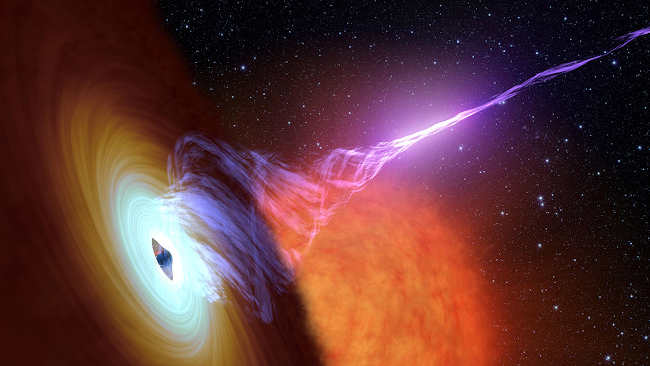
Revealing the power of ‘undead’ stars
NuSTAR is a kind of zombie hunter: It’s deft at finding the undead corpses of stars. Known as neutron stars, these are dense nuggets of material left over after a massive star runs out of fuel and collapses.
Though neutron stars are typically only the size of a large city, they are so dense that a teaspoon of one would weigh about a billion tons on Earth. Their density, combined with their powerful magnetic fields, makes these objects extremely energetic: One neutron star located in the galaxy M82 beams with the energy of 10 million Suns.
Without NuSTAR, scientists wouldn’t have discovered just how energetic neutron stars can be. When the object in M82 was discovered, researchers thought that only a black hole could generate so much power from such a small area.
NuSTAR was able to confirm the object’s true identity by detecting pulsations from the star’s rotation – and has since shown that many of these ultraluminous X-ray sources, previously thought to be black holes, are in fact neutron stars. Knowing how much energy these can produce has helped scientists better understand their physical properties, which are unlike anything found in our solar system.
Solving supernova mysteries
During their lives, stars are mostly spherical, but NuSTAR observations have shown that when they explode as supernovae, they become an asymmetrical mess.
The space telescope solved a major mystery in the study of supernovae by mapping the radioactive material left over by two stellar explosions, tracing the shape of the debris and in both cases revealing significant deviations from a spherical shape.
Because of NuSTAR’s X-ray vision, astronomers now have clues about what happens in an environment that would be almost impossible to probe directly. The NuSTAR observations suggest that the inner regions of a star are extremely turbulent at the time of detonation.
More about the mission
NuSTAR launched on June 13, 2012. The mission’s principal investigator is Fiona Harrison, chair of the Division of Physics, Mathematics, and Astronomy at Caltech in Pasadena, California.
A Small Explorer mission managed by the agency’s Jet Propulsion Laboratory in Southern California for NASA’s Science Mission Directorate in Washington, NuSTAR was developed in partnership with the Danish Technical University, or DTU, and the Italian Space Agency, or ASI.
The telescope optics were built by Columbia University, NASA’s Goddard Space Flight Center in Greenbelt, Maryland, and DTU.
The spacecraft was built by Orbital Sciences Corp. in Dulles, Virginia. NuSTAR’s mission operations center is at the University of California, Berkeley, and the official data archive is at NASA’s High Energy Astrophysics Science Archive Research Center. ASI provides the mission’s ground station and a mirror data archive. Caltech manages JPL for NASA.
For more information on NuSTAR, visit www.nustar.caltech.edu.
- Details
- Written by: Elizabeth Larson
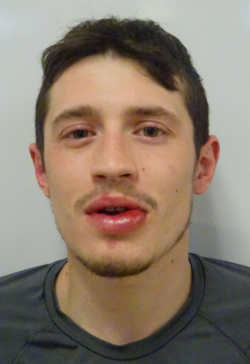
LAKE COUNTY, Calif. — The District Attorney’s Office has charged a Cobb man with numerous felony charges for a shooting that occurred after an early Tuesday morning fight at a barbecue.
Hunter Christian Toles, 23, appeared before Judge Andrew Blum in Lake County Superior Court for arraignment on the charges Thursday afternoon.
He was arrested early Tuesday after the shooting, which occurred on Rainbow Road in Cobb, the Lake County Sheriff’s Office reported.
Toles, who has remained in custody since his arrest, appeared via Zoom from the Lake County Jail.
Chief Deputy District Attorney Richard Hinchcliff told the court that Toles has no prior criminal history and that the investigation is ongoing.
Based on the reports so far and speaking to the lead officer in the investigation, Hinchcliff said Toles was at a barbecue where people were drinking and a fight broke out.
Toles is reported to have grabbed a shotgun and fired three shots. One of the shots hit a female victim at close range. Hinchcliff didn’t have a report on her condition. While it wasn’t terminal, “she was shot up pretty good,” he added.
Another shot went through a wall where there was a 3-year-old child sleeping on the other side, Hinchcliff said.
Hinchcliff filed a complaint on Thursday that charged Toles with attempted murder, assault with a firearm and battery causing serious bodily injury for shooting the woman, along with special allegations of personally and intentionally discharging a firearm, personal use of a shotgun and inflicting great bodily injury on the female victim.
Charges also were filed against Toles for another adult victim who was not reported to have been physically injured. For that second victim he’s facing charges of attempted murder and assault with a firearm, and special allegations of personal use of a firearm and personally and intentionally discharging a shotgun.
For the child victim, he was charged with assault with a firearm and felony child endangerment, and special allegations of use of a firearm and that the crime involved great violence and a firearm, and that the victim was particularly vulnerable.
Blum said during the hearing that Toles is facing the potential of three life sentences if convicted of the charges.
Hinchcliff said several of the charges carried $1 million bail requirements, with $25,000 for the child victim. Altogether, the charges called for bail totaling $3,025,000.
Toles said he could not afford an attorney and asked for one to be assigned. Defense attorney Tom Quinn agreed to take the case and asked for it to be set for entry of a plea on Tuesday.
Toles wanted to speak about his case but Quinn told him not to say anything.
“The defendant is claiming self-defense,” Hinchcliff said.
The mother of Toles’ two young children asked Blum to reduce his bail or release him on his own recognizance. Quinn said no one would get such a release on a case like this one.
She told the court the charges filed against him were different from those on his online jail booking sheet.
“The sheriff doesn’t make charges. They arrest people,” said Blum.
Quinn said they might be able to get the bail reduced to $100,000 but couldn’t do that in the Thursday hearing. Toles’ partner said she had money to hire an attorney the same day.
Blum set Toles’ bail at $3,025,000 and ordered him to be present for plea entry in Department 3 at 10 a.m. Tuesday, June 14.
Email Elizabeth Larson at
- Details
- Written by: DISTRICT ATTORNEY’S OFFICE
LAKE COUNTY, Calif. — A man with a history of child abuse who was convicted of the 1990 beating death of his girlfriend’s young child has been denied parole.
On Tuesday, the Board of Parole Hearings denied parole for convicted murderer and child abuser Leonard Scott Snider, 61, a prior resident of Kelseyville, Chief Deputy District Attorney Richard Hinchcliff reported.
Deputy District Attorney Art Grothe attended the lifer hearing to argue against Snider’s release.
Hinchcliff said Snider was found guilty by a jury on Aug. 31, 1990, of the first degree murder of a 3 and a half year old Lakeport boy, and felony child abuse of another young boy, and sentenced to 31 years to life.
Snider was sentenced by Superior Court Judge Robert L. Crone Jr. and originally prosecuted by District Attorney Stephen O. Hedstrom.
According to investigation reports, between 1988 and 1990 Snider was involved in several incidents of domestic violence against his girlfriends, including threats and physical violence.
The 8-year-old son of one of Snider’s girlfriends, during a 1990 interview, reported to a district attorney investigator that Snider had been abusing him for a long time.
The victim reported being beaten by Snider many times, including beating him against a wall, slapping him, placing him in steaming hot water in a bathtub numerous times, smashing his face into things, giving him a black eye, kicking him in the groin with hiking boots, holding his head under water, pulling hair out of his head, tying a rope around his neck so he had difficulty breathing, and repeatedly beating, bruising and threatening the victim.
The child victim also reported Snider put a rubber band around the child’s genitals and repeatedly snapped it while covering the victim’s mouth so he could not scream.
On April 7, 1990, sheriff’s deputies and Lakeport Police responded to the hospital in Lakeport regarding a 3 and a half old boy, the son of Snider’s new girlfriend at the time, who was dying from severe trauma. Snider initially claimed that the boy had fallen off of a deck and injured himself.
Doctors at the UC Davis Medical Center determined the child had died from blunt force trauma to the head. At the time the child had severe bruising to his body, cerebral trauma and swelling, scars on his body, scarring of his genitals, burns on his legs, and a fractured arm.
Police responded to the child’s home on Sixth Street in Lakeport and found several areas of blood inside the house.
During the investigation Snider finally admitted he lost it and spanked the child too hard. During the investigation an adult relative of the child advised investigators she had previously witnessed Snider beating the child, and had seen severe bruising to the child and chunks of hair missing from the child’s head. When asked at the time the child said Snider caused the injuries.
During a post-conviction interview Snider claimed that both children loved him, he loved them and he was like a father figure to the children. Snider blamed the child’s mother for the death and denied abusing the children.
In an October 2012 interview in prison Snider continued to deny committing any child abuse and claimed he was wrongfully incriminated. During his time in prison Snider has had disciplinary problems.
At this week’s hearing the parole commissioners issued a five-year denial of parole, and Snider’s next parole hearing will be some time in 2027.
Hinchcliff said the Lake County District Attorney’s Office attends all parole hearings for inmates convicted in Lake County and receiving life sentences, and will be at Snider’s next hearing to oppose parole.
Because of changes in recent years to sentencing laws by voters and elected state representatives, punishment for serious and violent felons has become much more lenient, and inmates convicted of murder and other serious crimes that receive “life” sentences are becoming eligible for parole at earlier dates, and are receiving more frequent parole hearings, Hinchcliff said.
Not too long ago the Lake County District Attorney’s Office would only have one or two parole hearings per year, Hinchcliff said. Now it is common for the District Attorney’s Office to attend a half dozen or more hearings each year.
- Details
- Written by: Lake County Behavioral Health Services
In 2010, the U.S. Senate declared June 27 National Post-traumatic Stress Disorder Awareness Day, and the entire month of June was designated National PTSD Awareness Month in 2014.
If you think you, or someone you know, has PTSD, you are not alone, and Lake County Behavioral Health Services wants to ensure you have access to information resources and supports.
Self-care and learning to identify indicators of PTSD in ourselves and loved ones are essential to ensuring people affected by this prevalent condition receive appropriate resources and treatment.
Unfortunately, most people who have PTSD do not get the help they need.
Post-traumatic stress disorder can affect individuals at any age. It is defined by the American Psychological Association as, “an anxiety problem that develops in some people after extremely traumatic events.”
PTSD can result from going through or seeing a life-threatening event. Stress reactions in response to these types of events are expected, and most people begin to feel better, in time. PTSD can result in recurrent dreams about the trauma, disturbances in relationships, irritability, anger and isolation.
As the weather grows warmer and drier, Lake County residents may be reminded of the fire disasters we have experienced.
“Although we are a strong and resilient community, it is important to be aware of our mental health, and how critical good mental health is to our overall health,” said Todd Metcalf, director of Lake County Behavioral Health Services. “It’s okay to not be OK. However, seeking appropriate help and support when struggling with PTSD, or any other mental health issue, is critical to proper management.”
Treatments are available that can assist individuals suffering from PTSD. Options include different types of trauma-informed therapy, as well as medications designed to help manage symptoms.
Many find the American Psychological Association’s “How Do I Know if I need Therapy?” resource a helpful guide.
Supports and treatment for people affected by PTSD are available right here in Lake County.
For more information, contact Lake County Behavioral Health Services at 707-274-9101 or 707-994-7090.