How to resolve AdBlock issue?
Refresh this page
How to resolve AdBlock issue?
Refresh this page
Lake County News,California
  • Home
    • Registration Form
  • News
    • Education
    • Veterans
    • Community
      • Obituaries
      • Letters
      • Commentary
    • Police Logs
    • Business
    • Recreation
    • Health
    • Religion
    • Legals
    • Arts & Life
    • Regional
  • Calendar
  • Contact us
    • FAQs
    • Phones, E-Mail
    • Subscribe
  • Advertise Here
  • Login
How to resolve AdBlock issue?
Refresh this page

News

Cobb area pavement project to resume Oct. 13

Details
Written by: Elizabeth Larson
Published: 06 October 2025

LAKE COUNTY, Calif. — A county road construction project in the Cobb area that was stopped temporarily over the summer due to quality concerns is set to restart.

The work is part of the county’s 2024 Pavement Rehabilitation Project, which will resume on Monday, Oct. 13.

The $5 million project was paused over the summer due to quality and durability concerns, as Lake County News has reported.

At the board’s Sept. 9 meeting, the supervisors approved a $1 million change to the contract with Argonaut Constructors Inc. to upgrade the project’s surface treatment from chip
seal to a longer-lasting asphalt paving surface, raising the total contract cost to $6.1 million.

Lake County Public Works said the work that’s slated to begin next week will include grading existing road sections; placing new asphalt pavement, aggregate base and shoulder backing; and adjusting utility covers to match the new road surface.

Public Works said drivers should expect construction activity and possible delays in the Cobb area while the work is underway.

For questions or more information, contact the Lake County Public Works Department at 707-263-2341.

Email Elizabeth Larson at This email address is being protected from spambots. You need JavaScript enabled to view it.. Follow her on Twitter, @ERLarson, and on Bluesky, @erlarson.bsky.social. Find Lake County News on the following platforms: Facebook, @LakeCoNews; X, @LakeCoNews; Threads, @lakeconews, and on Bluesky, @lakeconews.bsky.social. 

Federal judge blocks deployment of California National Guard to Portland

Details
Written by: LAKE COUNTY NEWS REPORTS
Published: 06 October 2025

On Sunday night, in a court victory for California, a federal judge blocked the Trump Administration’s attempt to deploy 300 California National Guard soldiers to Portland, Oregon – an effort the judge called an improper effort to “circumvent” her ruling on Saturday that Oregon National Guard members could not be federalized and deployed. 

Judge Karin Immergut, a Trump appointee, granted the state of California’s request for a temporary restraining order, which halts any federalization, relocation or deployment of any guards members to Oregon from any state.

“The rule of law has prevailed — and California’s National Guard will soon be heading home,” said Gov. Gavin Newsom. “This ruling is more than a legal victory, it’s a victory for American democracy itself. Donald Trump tried to turn our soldiers into instruments of his political will. While our fight continues, tonight the rule of law said ‘hell no’.”

“The Trump Administration’s flagrant disregard for the courts was on full display when it sought to circumvent Judge Immergut’s order blocking the federalization of the Oregon National Guard by redeploying troops from Los Angeles to Portland,” said Attorney General Rob Bonta. “This disrespect for the rule of law cannot stand — and I’m glad the court agreed. The president’s move to deploy the National Guard of one state over the objections of a governor to another state over the objections of a second is well outside of the norms or practices of any president in recent history. But this President is determined to take as much power as the courts will give him. This fight isn’t over, but today’s rebuke of the President’s illegal actions is a step in the right direction.”

Earlier on Sunday, Gov. Newsom announced the state’s intention to sue the Trump Administration after the White House sought to deploy 300 California National Guard personnel into Portland — a move Newsom called illegal — the day after a federal district court blocked the attempted federalization of Oregon’s National Guard. 

California joined Oregon’s suit in the Oregon federal court. 

Trump tries to send California troops to Oregon

Despite a federal court order finding no legal basis to deploy state National Guard troops to the streets of Portland and ordering that control of the Oregon National Guard be returned to state command, the Trump Administration tried to send 300 federally controlled members of the California National Guard to Portland to take their place. 

The troops originally had been federalized months ago in response to what Newsom’s office called “unfounded claims” that unrest in Los Angeles — conditions that never necessitated their deployment in the first place, and have long since subsided anyway. 
 
Courts rebuke Trump for deployment 

In her Saturday ruling, Judge Immergut rejected the Trump Administration’s justification for deploying federalized troops, writing in her order, “This historical tradition boils down to a simple proposition: this is a nation of Constitutional law, not martial law. Defendants have made a range of arguments that, if accepted, risk blurring the line between civil and military federal power — to the detriment of this nation.”

The court found that the president’s own statements regarding the deployment of federalized National Guard were not “conceived in good faith” and were “simply untethered to the facts.”

World War II nurse donates cherished bullet to Pearl Harbor National Memorial

Details
Written by: Kyler Hood
Published: 05 October 2025
Alice Beck Darrow, a 106-year-old former Navy nurse who served during World War II, holds up a bullet that was once lodged in her husband's heart before she donated it to the Pearl Harbor National Memorial on Sept. 18, 2025 on the patio outside the Pearl Harbor classroom. Darrow hopes the bullet will serve as a reminder of the devastation caused by the conflict and as a remembrance of her husband, whom the bullet allowed her to meet. During the attack on Pearl Harbor on December 7, 1941, Fire Controlman Dean Darrow was serving aboard the USS West Virginia (BB 48) when the ship was struck by torpedoes. Wounded by gunfire in the attack, Dean was later transported to Mare Island Naval Hospital. There, a young Navy nurse named Alice Beck tended to him as surgeons removed a bullet lodged in his heart. Against all odds, he survived. Nurse Alice and her patient Dean later married, and the couple cherished the relic throughout their lives together. U.S. Navy photo by Kyler Hood.

JOINT BASE PEARL HARBOR-HICKAM, HAWAII, UNITED STATES — For most people, a bullet in the heart means certain death. 

But for a World War II Sailor and his nurse, the precariously located bullet marked the start of an enduring love story symbolizing the resilience of the greatest generation.

During the attack on Pearl Harbor on Dec. 7, 1941, Fire Controlman Dean Darrow was serving aboard the USS West Virginia (BB 48) when it was struck by torpedoes. 

He was flung into the harbor’s oily, burning water. After Darrow was rescued and his wounds were treated, he was cleared for duty. But health complications kept him from returning to combat. 

Darrow was transferred to Mare Island Naval Hospital in California where an X-ray revealed a bullet lodged in the muscle of his heart. 

As he was being prepped for surgery, Darrow asked the nurse that had been assigned to him, Alice Beck, to go on liberty with him if he made it through the procedure. Beck agreed but wasn’t sure if the young Sailor would survive.

Fortunately, the bullet was successfully removed from Darrow’s heart and he and Beck went on their date. The two fell in love and later married. They raised four children: two sons, and two daughters. The bullet became a cherished keepsake of survival and the couple’s decades-long love story.

The Darrows later made their home in Lake County, California. Dean Darrow died in 1991 and Alice held on to the bullet, which meant everything to them.

Despite her attachment to the memento, Alice, now 106 years old, made the decision to donate the bullet so others could understand its significance — as a symbol of their love and to honor all who served and sacrificed.

Darrow and her family traveled to Hawaii where she gave the bullet to a museum technician from the National Park Service which manages the Pearl Harbor National Memorial on Sept. 18, 2025.

Alice said donating the bullet was bittersweet. She was saddened to part with the memento that brought her and her husband together but was also happy that the bullet could serve as a reminder of the devastation caused by war.

“This is the right place for it to be, where it can be displayed, and other boys can see it. Youngsters can see it, and realize what war is like,” she said, flanked by Navy Sailors from the Arizona Detachment and National Park Service rangers who were on hand for the transfer of a piece of World War II history.

“The heart that she has to have to be able to pass down something that she cherishes so much is a big deal,” said Damage Controlman 3rd Class Paul Esposito, a Sailor from the Arizona Detachment, the unit that ferries over 4,000 visitors daily to the Arizona Memorial. “And it shows the respect and appreciation that she has for the Navy.”

“We are honored to receive this piece of history,” said Mikael Fox, the museum technician with the National Park Service, who accepted the bullet and is working with the Darrow family to collect historical information about Dean and Alice Darrow for the Pearl Harbor National Memorial’s website and for a future exhibit.

In a short biography of her father’s life, Becky Mitchell recalled her parents’ fond memories of how the bullet brought them together.

“Dean would sometimes say: ‘The best thing I ever got out of the Navy was my nurse’. Alice would then reply: ‘After the surgery, it left a hole in his heart. I was able to fill that hole with my love.’”

Museum technician Fox said the Darrows’ story of love and resilience in the aftermath of Dec. 7 is representative of the powerful transformation depicted in the Tree of Life monument at the Arizona Memorial Visitors Center. The Tree of Life design is also featured on both side walls in the USS Arizona Memorial’s shrine room, allowing natural lighting to illuminate the names of fallen service members.

“The idea behind that sculpture is that even in the darkest moments under the darkest clouds, you can always find these bits of light filtering through, and I think the Alice and Dean story really embodies that,” Fox said. “This idea that in the aftermath of this tragedy so many had died and with Dean’s life at risk they found each other, and they continued to have each other for nearly 50 years.”

Editor’s note: Alice Darrow, formerly a Lake County resident, now lives in Contra Costa County with her daughter, Becky Mitchell. 

Kyler Hood is a public affairs specialist with the Navy Hawaii Region at Pearl Harbor.

How the government shutdown is hitting the health care system – and what the battle over ACA subsidies means

Details
Written by: Simon F. Haeder, The Ohio State University
Published: 05 October 2025

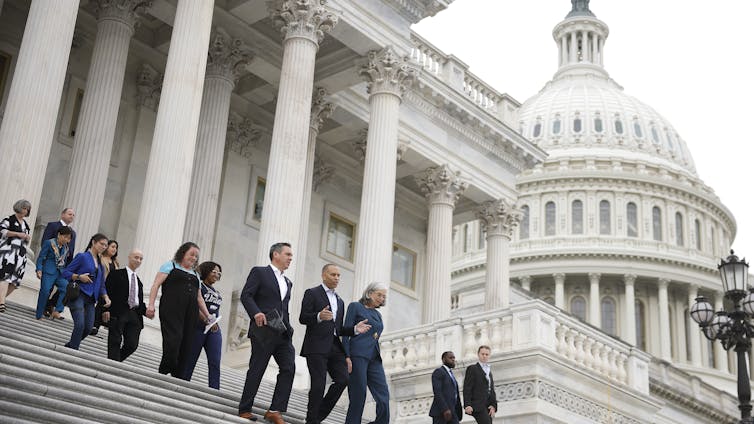
Democrats demanded that Republicans negotiate with them on ACA subsidies and Medicaid cuts. Kevin Dietsch/Getty Images News

Major rifts over key health care issues are at the heart of the federal government shutdown that began at the stroke of midnight on Oct. 1, 2025.

This is not the first time political arguments over health care policy have instigated a government shutdown. In 2013, for example, the government shut down due to disputes over the Affordable Care Act.

This time around, the ACA continues to play a central role, with Democrats demanding, among other things, an extension of subsidies for ACA plan insurance premiums that are set to expire at the end of 2025. Democrats are also holding out to roll back cuts to the Medicaid program that President Donald Trump signed into law on July 4, as part of what he called his “One Big Beautiful Bill.”

Without a budget agreement in place, Trump ordered most federal agencies to wind down their nonessential activities. The shutdown will continue until Congress passes either a short-term or long-term funding bill and Trump signs it.

Government shutdowns are nothing new, but as a health policy expert, I worry this time around the impasse may have far-reaching effects on health care.

Even as Democrats stage their battle over access to health care, the shutdown itself could also make it harder for Americans to get the care they need. Meanwhile, Trump has threatened to use the crisis to permanently cut federal jobs on a mass scale, including ones in the health care sector, which could substantially reshape federal health agencies and their ability to protect Americans’ health.

The partisan health care divide

Historically, questions about how the government should support access to health care have long been a source of conflict between the two main political parties. The passage of the ACA in 2010 and its implementation have only intensified this friction.

In the lead-up to the current shutdown, Republicans needed Democratic votes in the Senate to pass a bill that would keep funding the government at existing levels at least until November.

In return for their support, Democrats sought several concessions. A major one was to extend subsidies for ACA insurance policy premiums, which were established during the COVID-19 pandemic. These subsidies addressed a shortcoming in the ACA by decreasing premiums for millions of Americans – and they played a crucial role in more than doubling enrollment in the ACA marketplaces.

Without this extension, ACA premiums are set to rise by more than 75% in 2026, and the Congressional Budget Office estimated that 4.2 million Americans would lose insurance. At least some Republicans seemed open to considering the ACA subsidies, particularly those from districts that were more moderate and that had large numbers of people enrolled in ACA plans. But many have objected to doing that as part of the budget process.

Democrats are also pushing to renegotiate some of the changes made to Medicaid in the budget bill. These include new work requirements that are a cornerstone of Republican demands, under which certain adults would have to work or engage in qualifying activities to maintain Medicaid benefits. Work requirements are set to take effect in 2027, but implementing them would lead to an estimated 5 million people losing their health insurance coverage.

ACA subsidies are a major bone of contention in the standoff between Democrats and Republicans.

Most contentiously, these rollbacks to Medicaid cuts would reverse restrictions that made immigrants who are generally present in the country legally, such as refugees and asylum-seekers, ineligible for Medicaid and ACA coverage. These restrictions, which were included in the budget bill, could lead to the loss of insurance for about 1.4 million lawfully present immigrants, the Congressional Budget Office has estimated.

Republicans have balked at these demands, taking particular issue with the prospect of restoring Medicaid benefits to immigrants. Some Republicans – and Trump himself – have misconstrued the Democrats’ position, saying they are seeking free health care for immigrants in the country illegally.

What kinds of health services might be affected?

Most obviously, large-scale staff reductions would interfere with a wide range of health-related services not considered essential during the shutdown. This includes everything from surveying and certifying nursing homes to assisting Medicaid and Medicare beneficiaries and overseeing contracts or extra payments to rural ambulance providers.

Protesters on September 30, 2025, at a rally against cuts to health care
If the shutdown becomes protracted, health care services may be affected. Tasos Katopodis/Getty Images Entertainment

Some seniors may face an immediate impact as two programs have now lost funding without a new budget in place. One expanded access for seniors to telehealth services. The other allowed people to receive services at home that are generally provided in a hospital.

Crucially, most seniors will continue to receive Social Security payments. However, providers might be hesitant to schedule patients covered by Medicare if the shutdown drags on over a long period of time. This is because payments to medical providers would likely be delayed.

What health services will continue to function?

The Centers for Medicare and Medicaid Services has indicated that there is enough funding for Medicaid, the government program that primarily provides health services to low-income Americans, to support the program through the end of the calendar year. If the shutdown lasts beyond that, states may have to decide whether to temporarily fund the program on their own or whether to reduce or delay provider payments. However, no previous shutdown has ever lasted more than 34 days.

Community health centers are generally expected to receive some funding, at least for now. These providers offer nonemergency medical services for about 34 million Americans each year. Many also provide important services across the nation’s schools. However, if the standoff continues for more than a few days, those centers may struggle to keep their doors open.

Health and Human Services has also indicated that it will use all available funding to maintain “minimal readiness for all hazards” and will maintain certain medical services, such as the Indian Health Service. The Veterans Health Administration will also stay open. One of the agencies most affected by previous layoffs, the Food and Drug Administration, has indicated that it would be exempt from further cuts.

A longer-term view

Ultimately, the severity of the shutdown’s effects on health care will depend on how long it lasts.

It will also depend on whether Trump makes good on his stated intention to use the shutdown as “an unprecedented opportunity” to reshape the federal bureaucracy. The White House announced plans for potential mass firings of workers, particularly those at “Democrat Agencies.”

Whether this threat is simply a bargaining tactic remains to be seen, and it’s unclear whether health-related workers and agencies are in the crosshairs. But given that previous layoffs specifically targeted health programs, more permanent reductions in programs that affect health care may be on the way.The Conversation

Simon F. Haeder, Associate Professor of Public Health, The Ohio State University

This article is republished from The Conversation under a Creative Commons license. Read the original article.

  1. Helping Paws: New dogs and puppies
  2. Space News: What’s up for October 2025 
  3. Unionized staff at Sutter Lakeside, seven other hospitals vote to strike
  • 138
  • 139
  • 140
  • 141
  • 142
  • 143
  • 144
  • 145
  • 146
  • 147
How to resolve AdBlock issue?
Refresh this page