 How to resolve AdBlock issue?
News
- Details
- Written by: CAL FIRE
State Fire Marshal Michael J. Richwine has announced his retirement from the California Department of Forestry and Fire Protection, or Cal Fire, Office of the State Fire Marshal, after a 42-year career, including 36 years with the department.
Chief Richwine was appointed State Fire Marshal by Governor Gavin Newsom on May 15, 2020, after serving as the assistant state fire marshal from 2012 to 2018.
As state fire marshal, Chief Richwine oversaw a staff of more than 220 employees.
“Among many things, one of my proudest career achievements was leading the Office of the State Fire Marshal and overhauling the California Fire Service Training and Education System — a state fire training certification and education program — including aligning it with national training standards and national and international accreditation of the firefighter program,” said Chief Richwine. “Through this important work, we continue to find ways to innovate, set the bar high and prepare the next generation of fire professionals in California.”
Chief Richwine's total 42-year fire service career began with the Hanford Fire Department. He has since risen through the ranks and held a variety of fire prevention and training positions within the Office of the State Fire Marshal, including, fire service training specialist, deputy state fire marshal within fire and life safety, Hazardous Materials and Pipeline Safety Divisions, chief of state fire training, and chief of the Fire Engineering Division.
Chief Richwine also served as a member on Cal Fire’s Incident Management Teams for six years and holds numerous professional certifications.
“My hope for the future is that the Office of the State Fire Marshal continues its tradition of working collaboratively with its many partners and continues to communicate effectively. That is what I have preached on a regular basis — up and down and across our entire organization,” said Chief Richwine.
The mission of the State Fire Marshal is to protect life and property through the development and application of fire prevention engineering, education, and enforcement.
The Office of the State Fire Marshal supports the mission of Cal Fire by focusing on fire prevention and providing support through a wide variety of fire safety responsibilities through code development and analysis, community wildfire preparedness and mitigation, fire and life safety, fire engineering and investigations, pipeline safety and certified unified program agency, and state fire training.
During his retirement, Chief Richwine is looking forward to spending time with his wife, a retired elementary school teacher, and their children and grandchildren.
His last day with the Department will be Dec. 30.
- Details
- Written by: Shane Coffield, NASA and James Randerson, University of California, Irvine
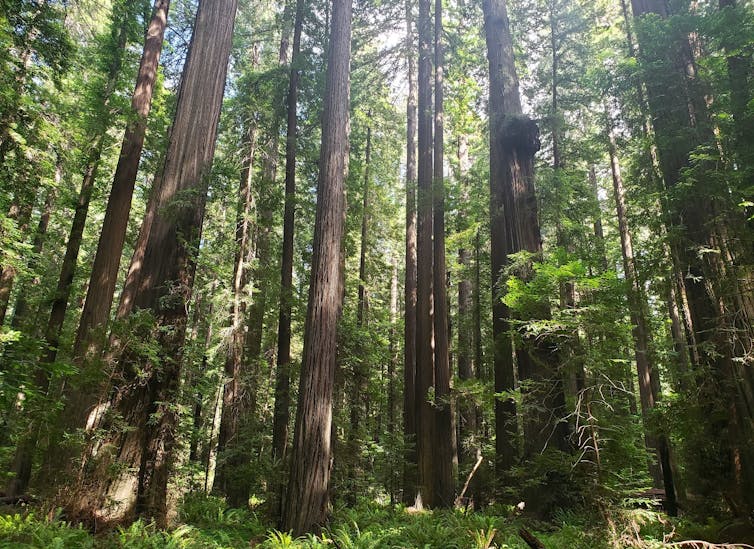
Many of the companies promising “net-zero” emissions to protect the climate are relying on vast swaths of forests and what are known as carbon offsets to meet that goal.
On paper, carbon offsets appear to balance out a company’s carbon emissions: The company pays to protect trees, which absorb carbon dioxide from the air. The company can then claim the absorbed carbon dioxide as an offset that reduces its net impact on the climate.
However, our new satellite analysis reveals what researchers have suspected for years: Forest offsets might not actually be doing much for the climate.
You can listen to more articles from The Conversation, narrated by Noa, here.
When we looked at satellite tracking of carbon levels and logging activity in California forests, we found that carbon isn’t increasing in the state’s 37 offset project sites any more than in other areas, and timber companies aren’t logging less than they did before.
The findings send a pretty grim message about efforts to control climate change, and they add to a growing list of concerns about forest offsets. Studies have already shown that projects are often overcredited at the beginning and might not last as long as expected. In this case we’re finding a bigger issue: a lack of real climate benefit over the 10 years of the program so far.
But we also see ways to fix the problem.
How forest carbon offsets work
Forest carbon offsets work like this: Trees capture carbon dioxide from the air and use it to build mass, effectively locking the carbon away in their wood for the life of the tree.
In California, landowners can receive carbon credits for keeping carbon stocks above a minimum required “baseline” level. Third-party verifiers help the landowners take inventory by manually measuring a sample of trees. So far, this process has only involved measuring carbon levels relative to baseline and has not leveraged the emerging satellite technologies that we explored.
Forest owners can then sell the carbon credits to private companies, with the idea that they have protected trees that would otherwise be cut down. These include large oil and gas companies that use offsets to meet up to 8% of their state-mandated reductions in emissions.
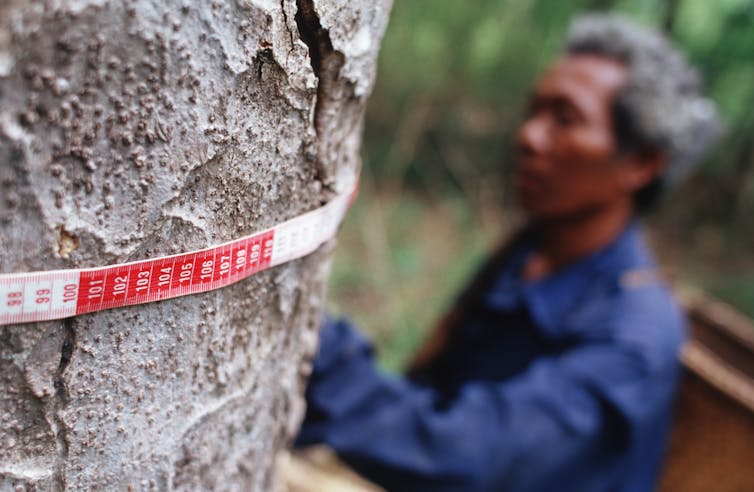
Forest offsets and other “natural climate solutions” have received a great deal of attention from companies, governments and nonprofits, including during the U.N. climate conference in November 2022. California has one of the world’s largest carbon offset programs, with tens of millions of dollars flowing through offset projects, and is often a model for other countries that are planning new offset programs.
It’s clear that offsets are playing a large and growing role in climate policy, from the individual to the international level. In our view, they need to be backed by the best available science.
3 potential problems
Our study used satellite data to track carbon levels, tree harvesting rates and tree species in forest offset projects compared with other similar forests in California.
Satellites offer a more complete record than on-the-ground reports collected at offset projects. That allowed us to assess all of California since 1986.

From this broad view, we identified three problems indicating a lack of climate benefit:
-
Carbon isn’t being added to these projects faster than before the projects began or faster than in non-offset areas.
-
Many of the projects are owned and operated by large timber companies, which manage to meet requirements for offset credits by keeping carbon above the minimum baseline level. However, these lands have been heavily harvested and continue to be harvested.
-
In some regions, projects are being put on lands with lower-value tree species that aren’t at risk from logging. For example, at one large timber company in the redwood forests of northwestern California, the offset project is only 4% redwood, compared with 25% redwood on the rest of the company’s property. Instead, the offset project’s area is overgrown with tanoak, which is not marketable timber and doesn’t need to be protected from logging.

How California can fix its offset program
Our research points to a set of recommendations for California to improve its offsets protocols.
One recommendation is to begin using satellite data to monitor forests and confirm that they are indeed being managed to protect or store more carbon. For example, it could help foresters create more realistic baselines to compare offsets against. Publicly available satellite data is improving and can help make carbon offsetting more transparent and reliable.
California can also avoid putting offset projects on lands that are already being conserved. We found several projects owned by conservation groups on land that already had low harvest rates.
Additionally, California could improve its offset contract protocols to make sure landowners can’t withdraw from an offset program in the future and cut down those trees. Currently there is a penalty for doing so, but it might not be high enough. Landowners may be able to begin a project, receive a huge profit from the initial credits, cut down the trees in 20 to 30 years, pay back their credits plus penalty, and still come out ahead if inflation exceeds the liability.
Ironically, while intended to help mitigate climate change, forest offsets are also vulnerable to it – particularly in wildfire-prone California. Research suggests that California is hugely underestimating the climate risks to forest offset projects in the state.
The state protocol requires only 2% or 4% of carbon credits be set aside in an insurance pool against wildfires, even though multiple projects have been damaged by recent fires. When wildfires occur, the lost carbon can be accounted for by the insurance pool. However, the pool may soon be depleted as yearly burned area increases in a warming climate. The insurance pool must be large enough to cover the worsening droughts, wildfires and disease and beetle infestations.
Considering our findings around the challenges of forest carbon offsets, focusing on other options, such as investing in solar and electrification projects in low-income urban areas, may provide more cost-effective, reliable and just outcomes.
Without improvements to the current system, we may be underestimating our net emissions, contributing to the profits of large emitters and landowners and distracting from the real solutions of transitioning to a clean-energy economy.
Shane Coffield, Postdoctoral Scientist in Biospheric Sciences, Goddard Space Flight Center, NASA and James Randerson, Professor of Earth Science, University of California, Irvine
This article is republished from The Conversation under a Creative Commons license. Read the original article.
- Details
- Written by: Elizabeth Larson
The raise amounts to an annual increase to the supervisors’ base salaries of more than $25,500, or an additional $2,100 a month.
The board had previously discussed the proposal in November and had voted to bring it back, at the latest, by Jan. 23.
However, it came before Christmas, on Dec. 20.
Earlier in the meeting, in a 3-2 vote, the board denied a request by the Behavioral Health Services Department to offer an advanced step request for a highly qualified senior substance abuse counselor candidate in a difficult-to-fill position, a matter raised during the board raise discussion. Human Resources staff raised questions about equity and process.
The ordinance that implements the supervisorial pay raise will require a second reading, expected to take place on Jan. 10, the board’s first meeting of 2023.
The ordinance the board approved ties supervisors’ raises to the salaries of Superior Court judges, a move that county staff favored instead of tying the raises to 60% of elected department head salaries as it was meant to “mitigate the appearance of a conflict of your Board approving raises for themselves,” according to County Administrative Officer Susan Parker’s written report in the November discussion.
However, county officials and board members have had to admit that they are still involved with setting their own salaries by taking action to set it in one way or another.
Going forward, board members will now get 38.6% of Superior Court judges salaries, which change on an annual basis — and sometimes more often due to salary adjustments — through a state calculation process.
The board’s packet contained a memo to the board with typos in the proposed amounts — stating that it would be 28%, not 38%, of Superior Court judges’ salaries as had been discussed in November — mistakes which were repeated in the draft ordinance.
Despite those errors, acknowledged by Parker, the board did not hold the matter over in order to give the public a chance to comment on the corrections made to the ordinance. A corrected version of the ordinance was later posted on the county’s website but Parker’s report was not updated and the typos remained in place afterward.
Changes to Superior Court judges’ salaries
When Parker first presented the proposal for that raise to the board at the start of November, she suggested giving the board 38.6% of the salaries of Superior Court judges, which as of July 1 totaled $229,125 annually.
The numbers she shared in November proposed a scenario that raised the annual pay for a supervisor from a base pay of $63,714 — with an additional $2,400 for the chair — to $88,483.20 annually, a 38.8%-percent increase from the current salary level, with the chair to receive an additional 5%, or $4,472.
However, since then, Superior Court judges have received a pay increase.
A Dec. 1 letter from the California Department of Human Resources, which the Judicial Council of California provided to Lake County News, stated that judicial salaries have been adjusted back to July 1 due to bargaining units receiving increases.
That adjustment raises the new annual salary for Superior Court judges by almost $2,000 dollars per year, from $229,125 to $231,174.
That means that the supervisors’ new salary will not be $88,483.20, as Parker had originally reported, but $89,233.16.
Moving from a base salary of $63,714 to $89,233.16 annually is a 40% jump for the supervisors.
The California Department of Human Resources told Lake County News that the calculation for Superior Court judges’ salaries is completed on a fiscal year basis and has not been finalized yet for 2023-24.
“Since the calculations are based on the average percentage salary increase for each fiscal year, we typically need to wait for collective bargaining to conclude to determine the applicable percentage for that fiscal year,” the agency said in a statement to Lake County News.
Supervisorial raises the latest result of class and comp study
The County Administrative Office presented the salary increase for the board in the context of its 2019 classification and compensation study.
In the fall of 2020 and 2021, in the midst of the pandemic, the board approved $21 million in raises based on that study, but had so far held off on raising its own member salaries.
The classification and compensation study showed that the Board of Supervisors’ salaries actually were 1.6% above the “base salary median” when compared to 12 other counties.
However, when asked by Lake County News about that on Dec. 20, administrative staff dismissed that comparison, saying it wasn’t “apples to apples” with other boards and that some of those other boards only showed up for meetings, unlike, they said, the Lake County Board of Supervisors.
The ordinance the board approved also states Lake County’s supervisors are now “full time.”
County staff said that they had held the matter over to make sure that funding was available.
Assistant County Administrative Officer Stephen Carter said the first payments of property tax had come through, and staff believed revenue was strong enough to support the raises.
The staff report explained, “The fiscal year 2022-23 currently has secured property taxes revenue budgeted to be $18,446,080 which means during the midyear budget staff will be requesting to increase the revenue projected by $342,170.23 that would cover the proposed increase of $165,847 for the BOS.”
Supervisor Bruno Sabatier said he was all for moving forward but he cautioned the board about the action.
He wanted to tie board salaries to 60% of elected department heads’ pay, which Parker said had been the formula before the county’s implementation of the classification and compensation study.
By the numbers, the difference between the two proposals for determining board salaries would have been minor. If using the 60% of elected department heads salary calculation, it would have amounted to a 37% raise, increasing board salaries to $87,573.60.
However, Sabatier believed that option would have insulated the board from criticism. He said he was concerned about what county staff would say when supervisors get raises at times when staffers don’t because of the more changeable judicial salary basis. He raised that issue in the context of the board talking a lot about staff morale.
Supervisor Jessica Pyska responded by saying the board had discussed the pay raise several times and neither way is perfect.
Michael Green, the board’s newest member, touched on public perception and said the county has stretched the limits of the classification and compensation study.
He pointed to the board’s action to deny Behavioral Health’s request to give Denise Newman a step five placement as a substance abuse counselor, because the lower step the county was offering was more than a dollar an hour less than she’s making. The request was turned down despite the fact that staff said she would be able to bill at a rate that would cover her pay.
Green had noted during the discussion about Newman’s proposed hire that he would take a hit to the integrity of the classification and compensation study due to the need for the position and her qualifications — which included more than 20 years of experience, which staff said was more than five times the minimum qualifications as outlined in the job description.
Human Resources Director Pam Samac told the board that county staff is planning to begin new discussions about classifications in January.
The board voted 3-2 to deny the step request — Moke Simon, Pyska and Sabatier voting yes, and Green and Board Chair EJ Crandell voting no.
During the board raise discussion, Green said being a supervisor is definitely a step up in responsibility and scope of work and tying it to the judges’ salaries makes sense, as he said the board is not going to get out of the controversy.
He would offer both motions needed to approve the action, including waiving the reading of the corrected ordinance and reading it in title only, which was approved 4-1, with Sabatier voting no, and advancing the corrected ordinance for the second reading at the Jan. 10 meeting, which the board approved 5-0.
County Counsel Anita Grant said the ordinance will not go into effect until 60 days after its anticipated second passage on Jan. 10, putting its implementation date at around March 10.
While most county ordinances go into effect 30 days after passage, certain ordinances — including those involving supervisorial pay — have a 60-day period after final passage before becoming effective.
That is, if they are not challenged by a referendum.
Before the ordinance goes into effect in March, county residents who oppose the raise could stop it by submitting qualified signatures totaling 10% of the entire votes cast in Lake County for all candidates in the last gubernatorial election, which was in November.
In Lake County, votes for governor in November totaled 20,131 votes, according to the final election results provided by the Lake County Registrar of Voters Office. That means, 2,013 verified signatures would be required for a referendum effort to succeed.
The last successful referendum in the unincorporated county was in 2014 in response to a marijuana cultivation ordinance passed by the board.
Email Elizabeth Larson at
- Details
- Written by: Elizabeth Larson
The flood watch will be in effect from 4 p.m. Thursday through 4 p.m. Saturday.
The National Weather Service said another round of rain is expected to bring an additional 2 to 4 inches of rain to low elevation locations with total amounts approaching 7 inches at higher elevations over the coming week.
Forecasters said already saturated soils will increase the risk of flooding as a result.
The forecast also calls for a potential break in the rain on Sunday, followed by “a pattern
conducive to atmospheric rivers” that will continue from the middle to late next week.
The specific Lake County forecast is predicting the potential for nearly 8 inches of rain from Thursday through Saturday.
Sunday, New Year’s Day, is predicted to have patchy fog in the morning, followed by sunny conditions and no rain during the day, with temperatures in the low 50s. Sunday night is forecast to be mostly cloudy with a temperature low in the high 30s.
Showers are then forecast to return from Monday through Wednesday.
Temperatures during the day will hover in the high 40s to low 50s through next week, with nighttime temperatures ranging from the high 30s to low 40s.
From Thursday through Saturday, winds of up to 11 miles per hour also are anticipated.
Email Elizabeth Larson at