 How to resolve AdBlock issue?
News
- Details
- Written by: Mike Sori, Purdue University
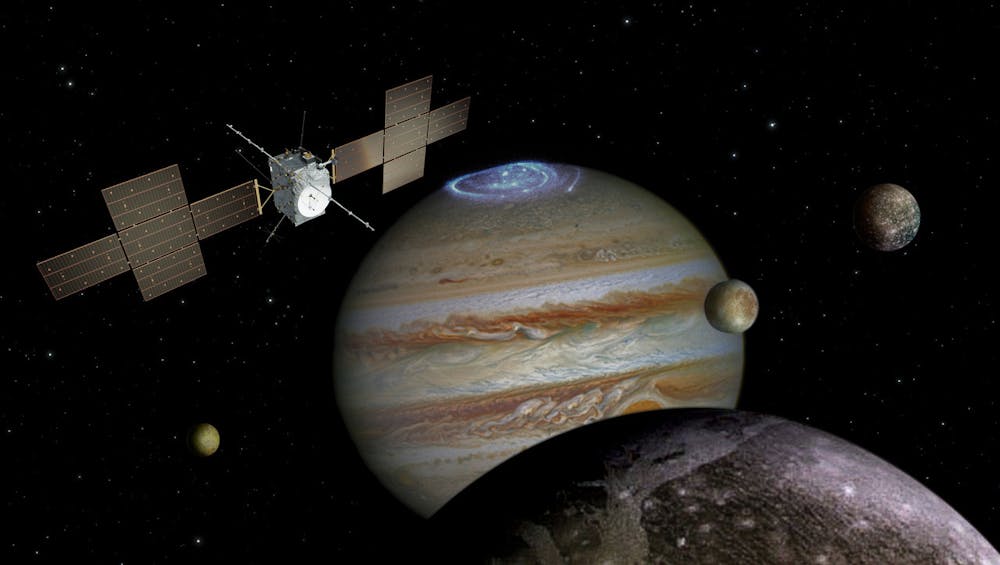
On April 13, 2023, the European Space Agency is scheduled to launch a rocket carrying a spacecraft destined for Jupiter. The Jupiter Icy Moons Explorer – or JUICE – will spend at least three years on Jupiter’s moons after it arrives in 2031. In October 2024, NASA is also planning to launch a robotic spacecraft named Europa Clipper to the Jovian moons, highlighting an increased interest in these distant, but fascinating, places in the solar system.
I’m a planetary scientist who studies the structure and evolution of solid planets and moons in the solar system.
There are many reasons my colleagues and I are looking forward to getting the data that JUICE and Europa Clipper will hopefully be sending back to Earth in the 2030s. But perhaps the most exciting information will have to do with water. Three of Jupiter’s moons – Europa, Ganymede and Callisto – are home to large, underground oceans of liquid water that could support life.

Meet Io, Europa, Ganymede and Callisto
Jupiter has dozens of moons. Four of them in particular are of interest to planetary scientists.
Io, Europa, Ganymede and Callisto are, like Earth’s Moon, relatively large, spherical complex worlds. Two previous NASA missions have sent spacecraft to orbit the Jupiter system and collected data on these moons. The Galileo mission orbited Jupiter from 1995 to 2003 and led to geological discoveries on all four large moons. The Juno mission is still orbiting Jupiter today and has provided scientists with an unprecedented view into Jupiter’s composition, structure and space environment.
These missions and other observations revealed that Io, the closest of the four to its host planet, is abuzz with geological activity, including lava lakes, volcanic eruptions and tectonically formed mountains. But it is not home to large amounts of water.
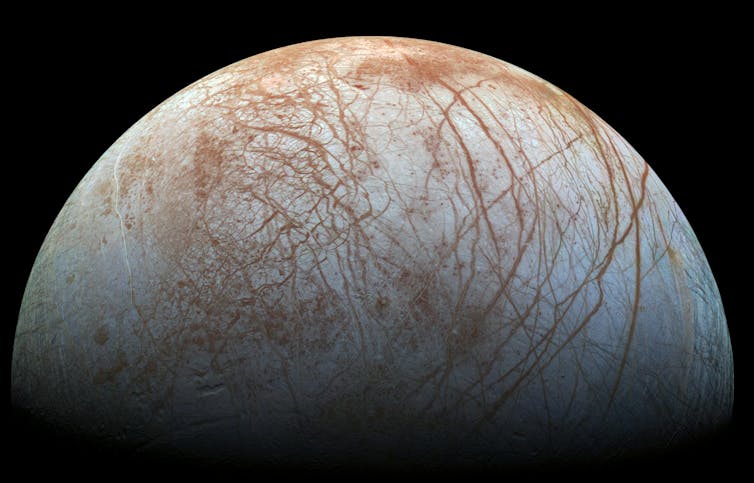
Europa, Ganymede and Callisto, in contrast, have icy landscapes. Europa’s surface is a frozen wonderland with a young but complex history, possibly including icy analogs of plate tectonics and volcanoes. Ganymede, the largest moon in the entire solar system, is bigger than Mercury and has its own magnetic field generated internally from a liquid metal core. Callisto appears somewhat inert compared to the others, but serves as a valuable time capsule of an ancient past that is no longer accessible on the youthful surfaces of Europa and Io.
Most exciting of all: Europa, Ganymede and Callisto all almost certainly possess underground oceans of liquid water.
Ocean worlds
Europa, Ganymede and Callisto have chilly surfaces that are hundreds of degrees below zero. At these temperatures, ice behaves like solid rock.
But just like Earth, the deeper underground you go on these moons, the hotter it gets. Go down far enough and you eventually reach the temperature where ice melts into water. Exactly how far down this transition occurs on each of the moons is a subject of debate that scientists hope to resolve with JUICE and Europa Clipper. While the exact depths are still uncertain, scientists are confident that these oceans exist.
The best evidence of these oceans comes from Jupiter’s magnetic field. Saltwater is electrically conductive. So as these moons travel through Jupiter’s magnetic field, they generate a secondary, smaller magnetic field that signals to researchers the presence of an underground ocean. Using this technique, planetary scientists have been able to show that the three moons contain underground oceans. And these oceans are not small – Europa’s ocean alone might have more than double the water of all of Earth’s oceans combined.
An obvious and tantalizing next question is whether these oceans can support extraterrestrial life. Liquid water is an important piece of what makes for a habitable world, but far from the only requirement for life. Life also needs energy and certain chemical compounds in addition to water to flourish. Because these oceans are hidden beneath miles of solid ice, sunlight and photosynthesis are out. But it’s possible other sources could provide the needed ingredients.
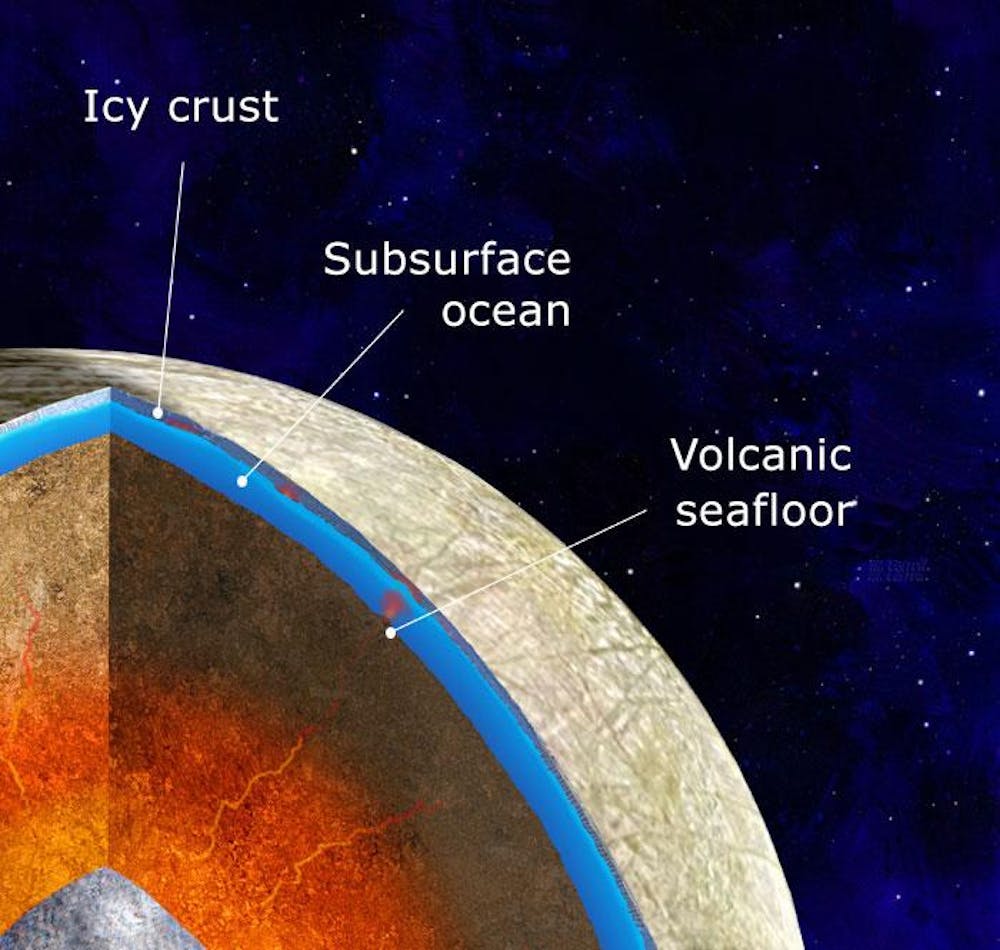
On Europa, for example, the liquid water ocean overlays a rocky interior. That rocky seafloor could provide energy and chemicals through underwater volcanoes that could make Europa’s ocean habitable. But it is also possible that Europa’s ocean is a sterile, inhospitable place – scientists need more data to answer these questions.
Upcoming missions from ESA and NASA
JUICE and Europa Clipper are set up to give scientists game-changing information about the potential habitability of Jupiter’s moons. While both missions will gather data on multiple moons, JUICE will spend time orbiting and focusing on Ganymede, and Europa Clipper will make dozens of close flybys of Europa.
Both of the spacecraft will carry a suite of scientific instruments built specifically to investigate the oceans. Onboard radar will allow JUICE and Europa Clipper to probe into the moons’ outer layers of solid ice. Radar could reveal any small pockets of liquid water in the ice, or, in the case of Europa, which has a thinner outer ice layer than Ganymede and Callisto, hopefully detect the larger ocean.
Magnetometers will also be on both missions. These tools will give scientists the opportunity to study the secondary magnetic fields produced by the interaction of conductive oceans with Jupiter’s field in great detail and will hopefully give researchers clues to salinity and volumes of the oceans.
Scientists will also observe small variations in the moons’ gravitational pulls by tracking subtle movements in both spacecrafts’ orbits, which could help determine if Europa’s seafloor has volcanoes that provide the needed energy and chemistry for the ocean to support life.
Finally, both craft will carry a host of cameras and light sensors that will provide unprecedented images of the geology and composition of the moons’ icy surfaces.
Maybe one day, a spacecraft will be able to drill through the miles of solid ice on Europa, Ganymede or Callisto and explore oceans directly. Until then, observations from spacecraft like JUICE and Europa Clipper are scientists’ best bet for learning about these ocean worlds.
When Galileo discovered these moons in 1609, they were the first objects known to directly orbit another planet. Their discovery was the final nail in the coffin of the theory that Earth – and humanity – resides at the center of the universe. Maybe these worlds have another humbling surprise in store.
Mike Sori, Assistant Professor of Planetary Science, Purdue University
This article is republished from The Conversation under a Creative Commons license. Read the original article.
- Details
- Written by: Elizabeth Larson

NORTHERN CALIFORNIA — The Yuba Community College District’s two-year process to find a new chancellor came to an end on Thursday evening with a unanimous vote of the board of trustees to select their top candidate.
During the board’s regular meeting, its members voted to appoint Dr. Shouan Pan as the district’s next chancellor, approving a three-year employment contract.
“I’m honored,” Pan, who attended the meeting via Zoom, told the board members, adding that he was humbled by their trust and confidence in him.
Pan said he’s looking forward to joining the district and creating a greater impact.
The employment contract the board approved with Pan is for a three-year period from June 2023 to June 2026, with an annual salary of $256,000.
Pan holds a bachelor’s degree in English from Hefei Polytechnic University in China, where he was born and raised.
He came to the United States in 1985, earning a Master of Education degree from Colorado State University and a Doctor of Philosophy in higher education from Iowa State University.
Pan has held leadership positions in colleges across the country, including Broward College-South Campus in Florida, Florida State College at Jacksonville, Community College of Philadelphia, Northern Arizona University, Mesa Community College in Arizona and, most recently, Seattle Colleges in Washington, where he left his post as chancellor in August.
He and three other chancellor candidate finalists — Dr. Beatriz Espinoza, Dr. Eugene Giovannini and Dr. Wei Zhou — were introduced to the college community during forums in Marysville and Woodland earlier this month.
Board members thanked staff, the screening committee and the search firm hired to lead the recruitment.
Trustee Richard Teagarden said it had taken almost two years to get to that point, with hundreds of hours of work.
The Yuba Community College District crosses eight counties and serves an estimated 13,000 students.
The district includes both Yuba College and Woodland Community College, with the Clearlake campus a part of the latter. In addition to Clearlake, there are campuses in Marysville and Woodland, and Colusa and Sutter counties.
Pan will take over from Dr. James L.J. Houpis, who has served as interim chancellor since July 1, 2021, following the departure of Chancellor Dr. Douglas B. Houston, who left the college last year.
Originally, Houpis — selected after a nationwide search — was supposed to serve until June 30, 2022.
However, in November 2021, the district board voted to pause the recruitment process, with proponents of that pause arguing for taking additional time in order to also work through human resources and financial issues.
On Thursday evening, Houpis congratulated Pan, and said he will be blessed to work with an outstanding staff.
Board President Juan Delgado thanked everyone for their work in the chancellor selection process.
Delgado said it took time, but patience is a virtue, and waiting two years to make the hire was the right thing to do.
Email Elizabeth Larson at
- Details
- Written by: Elizabeth Larson

LAKE COUNTY, Calif. — The Lakeport Fire Protection District Board has approved a contract for repairs to Station 52, damaged by a vehicle crash in the fall.
During a special Tuesday evening meeting, the board voted to authorize Chief Patrick Reitz to enter into a contract with Fort Bragg Electric for repairs to the station, located at 3600 Hill Road East.
Fort Bragg Electric submitted the lowest bid, $203,046. The other qualified bidder was Bridges Construction, which bid the job at $260,000.
The third bidder, which was disqualified because it didn’t include prevailing wage, was Crane of Ukiah, whose proposal said it built Station 52 in 1990.
In recent years, the district has not had enough personnel to staff Station 52.
Shortly after 9 p.m. Nov. 12, a driver traveling at high speed was unable to properly negotiate the Hill Road exit off Highway 29.
The driver lost control of the vehicle, which crossed Park Way, went over a curb and through a grassy area, crashed through a Caltrans highway fence and traveled across Hill Road before hitting Station 52. The driver was uninjured.
Officials at the time said the crash caused significant damage to the structure’s steel framework and bay doors, as Lake County News has reported.
Fort Bragg Electric’s scope of work includes installing new metal columns, doors, water lines, irrigation equipment, lighting and siding.
Email Elizabeth Larson at
- Details
- Written by: LAKE COUNTY NEWS REPORTS
Please sign up early to ensure a spot.
Home brewers and winemakers throughout Northern California are invited to participate and supply samples of their product to the public.
They also have a chance to win a coveted “Peoples’ Choice” award for their homemade beverages, voted on by event attendees.
Home winemakers also have the chance to enter their creations for judging by experts the evening before the Winefest.
There is no booth fee for amateur wine and beer makers.
Vendors selling food, arts and crafts, agricultural products, clothing, and other products are a welcome addition to the Winefest and help make it more enjoyable for everyone. Vendor booth fees are $35. Vendors may bring their own canopies or rent one for $25 to provide shade.
Home winemakers, beer makers and vendors wishing to participate should go to https://www.lakecountywinefest.com to download applications for the 2023 Winefest.
For more information, email