How to resolve AdBlock issue?
Refresh this page
How to resolve AdBlock issue?

Refresh this page
Lake County News,California
  • Home
    • Registration Form
  • News
    • Education
    • Veterans
    • Community
      • Obituaries
      • Letters
      • Commentary
    • Police Logs
    • Business
    • Recreation
    • Health
    • Religion
    • Legals
    • Arts & Life
    • Regional
  • Calendar
  • Contact us
    • FAQs
    • Phones, E-Mail
    • Subscribe
  • Advertise Here
  • Login
How to resolve AdBlock issue?

Refresh this page

News

Helping Paws: Cattle dogs, retrievers and terriers

Details
Written by: Elizabeth Larson
Published: 07 February 2026
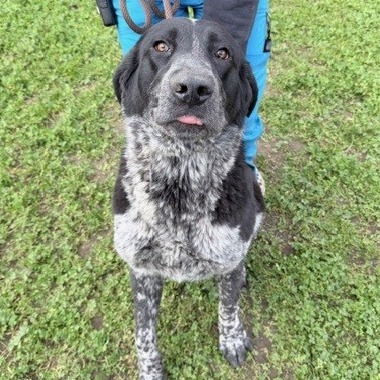
“Ryder.” Kennel No. 23 Photo courtesy of Lake County Animal Care and Control.


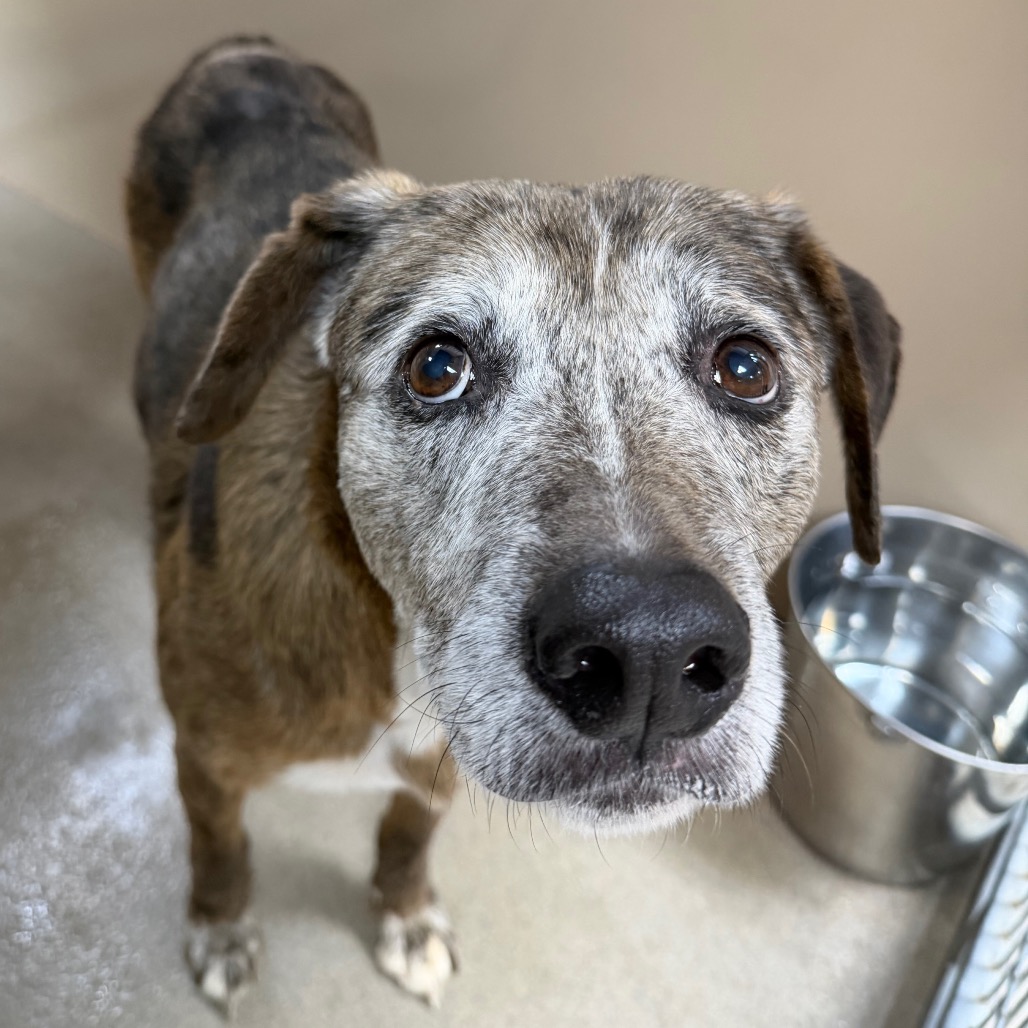
LAKE COUNTY, Calif. – Lake County Animal Care and Control has more new dogs waiting to be adopted this week.

The dogs available for adoption this week include mixes of Australian shepherd, cattle dog, German shepherd, husky, Labrador retriever, mastiff, pit bull terrier, poodle, Rottweiler and shepherd.

Dogs that are adopted from Lake County Animal Care and Control are either neutered or spayed, microchipped and, if old enough, given a rabies shot and county license before being released to their new owner. License fees do not apply to residents of the cities of Lakeport or Clearlake.

Those animals shown on this page at the Lake County Animal Care and Control shelter have been cleared for adoption.

Call Lake County Animal Care and Control at 707-263-0278 or visit the shelter online for information on visiting or adopting.

The shelter is located at 4949 Helbush in Lakeport.

Email Elizabeth Larson at This email address is being protected from spambots. You need JavaScript enabled to view it.. Follow her on Twitter, @ERLarson, and on Bluesky, @erlarson.bsky.social. Find Lake County News on the following platforms: Facebook, @LakeCoNews; X, @LakeCoNews; Threads, @lakeconews, and on Bluesky, @lakeconews.bsky.social. 


Kennel#10 Odin's preview photo
Kennel#10 Odin
 
Kennel#7 Tara's preview photo
Kennel#7 Tara

Kennel#20Titan's preview photo
Kennel#20Titan
 
Kennel#27 Maizey's preview photo
Kennel#27 Maizey

Kennel#30 Rover's preview photo
Kennel#30 Rover

Kennel#31 Rolo's preview photo
Kennel#31 Rolo

Kennel#24Stormy 's preview photo
Kennel#24Stormy

Kennel#28 Mochi's preview photo
Kennel#28 Mochi

Kennel#29 Benny's preview photo
Kennel#29 Benny
 
Kennel#25 Arrow's preview photo
Kennel#25 Arrow

Kennel#9 Shasta's preview photo
Kennel#9 Shasta

Kennel#16 Ty's preview photo
Kennel#16 Ty

Kennel#18 Rowan's preview photo
Kennel#18 Rowan

Kennel#26a(blue collar)'s preview photo
Kennel#26a(blue collar)

Kennel#26b(red collar)'s preview photo
Kennel#26b(red collar)

Kennel#34(Kilo)'s preview photo
Kennel#34(Kilo)

Kennel#15(Hugo)'s preview photo
Kennel#15(Hugo)


Kennel#4 Tito's preview photo
Kennel#4 Tito

Kennel#5(Tank)'s preview photo
Kennel#5(Tank)
 
Kennel#11's preview photo
Kennel#11
 

Kennel#21(BD)'s preview photo
Kennel#21(BD)

Kennel#17 Chewbacca's preview photo
Kennel#17 Chewbacca

Climate change threatens the Winter Olympics’ future – and even snowmaking has limits for saving the Games

Details
Written by: Steven R. Fassnacht, Colorado State University and Sunshine Swetnam, Colorado State University
Published: 07 February 2026

Italy’s Predazzo Ski Jumping Stadium, which is hosting events for the 2026 Winter Olympics, needed snowmaking machines for the Italian National Championship Open on Dec. 23, 2025. Mattia Ozbot/Getty Images

Watching the Winter Olympics is an adrenaline rush as athletes fly down snow-covered ski slopes, luge tracks and over the ice at breakneck speeds and with grace.

When the first Olympic Winter Games were held in Chamonix, France, in 1924, all 16 events took place outdoors. The athletes relied on natural snow for ski runs and freezing temperatures for ice rinks.

Two skaters on ice outside with mountains in the background. They are posing as if gliding together.
Sonja Henie, left, and Gilles Grafstrom at the Olympic Winter Games in Chamonix, France, in 1924. The Associated Press

Nearly a century later, in 2022, the world watched skiers race down runs of 100% human-made snow near Beijing. Luge tracks and ski jumps have their own refrigeration, and four of the original events are now held indoors: figure skaters, speed skaters, curlers and hockey teams all compete in climate-controlled buildings.

Innovation made the 2022 Winter Games possible in Beijing. Ahead of the 2026 Winter Olympics in northern Italy, where snowfall was below average for the start of the season, officials had large lakes built near major venues to provide enough water for snowmaking. But snowmaking can go only so far in a warming climate.

As global temperatures rise, what will the Winter Games look like in another century? Will they be possible, even with innovations?

Former host cities that would be too warm

The average daytime temperature of Winter Games host cities in February has increased steadily since those first events in Chamonix, rising from 33 degrees Fahrenheit (0.4 Celsius) in the 1920s-1950s to 46 F (7.8 C) in the early 21st century.

In a recent study, scientists looked at the venues of 19 past Winter Olympics to see how each might hold up under future climate change.

A cross-country skier falls in front of another during a race. The second skier has his mouth open as if shouting.
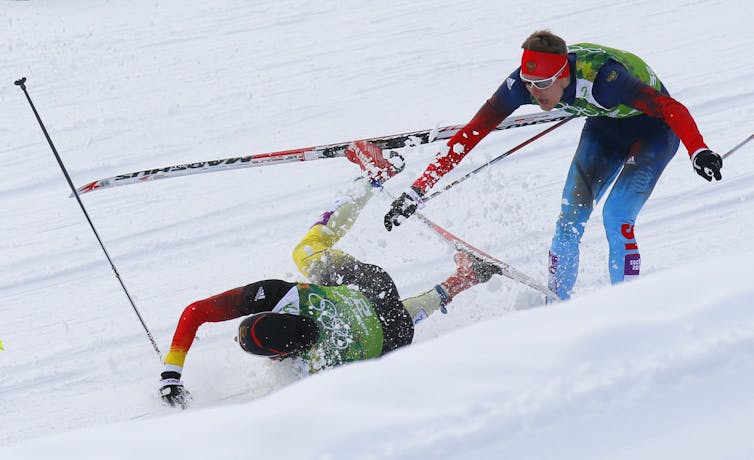
Human-made snow was used to augment trails at the Sochi Games in Russia in 2014. Some athletes complained that it made the trails icier and more dangerous. AP Photo/Dmitry Lovetsky

They found that by midcentury, four former host cities – Chamonix; Sochi, Russia; Grenoble, France; and Garmisch-Partenkirchen, Germany – would no longer have a reliable climate for hosting the Games, even under the United Nations’ best-case scenario for climate change, which assumes the world quickly cuts its greenhouse gas emissions. If the world continues burning fossil fuels at high rates, Squaw Valley, California, and Vancouver, British Columbia, would join that list of no longer being a reliable climate for hosting the Winter Games.

By the 2080s, the scientists found, the climates in 12 of 22 former venues would be too unreliable to host the Winter Olympics’ outdoor events; among them were Turin, Italy; Nagano, Japan; and Innsbruck, Austria.

In 2026, there are now five weeks between the Winter Olympics and the Paralympics, which last through mid-March. Host countries are responsible for both events, and some venues may increasingly find it difficult to have enough snow on the ground, even with snowmaking capabilities, as snow seasons shorten.

Ideal snowmaking conditions today require a dewpoint temperature – the combination of coldness and humidity – of around 28 F (-2 C) or less. More moisture in the air melts snow and ice at colder temperatures, which affects snow on ski slopes and ice on bobsled, skeleton and luge tracks.

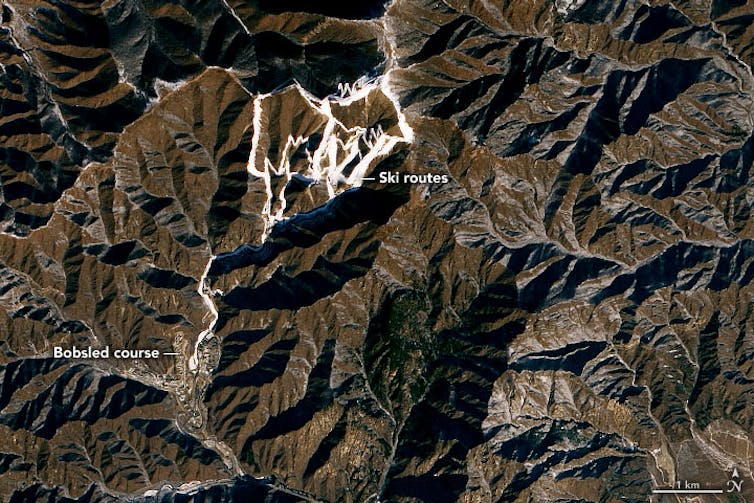
Stark white lines etched on a swath of brown mountains delineate ski routes and bobsled course.
A satellite view clearly shows the absence of natural snow during the 2022 Winter Olympics. Beijing’s bid to host the Winter Games had explained how extensively it would rely on snowmaking. Joshua Stevens/NASA Earth Observatory
A gondola passes by with dark ground below and white ski slopes behind it.
The finish area of the Alpine ski venue at the 2022 Winter Olympics was white because of machine-made snow. AP Photo/Robert F. Bukaty

As Colorado snow and sustainability scientists and also avid skiers, we’ve been watching the developments and studying the climate impact on the mountains and winter sports we love.

Conditions vary by location and year to year

The Earth’s climate will be warmer overall in the coming decades. Warmer air can mean more winter rain, particularly at lower elevations. Around the globe, snow has been covering less area. Low snowfall and warm temperature made the start to the 2025-26 winter season particularly poor for Colorado’s ski resorts.

However, local changes vary. For example, in northern Colorado, the amount of snow has decreased since the 1970s, but the decline has mostly been at higher elevations.

Several machines pump out sprays of snow across a slope.
Snow cannons spray machine-made snow on a ski slope ahead of the 2026 Winter Olympics. Mattia Ozbot/Getty Images

A future climate may also be more humid, which affects snowmaking and could affect bobsled, luge and skeleton tracks.

Of the 16 Winter Games sports today, half are affected by temperature and snow: Alpine skiing, biathlon, cross-country skiing, freestyle skiing, Nordic combined, ski jumping, ski mountaineering and snowboarding. And three are affected by temperature and humidity: bobsled, luge and skeleton.

Technology also changes

Developments in technology have helped the Winter Games adapt to some changes over the past century.

Hockey moved indoors, followed by skating. Luge and bobsled tracks were refrigerated in the 1960s. The Lake Placid Winter Games in 1980 in New York used snowmaking to augment natural snow on the ski slopes.

Today, indoor skiing facilities make skiing possible year-round. Ski Dubai, open since 2005, has five ski runs on a hill the height of a 25-story building inside a resort attached to a shopping mall.

Resorts are also using snowfarming to collect and store snow. The method is not new, but due to decreased snowfall and increased problems with snowmaking, more ski resorts are keeping leftover snow to be prepared for the next winter.

Two workers pack snow on an indoor ski slope with a sloped ceiling overhead.
Dubai has an indoor ski slope with multiple runs and a chairlift, all part of a shopping mall complex. AP Photo/Jon Gambrell

But making snow and keeping it cold requires energy and water – and both become issues in a warming world. Water is becoming scarcer in some areas. And energy, if it means more fossil fuel use, further contributes to climate change.

The International Olympic Committee recognizes that the future climate will have a big impact on the Olympics, both winter and summer. It also recognizes the importance of ensuring that the adaptations are sustainable.

The Winter Olympics could become limited to more northerly locations, like Calgary, Alberta, or be pushed to higher elevations.

Summer Games are feeling climate pressure, too

The Summer Games also face challenges. Hot temperatures and high humidity can make competing in the summer difficult, but these sports have more flexibility than winter sports.

For example, changing the timing of typical summer events to another season can help alleviate excessive temperatures. The 2022 World Cup, normally a summer event, was held in November so Qatar could host it.

What makes adaptation more difficult for the Winter Games is the necessity of snow or ice for all of the events.

A snowboarder with 'USA' on her gloves puts her arms out for balance on a run.
Climate change threatens the ideal environments for snowboarders, like U.S. Olympian Hailey Langland, competing here during the women’s snowboard big air final in Beijing in 2022. AP Photo/Jae C. Hong

Future depends on responses to climate change

In uncertain times, the Olympics offer a way for the world to come together.

People are thrilled by the athletic feats, like Jean-Claude Killy winning all three Alpine skiing events in 1968, and stories of perseverance, like the 1988 Jamaican bobsled team competing beyond all expectations.

The Winter Games’ outdoor sports may look very different in the future. How different will depend heavily on how countries respond to climate change.

This updates an article originally published Feb. 19, 2022, with the 2026 Winter Games.The Conversation

Steven R. Fassnacht, Professor of Snow Hydrology, Colorado State University and Sunshine Swetnam, Assistant Professor of Natural Resources, Colorado State University

This article is republished from The Conversation under a Creative Commons license. Read the original article.

CHP is game-day ready for Super Bowl LX

Details
Written by: Lake County News Reports
Published: 07 February 2026

LAKE COUNTY, Calif. – The California Highway Patrol said it is game-day ready for Super Bowl LX, the NFL’s biggest event of the season. 

With this year’s big game headed to Levi’s Stadium in Santa Clara on Sunday, Feb. 8, the CHP urges fans across the state to make smart, responsible decisions – whether they’re attending the game in person, heading to a watch party or celebrating at home.

“Super Bowl Sunday brings excitement, energy and visitors from across the country. We want everyone who comes to the Bay Area to enjoy the experience, make responsible decisions behind the wheel and leave with great memories, not life-changing consequences. Our goal is to keep California’s roads safe, and we will actively enforce laws against unsafe and reckless driving. At the end of the day, the real winner is the one who makes it home safely,” said Commissioner Sean Duryee. 

Studies show that incidents of impaired driving are significantly higher on Super Bowl Sunday, compared to an average Sunday.

During last year’s Super Bowl, impaired driving led to CHP officers arresting more than 200 drivers and responding to over 130 crashes within their jurisdiction, resulting in one fatality and over 60 injuries. 

Celebrate responsibly

The CHP said it will help keep our roadways safe this Super Bowl Sunday by increasing patrols to promote public safety for motorists, residents, and visitors participating in the festivities.

Drivers are reminded to obey speed limits, always wear a seat belt, and score a sober ride by designating a sober driver, using a ride-share service or taking public transportation.

As outlined in a press release issued by Gov. Gavin Newsom, the CHP is working with the San Francisco Police Department, the Santa Clara Police Department, the Santa Clara County Sheriff's Office and the San Jose Police Department to provide additional safety and assistance on the roads and at related events throughout the weekend.

To accommodate the influx of people, the CHP recommends motorists plan their routes in advance, know the location of their destination and allow extra time to travel. Be aware that road closures may be in effect in some areas. To check for closure updates, visit the Bay Area Host Committee’s website for details. Additional real-time traffic information will be shared on X via @CHP_GoldenGate.

The public can assist law enforcement by calling 9-1-1 if they suspect a drunk driver. Callers should be prepared to give the vehicle’s description, location, license plate number and direction of travel.

Don’t earn a flag on the play for unsportsmanlike conduct; let’s all work together to keep California’s roads safer.

Space News: What’s up for February 2026

Details
Written by: Chelsea Gohd
Published: 07 February 2026
The Constellation Orion. NASA/JPL-Caltech.


The Moon could have human visitors for the first time since 1972, the constellation Orion will be clear to see, and a planetary parade will sparkle across the skies.

That's what's up, this February.

The Moon could have some visitors soon!

NASA's Artemis II mission will send astronauts to fly around the Moon. The first opportunities for launch are this February.

This mission will pave the way for Artemis III, which will be the first time we’ve sent humans to the lunar surface since the final Apollo mission, Apollo 17, in 1972.

So this month, look up to the Moon shining bright in the night sky and there might be somebody looking back down at you.

Can you spot Orion the Hunter in the night sky?

Above Orion's belt, the hunter's right shoulder is actually Betelgeuse (or Alpha Orionis), one of the brightest stars in the night sky!

Most visible in the winter, February is one of the clearest times to see Orion in the sky.

From dusk through the night, look to the southern sky and try and spot the hunter for yourself.

A planetary parade will march across the sky this month!

Mid-February, Saturn will drop down toward the horizon as Venus and Mercury climb upward in the sky, meeting together in the west to southwestern sky.

Jupiter will find itself high in the sky.

And even Uranus, found in the southern sky, and Neptune, found nearby Saturn, will join the parade — though you'll need binoculars or a telescope to spot these two far-off planets.

The planets will be visible soon after sunset throughout the month of February, but they’ll be lined up best toward the end of the month.

So, go outside and see how many planets you can find!

You can stay up to date on all of NASA's missions exploring the solar system and beyond at science.nasa.gov. 

Chelsea Gohd works for NASA's Jet Propulsion Laboratory.

  1. CHP’s Clear Lake Area office welcomes new officer
  2. Tribes cite ongoing federal review and judicial warnings in opposing Scotts Valley ‘preview casino’ in Vallejo
  3. What Olympic athletes see that viewers don’t: Machine-made snow makes ski racing faster and riskier – and it’s everywhere
  • 7
  • 8
  • 9
  • 10
  • 11
  • 12
  • 13
  • 14
  • 15
  • 16
How to resolve AdBlock issue?

Refresh this page