 How to resolve AdBlock issue?
News
- Details
- Written by: Elizabeth Larson
CLEARLAKE – The day after it closed its Clearlake thrift store and laid off four staff members, the Clear Lake Animal Welfare Society board was moving ahead with plans to keep its voucher program together and address issues relating to its building.
The board has emphasized that CLAWS will continue its voucher program, which helps low-income applicants afford spay-neuter services for their pets.
Over the past five years, CLAWS has paid nearly a quarter of a million dollars to reimburse local veterinarians who honor the vouchers.
In recent weeks, issues with the thrift store's condition and losses in sales as compared to last year led the board to the layoffs and closure, said Board President Laurelee Roark.
The issues were compounded when the state Division of Occupational Health and Safety (OSHA) sent them a letter June 5 regarding a complaint lodged by employee Veronica Morgan regarding allegations of black mold, rodents, sewage backups and holes in the roof.
On Thursday, in response to OSHA's request for a response, Roark sent the agency a letter answering each of the complaint's points, saying that the issues had either been resolved or were not as portrayed in the complaint. With regard to the mold concern, she said there were no mushrooms and that she only saw a small, quarter-sized dark area that she could not confirm was mold or mildew.
The CLAWS store closing and layoff Wednesday was the culmination of several months of tension between the board and employees, among them Morgan and Executive Director Lisa Pecchenino.
Last month a petition requesting the resignation of the three board members – Roark, Marilyn Ferrante and Leslie Wood – surfaced, signed by an estimated 600 residents around the county.
The petition does not state who started it, and both Pecchenino and Morgan say they don't know who is responsible. Roark said she and the other board members haven't seen the petition.
Since the petition starting being publicized, Roark said she and other board members have begun receiving anonymous, threatening phone calls at their homes and work.
The one thing both sides appear to agree on is that the disagreements came to a head at a March board meeting.
Pecchenino, who joined CLAWS as a full-time employee in December 2003, said that at that March meeting she asked for more autonomy in organizing its “Calendar Girls” fundraiser. and told the board they needed “boundaries” because she felt they had bullied and harassed her for months.
When she made that request, she said, “All hell broke loose,” alleging that boardmembers spent the rest of that meeting verbally attacking her.
But Roark said it didn't happen that way, and that the issue was a matter of Pecchenino struggling with the board for more control and less accountability.
Why CLAWS shut the thrift store
The thrift store's viability is another point of disagreement between the board and employees.
For the last nine months, Roark said the Clearlake store has been operating at a $3,000-per-month deficit.
CLAWS' profit and loss statements show that the store made $14,320.45 from January to April, which is approximately half of what the store made during the same period last year. Roark attributes lower sales to the economy.
Coupled with the expenses to run the store, the halving of store profits – which from January to April amounted to about $3,500 less per month – caused CLAWS to run at a loss, said CLAWS bookkeeper Marlene Wentz.
Despite those numbers, Pecchenino said she believes sales at the thrift store are about the same as they ever were, and that the closure was an excuse to dismiss the staff.
She said the store also fulfilled an important community service, providing a place where people could buy clothing, appliances, books and more at affordable prices.
The store also is important to securing grants, she said.
Denise Johnson, Lake County's Animal Care & Control director, said Pecchenino was correct about the need to show granting organizations another source of income.
But Roark said closing the store “is the only way to keep the voucher program safe.” She said it was a hard decision to make, but repairs and other issues gave them no other choice.
Pecchenino said she and Morgan are considering a lawsuit against CLAWS for harassment, but that they don't want to take money away from helping animals.
Both women and their families have their homes on the market and plan to leave Clearlake as soon as they're able.
“We're going to move on and CLAWS is not,” said Pecchenino.
Looking at the group's finances
CLAWS' Form 990s, which income-tax exempt organizations are required to file with the Internal Revenue Service, shows the group's income and expenses over the last several years, including veterinarian costs to cover its spay-neuter voucher program and employee wages.
Over the last five years, CLAWS has provided $237,075 to pay for spay-neuter services for those community members whose income levels qualify them for assistance.
The Form 990s show the following:
– 2006: revenue, $146,185 (grants, $7,699); expenses, $140,545 (veterinarian costs, $22,182; wages, $50,228); total assets at start of year, $194,816; total assets at year's end, $195,617.
– 2005: revenue, $131,028 (grants, $0); expenses, $174,658 (veterinarian costs, $48,144; wages, $56,848); deficit, $43,630; total assets at start of year, $240,501; total assets at year's end, $194,816.
– 2004: revenue, $181,121 (grants, $7,983); expenses, $188,479 (veterinarian costs, $52,387; wages, $65,740); deficit, $7,358; total assets at start of year, $120,728; total assets at year's end, $240,501. (In 2004, CLAWS bought its Clearlake thrift shop building for $112,567.)
– 2003: revenue, $188,137 (grants, $0); expenses, $111,508 (veterinarian costs, $45,988; wages, $25,303); total assets at start of year: $40,883; total assets at end of year, $120,728.
– 2002: revenue, $99,572 (grant amounts were not separated from contributions); expenses, $67,924 (veterinarian costs, $31,547; wages, $7,858); total assets at start of year: $8,057; total assets at end of year, $44,146.
Between January and April of this year, CLAWS' financials show the group put more than $6,100 into its voucher program. Roark estimated that the vouchers average $100 per animal – some are higher, some are lower, based on what procedure is being done and what the pet owner can afford. That rough estimate equals altering services for about 600 animals.
That $6,100 figure for 2007 is about half of what CLAWS paid in vouchers from January through April of 2006.
Roark attributes the reduction to the loss of veterinarians at both ends of the lake, and therefore fewer vets to schedule procedures and honor the vouchers.
Voucher program remains active
Dr. Debra Sally, the veterinarian who works most with CLAWS, confirmed that there are fewer vets and less availability to honor vouchers.
Sally said she has worked with CLAWS since the 1990s, and that the group has made responsible pet ownership responsible for many people who otherwise couldn't have afforded it and educated people about pet overpopulation, which she said is an “overwhelming problem.”
She said she has always worked well with both the CLAWS board and staff to provide spay and neuter services for both dogs and cats through the voucher program. Over the last three years the program has become more efficient and given out more vouchers.
Sally estimates she currently does 40 spay or neuter operations a month in the voucher program. She's the only south county vet clinic to honor the vouchers, she said, because vets lose money on them. “It's a community service,” she said.
She said she plans to continue to honor CLAWS' spay-neuter vouchers, adding she had no reason to believe CLAWS won't continue to pay for them.
Going beyond signing vouchers
Johnson said Wednesday she was shocked to hear of CLAWS' situation, noting that Animal Care & Control has had a close working relationship with CLAWS over the years.
Johnson said CLAWS does “so much more than sign vouchers,” which includes its effort to educate the community about spaying and neutering pets.
She said she hopes the group continues its work, not having those services would be “devastating to the community.”
Johnson said animal groups are emotionally charged, and she's seen situations where emotions override an organization's mission. “The animals and the community are what suffer.”
For those wishing to volunteer to help CLAWS continue its mission, call the CLAWS main number, 994-9505.
E-mail Elizabeth Larson at
{mos_sb_discuss:2}
- Details
- Written by: Elizabeth Larson
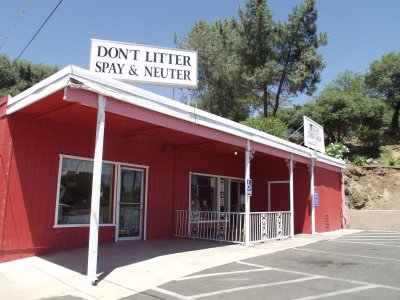
CLEARLAKE – Citing lagging sales and serious building repair issues, the Clear Lake Animal Welfare Society closed down its Clearlake thrift store Wednesday morning and laid off all four of its employees.
CLAWS Board President Laurelee Roark emphasized that CLAWS itself will continue its work on behalf of animals, and that the layoffs and closure were necessary in order to keep the nonprofit's spay-neuter voucher program safe.
Board members Roark, Leslie Woods and Marilyn Ferrante called an emergency 11 a.m. meeting with staff in front of the store, where they made the announcement, handed out final checks and collected keys and CLAWS materials from staff.
Three police officers stood nearby as Roark read a letter to employees explaining the board's decision, which was attributed, in part, to the store running at a $3,000-per-month deficit for the past nine months and building repair issues.
“It's hard to believe you guys are acting in good faith,” Veronica Morgan, one of the employees laid off, said to the board members Wednesday.
The store itself was closed Tuesday after Lisa Pecchenino, the executive director, said they opened the shop that morning to find it flooded with water. Roark and Pecchenino said they were unable to locate the leak.
On June 5, the state division of Occupational Safety and Health (OSHA) sent a letter to CLAWS, notifying them of a complaint involving possible health and safety violations filed with their office.
Employee Veronica Morgan said Wednesday she filed the complaint last month, citing black mold and mushrooms growing out of the building's middle wall; plumbing issues with raw sewage entering the work area; holes in the roof and collapsing walls; extension cords being used as permanent wiring; and rodents and spiders in the building.
An individual who supports the CLAWS employees took the City of Clearlake a copy of the OSHA complaint. City Administrator Dale Neiman confirmed Wednesday that the city had received the OSHA document.
Scott Spivey, the city's chief building inspector, said he and Senior Code Enforcement Officer Janine Lowe spent an hour at the store Tuesday to see what the situation was.
“We had no intention of red-tagging the place,” Spivey said.
Walking into the building, which is located a few doors down from City Hall, Spivey said, “I smelled mold right away.”
In addition, he and Lowe found a number of different violations and safety issues for the workers.
Neiman said that, because of the seriousness of the health and safety concerns, he directed Code Enforcement staff to contact the county's Environmental Health Department.
“We have an obligation to deal with the problem and I think Environmental Health does, too, so it's best if we coordinate,” Neiman said.
Spivey said OSHA is the lead enforcement agency on this. He added that with CLAWS closing their doors, the problem is over. If the building is sold, the new owners will be responsible for bringing the building up to code, Spivey added.
As to the responsibility for making the repairs, Pecchenino and Roark told contrasting stories. Pecchenino said the board wouldn't let her move ahead with repairs; Roark said they had given Pecchenino instruction to deal with the mold issue, which she said Pecchenino told her was completed.
The Clearlake store's closure follows that of the Lakeport store, which Roark said took place last spring after the landlord doubled their rent to $2,000 a month.
Plans for moving forward
Roark said CLAWS has several plans for moving forward.
First, CLAWS is considering selling or leasing the Clearlake store, which it bought several years ago from Supervisor Ed Robey, said Roark. However, they've made no definite decision.
As to the store's inventory, Roark said the plan is to have a couple of sidewalk sales and liquidate the store's inventory.
On the grant side, she said former board member Myra Wendt has agreed to volunteer time to follow up on the largest grant CLAWS receives.
Regarding vouchers, Roark said, “The plan right now is to write vouchers in Lakeport and in Clearlake. Where exactly and when exactly we don't know.”
In addition, CLAWS will have a big dog fix at Wasson Memorial Veterinary Clinic in Lakeport toward the end of August.
The three board members will take on most of the responsibilities formerly covered by employees, but they'll need extra volunteer help, Roark said. They're already receiving calls from people willing to help.
For those wishing to volunteer, calls the CLAWS main number, 994-9505.
Tomorrow, Lake County News will take a look at CLAWS' financials and the rift between the board and employees.
E-mail Elizabeth Larson at
{mos_sb_discuss:2}
- Details
- Written by: Lake County News Reports
LAKE COUNTY – The county reached its highest temperatures of the year so far on Wednesday, and temperatures are forecast to reach the century mark today.
According to the National Weather Service (NWS) in Sacramento, today should be the hottest day since last summer's heatwave of 11 consecutive days of triple-digit temperatures, which claimed the lives of 141 people and tens of thousands of livestock across California.
Local weather stations in Lower Lake recorded a high temperature on Wednesday of 95, with Lakeport topping out at 93.
Last year's sizzling temperatures – which toppled records in Upper Lake on July 23, 2006 at 105 degrees – not only caused the loss of human and animal life, but also cost California farmers millions in crop destruction and damage.
With the beginning of high and dry daytime temperatures, the NWS reminds us that extra precautions are necessary when dealing with summer heat. Drink extra fluids, seek shade or go indoors. Also remember to check on the elderly and the young who are less able to deal with the heat.
Also remember to give extra water to your livestock and pets. Do not leave pets unattended in your vehicle – even in the shade.
Under a new California law that went into effect January 2007, the owner of an unattended hot vehicle containing a pet will face a fine of up to $500 and as much as six months in jail.
Highs today are expected to reach 100, with lows in the mid-50s, with Friday being a few degrees cooler, according to the NWS. Saturday and Sunday should return to the mid-80s with lows near 48.
E-mail Terre Logsdon at
{mos_sb_discuss:2}
- Details
- Written by: Editor
SACRAMENTO – Evergreen Lakeport Healthcare skilled nursing facility in Lake County has received a "AA" citation, the most severe under state law, and a $100,000 fine, the highest fine under state law, from the state of California after an investigation by the California Department of Health Services (CDHS) concluded that poor care of a 44-year-old resident led to her death, State Public Health Officer Dr. Mark Horton announced today.
Records show that the resident required total assistance with daily living activities.
On June 2, 2006, three days after admission, the resident suffered a seizure and aspirated material into her lungs. When staff responded, suction equipment was unavailable in the resident’s room. When an emergency cart was found, it was not stocked with the necessary equipment to set up emergency suction to clear the resident’s airway. Cardiopulmonary resuscitation (CPR) was initiated, but was stopped before paramedics arrived. The death certificate indicated "aspiration and seizure disorder" as the cause of death.
CDHS determined that the facility failed to assess for and prevent aspiration, failed to ensure staff were adequately trained in emergency response procedures and CPR techniques and failed to ensure emergency airway equipment was stocked and available to nursing staff during a life-threatening situation.
All nursing facilities in California are required to be in compliance with applicable state and federal laws and regulations governing health care facilities. Facilities are required to comply with these standards to ensure at least a minimal level of quality of care.
California has the statutory authority to impose fines against nursing facilities it licenses as a tool in its arsenal of enforcement remedies for poor care. The "AA" citation process is part of CDHS’ ongoing enforcement efforts in improving the quality of care provided to residents of the state’s approximately 1,400 skilled nursing facilities.
State citations that require a civil monetary penalty be imposed are categorized as Class B, A or AA. The associated fines range from $100 to $1,000 for Class B, $2,000 to 20,000 for Class A and $25,000 to $100,000 for Class AA.
The citation class and amount of the fine depend upon the significance and severity of the substantiated violation, as prescribed and defined in California law. By providing nursing facilities it licenses with consequences for substantiated violations, CDHS strives to protect the health and safety of vulnerable individuals.
{mos_sb_discuss:2}