 How to resolve AdBlock issue?
News
- Details
- Written by: Elizabeth Larson
Dogs available for adoption this week include mixes of Australian shepherd, border collie, boxer,
Catahoula leopard dog, Doberman pinscher, German shepherd, hound, Labrador retriever, mastiff, Papillon, pit bull, Queensland heeler, Rottweiler, shepherd and terrier.
Dogs that are adopted from Lake County Animal Care and Control are either neutered or spayed, microchipped and, if old enough, given a rabies shot and county license before being released to their new owner. License fees do not apply to residents of the cities of Lakeport or Clearlake.
Those dogs and the others shown on this page at the Lake County Animal Care and Control shelter have been cleared for adoption.
Call Lake County Animal Care and Control at 707-263-0278 or visit the shelter online for information on visiting or adopting.
The shelter is located at 4949 Helbush in Lakeport.
Email Elizabeth Larson at


































- Details
- Written by: Ziyad Al-Aly, Washington University in St. Louis
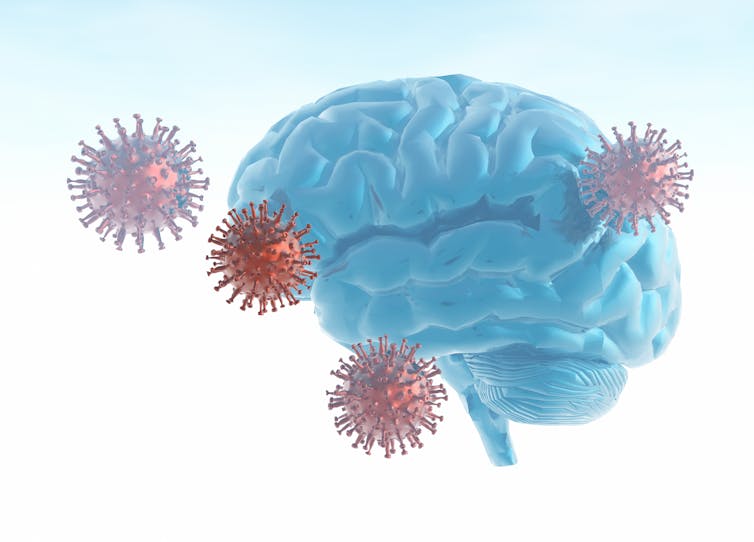
From the very early days of the pandemic, brain fog emerged as a significant health condition that many experience after COVID-19.
Brain fog is a colloquial term that describes a state of mental sluggishness or lack of clarity and haziness that makes it difficult to concentrate, remember things and think clearly.
Fast-forward four years and there is now abundant evidence that being infected with SARS-CoV-2 – the virus that causes COVID-19 – can affect brain health in many ways.
In addition to brain fog, COVID-19 can lead to an array of problems, including headaches, seizure disorders, strokes, sleep problems, and tingling and paralysis of the nerves, as well as several mental health disorders.
A large and growing body of evidence amassed throughout the pandemic details the many ways that COVID-19 leaves an indelible mark on the brain. But the specific pathways by which the virus does so are still being elucidated, and curative treatments are nonexistent.
Now, two new studies published in the New England Journal of Medicine shed further light on the profound toll of COVID-19 on cognitive health.
I am a physician scientist, and I have been devoted to studying long COVID since early patient reports about this condition – even before the term “long COVID” was coined. I have testified before the U.S. Senate as an expert witness on long COVID and have published extensively on this topic.
How COVID-19 leaves its mark on the brain
Here are some of the most important studies to date documenting how COVID-19 affects brain health:
-
Large epidemiological analyses showed that people who had COVID-19 were at an increased risk of cognitive deficits, such as memory problems.
-
Imaging studies done in people before and after their COVID-19 infections show shrinkage of brain volume and altered brain structure after infection.
-
A study of people with mild to moderate COVID-19 showed significant prolonged inflammation of the brain and changes that are commensurate with seven years of brain aging.
-
Severe COVID-19 that requires hospitalization or intensive care may result in cognitive deficits and other brain damage that are equivalent to 20 years of aging.
-
Laboratory experiments in human and mouse brain organoids designed to emulate changes in the human brain showed that SARS-CoV-2 infection triggers the fusion of brain cells. This effectively short-circuits brain electrical activity and compromises function.
-
Autopsy studies of people who had severe COVID-19 but died months later from other causes showed that the virus was still present in brain tissue. This provides evidence that contrary to its name, SARS-CoV-2 is not only a respiratory virus, but it can also enter the brain in some individuals. But whether the persistence of the virus in brain tissue is driving some of the brain problems seen in people who have had COVID-19 is not yet clear.
-
Studies show that even when the virus is mild and exclusively confined to the lungs, it can still provoke inflammation in the brain and impair brain cells’ ability to regenerate.
-
COVID-19 can also disrupt the blood brain barrier, the shield that protects the nervous system – which is the control and command center of our bodies – making it “leaky.” Studies using imaging to assess the brains of people hospitalized with COVID-19 showed disrupted or leaky blood brain barriers in those who experienced brain fog.
-
A large preliminary analysis pooling together data from 11 studies encompassing almost 1 million people with COVID-19 and more than 6 million uninfected individuals showed that COVID-19 increased the risk of development of new-onset dementia in people older than 60 years of age.
Drops in IQ
Most recently, a new study published in the New England Journal of Medicine assessed cognitive abilities such as memory, planning and spatial reasoning in nearly 113,000 people who had previously had COVID-19. The researchers found that those who had been infected had significant deficits in memory and executive task performance.
This decline was evident among those infected in the early phase of the pandemic and those infected when the delta and omicron variants were dominant. These findings show that the risk of cognitive decline did not abate as the pandemic virus evolved from the ancestral strain to omicron.
In the same study, those who had mild and resolved COVID-19 showed cognitive decline equivalent to a three-point loss of IQ. In comparison, those with unresolved persistent symptoms, such as people with persistent shortness of breath or fatigue, had a six-point loss in IQ. Those who had been admitted to the intensive care unit for COVID-19 had a nine-point loss in IQ. Reinfection with the virus contributed an additional two-point loss in IQ, as compared with no reinfection.
Generally the average IQ is about 100. An IQ above 130 indicates a highly gifted individual, while an IQ below 70 generally indicates a level of intellectual disability that may require significant societal support.
To put the finding of the New England Journal of Medicine study into perspective, I estimate that a three-point downward shift in IQ would increase the number of U.S. adults with an IQ less than 70 from 4.7 million to 7.5 million – an increase of 2.8 million adults with a level of cognitive impairment that requires significant societal support.
Another study in the same issue of the New England Journal of Medicine involved more than 100,000 Norwegians between March 2020 and April 2023. It documented worse memory function at several time points up to 36 months following a positive SARS-CoV-2 test.
Parsing the implications
Taken together, these studies show that COVID-19 poses a serious risk to brain health, even in mild cases, and the effects are now being revealed at the population level.
A recent analysis of the U.S. Current Population Survey showed that after the start of the COVID-19 pandemic, an additional 1 million working-age Americans reported having “serious difficulty” remembering, concentrating or making decisions than at any time in the preceding 15 years. Most disconcertingly, this was mostly driven by younger adults between the ages of 18 to 44.
Data from the European Union shows a similar trend – in 2022, 15% of people in the EU reported memory and concentration issues.
Looking ahead, it will be critical to identify who is most at risk. A better understanding is also needed of how these trends might affect the educational attainment of children and young adults and the economic productivity of working-age adults. And the extent to which these shifts will influence the epidemiology of dementia and Alzheimer’s disease is also not clear.
The growing body of research now confirms that COVID-19 should be considered a virus with a significant impact on the brain. The implications are far-reaching, from individuals experiencing cognitive struggles to the potential impact on populations and the economy.
Lifting the fog on the true causes behind these cognitive impairments, including brain fog, will require years if not decades of concerted efforts by researchers across the globe. And unfortunately, nearly everyone is a test case in this unprecedented global undertaking.
Ziyad Al-Aly, Chief of Research and Development, VA St. Louis Health Care System. Clinical Epidemiologist, Washington University in St. Louis
This article is republished from The Conversation under a Creative Commons license. Read the original article.
- Details
- Written by: European Southern Observatory

Researchers have found water vapor in the disc around a young star exactly where planets may be forming.
Water is a key ingredient for life on Earth, and is also thought to play a significant role in planet formation.
Yet, until now, we had never been able to map how water is distributed in a stable, cool disc — the type of disc that offers the most favorable conditions for planets to form around stars.
The new findings were made possible thanks to the Atacama Large Millimeter/submillimeter Array, or ALMA, in which the European Southern Observatory is a partner.
“I had never imagined that we could capture an image of oceans of water vapor in the same region where a planet is likely forming,” said Stefano Facchini, an astronomer at the University of Milan, Italy, who led the study published today in Nature Astronomy. The observations reveal at least three times as much water as in all of Earth’s oceans in the inner disc of the young Sun-like star HL Tauri, located 450 light-years away from Earth in the constellation Taurus.
“It is truly remarkable that we can not only detect but also capture detailed images and spatially resolve water vapor at a distance of 450 light-years from us,” added co-author Leonardo Testi, an astronomer at the University of Bologna, Italy.
The “spatially resolved” observations with ALMA allow astronomers to determine the distribution of water in different regions of the disc.
“Taking part in such an important discovery in the iconic HL Tauri disc was beyond what I had ever expected for my first research experience in astronomy,” said Mathieu Vander Donckt from the University of Liège, Belgium, who was a master’s student when he participated in the research.
A significant amount of water was found in the region where a known gap in the HL Tauri disc exists. Ring-shaped gaps are carved out in gas- and dust-rich discs by orbiting young planet-like bodies as they gather up material and grow.
“Our recent images reveal a substantial quantity of water vapor at a range of distances from the star that include a gap where a planet could potentially be forming at the present time,” said Facchini. This suggests that this water vapor could affect the chemical composition of planets forming in those regions.
Observing water with a ground-based telescope is no mean feat as the abundant water vapor in Earth’s atmosphere degrades the astronomical signals.
ALMA, operated by European Southern Observatory together with its international partners, is an array of telescopes in the Chilean Atacama Desert at about 5,000 meters elevation that was built in a high and dry environment specifically to minimize this degradation, providing exceptional observing conditions.
“To date, ALMA is the only facility able to spatially resolve water in a cool planet-forming disc,” said co-author Wouter Vlemmings, a professor at the Chalmers University of Technology in Sweden.
“It is truly exciting to directly witness, in a picture, water molecules being released from icy dust particles,” said Elizabeth Humphreys, an astronomer at European Southern Observatory who also participated in the study.
The dust grains that make up a disc are the seeds of planet formation, colliding and clumping into ever larger bodies orbiting the star. Astronomers believe that where it is cold enough for water to freeze onto dust particles, things stick together more efficiently — an ideal spot for planet formation.
“Our results show how the presence of water may influence the development of a planetary system, just like it did some 4.5 billion years ago in our own Solar System,” Facchini added.
With upgrades happening at ALMA and the European Southern Observatory’s Extremely Large Telescope, or ELT, coming online within the decade, planet formation and the role water plays in it will become clearer than ever.
In particular METIS, the Mid-infrared ELT Imager and Spectrograph, will give astronomers unrivaled views of the inner regions of planet-forming disks, where planets like Earth form.

- Details
- Written by: Elizabeth Larson
The warning will remain in effect until 10 a.m. Sunday.
Rain fell across Lake County on Thursday evening and much of the day on Friday.
Rainfall totals in inches for the 48-hour period ending at 2 a.m. Saturday are as follows:
— Indian Valley Reservoir: 0.89.
— Kelseyville: 1.97.
— Knoxville Creek: 1.61.
— Lake Pillsbury: 3.37.
— Lower Lake: 0.87.
— Lyons Valley: 1.81.
— Middletown: 2.01.
— Whispering Pines: 3.36.
The updated forecast expected rain and snow showers overnight along with high winds.
Those conditions are expected to continue throughout the day on Saturday and into Saturday night, with chances of more rain and show early Sunday before giving way mostly to rain and more high winds for the rest of the day and night.
Rain is forecast to continue on Monday and through midweek, when a break in the rain is expected.
The latest storm system is expected to push the level of Clear Lake up again. It peaked last week at nearly 8.5 feet Rumsey, the special measure for the lake, but was down to just above 8 feet Rumsey by early Saturday. The 8 foot Rumsey measure put the lake in “monitor” or “action” stage, at which point the speed limit close to the shore on the lake is temporarily reduced.
In other weather news, millions of Americans just experienced the warmest meteorological winter on record, according to preliminary data collected by AccuWeather meteorologists.
Every state in the continental U.S. had temperatures warmer than the historical average this winter, unlike last winter when the western U.S. was colder than the historical average, AccuWeather reported.
AccuWeather Chief Meteorologist Jon Porter said our warming climate also contributed to the unusually mild conditions for much of the country this winter.
“This existing trend, resulting from a warming atmosphere driven by climate change, and other factors, was likely amplified this winter as a result of the additional warmth imparted in the atmosphere by the El Nino,” said Porter. “The largest increases in average temperature, as compared to long-term historical averages, have been across the northern part of the United States, especially during the winter months.”
Email Elizabeth Larson at