 How to resolve AdBlock issue?
News
- Details
- Written by: Lake County News reports

MIDDLETOWN – Lake County International Charter School second grade teacher Vanessa Halliday's efforts to increase the safety of her students has made her a national standout.
Honeywell and the National Center for Missing and Exploited Children recently unveiled a classroom makeover for Halliday, grand prize winner of the third annual Got 2B Safe! Awards Program that recognizes teachers committed to keeping children safer from abduction and sexual exploitation.
This year, 105 teachers from 30 states were honored, including five Grand Prize winners who have created effective techniques to teach children the important safety rules in the Got 2B Safe! program.
“It is critically important that we do everything we can to protect our nation’s children from abduction and exploitation,” said Tom Buckmaster, president, Honeywell Hometown Solutions.
According to the U.S. Department of Justice, 797,500 children (younger than 18) were reported missing during a one year period of time, resulting in an average of 2,185 children reported missing each day. Though many of these children are recovered quickly, these staggering numbers highlight the need for increased child safety programming in our nation’s schools.
In 2003, Honeywell and NCMEC created the Got 2B Safe! program to arm teachers, parents and children with vital child safety skills. This year, five Grand Prize winners received a free classroom makeover from a professional designer valued at $10,000, and 100 First Prize winners received $500 worth of school supplies. To enter, teachers submitted a lesson plan or essay demonstrating how they taught the Got 2B Safe! Four Rules of Safety.
Halliday’s Grand Prize winning essay detailed how she applied the Got 2B Safe! Four Rules of Safety in the classroom through creating a skit and song performed at their school assembly. The performance, which featured a Got 2B Safe! safety song, was video-taped for future school presentations.
“The importance of arming our educators, parents and guardians and ultimately, children with child safety tools cannot be underestimated,” said Ernie Allen, president and CEO, NCMEC. “We believe that teaching children about personal safety should be a top priority for everyone, and we are excited to partner with Honeywell on this important program that recognizes these exceptional educators.”
The Got 2B Safe! program provides four simple rules for children to follow with the help of their families and teachers. Additional information is available at www.got2bsafe.com.
Got 2B Safe! Four Rules:
1. Check First: Children should always check with parents and guardians before accepting gifts, rides or invitations from anyone, including friends, acquaintances and people they don't know.
2. Go With a Friend: Simple and straightforward – never go anywhere alone. Being with another person in public is safer and more fun.
3. It's My Body: Teach your children they have the right to say NO to any unwelcome, uncomfortable, or confusing touch or actions by others.
4. Tell a Trusted Adult: Teach your children to TELL a trusted adult – parent, guardian, teacher, etc. – if anyone or anything makes them feel scared, uncomfortable or confused.

{mos_sb_discuss:2}
- Details
- Written by: Lake County News reports
In support of the OPC’s historic resolution last year to eliminate marine debris, the draft recommendations also call for plastic manufacturers to recover and dispose of their products and for product user fees to be assessed.
“There is no question that these kinds of steps are critical if we’re going to address the issue of marine debris in a serious way,” said state Secretary for Resources Mike Chrisman. “The release of these proposed recommendations will continue our open public dialog on this issue and enhance the discussion about how we may best work together to reduce the threats to our ocean and coast.”
The release of the OPC staff draft strategy is designed to set the stage for actions that, when implemented, will have far reaching benefit for ocean health.
If accepted by the OPC, most of the recommendations would require legislation to be enacted.
The implementation strategy identifies three primary approaches that California should take to eliminate marine debris.
California should: (1) establish a “take-back” program for many types of product packaging that would require plastic packaging manufacturers to take these products back and dispose of them properly; (2) institute a statewide prohibition on single-use plastic bags and polystyrene takeout containers; and (3) impose fees on other packaging.
OPC staff is seeking comments on the draft implementation strategy in writing by Aug. 21. Staff will incorporate changes to the draft based on comments received.
The OPC is also soliciting public comment during its meeting Sept. 11 at 9 a.m. in Half Moon Bay. An updated recommended strategy that will include public input will be presented to the OPC for its consideration at this meeting.
On Feb. 8, 2007, the OPC passed a marine debris resolution that identified 13 recommendations for reducing and preventing ocean litter. The council noted that this litter, commonly known as marine debris, harms hundreds of marine species, from birds that eat small pieces of debris and feed it to their young, to marine mammals that get entangled in larger pieces.
According to the Long Beach-based Algalita Marine Research Foundation, 60 to 80 percent of the world’s ocean litter is made up of plastic. In some areas, 90 to 95 percent of the marine debris is plastic.
State and local governments spend millions of dollars every year on ocean litter cleanup. In fiscal year 2006, Caltrans spent $55 million to remove litter and debris from roadsides and highways. Uncollected, most of this will ultimately drain into the ocean.
Marine debris also negatively impacts California’s $46 billion tourism-based ocean-dependent economy. Despite an ongoing effort for decades to reduce ocean litter, the proliferation of plastic debris has increased exponentially.
California communities are not alone in recognizing plastic bags as a significant threat to the marine environment. Several states, including Alaska, Massachusetts, New York, and Washington are considering plastic bag prohibitions. China, Australia, South Africa, Bangladesh, Tanzania, and several other countries recently banned plastic grocery bags. In 2002, Ireland imposed a tax on the distribution of plastic grocery bags that resulted in a 95 percent drop in plastic bag use since the tax was implemented. Whole Foods Market recently stopped offering plastic bags in its nearly 300 stores.
Full and partial polystyrene food container prohibitions have been implemented in many California cities including: Alameda, Aliso Viejo, Berkeley, Calabasas, Capitola, Carmel, Emeryville, Fairfax, Hercules, Huntington Beach, Laguna Beach, Laguna Woods, Los Angeles, Malibu, Millbrae, Oakland, Pacific Grove, Pittsburg, San Clemente, San Francisco, San Juan Capistrano, Santa Cruz, Santa Monica, Scotts Valley and West Hollywood.
The counties of Ventura, San Mateo and Sonoma have also imposed some kind of prohibition as have the cities of Rahway, N.J., Portland, Ore., and Freeport, Maine and Suffolk County, N.Y.
For a copy of the draft implementation strategy or instructions for submitting comments to the OPC, visit the Web site: http://www.resources.ca.gov/copc/.
To view the OPC’s Feb. 8, 2007 marine debris resolution visit http://www.resources.ca.gov/copc/02-08-07_meeting/Adopted_Marine_Debris_Res_0207.pdf.
{mos_sb_discuss:2}
- Details
- Written by: Elizabeth Larson

CLEARLAKE – The knock that came at Denise Wilson's front door early on the morning of July 21 would change her life – and that of her family – forever. {sidebar id=91}
The 41-year-old mother of three opened the door – which is decorated with two yellow ribbons and framed by two small US flags – to find two US Marines acting as messengers.
The news they brought was the worst the mother of a Marine could expect – that her 22-year-old son, Ivan Wilson, had died earlier that day in Afghanistan, on his second tour of duty in the Middle East.
She said she wakes up often in a cold sweat now, as if anticipating that knock again and again.
But this time when she wakes, it's the voice of her 3-year-old son, Nathaniel that she hears, telling her, “Momma, everything is going to be OK.”
Denise Wilson's son Ivan was the first member of the US Armed Forces from Lake County to die in the current war in the Middle East.
This Sept. 12 would have marked the third anniversary of the day, back in 2005, when he got to the US Marines training center in San Diego and put his boots on the yellow outlines, sealing himself into the brotherhood of the Marine Corps.
His route to that day had included a brief stint at College of the Redwoods; living in a tent city in Seattle, where he'd veered off a planned trip to work on the fishing boats in Alaska; and other places he'd sought to make a place for himself but where his family said the fit just wasn't right.
“Life was hard for Ivan,” his mother said.
So he turned to the Marines, a place many young people have looked for opportunity.
A Marine recruiter, Sgt. Michael Archer, sent Denise Wilson an email July 27, recounting his first meeting with her son on a rainy morning in December 2004 in a Middletown deli.
“Ivan was one of the most respectful and delightful young men I ever had the pleasure of working with on my recruiting tour,” Archer wrote.
Denise Wilson, with 19-year-old daughter Jackie at her side, reads through the e-mails from Archer and many other young men who knew her son – known to them variously as “Willy” or “Juggernaut” – and whose lives he obviously touched.
They remembered him variously as a brave and respected Marine, someone whose sense of humor and friendship made their service easier, and a good young man whose life ended suddenly.
One young Marine, Corporal A.W. Tombleson, said that, had it not been for Ivan Wilson – who laid down M16 rounds as well as explosive rounds to cover him in an exposed position – he wouldn't have survived. Lance Corporal Matthew Perry called him “an outstanding friend,” still another Marine who only signed his name as “Quinn” called Ivan Wilson a “hero amongst the proud and few.”
“I just don't believe that he's gone,” she said of her son, who she called “Sonny Boy Ivan.”
“It's not fair,” she said. “This shouldn't happen ... It just hurts too much.”
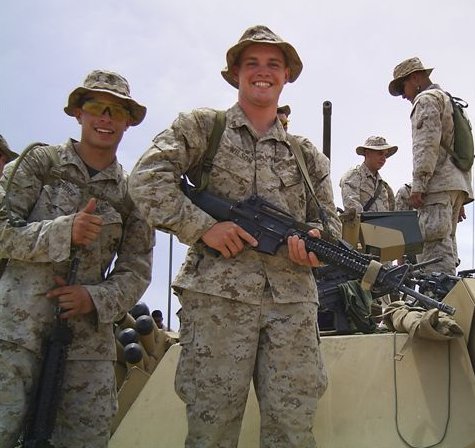
The shaping of a young life
Ivan Wilson was born in Sonora on May 29, 1986, and he grew up in Clearlake, living with his family in an apartment on Old Highway 53.
His mother said he attended local schools, eventually wrestling and playing football at Lower Lake High, where both he and sister Jackie were in the SERVE Academy, an academic program with special focus areas including emergency response. He would graduate in 2004 from Clearlake Community School.
He briefly attended College of the Redwoods. “It just didn't work out for him so he came home,” Denise Wilson said.
Ivan Wilson wasn't afraid to try different things, and his mother never faltered in backing him up. “I supported him in everything he did.”
Joining the Marines was a path he took to get his life straightened out, a decision he made “when other things just weren't working out in his world,” his mother wrote in a prepared statement. It was a decision, she said, that he felt was one of the best choices he'd made in a very long time.
After joining the Marines Ivan Wilson the man began to take shape.
He spent January to August of 2007 in Iraq as part of the Second Battalion, Seventh Marine Regiment's Fox Company. During his time there some of his Marine friends were seriously injured in a bridge explosion, Denise Wilson said. Ivan Wilson himself was scraped up in a building explosion, but otherwise came away unhurt.
When he returned home on leave, he kept his thoughts on what he'd seen in that country mostly to himself, his mother said.
“Ivan didn't really talk about it much at all,” she said. “When he came back he was a different person.”
He started working on his issues with alcohol, which had gotten him into some trouble, including an arrest earlier this year. His mother said he was continuing to address his problems and was optimistic about the future.
Ivan Wilson also was eager to see the world – beyond his Middle Eastern tours. “He wanted to go all over the world,” his mother said, and was looking forward to traveling around Europe after his enlistment was up.
His mother said he talked about being a lawyer or an optometrist, and possibly reenlisting in the Navy in order to pursue a career as a pharmacy technician. Sister Jackie said he hadn't shared a lot of details about his future plans.
Following additional training, he was deployed in April to Afghanistan. Communications from, and about, that experience were even more guarded, Denise Wilson said.
She said her son promised that, when he came home, he would tell her more. “They couldn't tell us a lot,” she said, due to security reasons.
She did know he was training friendly Afghan forces during his time in Afghanistan. She would later discover, through e-mail messages from his friends, that he was increasingly taking on a leadership role, asking to “take point,” a term for the most exposed position in a military formation.
In his messages home he was upbeat. In the weeks before his death recounted that “we blew some stuff up” to celebrate July 4, and he was happy to have received some head phones and a video game.
Despite an explosion near his position the night before, on July 10 Wilson told his mother in an e-mail, “Life is good right now.”
He continued, “Last night was explosive quite literally. Everybody is all right though. To you the story would probably make you really concerned for our safety, though we were pumped. There will be plenty of stories to tell when I get home. Like I said before this deployment is crazy and I'm loving it. Send my love to the family.”
In the heart of the insurgency
Because he was so far from home, and his activities kept so secretive even from his family, it has taken time to piece together the events surrounding his death.
A letter to Denise Wilson from Lt. Col. Richard D. Hall, Ivan's battalion commander, tells part of the story.
The Marine was on patrol in the village of Naw Zad, Afghanistan, located to the north of Lashkar Gah, capital of the southern Helmand province, Hall's letter stated.
Ivan Wilson was fatally injured by an explosive, and was treated at the scene, Hall said. While being transported to the medical facility at Britain's Camp Bastion, Ivan Wilson's hopeful young life ended, despite the efforts of his fellow Marines, according to Marine Edwin “Doc” Daniel, who wrote Denise Wilson.
“He did not suffer,” Hall wrote Denise Wilson. “I tell you this because I thought you would want to know.”
The US Marine Corps told Lake County News that following his death, Ivan Wilson was promoted from private first class to lance corporal.
As a rifleman, Ivan Wilson was security for Lance Corporal Daniel Burmeister, a machine gunner who e-mailed Denise Wilson to say he was preparing to dismount from a seven-ton truck, with Ivan Wilson 30 meters ahead of him, when he was hit by the explosive. “I prayed for him right away when I found out that he was hit.”
A United Nations report an area in the heart where opium poppy cultivation activity is extremely high.
It's also the heart of the insurgency, Dr. Tom Gouttiere, director of the University of Nebraska's Center for Afghan Studies, told Lake County News in an interview.
In southern Afghanistan, including Helmand province, what Gouttiere called the “Neo-Taliban” – insurgency forces including former Taliban fighters and new members – are waging war against coalition forces.
The opium poppies in the area form an important funding source on the black market for Neo-Taliban and Al Qaida, and the groups fight to protect the crop, Gouttiere said.
“Marines take on the tasks of going in and being a kind of an attack force in critical, crucial areas,” said Gouttiere, including Helmand, which also is the site of critical electrical grid and hydroelectric projects.
Intense fighting has taken place in the area in the last few months. The Associated Press reported on July 17 that a senior Taliban commander had been among 10 insurgents killed in an air strike in Naw Zad district.
Since Ivan Wilson's death, several more British soldiers have been killed in Helmand province as well, according to British media reports.
As Hall would write to Denise Wilson in a followup e-mail, “We chose a dangerous profession.”
“He led from the front and that is why he is not here today,” Denise Wilson said.
First Lt. Curtis Williamson, spokesman for the First Marine Division, told Lake County News that Lance Corporal Ivan Wilson's awards included the Combat Action Ribbon, Afghanistan Campaign Medal, Iraq Campaign Medal, Global War on Terrorism Service Medal, National Defense Service Medal and Sea Service Deployment Ribbon.

Reconstructing lives
Ivan Wilson's little sister, Jackie, is a bright teen who was home on summer break from college when the news of her older brother's death arrived.
She's studying at St. Mary's College in Moraga, considering a sociology major and psychology minor.
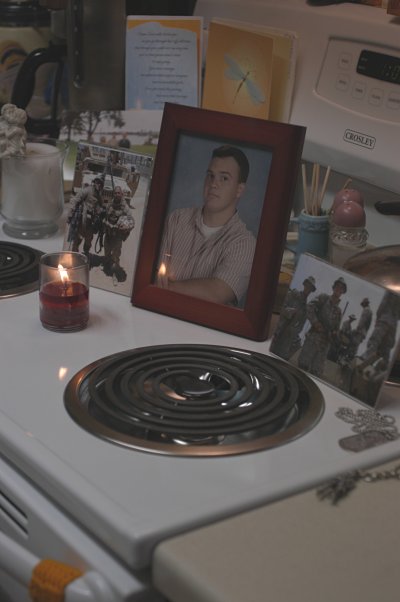
Denise Wilson stands by a little altar of sorts to her son set up in the kitchen – photos of him from high school and later in the Marine Corps, a set of his dog tags and a small Marine on a key chain he gave to her and to his father, Chris, who lives in Clearlake also.
She looks at the pictures of her son, and then at her daughter, and worries that Jackie will be OK when she goes back to school.
Little Nathaniel – “Nate Dogg,” a name his older brother and no one else got to call him – doesn't quite understand yet. Her eldest son loved his little brother, Denise Wilson said, showing a picture from Ivan Wilson's basic training in which he holds up Nathaniel.
The whole family is working on holding it together, and they have the support of other Marine parents, friend and neighbors, and the community. On Wednesday morning Denise Wilson received a call from Congressman Mike Thompson in Washington, D.C., asking how he could help.
She said she's grateful for all the letters and notes. “I'm just thankful for all those people,” she said.
Denise Wilson's grief is free of ideology or any hint of a political stance. She's just a mom, still not believing her firstborn son died thousands of miles away.
“I can't take back what happened,” she said of her feelings about her son's death. Of the war, she added, “I think it needs to end soon or come to some resolution.”
First and foremost, she loves her children, and wants to support them.
So, what if Nathaniel came to her in 16 or 17 years, wanting to follow in his big brother's footsteps, and join the military?
She said she wouldn't tell him no.
“I would be supportive of anything my kids wanted to do,” she said.
E-mail Elizabeth Larson at
{mos_sb_discuss:2}
- Details
- Written by: Elizabeth Larson
The state Office of Emergency Services put out a call for firefighters to fight a new fire that broke out in Santa Clara County on Wednesday, said Northshore Fire Protection District Chief Jim Robbins.
On Wednesday afternoon at around 2 p.m., Robbins had just received the call from the Office of Emergency Services and was getting an engine and three firefighters ready to leave Thursday morning.
The Northshore engine will be part of a five-engine strike team, with four other counties also sending an engine each, he said.
“They know we're strapped,” he said, so the Office of Emergency Services wasn't asking for any more than one engine per county.
Cal Fire firefighters were already headed south Wednesday afternoon, Robbins said.
How long the Northshore firefighters would be gone depended on the size of the fire, said Robbins.
So far this year local firefighters have worked on the Summit Fire in the Santa Cruz Mountains, the Humboldt Fire in Butte County and the Mendocino Lighting Complex.
In late June firefighters from all local fire districts were first on scene in the battle against the 14,500-acre Walker Fire, as Lake County News has reported.
E-mail Elizabeth Larson at
{mos_sb_discuss:2}